
In my extensive experience with precision lost wax casting, also known as investment casting, I have found it to be an indispensable method for producing intricate components with high dimensional accuracy and excellent surface finish. The technique of precision lost wax casting is particularly valuable for manufacturing parts with complex internal geometries, such as multi-hole castings, where traditional sand casting methods often fall short due to core removal challenges and poor yield. This article delves into a detailed first-person account of the optimized processes we employ, focusing on the critical aspects of wax pattern fabrication, gating and chilling system design, shell building, and final pouring. Throughout this discussion, I will emphasize the principles and practices that define successful precision lost wax casting, a phrase I will reiterate to underscore its centrality to our work.
The fundamental challenge in precision lost wax casting for parts with numerous intersecting internal channels lies in the creation of a disposable wax pattern that accurately replicates the final metal part. In our standard approach for a typical multi-hole pump body casting—representative of complex geometries—the pattern must incorporate all internal passages. However, when certain core pins or internal features become mechanically locked and cannot be withdrawn from the mold, alternative solutions are required. Instead of resorting to expensive and sometimes fragile ceramic or soluble cores, we have developed a reliable method involving strategic wax pattern modification.
We address non-retractable core areas by designing and incorporating wax “process holes” into the main wax pattern. These holes are tapered to facilitate later sealing and are intentionally made slightly smaller than the final required opening, typically leaving a gap of about 0.5 mm for alignment purposes. To seal these process holes, we prepare complementary wax plugs. The joining process is critical: we apply acetone to the rim of the process hole and a thin layer of molten wax to the plug, then carefully position and align the plug. The seam is meticulously smoothed using a brush dipped in a wax-adhesive solution and finally finished with a modeling knife. This repair yields a wax pattern of sufficient integrity and surface quality, fully suitable for the subsequent shell-building stages of precision lost wax casting. The success of this step is foundational to the entire precision lost wax casting process.
Once a sound wax pattern assembly, including gates and risers, is created, the next pivotal phase in precision lost wax casting is the design of the feeding and cooling system to ensure sound, shrinkage-free castings. For the pump body example, we utilize a top-pouring gating system coupled with risers and external chills. The risers provide the necessary molten metal reservoir to compensate for solidification shrinkage, while the chills accelerate cooling in specific thick sections to promote directional solidification towards the riser. The design calculations for these elements are based on empirical formulas derived from years of practice in precision lost wax casting.
The riser dimensions are primarily determined by the thermal modulus of the casting section it is intended to feed. Let $D_{hot}$ represent the diameter of the inscribed circle (the “hot spot”) at the section requiring feeding, and let $t$ be the distance from the hot spot to the riser neck or the height of the thick section needing feeding. The key formulas are:
Riser Diameter, $D_r$: $$D_r = (1.5 \sim 1.7) \times D_{hot}$$
Riser Height, $H_r$: $$H_r = (1.8 \sim 2.5) \times D_{hot} + \frac{t}{4}$$
Riser Neck Diameter, $D_n$: $$D_n = (1.0 \sim 1.2) \times D_{hot}$$
Riser Neck Height, $H_n$: $$H_n = 16 \sim 20 \text{ mm}$$
For external chills, which are essential in precision lost wax casting to control solidification in areas where risers are impractical, the design focuses on surface area and thickness. Let $T$ be the thickness of the casting wall to be chilled, $F_c$ the surface area of the chill, and $f$ the surface area of the casting region to be chilled. The chill thickness $B_c$ and area are determined by:
Chill Thickness, $B_c$: $$B_c = \frac{1}{2}T \quad \text{or} \quad B_c = T$$
Chill Surface Area, $F_c$: $$F_c = (0.3 \sim 0.5) \times f \quad \text{or} \quad F_c = (0.4 \sim 1.0) \times f$$
It is important to note that external chills are most effective for sections where $D_{hot}$ is less than 30 mm and wall thickness $T$ is under 30 mm. In our precision lost wax casting practice, we use steel or cast iron chills. After applying the primary ceramic coats to the wax assembly, the chills are fixed in place against the pattern using wires. The shell building then continues over them. Before the final firing, for shell molds that will be backed with sand, we often remove any invested sand covering the outer face of the chill and may place additional metal blocks against it post-firing to enhance its cooling power, counteracting any heat absorption during the mold preheat. This meticulous control is a hallmark of advanced precision lost wax casting.
The construction of the ceramic shell is arguably the most process-sensitive stage in precision lost wax casting. We employ a hybrid silica-aluminosilicate shell system using sodium silicate (water glass) as a binder, hardened alternately by ammonium chloride and crystalline aluminum chloride solutions. The goal is to build a shell that is strong enough to withstand metallostatic pressure during pouring yet readily removable after shakeout. The following tables summarize our standard formulations and processing parameters, which are critical for achieving consistency in precision lost wax casting.
| Coating Layer | Binder (Sodium Silicate) Modulus: 3.0-3.3, Density (g/cm³) |
Refractory Flour Blend (Weight Ratio) | Additives (% by weight of slurry) |
|---|---|---|---|
| Primary (Face Coat) | 1 : (1.2-1.4) (d=1.23) |
Quartz Flour : 1 | JFC: 0.05% n-Octanol: 0.01% |
| Secondary (Transition) | 1 : 1 (d=1.31) |
Quartz Flour : Calcined Kaolin (Chamotte) : 1 : 0.5 | JFC: 0.05% |
| Tertiary & Subsequent (Back-up Coats) | 1 : 1 (d=1.31) |
Calcined Kaolin (Chamotte) : 1 | JFC: 0.05% |
Note on Refractory Grading: The quartz flour is graded with over 25% finer than 270 mesh. The chamotte flour blend includes a controlled distribution from 150 mesh to fine powders to ensure good packing density and shell permeability, a key concern in precision lost wax casting.
| Layer Sequence & Type | Stucco Sand (Mesh Size) | Hardening Solution & Parameters | Drying Time (minutes) |
|---|---|---|---|
| 1. Primary Coat | 70 mesh | Ammonium Chloride, 18-20% concentration, 3-5 min immersion | 30-60 (Until surface is dry and not tacky) |
| 2. Secondary Coat | 70 mesh | Crystalline Aluminum Chloride, specific gravity 1.17-1.19, 5-7 min immersion | 30 |
| 3. First Back-up Coat | 40 mesh | Crystalline Aluminum Chloride, S.G. 1.17-1.19, 7 min immersion | 20 |
| 4. Second Back-up Coat | 40 mesh | Crystalline Aluminum Chloride, S.G. 1.17-1.19, 7 min immersion | 20 |
| 5. Third Back-up Coat | 10 mesh | Crystalline Aluminum Chloride, S.G. 1.17-1.19, 7 min immersion | 20 |
| 6. Fourth Back-up Coat | 10 mesh | Crystalline Aluminum Chloride, S.G. 1.17-1.19, 7 min immersion | 20 |
| 7. Fifth Back-up Coat | 10 mesh | Crystalline Aluminum Chloride, S.G. 1.17-1.19, 7 min immersion | 20 |
Several critical practice notes accompany these parameters in our precision lost wax casting routine. First, we add a wetting agent (JFC at 0.07%) to the crystalline aluminum chloride hardening bath to improve its penetration into the ceramic coat. Second, for castings with many small intersecting holes (e.g., under 30 mm diameter), we carefully fill these cavities with dry sand after applying the first few ceramic layers and then seal them with slurry. This prevents metal penetration (“run-out”) during pouring, a common defect if not managed. Finally, after applying the seventh stucco layer, we dip the entire assembly once more in the back-up slurry and allow it to dry naturally, consolidating the shell’s outer surface. Each of these steps contributes to the robustness required in precision lost wax casting shells.
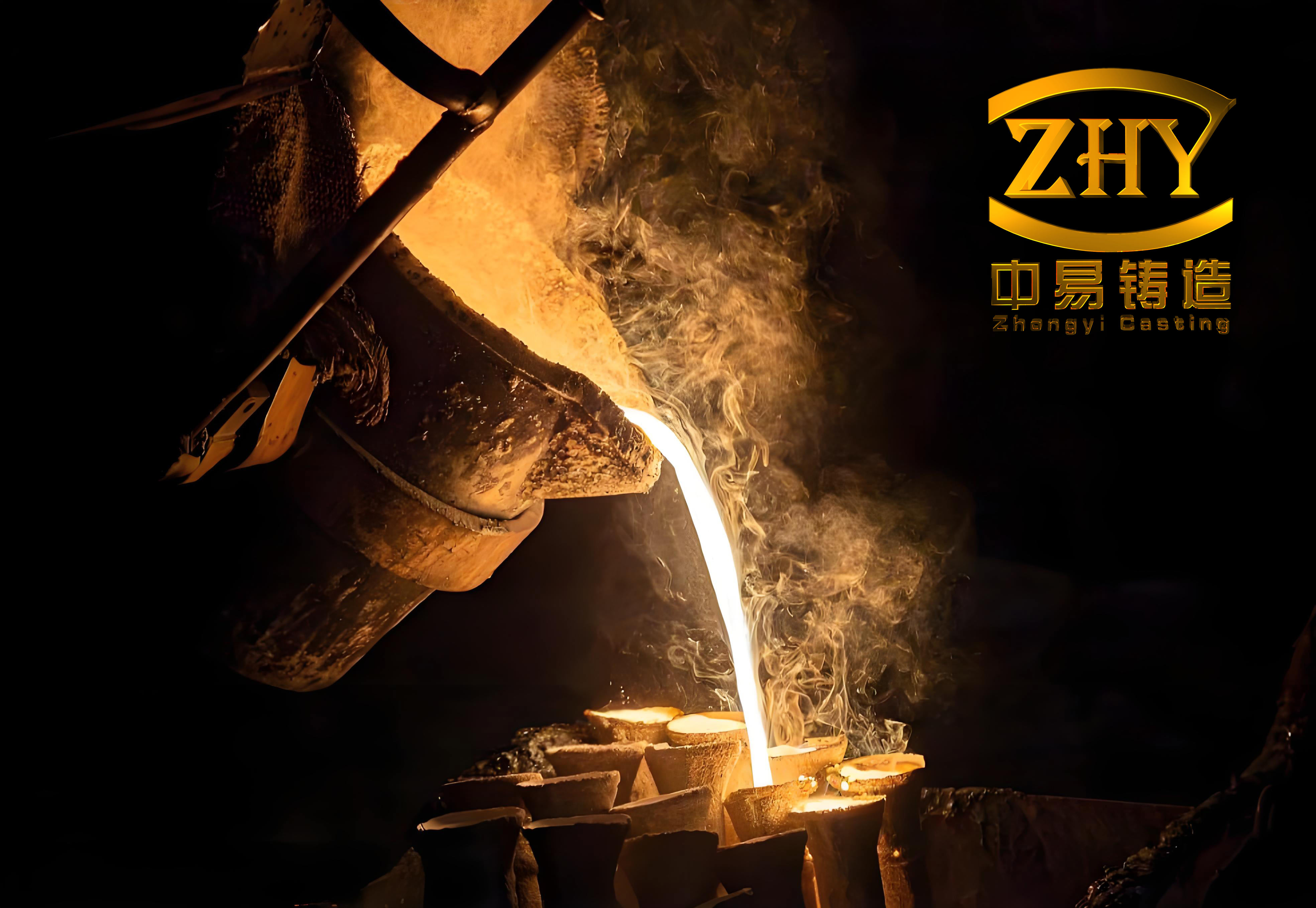
The final preparation stages in precision lost wax casting are mold firing and metal pouring. For the type of multi-hole casting discussed, we often use the shell mold without granular backup (a “monolithic” shell) to achieve better dimensional control. The firing cycle is crucial: we slowly heat the dewaxed and dried shells to a temperature of 850°C and hold for at least 2 hours. This ensures complete burnout of residual pattern material and combustion products, and it brings the mold to a thermally stable state. It is vital to control the mold temperature at the time of pouring; we ensure it is no lower than 600°C to prevent premature freezing of the metal in thin sections and to promote proper fluidity.
The metallurgical parameters are equally precise. For a carbon steel casting similar to ZG45, the tapping temperature from the furnace is maintained between 1550°C and 1560°C. The actual pouring temperature is carefully adjusted to be in the range of 1500°C to 1520°C. The pouring rate is controlled to approximately 0.4 seconds per kilogram of metal weight. This balanced approach—a sufficiently hot mold and a metal temperature that minimizes gas dissolution and oxidation while ensuring complete filling—is essential for producing sound castings via precision lost wax casting. The solidification sequence, guided by the risers and chills designed earlier, then proceeds to yield a dense, shrinkage-free component.
To further illustrate the thermodynamic principles at play during solidification in precision lost wax casting, we can consider the fundamental heat transfer equation. The rate of heat extraction by a chill can be approximated by Fourier’s law. The heat flux $q$ from the casting into the chill is given by:
$$q = -k \cdot A \cdot \frac{dT}{dx}$$
where $k$ is the thermal conductivity of the chill material, $A$ is the interfacial area ($F_c$ from our design), and $\frac{dT}{dx}$ is the temperature gradient at the interface. By designing the chill’s surface area and ensuring intimate contact (aided by the shell’s conformity), we maximize this gradient and the subsequent cooling rate $R_c$, which can be approximated for a simple geometry as:
$$R_c \approx \frac{T_{pour} – T_{solidus}}{t_f}$$
where $T_{pour}$ is the pouring temperature, $T_{solidus}$ is the solidus temperature of the alloy, and $t_f$ is the local solidification time, which we aim to minimize in chilled areas. The relationship between solidification time $t_f$ and modulus $M$ (volume/area) for a simple shape is often expressed by Chvorinov’s rule:
$$t_f = B \cdot M^n$$
where $B$ is a mold constant and $n$ is an exponent typically close to 2. The chill effectively reduces the local modulus $M$ perceived by the solidifying metal, thereby drastically shortening $t_f$ and promoting directional solidification. This scientific underpinning is applied empirically in our precision lost wax casting practice through the chill area formulas provided earlier.
The benefits of this comprehensive approach to precision lost wax casting are manifold. For complex multi-hole components, the process yields exceptionally high dimensional accuracy, often eliminating the need for extensive machining on internal passages. Surface finishes are superior to those from sand casting, and the mechanical properties are enhanced due to the rapid and controlled solidification enabled by the chilling system. Yield rates for such problematic castings can exceed 95%, a significant improvement over conventional methods, translating directly into material and energy savings. The repeatability and reliability of the process make it a cornerstone for manufacturing critical components across various industries.
In conclusion, the successful application of precision lost wax casting to intricate multi-hole castings hinges on a series of interconnected, meticulously controlled steps. From the innovative repair of wax patterns to the calculated design of feeding and chilling systems, and from the chemistry-controlled shell building to the precise thermal management during firing and pouring, each phase requires deep understanding and careful execution. The empirical formulas and process parameters shared here, derived from hands-on practice, provide a framework for achieving consistency. As technologies advance, the principles of precision lost wax casting continue to evolve, incorporating new materials and simulation tools, but the core objective remains: to transform a disposable wax model into a high-integrity metal component with precision and efficiency. The journey of each casting, from pattern to product, embodies the art and science of precision lost wax casting.