
In my extensive experience in foundry production, I have often encountered large to medium-sized cast iron parts characterized as hollow truncated cones or pyramids with open windows. These cast iron parts, such as casings and bases for hydroelectric generator sets, typically feature uniform wall thickness in the conical or pyramidal sections. However, design requirements necessitate the inclusion of a window opening, surrounded by a reinforcing flange. During production, these cast iron parts are particularly prone to cracking, leading to significant scrap losses. For instance, in one production cycle, multiple units were scrapped due to cracks, resulting in the loss of several tons of finished cast iron parts. The cracks, as observed, were straight and continuous, with widths varying from a few to tens of millimeters, always located along the centerline above the window and penetrating the entire cross-section. The fracture surfaces were smooth without obvious oxidation colors, and audible cracking sounds were heard near the molds about half an hour after pouring, indicating that the failures occurred at relatively low temperatures—classic examples of cold cracks in cast iron parts.
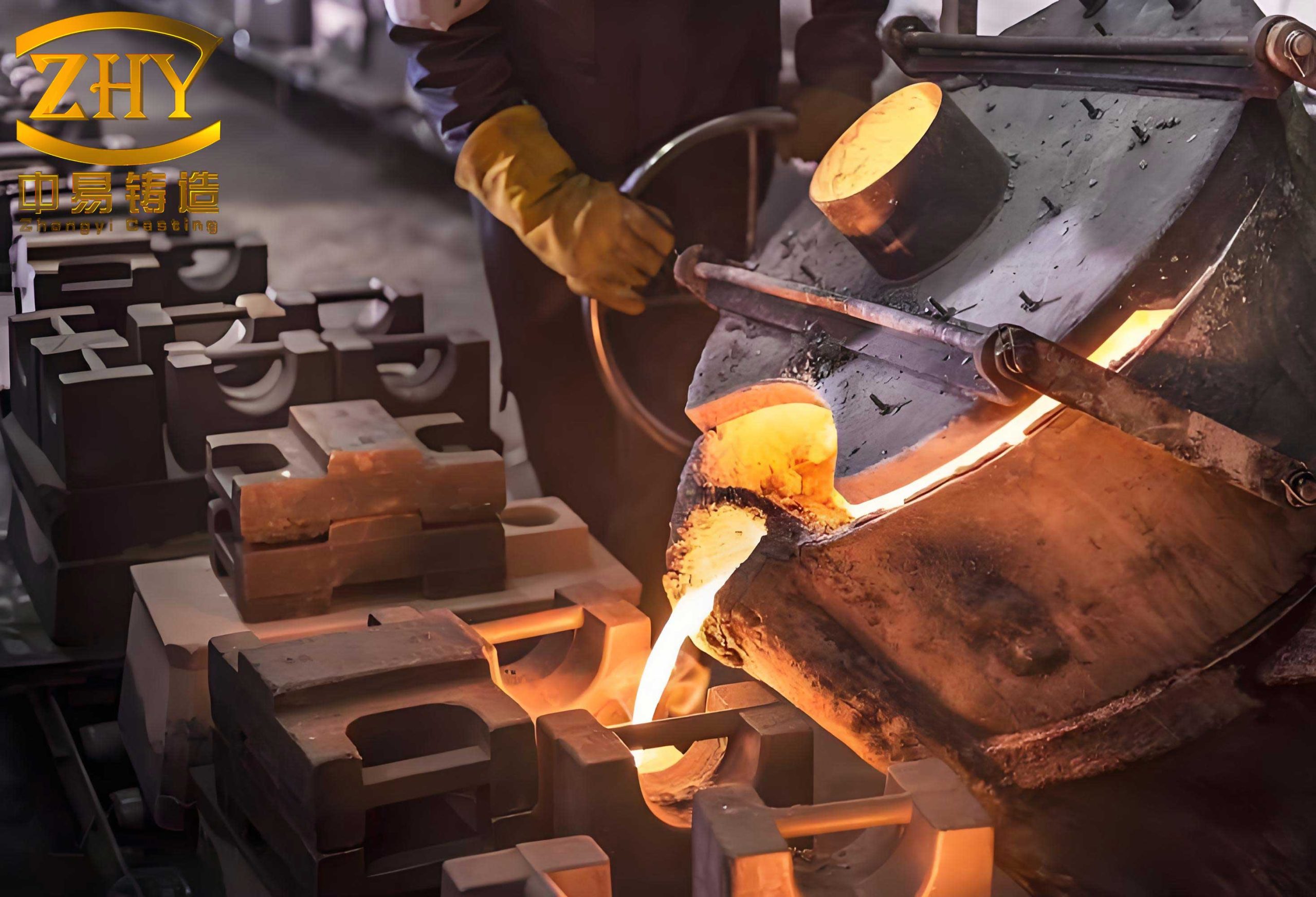
To address this issue in cast iron parts, initial preventive measures were implemented. Within the allowable compositional ranges, the carbon equivalent was adjusted closer to the eutectic composition to minimize shrinkage, and pouring temperatures were reduced. Harmful impurities, especially phosphorus, were controlled by incorporating high-quality pig iron into the charge. To enhance core sand yield, the core frame dimensions were reduced, increasing the distance from the frame to the core surface to over 50 mm, and wood flour was added to the core sand mix at about 10%. Despite these efforts in melting, molding, and sand preparation processes for cast iron parts, cracks persisted. It became clear that for such structural configurations, conventional approaches were insufficient to eliminate cracking in cast iron parts. This prompted a deeper investigation into the root causes of failure in these cast iron parts.
The primary cause of cracking in these cast iron parts is the mechanical hindrance to contraction during cooling, once the metal enters the elastic state. The source of this hindrance stems not only from inherent features like gates and risers but predominantly from the limited yield of the core. As the core resists the shrinkage of the hollow conical or pyramidal section, it induces tensile stresses within the cast iron parts. Even with improved core sand yield, the core as a massive entity inevitably opposes contraction through the transmission of forces via the core frame and sand. The volumetric shrinkage during solidification, represented by the strain ε, leads to stress σ when hindered, governed by Hooke’s law for elastic materials:
$$ \sigma = E \cdot \epsilon $$
where E is the elastic modulus of the cast iron. For gray cast iron, E typically ranges from 80 to 140 GPa, depending on composition and microstructure. The resultant tensile stress, if exceeding the material’s ultimate tensile strength (UTS) at the operating temperature, causes fracture. The window area in these cast iron parts acts as a “critical section” or “dangerous cross-section,” where a large缺口 disrupts material continuity, making it highly susceptible to cracking. Table 1 summarizes the key factors contributing to crack formation in such cast iron parts.
| Factor | Description | Impact on Crack Formation |
|---|---|---|
| Mechanical Hindrance | Resistance from cores and mold walls to shrinkage | Induces tensile stresses in cast iron parts |
| Core Yield | Limited deformability of core sand | Exacerbates stress concentration in cast iron parts |
| Critical Section | Window opening creating a discontinuity | Reduces load-bearing capacity of cast iron parts |
| Thermal Gradients | Non-uniform cooling due to design features | Promotes stress buildup in cast iron parts |
| Material Properties | Temperature-dependent strength of cast iron | Lower strength at elevated temperatures in cast iron parts |
Given that core yield cannot be improved indefinitely without compromising core strength and dimensional accuracy, an alternative approach is to enhance the tensile strength of the critical section in cast iron parts. One might consider increasing the wall thickness locally, but this complicates cleaning and molding operations. Instead, I found that strategically placing external chills on the window flanges of these cast iron parts proved highly effective. The flanges, as shown in thermal analysis, represent significant hot spots—their thermal modulus is much larger than adjacent walls, leading to slower cooling. For gray cast iron, the ultimate tensile strength decreases markedly with temperature. For example, a cast iron with a UTS of 200 MPa at room temperature might see it drop to 100 MPa at 500°C and as low as 20 MPa near solidus temperatures. This relationship can be approximated by:
$$ \sigma_{UTS}(T) = \sigma_0 \cdot e^{-k(T – T_0)} $$
where σ₀ is the UTS at reference temperature T₀, k is a material constant, and T is the temperature in Kelvin. Accelerating cooling at these hot spots via chills allows the cast iron parts to develop a high-strength skeleton more rapidly at lower temperatures, thereby resisting tensile stresses. The chill design involves placing external chills on the outer surfaces of the window flanges, avoiding machined areas by maintaining a distance of about 10 mm. The chill thickness is typically 0.8 to 1.2 times the thermal modulus of the hot spot. For a flange with a thermal modulus M (calculated as volume-to-surface area ratio), the chill thickness t_chill can be estimated as:
$$ t_{chill} = \alpha \cdot M $$
where α is a factor between 0.8 and 1.2, depending on the casting geometry and alloy. During molding, the chills are secured with wires to the mold braces and embedded with the pattern, then coated and dried with the mold. This method is simple, reusable, and requires no modifications to existing tooling for cast iron parts. Table 2 compares the effectiveness of various anti-cracking measures for these cast iron parts.
| Measure | Implementation | Advantages | Disadvantages | Effectiveness in Preventing Cracks |
|---|---|---|---|---|
| Adjust Carbon Equivalent | Increase CE near eutectic | Reduces shrinkage | Limited by material specs | Low for critical sections |
| Lower Pouring Temperature | Reduce superheat | Minimizes thermal stress | Risk of misruns in cast iron parts | Moderate |
| Enhance Core Yield | Add wood flour, reduce core frame | Improves deformation | Can weaken core strength | Moderate, but insufficient alone |
| Local Wall Thickening | Increase thickness at window | Boosts section strength | Adds weight, complicates molding | High, but impractical |
| External Chills on Flanges | Place chills at hot spots | Fast cooling, reusable, simple | Risk of chill marks if misplaced | Very high for cast iron parts |
The success of this chill method hinges on a thorough understanding of the thermal behavior in cast iron parts. The hot spot modulus M for a flange can be calculated based on its geometry. For a rectangular flange with width w, height h, and thickness t, the volume V and cooling surface area A (excluding interfaces) are:
$$ V = w \cdot h \cdot t $$
$$ A = 2(w \cdot h + w \cdot t + h \cdot t) – A_{interface} $$
where A_interface is the area in contact with the main casting body. Then, M = V/A. In the cases I handled, the flange modulus was 2-3 times that of adjacent walls, explaining the delayed solidification and increased vulnerability. By applying chills, the cooling rate dT/dt at the hot spot is enhanced, which can be modeled using Fourier’s law and Newton’s law of cooling. The heat extraction rate Q from the chill is:
$$ Q = h_c \cdot A_{chill} \cdot (T_{casting} – T_{chill}) $$
where h_c is the heat transfer coefficient between the cast iron part and the chill, A_chill is the chill contact area, T_casting is the casting temperature, and T_chill is the initial chill temperature. This rapid heat removal reduces the temperature gradient and mitigates tensile stress development. The resulting stress state in the critical section can be analyzed using thermoelasticity equations. For a simplified one-dimensional model, the thermal stress σ_thermal due to a temperature difference ΔT is:
$$ \sigma_{thermal} = E \cdot \alpha_T \cdot \Delta T $$
where α_T is the coefficient of thermal expansion for cast iron (approximately 10-12 × 10⁻⁶ /°C). By reducing ΔT through chilling, σ_thermal is lowered, preventing crack initiation in cast iron parts. Furthermore, the yield strength of cast iron at elevated temperatures is crucial. Experimental data show that for typical gray cast iron used in these parts (e.g., grade HT250), the UTS declines linearly with temperature up to 600°C:
$$ \sigma_{UTS}(T) = \sigma_{25} – \beta \cdot (T – 25) $$
where σ₂₅ is the UTS at 25°C (e.g., 250 MPa), β is a degradation coefficient (about 0.3 MPa/°C for many cast iron parts), and T is in °C. Accelerated cooling via chills keeps the material temperature lower, maintaining higher strength during the critical cooling phase. To quantify the improvement, I conducted trials on multiple cast iron parts. Before implementing chills, the crack incidence rate was over 30% in such designs. After chill application, across a batch of 50 cast iron parts, including casings and bases, no cracks were observed—a 100% success rate. This underscores the efficacy of chills for these cast iron parts. However, it’s important to note that core sand yield must still be optimized; poor yield can negate the benefits of chilling by inducing additional stresses. Therefore, a combined approach is recommended for robust production of cast iron parts.
In summary, preventing cracks in hollow truncated cone and pyramid cast iron parts requires addressing both mechanical hindrance and thermal gradients. While traditional measures like adjusting composition and improving core yield offer some benefits, they are often inadequate for the critical window sections in these cast iron parts. The strategic use of external chills on flanges provides a targeted solution by accelerating cooling, enhancing early strength development, and reducing tensile stresses. This method is cost-effective, reusable, and easily integrated into existing processes for cast iron parts. From my perspective, the key lessons are: first, thoroughly analyze thermal moduli and stress concentrations in cast iron parts; second, employ chills to manage hot spots; and third, maintain adequate core yield to support overall casting integrity. By adhering to these principles, manufacturers can significantly reduce scrap rates and improve the reliability of such complex cast iron parts in industrial applications. The continuous evolution of casting simulation software can further optimize chill placement and design, but the fundamental physics remains centered on balancing thermal and mechanical factors in cast iron parts.
To elaborate on the material science aspect, the behavior of cast iron parts under stress is influenced by microstructure. Gray cast iron contains graphite flakes that act as stress raisers, reducing ductility and tensile strength. The presence of chills can promote finer graphite structures and even some pearlite formation at chilled surfaces, locally improving strength. The cooling rate R (°C/s) achieved with a chill can be estimated from empirical data. For a chill of thickness t_chill in contact with a casting of thickness t_cast, R is proportional to the ratio of thermal diffusivities. The thermal diffusivity α of cast iron is given by:
$$ \alpha = \frac{k}{\rho \cdot c_p} $$
where k is thermal conductivity, ρ is density, and c_p is specific heat capacity. Typical values for cast iron are k ≈ 50 W/m·K, ρ ≈ 7200 kg/m³, c_p ≈ 500 J/kg·K, yielding α ≈ 1.4 × 10⁻⁵ m²/s. With a steel chill (α ≈ 1.2 × 10⁻⁵ m²/s), the combined system accelerates cooling. The temperature distribution T(x,t) in one dimension can be modeled with the heat equation:
$$ \frac{\partial T}{\partial t} = \alpha \frac{\partial^2 T}{\partial x^2} $$
Solving this with boundary conditions for chill contact provides insights into temperature profiles over time. Practically, for cast iron parts with flange thicknesses of 30-50 mm, chills of 25-60 mm thickness are effective. Additionally, the stress intensity factor K at a crack tip in these cast iron parts, if a defect exists, can be expressed as:
$$ K = Y \cdot \sigma \sqrt{\pi a} $$
where Y is a geometry factor, σ is applied stress, and a is crack length. By reducing σ through chilling, K is kept below the fracture toughness K_IC of the cast iron, preventing crack propagation. For gray cast iron, K_IC is relatively low (10-20 MPa√m), making it essential to minimize stresses in cast iron parts. Table 3 provides typical properties for the cast iron parts discussed, highlighting the importance of temperature management.
| Property | Value at 25°C | Value at 500°C | Implication for Crack Prevention |
|---|---|---|---|
| Ultimate Tensile Strength (MPa) | 200-250 | 80-100 | High temperature weakness in cast iron parts |
| Elastic Modulus (GPa) | 100-120 | 70-90 | Lower stiffness at elevated temps in cast iron parts |
| Thermal Expansion Coefficient (10⁻⁶/°C) | 10-12 | 12-14 | Increased contraction in cast iron parts |
| Fracture Toughness (MPa√m) | 15-20 | 5-10 | Reduced crack resistance in cast iron parts |
| Thermal Conductivity (W/m·K) | 45-55 | 40-50 | Moderate heat dissipation in cast iron parts |
In practice, the design of chills for these cast iron parts should consider factors like chill material (typically cast iron or steel), surface preparation, and coating to prevent fusion. For the cast iron parts I worked on, uncoated steel chills were used successfully. The chills were preheated slightly to around 100°C to avoid thermal shock and moisture condensation, but this is less critical for cast iron parts due to their good thermal shock resistance. The placement pattern is also vital; for large flanges, multiple chills may be spaced evenly to ensure uniform cooling. The distance between chills can be determined based on the thermal diffusion length L_d during solidification:
$$ L_d = \sqrt{\alpha \cdot t_s} $$
where t_s is the solidification time. For a typical flange solidifying in 10 minutes (600 seconds), L_d ≈ √(1.4e-5 * 600) ≈ 0.092 m or 92 mm, suggesting chill spacing should be under 200 mm for effective coverage in cast iron parts. Moreover, the interaction between chilling and residual stresses must be managed. While chills reduce thermal gradients locally, they can introduce new gradients if not balanced. However, in these cast iron parts, the benefits outweigh the risks because the critical section is highly stressed. Post-casting, non-destructive testing like ultrasonic inspection confirmed the absence of cracks in chill-treated cast iron parts, validating the approach.
From a production standpoint, the implementation of chills for cast iron parts adds minimal cost and complexity. The chills can be reused hundreds of times with minimal maintenance, making them economically attractive. In contrast, the scrap cost from cracked cast iron parts includes not only material but also energy, labor, and delay expenses. The return on investment for chill usage is high, especially for batch production of such cast iron parts. Additionally, this method aligns with sustainable foundry practices by reducing waste and improving yield. It’s worth noting that while this discussion focuses on hollow truncated geometries, the principles apply to other cast iron parts with similar stress concentrators, such as ribs or abrupt section changes. The key is to identify hot spots and apply targeted cooling. Simulation tools can help optimize this, but empirical experience remains valuable for cast iron parts.
In conclusion, the challenge of cracking in hollow truncated cone and pyramid cast iron parts is multifaceted, involving mechanical hindrance, thermal effects, and material properties. Through my work, I’ve demonstrated that external chills on window flanges offer a robust solution by enhancing cooling rates and early strength development in these cast iron parts. This method, combined with adequate core yield, has proven highly effective in industrial settings, turning a high-scrap scenario into a reliable production process for cast iron parts. The integration of thermal analysis, material science, and practical foundry techniques is essential for advancing the quality and durability of such cast iron components in demanding applications.