
In my experience working in a foundry environment, I have frequently encountered the persistent issue of crack formation in valve cast iron parts. These defects not only compromise the structural integrity of the components but also lead to increased production costs due to the need for complex repair welding and higher rejection rates. Our primary goal was to systematically reduce the occurrence of these cracks, particularly in large valve bodies, by delving into the root causes and implementing targeted operational and process improvements. This article details our journey, from problem identification to solution implementation, focusing on the technical measures that proved effective in mitigating crack defects in cast iron parts.
The significance of addressing cracks in cast iron parts cannot be overstated. Cast iron, particularly gray iron like HT200, is widely used for valve bodies due to its good castability, machinability, and damping capacity. However, its relatively low tensile strength and susceptibility to thermal stresses make it prone to cracking during the cooling and solidification stages. Through a detailed analysis and a series of controlled experiments, we developed a set of process protocols that significantly lowered the crack defect rate. The core of our approach revolves around understanding and controlling the stresses that develop during the casting process.
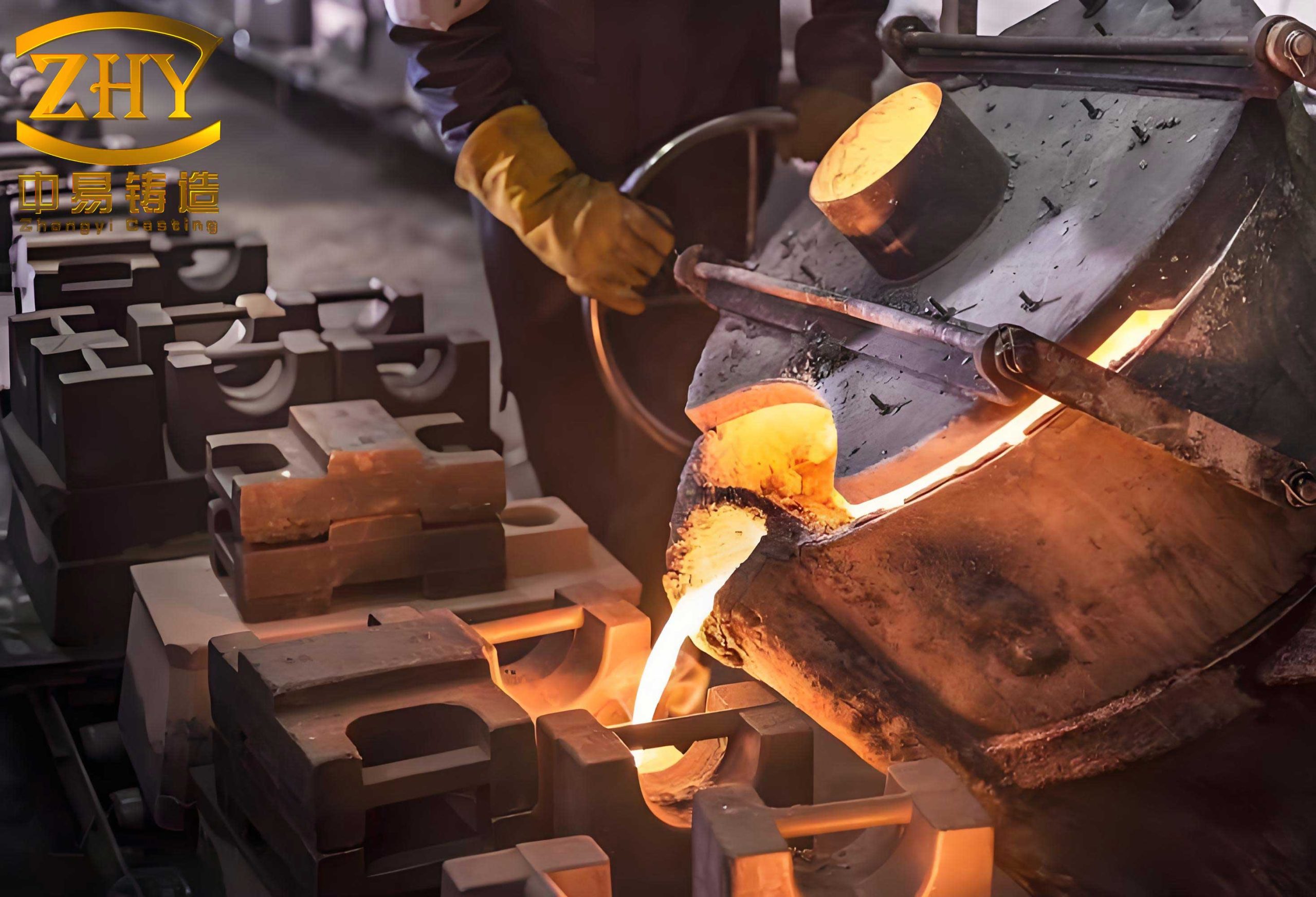
To set the stage, let me describe the initial situation. Our production involved valve bodies cast from HT200 iron, melted in a cupola furnace. The molding process used green sand with dry cores, and cleaning was done manually through hammering. A systematic audit of defects over a significant production batch revealed a troubling pattern. Cracks were the dominant flaw, accounting for a substantial portion of total defects. The specific location was consistently at the transition fillet between the valve body flange and the connecting web, as illustrated in the discussions later. These cracks were typically 20-40 mm long and about 0.5 mm wide, exhibiting a straight, continuous morphology. Fracture surface examination under magnification showed fresh metallic luster, confirming them as cold cracks—defects that occur after the cast iron parts have solidified and cooled to lower temperatures.
We compiled defect data to quantify the problem, which is summarized in Table 1 below. This Pareto analysis helped us focus our efforts on the most critical issue.
| Defect Category | Frequency (Number of Castings) | Percentage (%) | Cumulative Percentage (%) |
|---|---|---|---|
| Cracks | 85 | 32.1 | 32.1 |
| Mismatch (Misrun) | 68 | 25.7 | 57.8 |
| Sand Drop | 55 | 20.8 | 78.6 |
| Cold Shut | 35 | 13.2 | 91.8 |
| Others | 22 | 8.3 | 100.0 |
| Total | 265 | 100.0 |
The geometry of the valve body cast iron parts played a crucial role. The flange section was substantially thicker (approximately 50-60 mm) compared to the connecting web (around 20 mm). This significant variation in section thickness, with a ratio often less than 3:1, created an inherent condition for differential cooling. The thin web solidified and cooled rapidly, while the thick flange remained hot for a longer duration. This disparity is the fundamental source of thermal stress. The stress arising from hindered solid-state linear contraction is the primary driver for crack initiation in these cast iron parts.
To formalize the analysis, we must consider the mechanics of stress development. The total stress ($\sigma_{total}$) in a casting during cooling can be considered as a combination of thermal stress ($\sigma_{thermal}$) and stress due to mechanical restraint ($\sigma_{restraint}$). For cast iron parts, the thermal stress is particularly significant and can be approximated by:
$$ \sigma_{thermal} = E \cdot \alpha \cdot \Delta T $$
where $E$ is the elastic modulus of the cast iron material at the relevant temperature, $\alpha$ is the coefficient of thermal expansion, and $\Delta T$ is the temperature difference between different sections of the casting. In our valve bodies, $\Delta T$ between the web and flange during the cooling stage could be substantial. When this stress, potentially augmented by restraint stress from the mold, exceeds the tensile strength of the material at that temperature, a crack initiates. For cold cracks, this occurs below the brittle-ductile transition temperature, which for gray iron is in the range of $600^\circ\text{C}$ to $700^\circ\text{C}$.
Furthermore, the solidification shrinkage behavior of cast iron contributes to the stress state. The linear contraction during the solid-state cooling phase can be expressed as a function of temperature change:
$$ \epsilon_{contraction} = \alpha_{s} \cdot (T_{solidus} – T_{room}) $$
where $\alpha_{s}$ is the solid-state contraction coefficient, $T_{solidus}$ is the solidus temperature, and $T_{room}$ is room temperature. If this contraction is non-uniform or is restrained by the mold sand, stresses build up. The sand’s resistance to deformation, or its lack of “yieldability,” is a critical factor. Our initial molding sand, a clay-bonded green sand, sometimes had high clay and moisture content, reducing its permeability and yieldability, thereby increasing the restraint on the contracting cast iron parts.
Another contributing factor was the melting practice. The inadvertent inclusion of alloy steel scraps in the cupola charge altered the microstructure of the HT200 iron. It could promote the formation of carbides, reduce graphitization, and shift the solidification characteristics. This change affects the “shrinkage expansion” behavior and the material’s inherent resistance to cracking. The presence of carbides can make the cast iron parts more prone to brittle fracture.
The manual hammering during shakeout was identified as a triggering factor. Even if residual stresses were below the critical level, an external impact could provide the additional energy needed to propagate a crack. The impact stress ($\sigma_{impact}$) from hammering can be superimposed on the existing residual stress ($\sigma_{residual}$):
$$ \sigma_{total\_at\_impact} = \sigma_{residual} + \sigma_{impact} $$
When this sum exceeds the fracture strength, failure occurs. This was especially dangerous at stress concentration points like the fillet regions of our valve cast iron parts.
Based on this multi-faceted root cause analysis, we concluded that to prevent cold cracks in valve cast iron parts, we needed a holistic strategy targeting stress reduction at every stage: during melting, molding, solidification, and post-casting handling. The following sections detail the specific process measures we implemented, organized into key areas.
Detailed Process Measures and Controls
We implemented a series of interconnected measures, each designed to address a specific root cause. The overarching philosophy was to promote uniform cooling, reduce restraint, and eliminate external stress raisers. The measures are summarized in Table 2 for clarity, followed by a detailed explanation.
| Process Area | Specific Measure | Targeted Root Cause | Key Control Parameters |
|---|---|---|---|
| Melting & Charge Control | Strict Segregation of Charge Materials | Prevent adverse microstructure changes (carbides) | Exclusion of alloy steel scraps; Controlled scrap steel percentage |
| Optimized Charge Composition | Ensure proper graphitization and contraction behavior | Maintain consistent C, Si, CE (Carbon Equivalent) levels | |
| Molding Sand Control | Control of Clay and Moisture Content | Improve sand yieldability and reduce restraint | Clay content: 8-12%; Moisture content: 3.5-4.5% |
| Maintain New/Rebonded Sand Ratio | Prevent buildup of fines and dead clay | New sand addition: 15-20% of total sand system | |
| Use of Special Facing Sand at Critical Sections | Localized improvement in yieldability | Facing sand with 2-3% wood flour additive | |
| Prevent Over-use of Wood Flour | Avoid sand penetration/burning-on defects | Wood flour limited to max 3.5% in facing sand | |
| Casting Design & Gating | Application of Constant-Temperature Riser at Thin-Thick Junctions | Promote directional solidification & reduce thermal gradient | Riser size based on modulus calculation; Placed on thick flange section |
| Shakeout & Heat Treatment | Replace Manual Hammering with Vibratory Shakeout | Eliminate impact stress superposition | Controlled vibration frequency and amplitude |
| Stress Relief | Optimized Artificial Aging Cycle | Reduce and homogenize residual stresses | Slow heating (≤75°C/hr), Prolonged soak at 550°C for 4 hrs, Slow cooling (≤50°C/hr) |
1. Melting and Charge Control: The foundation of sound cast iron parts lies in consistent melt quality. We instituted a rigorous raw material management protocol. All incoming scrap was inspected, and any pieces identified as alloy steel (containing elements like Cr, Mo, Ni beyond trace amounts) were segregated and not charged into the cupola. This prevented the dilution of the base iron with elements that promote carbide stability. The charge composition was adjusted to maintain a Carbon Equivalent (CE) value conducive to good graphitization. The CE for gray iron is given by:
$$ CE = \%C + 0.33(\%Si + \%P) $$
We aimed for a CE value between 3.9 and 4.1 for our HT200 grade to ensure adequate graphite precipitation, which provides some stress relief during cooling via expansion. Controlling the chemistry minimized the latent factors that could reduce the material’s inherent resistance to cracking in the finished cast iron parts.
2. Molding Sand System Optimization: The sand mold must provide sufficient collapsibility to yield to the contracting casting. We focused on several aspects. First, we tightened control over the green sand properties. Regular tests for moisture, clay content, permeability, and compressive strength were instituted. The ideal ranges we established are shown in Table 2. High clay and moisture reduce permeability and increase hot strength, which in turn increases the restraint force ($F_{restraint}$) on the casting. This force relates to stress as:
$$ \sigma_{restraint} = \frac{F_{restraint}}{A_{contact}} $$
where $A_{contact}$ is the area of the casting restrained by the sand. By keeping clay and moisture in check, we reduced $F_{restraint}$.
Second, we ensured a consistent refreshment of the sand system by maintaining a minimum 15% addition of new sand. This prevented the accumulation of “dead” clay fines, which absorb water but contribute little bonding, ultimately increasing the water requirement and reducing yieldability.
Third, for the critical crack-prone areas—specifically the fillet between the flange and web—we used a special facing sand. This sand mix contained a higher percentage of wood flour (2-3%) compared to the backing sand. Wood flour combusts during pouring, creating voids that enhance the collapsibility of the sand in that localized region, effectively creating a “cushion” for the contracting cast iron parts at the most vulnerable point. However, we were careful to limit wood flour to avoid excessive gas generation and penetration defects.
3. Casting Design Modification via Riser Application: The geometric disparity between thick and thin sections was a design constraint. To mitigate its effects, we employed a thermal management technique using a constant-temperature riser (also known as a heating riser or exothermic riser). The principle is to feed the thick section and, more importantly, to keep the thermal junction hotter for longer, thereby reducing the temperature gradient ($\nabla T$). A smaller gradient directly reduces thermal stress, as seen in a more generalized form of the stress formula for a temperature field:
$$ \sigma_{thermal} \propto E \cdot \alpha \cdot L \cdot \nabla T $$
where $L$ is a characteristic length. The riser was sized using the modulus method. The modulus (M) is the volume-to-cooling-surface-area ratio:
$$ M = \frac{V}{A} $$
We calculated the modulus of the thick flange section and designed the riser to have a slightly higher modulus, ensuring it remained liquid and hot longer than the casting. This riser was placed on the flange, adjacent to the thin web junction. By doing so, it delayed the solidification of the flange near the junction, allowing the thin web to cool and contract with less restraint from the still-hot flange. This promoted a more simultaneous solidification pattern at the junction, drastically reducing the thermal stress in the cast iron parts. This was one of the most effective single measures we implemented.
4. Shakeout and Post-Casting Processing: We eliminated the manual hammering process entirely for these valve cast iron parts. It was replaced with a controlled vibratory shakeout machine. The vibratory action breaks the sand bond uniformly without imparting high-intensity, localized impact forces. This removed the variable of $\sigma_{impact}$ from the stress equation, ensuring that any residual stresses present were not catastrophically amplified.
Furthermore, we optimized the artificial aging (stress relief) cycle for all large valve bodies. The previous cycle was relatively fast. We adopted a much slower heating rate (≤75°C per hour) to allow temperature equalization throughout the bulky cast iron parts. The soaking temperature was set at $550^\circ\text{C}$, held for a minimum of 4 hours. This temperature is within the range where creep mechanisms become active in cast iron, allowing for plastic relaxation of locked-in stresses. The cooling rate was also controlled (≤50°C per hour down to $200^\circ\text{C}$, then furnace cooling to ambient). The slow cooling prevents the introduction of new thermal stresses from too rapid a temperature change. The efficacy of stress relief can be modeled by an exponential decay function of stress with time at temperature:
$$ \sigma_{residual}(t) = \sigma_{0} \cdot e^{-k t} $$
where $\sigma_{0}$ is the initial residual stress, $k$ is a temperature-dependent rate constant, and $t$ is time. The prolonged soak at an adequate temperature maximizes the reduction in $\sigma_{0}$.
Results, Verification, and Discussion
After implementing this comprehensive set of process measures, we monitored production over a 12-month period. The results were highly encouraging. The crack defect rate in valve body cast iron parts, which initially stood at 32.1%, plummeted to below 3%. This represented a reduction of over 90% in the occurrence of this critical defect. The overall scrap and rework rate decreased significantly, leading to direct cost savings from reduced welding consumables, labor, and energy for repairs. The consistency and quality of our cast iron parts improved markedly.
To verify the effectiveness of our sand modifications, we regularly tested key properties. Table 3 shows a comparison of average green sand properties before and after the improvements.
| Property | Before Improvement (Average) | After Improvement (Control Range) |
|---|---|---|
| Moisture Content (%) | 5.2 | 3.8 – 4.2 |
| Clay Content (Active, %) | 14.5 | 9.5 – 11.0 |
| Permeability Number | 75 | 110 – 130 |
| Green Compressive Strength (kPa) | 165 | 120 – 140 |
| Deformation (mm) | 1.1 | 1.5 – 1.8 |
The increased permeability and deformation, along with lower strength, confirm the improved yieldability of the sand, which directly contributed to lower restraint stresses on the solidifying cast iron parts.
We also performed a simple theoretical check on the thermal gradient reduction. Assuming a simplified 1D model across the web-flange junction, the temperature difference $\Delta T$ before using the riser could be estimated at a critical time during cooling. With the constant-temperature riser in place, the temperature of the flange near the junction ($T_{f,j}$) is maintained closer to the riser temperature ($T_{riser}$) for a longer period. If we model the cooling of the web alone, its temperature ($T_w$) drops quickly. The gradient $\nabla T$ is proportional to $(T_{f,j} – T_w)$. By maintaining a higher $T_{f,j}$, the difference $(T_{f,j} – T_w)$ is reduced during the critical phase when the web is passing through the elastic temperature range. Even a rough estimate shows a potential reduction in $\Delta T$ by 30-40% with an effective riser, which squares with the observed dramatic drop in cracks, as thermal stress is linearly proportional to $\Delta T$.
The success of these measures underscores a fundamental principle in foundry engineering: preventing defects in cast iron parts is often more about controlling the process environment and thermal history than about the material itself. Each measure we took—charge control, sand control, riser design, and shakeout modification—interacted to create a synergistic effect. For instance, improved sand yieldability made the riser’s thermal management role even more effective by providing less mechanical opposition to the contraction encouraged by the controlled cooling.
Conclusion and Broader Implications
In conclusion, the challenge of cold cracks in valve cast iron parts was successfully addressed through a systematic, root-cause-based approach. By recognizing that the defect stemmed from the interplay of thermal stresses, mechanical restraint, and external impacts, we were able to devise and implement a series of practical and effective process measures. Key among these were the strict control of charge materials to ensure a favorable microstructure, the optimization of molding sand to enhance its collapsibility, the strategic use of constant-temperature risers to manage thermal gradients at critical junctions, and the elimination of impact during shakeout combined with optimized stress relief annealing.
The methodology presented here is not limited to valve bodies. It can be adapted to a wide range of cast iron parts with varying section thicknesses or complex geometries prone to cracking. The core idea is to systematically identify and mitigate sources of stress throughout the casting process. For any foundry producing demanding cast iron parts, a focus on thermal management and mold-casting interaction is paramount. Our experience demonstrates that significant quality improvements and cost reductions are achievable through diligent process analysis and control, without necessarily requiring major capital investment in new equipment. The continuous monitoring and adherence to the established control parameters for sand, melting, and heat treatment are essential for sustaining these gains in the production of reliable, crack-free cast iron parts.
Future work could involve more sophisticated simulation of the solidification and stress development using finite element analysis (FEA) software to further optimize riser placement and size for different cast iron parts designs. Additionally, exploring the effects of minor alloying elements on the stress-relaxation behavior of cast iron during the aging cycle could provide further refinements. Nevertheless, the practical measures outlined in this article provide a robust and proven framework for significantly reducing the incidence of cold cracks in industrial cast iron castings.