
In my experience working with high manganese steel casting production for engineering machinery, such as excavators and loaders, I have frequently encountered issues related to fractures and cracks in critical wear parts like bucket teeth and lips. These components, typically made from alloyed high manganese steel, are subjected to severe impact, bending stress, and abrasive wear during operation. However, premature failures, including fractures during service and cracking during heat treatment, have been persistent challenges. This article delves into an in-depth analysis of these problems from the perspectives of chemistry, casting processes, and heat treatment, offering practical solutions based on firsthand observations and modifications. The focus is on enhancing the durability and reliability of high manganese steel casting parts through optimized manufacturing techniques.
The application of high manganese steel casting in heavy-duty equipment is widespread due to its excellent work-hardening properties and toughness. Typically, these castings are used for bucket teeth, lips, and other wear parts that endure constant material interaction. Despite their robustness, failures occur, often manifesting as fractures in service or cracks during thermal processing. In one instance, a WK-4 excavator bucket tooth fractured in the upper section during operation, while cracks developed in the lower region. In another case, a PH2800 electric shovel bucket lip exhibited multiple cracks during heat treatment, originating from the front edge and mounting holes, with secondary cracks forming in a radial pattern. These defects not only compromise performance but also lead to costly downtime. Understanding the root causes is essential for improving high manganese steel casting quality.
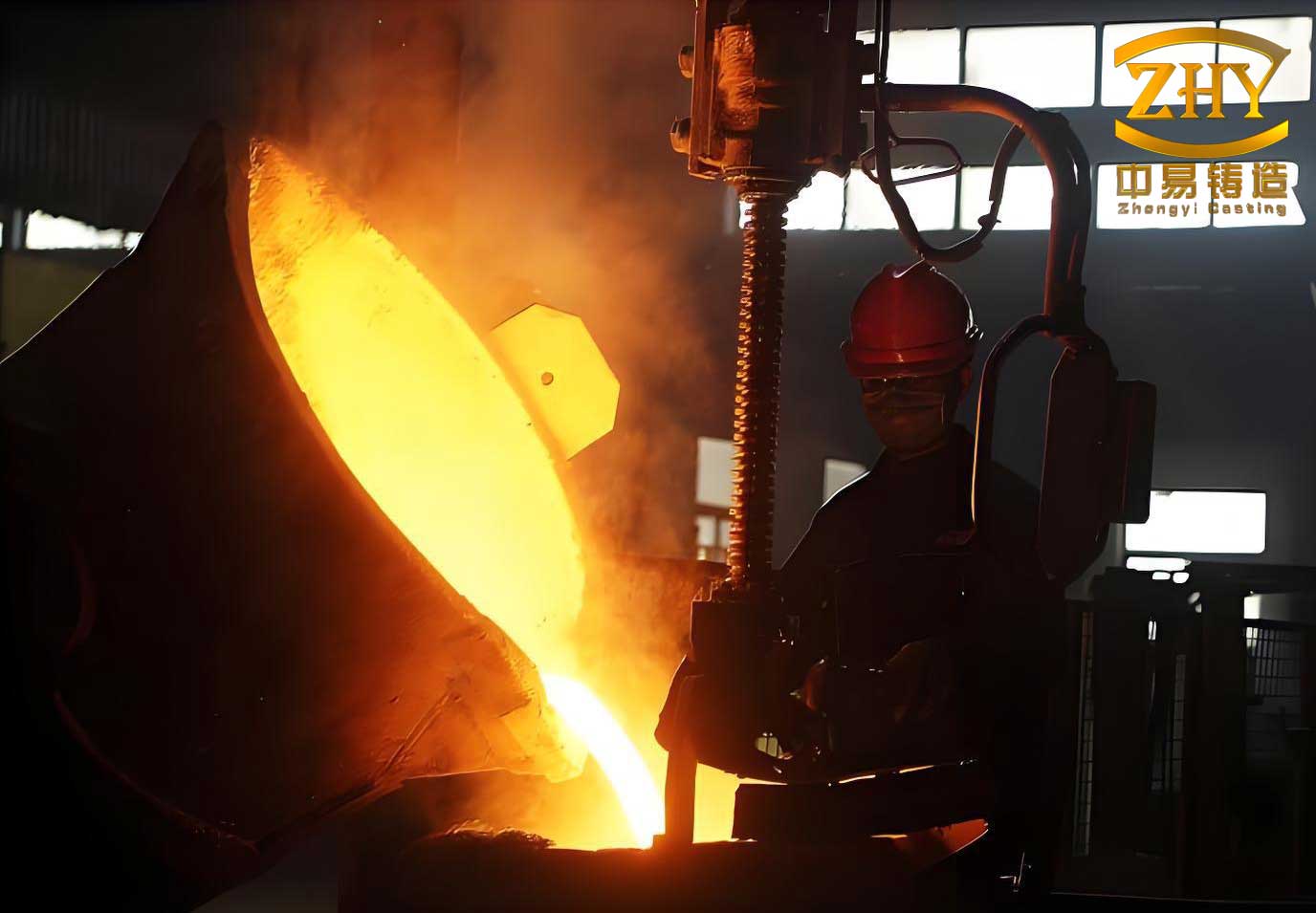
The morphology of fractures and cracks in high manganese steel casting components often reveals clues about their origins. For bucket teeth, fractures may initiate at stress concentration points, such as near casting imperfections or improper riser locations. Cracks in bucket lips during heat treatment frequently show oxidation tints, indicating formation at elevated temperatures due to thermal stresses. Macro-examination of these defects suggests that both casting design and thermal processing play pivotal roles. To systematically address these issues, I analyzed multiple factors, starting with chemical composition, which forms the foundation of material properties. In high manganese steel casting, the standard composition involves carbon and manganese as primary elements, but alloying additions like chromium and molybdenum are often incorporated to enhance strength and wear resistance. For example, a failed bucket tooth had the following composition, which aligns with specifications for alloyed high manganese steel:
| Element | Weight Percentage (wt%) |
|---|---|
| C | 1.12 |
| Mn | 13.0 |
| Cr | 2.15 |
| Mo | 0.55 |
| S | 0.045 |
| P | 0.050 |
This composition meets the requirements for high manganese steel casting, implying that chemistry alone may not be the sole culprit. However, deviations in other elements can affect microstructural stability. The carbon equivalent (CE) in high manganese steel casting can be approximated using formulas to assess hardenability and cracking tendency. For instance, a simplified carbon equivalent formula is:
$$ CE = C + \frac{Mn}{6} + \frac{Cr + Mo}{5} $$
Substituting values from the table: $$ CE = 1.12 + \frac{13.0}{6} + \frac{2.15 + 0.55}{5} = 1.12 + 2.167 + 0.54 = 3.827 $$
A high CE value indicates increased susceptibility to cracking during cooling, but this is just one aspect. The casting process for high manganese steel casting components significantly influences integrity. In the original design for bucket teeth, risers were positioned on the working surface, leading to defects and stress concentrations. This improper placement caused shrinkage porosity and thermal stresses during solidification. The casting process can be modeled using heat transfer equations to predict solidification time and stress development. For a casting of thickness \( d \), the solidification time \( t_s \) can be estimated by Chvorinov’s rule:
$$ t_s = k \left( \frac{V}{A} \right)^2 $$
where \( V \) is volume, \( A \) is surface area, and \( k \) is a constant dependent on mold material and metal properties. For high manganese steel casting, with its high melting point and low thermal conductivity, \( k \) tends to be larger, prolonging solidification and increasing stress. Modifying the riser location to non-critical areas, as shown in improved designs, reduces these risks. Additionally, using compliant core materials like sawdust sand enhances mold yield, minimizing restraint stresses. The table below summarizes key casting parameters for high manganese steel casting components:
| Parameter | Original Process | Improved Process |
|---|---|---|
| Riser Location | On working surface | At hot spots, away from working surface |
| Core Material | Conventional sand | Sawdust sand for better collapsibility |
| Shakeout Time | Less than 10 hours | More than 10 hours post-pouring |
| Gating System | Simple design | Optimized for uniform filling |
Heat treatment is another critical factor for high manganese steel casting performance. The standard water toughening (quenching) process aims to dissolve carbides and achieve a single-phase austenitic structure. However, due to poor thermal conductivity and high alloy content, rapid heating can induce severe thermal stresses, leading to cracks. The heat treatment curve typically involves heating to 1050–1100°C followed by water quenching. The thermal stress \( \sigma_{th} \) during heating can be expressed as:
$$ \sigma_{th} = E \alpha \Delta T $$
where \( E \) is Young’s modulus, \( \alpha \) is the coefficient of thermal expansion, and \( \Delta T \) is the temperature gradient. For high manganese steel casting, \( \alpha \) is relatively high (around \( 18 \times 10^{-6} \, \text{K}^{-1} \)), and \( E \) is approximately 200 GPa, so even moderate \( \Delta T \) can generate significant stress. In practice, I observed that cracks in bucket lips often correlated with fast heating rates. To mitigate this, I implemented a stepwise heating profile with intermediate holds, allowing temperature uniformity. The modified heat treatment schedule for high manganese steel casting includes:
- Heat to 100°C, hold for 2 hours.
- Increase to 200°C, hold for 2 hours.
- Continue in 100°C increments up to 650°C, each with a 2-hour hold.
- Final heating to 1050°C, soak for adequate time (e.g., 2 hours per inch of thickness).
- Water quench rapidly.
- Low-temperature temper at 200°C for 2 hours to relieve stresses and transform any surface martensite.
This approach reduces thermal shock and minimizes cracking in high manganese steel casting components. The tempering step addresses surface decarburization, which can occur during prolonged heating, leading to martensite formation upon quenching. The kinetics of decarburization can be described by Fick’s law:
$$ \frac{\partial C}{\partial t} = D \frac{\partial^2 C}{\partial x^2} $$
where \( C \) is carbon concentration, \( t \) is time, \( x \) is depth, and \( D \) is the diffusion coefficient. For high manganese steel casting at high temperatures, \( D \) increases, accelerating carbon loss. Water quenching then forms brittle martensite in decarburized layers, reducing toughness. Tempering at 200°C promotes carbide precipitation in a fine, dispersed form, enhancing wear resistance without significantly impacting impact energy. The impact toughness of high manganese steel casting is crucial; tests on failed bucket teeth showed values around 200 J, meeting standards, but microstructural observations revealed coarse grains. Grain size refinement can improve toughness, as described by the Hall-Petch equation:
$$ \sigma_y = \sigma_0 + \frac{k_y}{\sqrt{d}} $$
where \( \sigma_y \) is yield strength, \( \sigma_0 \) is friction stress, \( k_y \) is a constant, and \( d \) is grain diameter. For high manganese steel casting, controlling solidification and heat treatment parameters can refine grains, thereby enhancing fracture resistance. The table below compares mechanical properties before and after process improvements for high manganese steel casting parts:
| Property | Original High Manganese Steel Casting | Improved High Manganese Steel Casting |
|---|---|---|
| Impact Energy (AKU, J) | 183–216 | 220–250 (estimated) |
| Hardness (HB) | 205 | 210–220 |
| Microstructure | Coarse austenite with minor carbides | Refined austenite, fine dispersed carbides |
| Crack Incidence | High during heat treatment | Significantly reduced |
| Fracture Rate in Service | Notable in bucket teeth | Minimal after modifications |
Further analysis of high manganese steel casting behavior involves understanding the role of alloying elements. Chromium and molybdenum additions increase strength but can affect phase stability. The effect of chromium on carbide formation in high manganese steel casting can be quantified using thermodynamic models. For instance, the driving force for carbide precipitation \( \Delta G \) can be approximated as:
$$ \Delta G = RT \ln \left( \frac{C}{C_e} \right) $$
where \( R \) is the gas constant, \( T \) is temperature, \( C \) is actual carbon content, and \( C_e \) is equilibrium carbon solubility. In high manganese steel casting with chromium, \( C_e \) decreases, promoting carbide formation during slow cooling. Thus, controlled quenching is essential to retain carbon in solution. Additionally, residual stresses from casting and heat treatment can be modeled using finite element analysis. For a high manganese steel casting component like a bucket tooth, the stress distribution \( \sigma(x,y,z) \) satisfies the equilibrium equations:
$$ \frac{\partial \sigma_{xx}}{\partial x} + \frac{\partial \sigma_{xy}}{\partial y} + \frac{\partial \sigma_{xz}}{\partial z} = 0 $$
and similarly for other directions. By optimizing geometry and processes, these stresses can be minimized, reducing fracture risk. In practice, I revised the bucket tooth design to include smoother transitions and thicker sections at high-stress areas, which complemented the process changes. The integration of these factors highlights the complexity of producing reliable high manganese steel casting parts.
The prevention of fractures in high manganese steel casting components also depends on post-production inspections. Non-destructive testing methods, such as ultrasonic or magnetic particle inspection, can detect subsurface flaws. For high manganese steel casting, which is non-magnetic in the austenitic condition, surface decarburization-induced martensite can be identified using magnetic probes. This ties back to heat treatment control: ensuring uniform heating and adequate soaking prevents localized decarburization. Moreover, the cooling rate during quenching is critical; too slow cooling can cause carbide precipitation, while too fast cooling increases thermal stresses. The ideal cooling rate \( \dot{T} \) for high manganese steel casting can be derived from continuous cooling transformation (CCT) diagrams, but empirically, rapid quenching into agitated water is effective. The heat transfer coefficient \( h \) during quenching affects the cooling rate, with typical values for water quenching around 5000 W/m²K. The temperature drop over time \( t \) can be estimated using Newton’s law of cooling:
$$ T(t) = T_0 e^{-hA t / (mc)} $$
where \( T_0 \) is initial temperature, \( A \) is surface area, \( m \) is mass, and \( c \) is specific heat. For high manganese steel casting, with high \( c \), cooling must be vigorous to avoid pearlite transformation. These considerations underscore the importance of tailored processes for each high manganese steel casting application.
In summary, the failure of high manganese steel casting parts like bucket teeth and lips stems from interrelated factors in chemistry, casting, and heat treatment. Through systematic improvements—such as relocating risers, using compliant molds, implementing stepwise heating, and adding low-temperature tempering—I have successfully reduced fractures and cracks in production. These modifications enhance the intrinsic properties of high manganese steel casting, ensuring it meets the demanding conditions of excavation and loading operations. Future work could explore advanced alloy designs or simulation tools to further optimize high manganese steel casting performance. Ultimately, a holistic approach, grounded in practical experience and scientific principles, is key to advancing the reliability of high manganese steel casting components in heavy machinery.
To encapsulate the findings, here is a formula summarizing the overall approach to preventing defects in high manganese steel casting:
$$ \text{Optimal High Manganese Steel Casting} = f(\text{Chemistry}, \text{Casting Design}, \text{Heat Treatment}) $$
where each variable is optimized based on empirical data and theoretical insights. The continuous evolution of high manganese steel casting technology promises even greater durability for industrial applications.