
In my years of experience as a foundry engineer, I have dedicated significant effort to understanding and mitigating shrinkage defects in cast iron parts. Shrinkage cavities and porosity are pervasive issues that arise during the solidification of cast iron parts, often manifesting in thermal centers or hot spots due to inadequate compensation for liquid metal contraction. These defects can severely compromise the mechanical integrity, particularly fatigue strength, of cast iron parts, making their prevention a critical aspect of foundry practice. The tolerance for such defects varies based on the functional requirements of the cast iron parts; for instance, automotive components like brake discs or caliper housings demand zero defects in critical areas to prevent failures, while non-critical sections may allow minimal porosity. This article delves into the common methods employed to prevent shrinkage defects in cast iron parts, supported by theoretical principles, practical applications, and quantitative analyses. Through a first-person perspective, I will share insights on riser feeding, melting and pouring process control, chilling with denseners, use of cooling ribs or fins, and application of high thermal conductivity molding sands, all aimed at ensuring the production of sound cast iron parts.
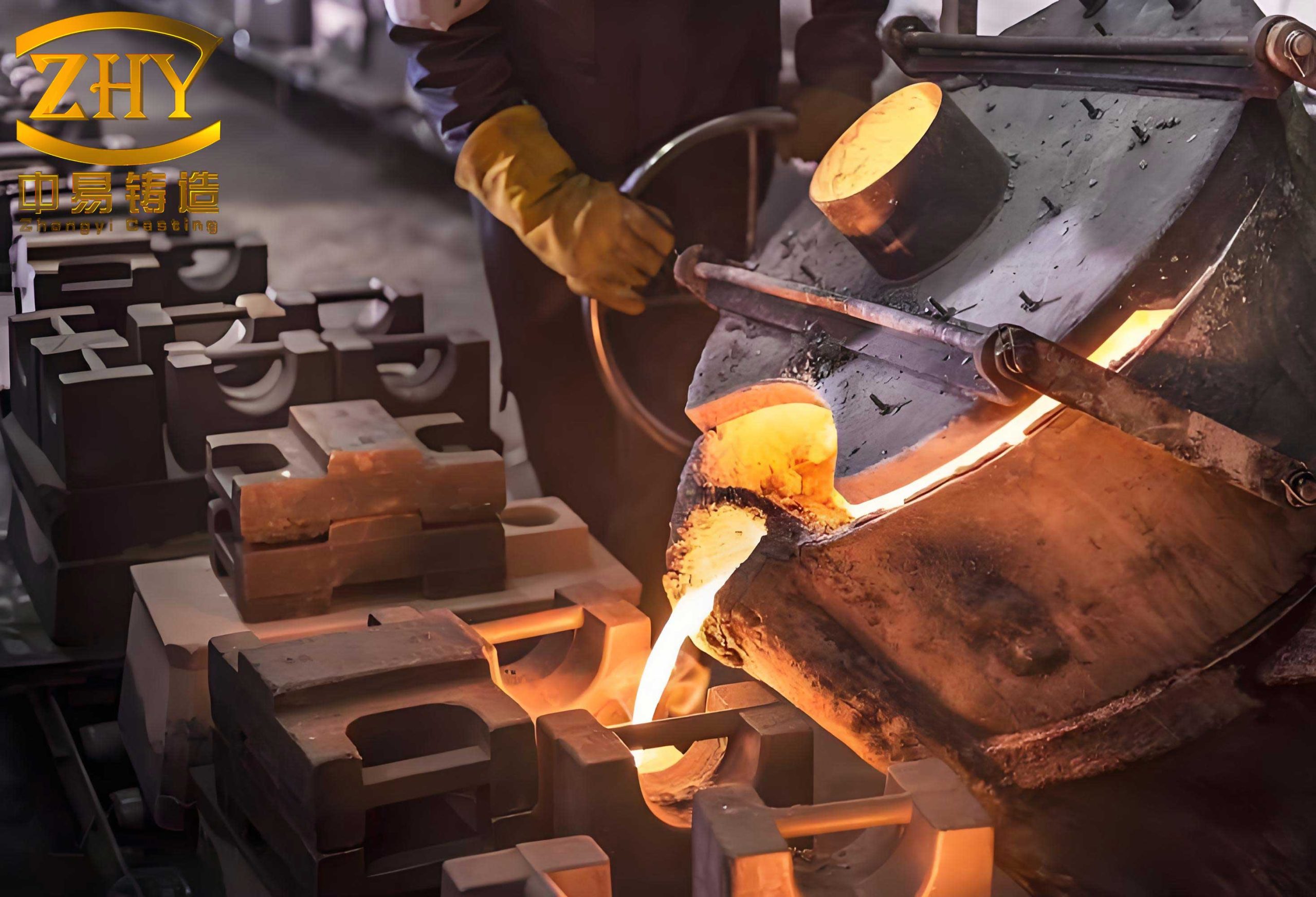
The detection of shrinkage defects in cast iron parts is paramount for quality assurance. Techniques such as X-ray radiography, ultrasonic testing, and metallographic examination are routinely used. For cast iron parts in safety-critical applications, like automotive braking systems, even microscopic shrinkage must be identified through methods like penetrant testing or microscopic analysis. The economic impact of these defects is substantial, influencing process yield, material efficiency, and overall production costs. Therefore, developing robust strategies to eliminate or minimize shrinkage in cast iron parts is essential for both performance and profitability. In the following sections, I will explore each prevention method in detail, incorporating formulas, tables, and examples from my hands-on experience with various cast iron parts.
Riser Feeding: The Primary Method for Shrinkage Compensation
Riser feeding is often the first line of defense against shrinkage defects in cast iron parts. The principle hinges on providing a reservoir of molten metal—the riser—that supplies liquid to the casting during solidification, offsetting volumetric contraction. Effective riser design for cast iron parts relies on the modulus method, which compares the volume-to-surface area ratio of the riser and the casting section it feeds. The modulus M is defined as:
$$ M = \frac{V}{A} $$
where V is the volume and A is the surface area. For a riser to adequately feed a cast iron part, the condition is:
$$ M_{riser} > M_{casting} $$
In practice, a safety factor is applied, typically making the riser modulus 1.2 to 1.5 times that of the casting for reliable feeding of cast iron parts. The required riser volume can be estimated from the solidification shrinkage factor α, which for gray cast iron parts is approximately 0.04 (4%). The formula is:
$$ V_r = \frac{V_c \cdot \alpha}{1 – \alpha} $$
where Vr is riser volume and Vc is casting volume. For ductile cast iron parts, which exhibit higher shrinkage tendencies due to graphite morphology, the factor may increase to 0.06, necessitating larger risers.
| Riser Type | Advantages | Disadvantages | Typical Application in Cast Iron Parts | Thermal Efficiency |
|---|---|---|---|---|
| Open Riser | Simple design, easy removal | High heat loss, low yield | General-purpose cast iron parts | Low (30-40%) |
| Blind Riser | Better insulation, higher yield | Complex molding, potential gas entrapment | Thick-section cast iron parts | Medium (50-60%) |
| Insulating Riser | Reduces heat loss, improves feeding | Additional material cost | Large or heavy cast iron parts | High (70-80%) |
| Exothermic Riser | Provides supplemental heat, excellent feeding | High cost, residue contamination | Critical cast iron parts with high integrity needs | Very High (80-90%) |
With the advent of computer simulation, riser design for cast iron parts has become more precise. Numerical models predict solidification patterns, allowing optimization of riser size, placement, and type. This reduces trial-and-error and enhances the yield of cast iron parts. In my experience, using insulating or exothermic risers for cast iron parts like engine blocks or crankshafts has boosted yield by over 10%, proving economically beneficial. The key is to balance riser efficacy with cost, ensuring that cast iron parts meet quality standards without excessive expense.
Melting and Pouring Process Control: Fine-Tuning for Micro-Shrinkage
When shrinkage defects in cast iron parts are subtle, such as micro-porosity, adjustments in melting and pouring parameters can offer effective mitigation. This method is particularly suitable for cast iron parts where defects are intermittent and not pervasive. Control over chemical composition, inoculation, and pouring temperature plays a pivotal role.
Chemical composition directly influences the shrinkage behavior of cast iron parts. For gray cast iron parts, increasing the carbon equivalent (CE) enhances graphite expansion during solidification, which counteracts shrinkage. The CE is calculated as:
$$ CE = C + \frac{Si + P}{3} $$
where C, Si, and P are weight percentages. A higher CE, within mechanical property limits, reduces shrinkage in cast iron parts. For ductile cast iron parts, residual magnesium content must be tightly controlled, as magnesium increases shrinkage propensity. I recommend maintaining residual magnesium between 0.035% and 0.05% for such cast iron parts to balance nodularity and shrinkage. Additionally, elements like tin (Sn) should be used cautiously; while Sn promotes pearlite, it exacerbates shrinkage compared to copper (Cu). For instance, in crankshaft cast iron parts, substituting Sn for Cu led to visible shrinkage in journal areas, underscoring the need for careful alloying.
| Element | Typical Range (wt%) | Influence on Shrinkage | Recommendation for Cast Iron Parts |
|---|---|---|---|
| Carbon (C) | 3.2-3.8 | Reduces shrinkage by promoting graphite expansion | Maximize within property limits |
| Silicon (Si) | 1.8-2.5 | Similar to carbon, but excessive Si may embrittle | Adjust to control CE |
| Magnesium (Mg) | 0.035-0.05 (residual) | Increases shrinkage, necessary for nodularity | Minimize while ensuring nodularization | Copper (Cu) | 0.5-1.5 | Moderate shrinkage increase, good for strength | Preferred over Sn for critical cast iron parts |
| Tin (Sn) | 0.05-0.1 | High shrinkage tendency, strong pearlite promoter | Use sparingly in non-critical cast iron parts |
Inoculation is another critical factor for cast iron parts. Certain inoculants, such as those containing sulfur and oxygen, improve graphite nucleation and reduce micro-shrinkage. The effectiveness can be quantified by the nucleation density N, which relates to the number of graphite particles per unit volume in cast iron parts:
$$ N = \frac{N_0}{V} \cdot f(I) $$
where N0 is a base nucleation count, V is volume, and f(I) is a function of inoculation intensity. In practice, using sulfur-oxygen inoculants for steering cylinder cast iron parts eliminated micro-shrinkage that was previously detected under microscopy, enhancing fatigue performance.
Pouring temperature selection for cast iron parts depends on geometry and riser use. For riser-fed cast iron parts, higher pouring temperatures (e.g., 1380-1430°C) improve fluidity and feeding. For cast iron parts without risers, lower temperatures (e.g., 1360-1390°C) reduce overall shrinkage. The optimal range must consider section thickness; thin-wall cast iron parts like exhaust manifolds require higher temperatures (1390-1450°C) to ensure fill, while thick cast iron parts like brake drums benefit from lower temperatures to minimize shrinkage. Statistical process control is essential to maintain consistency in pouring parameters for cast iron parts.
Chilling with Iron Denseners: Localized Cooling for Defect Translocation
Chills, or denseners, are external or internal metal inserts used to accelerate cooling in hot spots of cast iron parts, thereby shifting shrinkage defects to less critical areas or eliminating them through directional solidification. This method is invaluable for cast iron parts with isolated thermal centers that are difficult to feed with risers. The principle is based on rapid heat extraction, which modifies the solidification sequence.
The effectiveness of a chill for cast iron parts depends on its thermal properties and geometry. The heat transfer during chilling can be described by Fourier’s law of conduction:
$$ q = -k \frac{dT}{dx} $$
where q is heat flux (W/m²), k is thermal conductivity of the chill material (W/m·K), and dT/dx is the temperature gradient. For cast iron parts, the chill must have sufficient heat capacity to absorb the latent heat of solidification. The required chill mass m can be estimated from:
$$ m = \frac{Q}{c_p \cdot \Delta T} $$
where Q is the heat to be extracted (including latent heat), cp is specific heat of the chill, and ΔT is the temperature rise of the chill. Common materials for chills in cast iron parts include steel, copper, and graphite, each with distinct thermal conductivities.
| Material | Thermal Conductivity (W/m·K) | Specific Heat (J/kg·K) | Advantages for Cast Iron Parts | Limitations |
|---|---|---|---|---|
| Steel | 50 | 500 | Cost-effective, readily available | Moderate cooling rate |
| Copper | 400 | 385 | Excellent cooling, rapid heat extraction | Expensive, may cause chilling defects |
| Graphite | 100-150 | 710 | Good balance, reduces white iron formation | Fragile, requires careful handling |
| Cast Iron | 55 | 540 | Similar thermal expansion to casting | Heavy, less efficient than copper |
In application, chills are placed in molds adjacent to hot spots of cast iron parts. For example, in steering cylinder cast iron parts, replacing exothermic risers with steel chills resolved internal shrinkage while avoiding the hardness reduction and poor graphite structure associated with riser contacts. The chill design often involves matching the chill modulus to that of the hot spot, ensuring adequate heat withdrawal. However, over-chilling must be avoided, as it can lead to undesirable microstructures like cementite in cast iron parts. Proper chill sizing and placement, validated through simulation, are crucial for producing sound cast iron parts.
Cooling Ribs and Fins: Integral Features for Enhanced Heat Dissipation
Cooling ribs or fins are protrusions integrated into the mold design that act as extended surfaces to accelerate cooling in specific areas of cast iron parts. Unlike external chills, these features are part of the casting itself, eliminating additional material costs and simplifying the process. They function by increasing the surface area for heat transfer, effectively acting as heat sinks during solidification of cast iron parts.
The design of cooling ribs for cast iron parts typically involves adding thin rods (5-8 mm diameter) or plates (2-5 mm thickness) near hot spots. These ribs solidify rapidly, drawing heat away from the main body and reducing local solidification time. The heat transfer from a rib can be analyzed using fin theory. For a cylindrical rib, the temperature distribution along its length x is governed by:
$$ \frac{d^2T}{dx^2} – \frac{hP}{kA}(T – T_\infty) = 0 $$
where h is the convective heat transfer coefficient (W/m²·K), P is the perimeter of the rib, A is its cross-sectional area, k is thermal conductivity of the cast iron part, and T∞ is the ambient temperature. Solving this equation provides the efficiency of the rib in cooling the cast iron part. In practice, ribs are often empirical designed based on experience, but modeling can optimize their geometry for maximum effect.
For instance, in exhaust manifold cast iron parts, which are prone to shrinkage at junction points, adding cooling ribs to the mold eliminated porosity without compromising flow characteristics. The ribs, after casting, can be machined off if not functionally required, making this a versatile solution for cast iron parts. The key advantage is cost savings; no extra materials are needed, and the method integrates seamlessly into existing patterns. However, it is suitable only for external hot spots of cast iron parts, as internal areas require other approaches like high-conductivity cores.
High Thermal Conductivity Molding and Core Sands: Accelerating Cooling from Within
Using sands with high thermal conductivity in molds and cores is an effective way to enhance cooling in specific regions of cast iron parts, particularly internal sections that are inaccessible to chills or ribs. Materials such as chromite sand, zircon sand, or specialized aggregates offer higher thermal diffusivity than conventional silica sand, promoting faster heat extraction and reducing shrinkage risk in cast iron parts.
The thermal diffusivity α, which dictates how quickly heat spreads through a material, is given by:
$$ \alpha = \frac{k}{\rho c_p} $$
where k is thermal conductivity, ρ is density, and cp is specific heat capacity. Sands with higher α values dissipate heat more rapidly, altering the solidification profile of cast iron parts. For example, chromite sand has a thermal conductivity around 2.5 W/m·K, compared to 1.5 W/m·K for silica sand, making it ideal for cores in hot spots of cast iron parts.
| Sand Type | Thermal Conductivity (W/m·K) | Thermal Diffusivity (m²/s × 10⁻⁷) | Typical Use in Cast Iron Parts | Cost Relative to Silica Sand |
|---|---|---|---|---|
| Silica Sand | 1.5 | 8.0 | General molding, low-cost applications | 1.0x |
| Chromite Sand | 2.5 | 12.5 | Cores in hot spots, thick sections | 3.0x |
| Zircon Sand | 3.0 | 15.0 | Critical internal cores, high-integrity areas | 5.0x |
| Olivine Sand | 2.0 | 10.0 | Intermediate applications, environmental benefits | 2.5x |
In my practice, using chromite sand cores for steering knuckle cast iron parts resolved shrinkage in the central bore, a critical area prone to porosity. Similarly, for crankshaft cast iron parts, zircon sand cores in the pin journal regions ensured soundness without needing excessive risers. The selection of sand depends on the severity of shrinkage and cost constraints; while high-conductivity sands are more expensive, they can reduce overall costs by minimizing scrap rates and improving yield for cast iron parts. It is essential to balance thermal performance with other sand properties like refractoriness and compatibility with binders to maintain mold integrity for cast iron parts.
Integrated Application Examples from Experience
Drawing from my hands-on involvement, I have successfully applied these methods to various cast iron parts, often in combination. For brake disc cast iron parts, which require zero shrinkage in the friction area, a strategy combining insulated risers with controlled pouring temperature (1400-1420°C) eliminated defects while maintaining a yield above 85%. Computer simulation validated the riser placement, reducing development time.
For ductile iron crankshaft cast iron parts, which are challenging due to their complex geometry and high shrinkage tendency, a multi-pronged approach was used. High-conductivity chromite sand cores were employed in the crankpin areas, coupled with cooling ribs on the webs and modest risers at the ends. This ensured directional solidification toward the risers, producing sound cast iron parts that passed rigorous fatigue testing. The residual magnesium was kept at 0.04%, and inoculation with a sulfur-bearing compound further mitigated micro-shrinkage.
In another case, exhaust manifold cast iron parts, thin-walled and prone to shrinkage at junctions, were improved using cooling fins on the pattern and adjusted pouring temperature (1420-1450°C). This low-cost solution avoided the need for chills or risers, simplifying production. For steering housing cast iron parts, switching from exothermic risers to steel chills in the bolt boss areas not only eliminated shrinkage but also improved hardness consistency, showcasing how method substitution can enhance quality for cast iron parts.
These examples underscore that preventing shrinkage in cast iron parts is not a one-size-fits-all endeavor. It requires a deep understanding of the casting’s geometry, material behavior, and production constraints. Often, a hybrid approach yields the best results for cast iron parts, leveraging the strengths of multiple methods to achieve optimal quality and economy.
Conclusion: Strategic Selection for Optimal Results
In summary, preventing shrinkage defects in cast iron parts demands a comprehensive strategy that integrates design, process control, and material science. Riser feeding remains a cornerstone, especially when supplemented with insulating or exothermic technologies to improve yield. Melting and pouring adjustments offer fine-tuning for micro-shrinkage, but must align with mechanical property requirements. Chilling provides targeted cooling for hot spots, while cooling ribs and high-conductivity sands offer cost-effective alternatives for external and internal areas, respectively. The choice among these methods for cast iron parts depends on factors such as part geometry, alloy type, quality standards, and production volume. As foundries advance with simulation and smart manufacturing, the ability to predict and prevent shrinkage in cast iron parts will only improve, driving higher reliability and efficiency. Ultimately, the goal is to produce cast iron parts that meet performance demands without excessive cost, ensuring competitiveness in an evolving industry.