
In the production of high-performance diesel engines, the demand for superior cast components has escalated significantly. Nodular cast iron, renowned for its excellent mechanical properties and ductility, is increasingly employed for critical parts such as cylinder heads. However, the inherent characteristics of nodular cast iron, including its lower carbon equivalent and higher alloy content, often lead to pronounced shrinkage tendencies, resulting in porosity defects that compromise integrity and cause leakage. As a foundry engineer specializing in nodular cast iron applications, I have encountered numerous challenges with shrinkage porosities in complex castings. This article details my experiences and methodologies in addressing these issues, focusing on a case study of a cylinder head casting, while emphasizing the importance of effective chilling techniques. Through systematic analysis and iterative process modifications, we can mitigate defects and enhance production yield. The insights shared here are based on practical trials and theoretical foundations, aiming to provide a comprehensive guide for foundries working with nodular cast iron.
Nodular cast iron, also known as ductile iron, is characterized by its graphite spheroids, which impart high strength and toughness. The typical composition includes carbon, silicon, manganese, and alloying elements like molybdenum, chromium, copper, and tin to achieve desired grades such as EN-GJS-700-2 or ASTM A536. For cylinder heads, the material must meet stringent requirements: tensile strength exceeding 300 MPa in the body and 270 MPa at bolt hole locations, alongside impeccable surface quality free from defects like shrinkage, gas holes, or inclusions. Pressure tightness is critical; for instance, water jacket testing at 3 bar with minimal leakage differentials (e.g., below 41 Pa) is mandatory. These specifications necessitate precise control over the casting process, particularly for nodular cast iron, where shrinkage porosities are a prevalent concern due to the material’s solidification behavior.
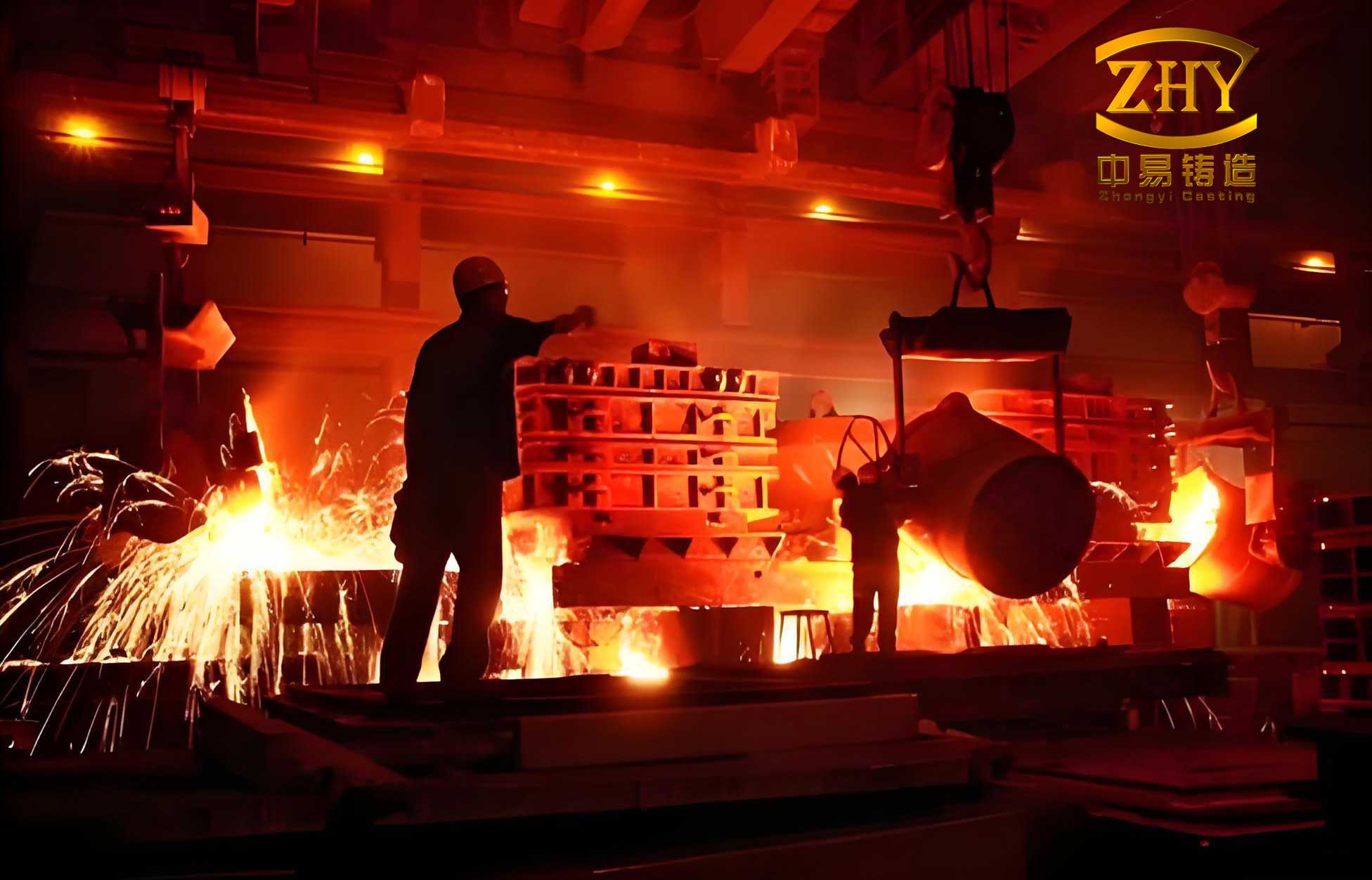
The casting process for nodular cast iron components often involves vertical pouring with core assembly to achieve intricate internal geometries. In our case, the cylinder head—a 6-cylinder, 4-valve design—weighs approximately 90 kg in rough form, with a minimum wall thickness of 5 mm. The cores, including base, water jacket, intake/exhaust ports, and end cores, are assembled using cold-box and ceramic sand techniques to reduce gas evolution. The gating system is designed as open-type with a ratio of sprue:runner:ingate = 1:1.2:1.8, ensuring smooth metal flow. To meet mechanical properties, we employ a low-carbon-equivalent base iron with high alloying and inoculation; however, this exacerbates shrinkage tendencies in nodular cast iron. The primary defect locations are non-cored bolt holes, which act as thermal junctions due to their substantial thickness (30–35 mm), leading to inadequate feeding during solidification. This results in shrinkage porosities that manifest as leakage paths during pressure testing, initially causing rejection rates over 70%.
To address shrinkage in nodular cast iron, we must first understand the solidification dynamics. The volume change during cooling can be modeled using the following equation for shrinkage formation:
$$ V_s = V_c \cdot (\beta – \alpha \cdot \Delta T) $$
where \( V_s \) is the shrinkage volume, \( V_c \) is the casting volume, \( \beta \) is the solidification contraction coefficient (typically 4-6% for nodular cast iron), \( \alpha \) is the thermal expansion coefficient, and \( \Delta T \) is the temperature drop. For nodular cast iron, the graphite expansion during eutectic solidification can partially compensate, but in heavy sections, residual liquid may not suffice. Thus, external or internal chills are employed to modulate cooling rates. Chills work by extracting heat rapidly, promoting directional solidification toward feeders. The effectiveness depends on chill size, material, and placement, which we evaluated through multiple schemes.
Our initial approach involved external chills at bolt hole locations. External chills are surface-mounted inserts that accelerate cooling at specific hotspots. We used cylindrical chills of 35 mm diameter and 30 mm thickness, placed on the bottom core corresponding to bolt holes. The results were unsatisfactory: while shrinkage at bolt holes reduced, it migrated to other thermal junctions like valve guide holes and oil injector holes. This phenomenon of defect translocation is common in nodular cast iron due to interdependent solidification patterns. The table below summarizes the outcomes of various chilling strategies for nodular cast iron castings:
| Scheme | Chill Type | Locations | Defect Occurrence | Rejection Rate |
|---|---|---|---|---|
| 1 | External Chills | Bolt Holes | Shifted to Guide/Oil Holes | 80% |
| 2 | External Chills | Bolt & Oil Holes | Shifted to Guide Holes | 71.4% |
| 3 | External Chills | Bolt, Oil, Guide Holes | Returned to Bolt Holes | 90% |
| 4 | Internal Chills | Bolt Holes | Reduced, Some Residual | 20.4% |
| 5 | Combined Internal & External | Bolt Holes (Int), Others (Ext) | Minimal | 16.7% |
The table illustrates that relying solely on external chills in nodular cast iron is ineffective, as shrinkage moves between hotspots. Internal chills, which are embedded within the casting, offer better performance. For scheme 4, we inserted internal chills—30 mm diameter, 55 mm long steel rods—into bolt holes, aligned with the water jacket core. This significantly lowered rejection rates to 20.4%, demonstrating that internal chills provide more localized and intense cooling for nodular cast iron. However, not all bolt holes could accommodate internal chills, so residual defects persisted. The heat extraction by internal chills can be approximated by Fourier’s law:
$$ Q = -k \cdot A \cdot \frac{dT}{dx} $$
where \( Q \) is heat flux, \( k \) is thermal conductivity of the chill material, \( A \) is contact area, and \( \frac{dT}{dx} \) is temperature gradient. For steel chills in nodular cast iron, \( k \) is high (~50 W/m·K), enabling rapid heat dissipation. Yet, internal chills must be sized correctly: too small, they melt entirely; too large, they cause bonding issues or cracks. The optimal diameter \( d \) can be estimated based on the thermal modulus \( M \) of the hotspot:
$$ d = C \cdot \sqrt{M} $$
with \( C \) as an empirical constant (typically 2–3 for nodular cast iron) and \( M = \frac{V}{A} \) (volume-to-surface-area ratio). For our bolt holes, \( M \approx 7.5 \, \text{mm} \), yielding \( d \approx 25 \, \text{mm} \); we used 30 mm for safety.
In scheme 5, we combined internal chills at accessible bolt holes with external chills (25 mm diameter, 30 mm thick) at other hotspots. This hybrid approach minimized defect translocation and achieved a rejection rate of 16.7%. Further validation via pressure testing on machined castings (with drilled bolt, guide, and oil holes) showed only one leak in 26 pieces, confirming efficacy. The synergy arises because internal chills dominate local solidification, while external chills moderate adjacent regions, creating a balanced thermal field. This is particularly beneficial for nodular cast iron, where uneven cooling can induce stresses alongside porosity.
Beyond chilling, other factors influence shrinkage in nodular cast iron. The gating design affects temperature distribution; we optimized the gating ratio to reduce turbulence and premature cooling. Inoculation practices are crucial: we use high-potency inoculants (e.g., FeSi-based with Ca, Ba) to enhance graphite nodule count, which improves feeding through expansion. The inoculation effect on shrinkage reduction can be expressed as:
$$ S_r = S_0 \cdot e^{-k_i \cdot N} $$
where \( S_r \) is residual shrinkage, \( S_0 \) is initial shrinkage potential, \( k_i \) is inoculation constant, and \( N \) is nodule count per unit area. For nodular cast iron, targeting >150 nodules/mm² is advisable. Additionally, mold material plays a role: ceramic sand for cores reduces gas defects but may alter cooling; we apply refractory coatings to control heat transfer. The overall process window for nodular cast iron must balance mechanical properties and castability, often requiring trade-offs.
To generalize, preventing shrinkage in nodular cast iron involves a multi-faceted strategy. Key principles include: (1) Identifying thermal junctions via simulation or empirical data—for cylinder heads, bolt holes, guide holes, and oil holes are critical. (2) Selecting chill type based on accessibility and severity; internal chills are superior for deep hotspots in nodular cast iron, while external chills suit surface regions. (3) Combining chills to manage interconnected solidification zones. (4) Optimizing alloy composition—for instance, adjusting carbon equivalent (CE) using the formula:
$$ \text{CE} = \%C + 0.33 \cdot \%Si + 0.33 \cdot \%P – 0.027 \cdot \%Mn $$
For high-strength nodular cast iron, CE is kept low (3.6–3.9), but slight increases can improve fluidity and feeding. (5) Controlling pouring temperature—we maintain 1,350–1,400°C for nodular cast iron to ensure fluidity without excessive shrinkage. (6) Implementing effective feeding with risers or padding, though for thin-walled nodular cast iron castings, chills are often more practical.
In conclusion, shrinkage porosities in nodular cast iron castings are a persistent challenge, but through systematic application of chilling techniques, they can be mitigated. Our experience shows that external chills alone cause defect translocation in nodular cast iron, while internal chills offer better performance, and a combination yields optimal results. These findings are applicable to various nodular cast iron components beyond cylinder heads, such as crankshafts, housings, and gears. Future work could explore advanced simulations to predict chill efficacy or novel chill materials for nodular cast iron. As the industry moves towards lighter and stronger castings, mastering these methods will be essential for producing defect-free nodular cast iron parts efficiently.
The journey to perfect nodular cast iron castings is iterative, requiring constant adaptation. By sharing these insights, I hope to contribute to the broader foundry community’s efforts in enhancing quality and productivity for nodular cast iron applications. Remember, every casting defect is an opportunity to learn and innovate—especially with nodular cast iron, where the material’s versatility meets process complexity. Through diligent practice and theoretical understanding, we can turn challenges into successes, ensuring that nodular cast iron remains a cornerstone of modern engineering.