
In my extensive experience with foundry processes, I have observed that pure copper, often referred to as red copper or electrolytic copper, is increasingly utilized across industries such as machinery, metallurgy, electronics, power generation, military, and aerospace due to its exceptional electrical and thermal conductivity. Components like electrode holders, conductive plates, collector rings, and furnace tuyeres require these properties, making pure copper castings essential. However, the sand casting of pure copper presents significant challenges due to its poor casting characteristics, notably high volumetric shrinkage (4.1%) and linear shrinkage (1.42%). These factors lead to surface defects like cold laps (wrinkles), craters (protrusions), burn-on (roughness), and slag conglomeration (scabbing), which compromise surface quality and aesthetic appeal. Therefore, reducing the surface roughness of pure copper sand castings is a critical foundry objective, especially in modern industrial applications where precision is paramount. This article delves into the root causes of these defects and outlines comprehensive preventive measures based on practical insights and technical analysis.
The fundamental issue in pure copper sand casting lies in its inherent material properties. Pure copper has a high melting point (approximately 1,083°C) and a narrow solidification range, which, combined with its substantial shrinkage, exacerbates defect formation. The linear shrinkage, often denoted as $$ \alpha_L = \frac{L_0 – L_f}{L_0} \times 100\% $$, where for pure copper, $$ \alpha_L \approx 1.42\% $$, and volumetric shrinkage, expressed as $$ \alpha_V = \frac{V_0 – V_f}{V_0} \times 100\% \approx 4.1\% $$, necessitate meticulous control over every aspect of the sand casting process. These shrinkage values are derived from empirical data and highlight the need for optimized gating, feeding, and cooling systems to mitigate stress and distortion.
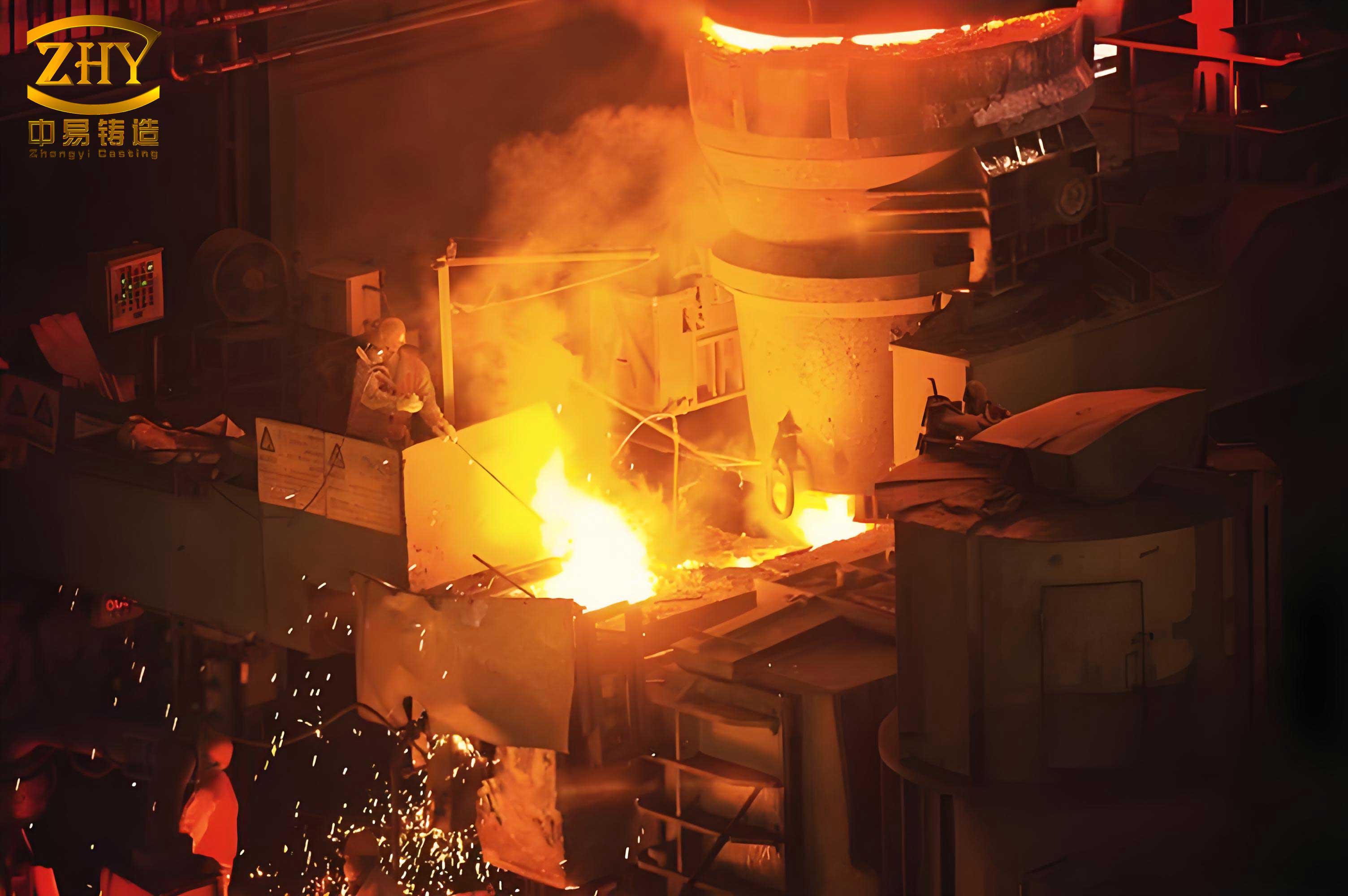
Surface defects in pure copper sand castings arise from a combination of factors, including mold quality, metal treatment, and pouring techniques. Below, I analyze the primary defects and their underlying causes, which I have encountered repeatedly in sand casting operations.
Cold Laps (Wrinkles): This defect manifests as irregular folds or seams on the casting surface, often in thin sections or corners. It results from poor fluidity of molten copper, which flows sluggishly compared to alloys. When the pouring temperature is too low, the metal front oxidizes and solidifies prematurely, leading to incomplete fusion. In sand casting, improper gating design, such as undersized ingates or insufficient numbers, exacerbates this by reducing flow velocity. Additionally, erratic pouring—characterized by intermittent or fluctuating metal stream—disrupts laminar flow, while inadequate mold drying leaves moisture that vaporizes and cools the metal. The oxidation tendency of copper further aggravates cold laps, as a thick oxide film forms and adheres to the surface. From a fluid dynamics perspective, the Reynolds number $$ Re = \frac{\rho v D}{\mu} $$, where ρ is density, v is velocity, D is hydraulic diameter, and μ is viscosity, should be maintained in a laminar regime (Re < 2,000) to prevent turbulence that promotes oxide entrapment in sand casting.
Surface Craters and Protrusions: These appear as hemispherical depressions or raised areas, primarily due to gas entrapment. During melting, if the metal is not adequately covered or degassed, it absorbs hydrogen and oxygen, which evolve during solidification. In sand casting, insufficient mold dehydration releases steam that gets trapped at the metal-mold interface, forming craters. Non-uniform mold compaction allows metal penetration, causing protrusions. The gas pressure can be modeled by the ideal gas law: $$ PV = nRT $$, where P is pressure, V is volume, n is moles of gas, R is the gas constant, and T is temperature. If venting is poor, pressure builds up, deforming the semi-solid surface. Gating systems that entrain air, such as those with abrupt changes, contribute significantly to this defect in sand casting.
Burn-on and Roughness: This defect involves metal adherence to sand grains, yielding a rough, sandy texture. It occurs when the mold surface fails to resist thermal and mechanical erosion. In sand casting, incomplete mold drying causes moisture migration, creating a weak layer that spalls off under heat. Coarse sand grains or impurities lower refractoriness, allowing metal or oxides to infiltrate pores. Low or uneven mold compaction reduces density, facilitating bonding. Excessive pouring temperature, often above 1,200°C, sinteres the sand. High metallostatic pressure, given by $$ P = \rho g h $$, where ρ is metal density, g is gravity, and h is head height, can force metal into voids. I have found that controlling these parameters is crucial for achieving smooth surfaces in pure copper sand castings.
Slag Conglomeration (Scabbing): This defect appears as crusty deposits of slag or sand on the casting surface. It stems from poor metal quality and mold integrity. Inadequate slag removal during melting introduces oxides and inclusions into the mold. Turbulent gating scours loosely compacted sand areas, dislodging particles that mix with the metal. Thermal expansion of sand, quantified by the coefficient of thermal expansion $$ \alpha = \frac{1}{L} \frac{dL}{dT} $$, can cause cracking and metal penetration. Residual sand or debris in the mold cavity prior to closing also contributes. For pure copper, which has high oxidation affinity, slag formation is pronounced, demanding rigorous process control in sand casting.
To address these defects, a holistic approach encompassing mold preparation, metal treatment, and pouring practices is essential. Below, I detail preventive measures derived from my hands-on experience in sand casting pure copper components.
Molding Sand Quality Control
The quality of molding sand directly influences surface finish in sand casting. I recommend using clay-bonded sand with high refractoriness (above 1,300°C), rounded grains, and low impurities. A dual-sand system is effective: facing sand with finer grains (100-200 mesh) to enhance surface detail, and backing sand with coarser grains (70-140 mesh) to improve permeability. The facing layer should be 10-20 mm thick, uniformly applied over backing sand. Proper drying is critical; molds must be thoroughly baked to eliminate moisture that causes defects. After assembly, the cavity should be cleaned of loose sand and debris. Table 1 summarizes a typical sand mixture for pure copper sand casting, based on my trials.
| Component | Facing Sand (wt%) | Backing Sand (wt%) |
|---|---|---|
| New Sand | 98-99 | 20-30 |
| Used Sand | 0 | 70-80 |
| Bentonite | 1-2 | 5-7 |
| Water | 5-6 | 5.5-6.5 |
The green strength of sand can be estimated using empirical formulas, such as $$ S_g = k \cdot C^{m} \cdot W^{n} $$, where Sg is green strength, C is clay content, W is water content, and k, m, n are constants. For pure copper sand casting, optimizing these values minimizes mold erosion.
Mold Compaction Requirements
Mold compaction is vital to prevent metal penetration and ensure dimensional accuracy. In dry sand casting, I aim for a surface compaction hardness exceeding 90% on a standard scale, achieved through uniform ramming. Backing sand should have 60-80% compaction to allow for gas escape and yielding, reducing stress on the casting. The compaction uniformity can be assessed using the variance formula $$ \sigma^2 = \frac{1}{N} \sum_{i=1}^{N} (x_i – \bar{x})^2 $$, where xi are hardness measurements and \bar{x} is the mean. Low variance indicates consistent compaction, crucial for defect-free sand casting.
Mold Coating Specifications
A high-quality coating is a frontline defense against burn-on in sand casting. I prepare coatings with excellent adherence and refractoriness. For dry molds, a layer of 0.5-1.0 mm is optimal. The coating must resist thermal shock and chemical interaction with molten copper. Table 2 presents a proven coating formulation for pure copper sand casting.
| Ingredient | Proportion (wt%) | Property |
|---|---|---|
| Graphite Powder | 93-95 | Base refractory |
| Fireclay | 5-7 | Binder |
| Hot Water | 180-200 (relative to solids) | Vehicle |
| – | Density: 1.3-1.35 g/cm³ | Suspension >90% |
The coating’s effectiveness can be modeled by its thermal conductivity $$ k_c = \frac{Q \cdot d}{A \cdot \Delta T} $$, where Q is heat flux, d is thickness, A is area, and ΔT is temperature difference. A lower kc value insulates the mold, reducing metal-mold interaction in sand casting.
Molten Metal Quality Management
Molten copper treatment is a multifaceted process that I meticulously control. The sequence involves: charge selection (Cu-2, Cu-3, or Cu-4 grades with Cu ≥99.50%), preheating, melting under cover (using charcoal), degassing with magnesium (Mg-2 or Mg-3, ≥99.85% purity), fluxing with zinc chloride, and slag removal. Melting temperature is maintained at 1,200-1,220°C, and pouring temperature at 1,100-1,150°C. A key step is process testing: I cast a conical sample in a refractory mold to assess gas content. If the sample surface bulges with bubbles, gas is excessive, requiring re-degassing. A slightly concave surface with minor tearing indicates sound metal. This test, governed by the solubility law $$ S = k \sqrt{P} $$, where S is gas solubility and P is partial pressure, ensures low hydrogen levels. Additionally, chemical analysis and mechanical tests verify composition and properties. Poor metal quality leads to defects like craters and slag in sand casting.
Gating System and Pouring Techniques
The gating design is pivotal for defect prevention in sand casting. For plate-like or bar-shaped pure copper castings, I prefer horizontal molding with vertical pouring, using a bottom-gated step system. This approach combines the advantages of top and bottom pouring, minimizing turbulence. For horizontal pouring, the gating ratio is set as ∑Fsprue : ∑Frunner : ∑Fingate = 1.2 : 1.5 : 1.0. For vertical pouring, runners are omitted, with a ratio of ∑Fsprue : ∑Fingate = 1.2 : 1.0. The ingate area can be calculated using the continuity equation $$ A_i = \frac{Q}{v_i} $$, where Q is flow rate and vi is ingate velocity, typically kept below 0.5 m/s to avoid turbulence. Pouring begins with a large stream to quickly fill the sprue base and lower ingates, then transitions to a smaller, steady stream with gradually raised pour height to maintain metallostatic pressure. This ensures laminar flow, reducing oxide formation and sand erosion. Improper gating causes cold laps and slag defects in sand casting.
Furthermore, thermal aspects are critical. The solidification time ts can be estimated using Chvorinov’s rule: $$ t_s = B \left( \frac{V}{A} \right)^n $$, where V is volume, A is surface area, B is mold constant, and n is exponent (≈2 for sand casting). For pure copper, with its high thermal conductivity, controlling ts through mold design prevents shrinkage defects.
Comprehensive Process Integration
From my perspective, achieving high-quality pure copper sand castings requires integrating all aforementioned factors. Each step—from sand preparation to pouring—must be monitored and controlled. For instance, the mold’s thermal properties influence defect formation; the heat transfer coefficient h between metal and mold, given by $$ q = h (T_m – T_s) $$, where q is heat flux, Tm is metal temperature, and Ts is mold surface temperature, should be optimized through coating and sand selection. Regular training and adherence to standardized procedures are essential for consistency in sand casting operations.
In conclusion, pure copper sand casting is a complex but manageable process when approached systematically. The surface defects—cold laps, craters, burn-on, and slag—are preventable through rigorous control of mold quality (using tailored sand mixtures and coatings), precise mold compaction, meticulous molten metal treatment (including degassing and temperature control), and optimized gating and pouring techniques. The synergy of these measures, backed by empirical formulas and practical insights, enables the production of smooth, defect-free pure copper sand castings suitable for demanding applications. As industries evolve, continuous refinement of these sand casting methodologies will remain crucial for advancing material performance and economic efficiency.
To further illustrate the importance of integrated process control in sand casting, consider the overall defect rate D, which can be expressed as a function of multiple variables: $$ D = f(S, M, P, G) $$, where S represents sand parameters, M metal quality, P process settings, and G gating design. Minimizing D requires partial derivatives $$ \frac{\partial D}{\partial S} = 0, \frac{\partial D}{\partial M} = 0, \frac{\partial D}{\partial P} = 0, \frac{\partial D}{\partial G} = 0 $$, indicating optimal conditions. In practice, this involves iterative testing and adjustment, underscoring the dynamic nature of sand casting. My experience confirms that a proactive, holistic stance is key to mastering pure copper sand casting, ensuring that components meet both functional and aesthetic standards in modern manufacturing.