
In the realm of precision manufacturing, investment casting stands as a pivotal process for producing complex, high-integrity components, particularly for aerospace, automotive, and medical industries. As a practitioner deeply involved in investment casting operations, I have encountered significant challenges related to defect formation, with cracks in long thin-walled castings being a predominant issue. This article delves into a comprehensive analysis of crack prevention strategies, drawing from extensive experience in a specialized investment casting facility. The focus is on systematic approaches to mitigate thermal cracks, which often account for a substantial portion of scrap rates in investment casting production. Through detailed examination of casting design, gating system configuration, and process parameters, we aim to provide actionable insights that enhance the reliability and efficiency of investment casting processes.
Crack defects in investment casting can severely compromise component performance and lead to economic losses. In our operations, utilizing a water-glass binder shell system for carbon and low-alloy steels, cracks constituted approximately 60% of total scrap, with long thin-walled geometries being particularly susceptible. This prompted an in-depth investigation into the root causes and remedial measures. The investment casting process, while offering superior surface finish and dimensional accuracy, is inherently prone to thermal stresses during solidification, especially in sections with abrupt thickness variations. By leveraging principles of metallurgy and heat transfer, we developed targeted solutions that reduced crack-related scrap from 40% to 4% for specific long thin-walled castings. This journey underscores the criticality of holistic process optimization in investment casting, where even minor adjustments can yield dramatic improvements.
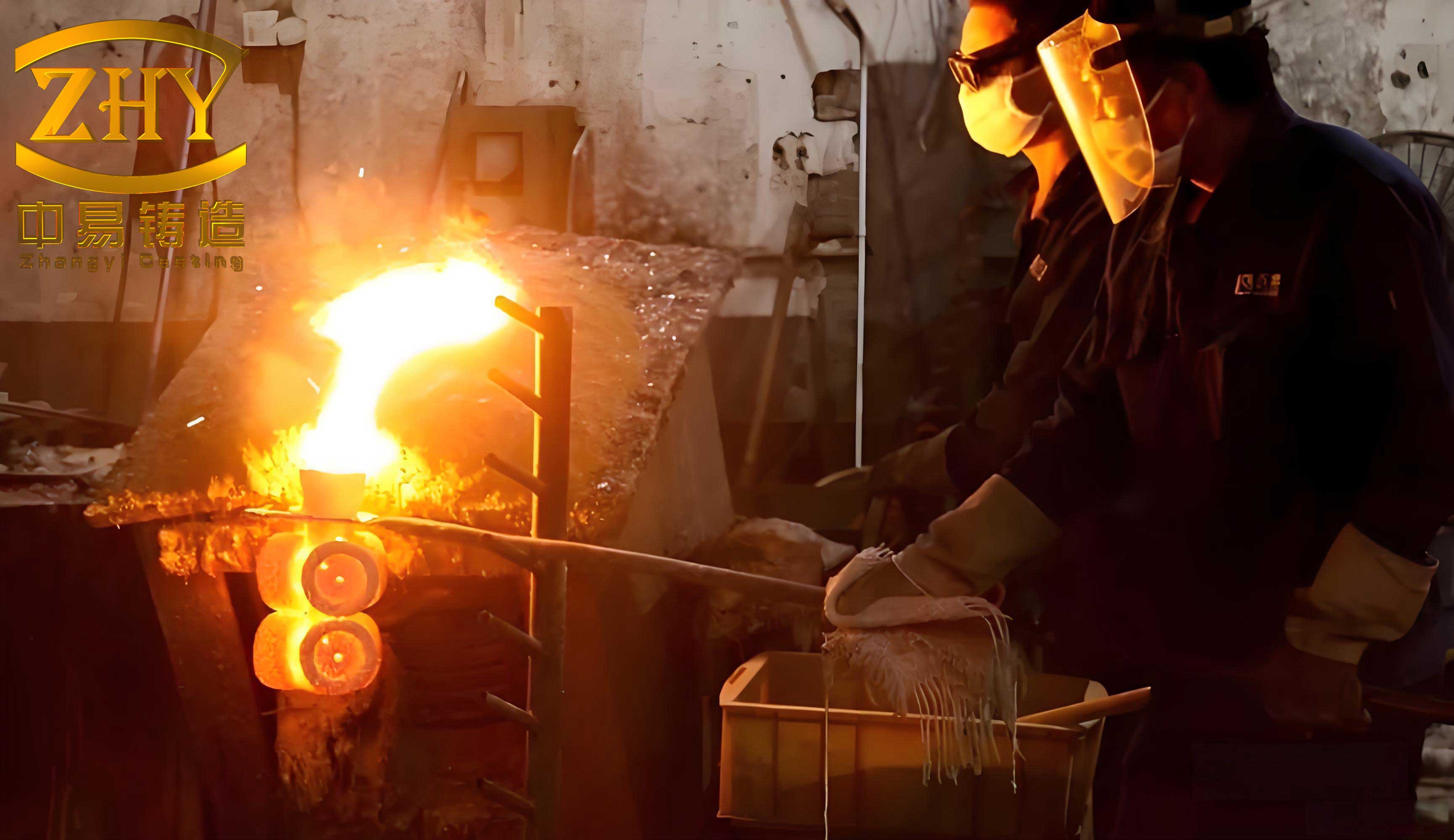
The characteristics of crack defects in our investment casting production were systematically documented. Primarily, these cracks exhibited features consistent with thermal cracking: they occurred during the late stages of solidification, often at locations of stress concentration. Specifically, for long thin-walled castings, cracks typically measured between 5 mm and 20 mm in length, with opening widths less than 0.5 mm. Their positions were recurrent, aligning with geometric transitions such as junctions between thin walls and thicker sections. This reproducibility indicated a process-driven origin rather than random variability. In investment casting, the shell mold’s properties can influence crack initiation, but our assessment suggested that alloy composition (e.g., ZG310-570 steel) and mold material had minimal direct impact. Instead, localized overheating of the shell mold emerged as a key contributor, exacerbating thermal gradients and restraining contraction. The following table summarizes the observed crack attributes:
| Attribute | Description |
|---|---|
| Crack Type | Thermal cracks (hot tears) |
| Length Range | 5–20 mm |
| Width Range | < 0.5 mm |
| Location Consistency | High (recurrent at stress concentrators) |
| Alloy Used | ZG310-570 (low crack susceptibility) |
| Scrap Rate Contribution | ~40% of total casting output initially |
To understand crack formation in investment casting, it is essential to consider the interplay of multiple factors: casting geometry, gating design, pouring temperature, and solidification dynamics. In investment casting, the shell mold acts as a refractory barrier, and its thermal behavior significantly affects the cooling rate. For long thin-walled castings, the inherent stiffness of the mold can restrain shrinkage, leading to tensile stresses that exceed the material’s hot strength. The fundamental equation for thermal stress ($\sigma$) during solidification can be expressed as:
$$\sigma = E \cdot \alpha \cdot \Delta T \cdot f(R)$$
where $E$ is Young’s modulus at elevated temperatures, $\alpha$ is the coefficient of thermal expansion, $\Delta T$ is the temperature gradient across the section, and $f(R)$ is a restraint factor dependent on mold rigidity. In investment casting, $\Delta T$ is often amplified by localized heating from molten metal impingement. Additionally, the critical strain theory for hot tearing suggests that cracks form when the accumulated strain ($\epsilon$) surpasses a threshold ($\epsilon_c$) during the brittle temperature range:
$$\epsilon = \int_{t_1}^{t_2} \frac{d\sigma}{dt} \cdot \frac{1}{E(T)} dt > \epsilon_c$$
Here, $t_1$ and $t_2$ define the vulnerable solidification interval, and $E(T)$ is temperature-dependent modulus. For investment casting alloys like ZG310-570, $\epsilon_c$ is relatively high, but geometric discontinuities can lower it effectively.
The casting structure played a pivotal role in crack initiation. In our case, the long thin-walled component featured drastic thickness variations: a thin section of 1.5 mm adjacent to a hot spot with an equivalent diameter of 15 mm. Such geometry induces steep thermal gradients, as described by Fourier’s law of heat conduction:
$$q = -k \frac{dT}{dx}$$
where $q$ is heat flux, $k$ is thermal conductivity, and $\frac{dT}{dx}$ is the temperature gradient. In investment casting, the thin wall cools rapidly, while the thick section retains heat, creating differential contraction. The resultant stress concentration factor ($K_t$) at the junction can be approximated for a notch:
$$K_t \approx 1 + 2\sqrt{\frac{a}{\rho}}$$
where $a$ is the crack length and $\rho$ is the root radius. Unfortunately, design modifications (e.g., increasing fillet radii) were not feasible due to assembly constraints, necessitating process-based solutions in the investment casting sequence.
Gating system design is a critical aspect of investment casting that directly influences fluid flow, temperature distribution, and solidification patterns. Initially, the gating system comprised two large runners arranged vertically, which led to excessive metal velocity and prolonged impingement on vulnerable areas. This caused localized overheating of the shell mold, elevating $\Delta T$ and restraint forces. The heat transfer during impingement can be modeled using the Reynolds number ($Re$) and Nusselt number ($Nu$):
$$Re = \frac{\rho v D}{\mu}, \quad Nu = \frac{h D}{k} = C Re^m Pr^n$$
where $\rho$ is density, $v$ is velocity, $D$ is characteristic diameter, $\mu$ is viscosity, $h$ is heat transfer coefficient, $k$ is thermal conductivity, $Pr$ is Prandtl number, and $C$, $m$, $n$ are constants. High $Re$ from large gates increases $h$, exacerbating mold heating. To address this, we redesigned the gating system for better thermal management in investment casting. The new configuration included three smaller runners positioned strategically to balance flow and reduce localized heat input. Specifically, the central runner was offset upward by approximately 8 mm to stagger metal entry and promote sequential filling. This modification lowered the effective $v$ and $Re$, thereby mitigating shell overheating. The table below compares the gating parameters:
| Parameter | Original Design | Improved Design |
|---|---|---|
| Number of Runners | 2 | 3 |
| Total Cross-Sectional Area | Large (baseline) | Reduced by ~30% |
| Runner Placement | Vertical grouping | Staggered with offset |
| Metal Velocity Estimate | High (turbulent) | Moderate (laminar-dominated) |
| Local Mold Overheating Risk | Severe at thin-thick junctions | Minimized through distributed flow |
Pouring temperature is another vital variable in investment casting that affects fluidity, shrinkage, and thermal stresses. Originally, a lower pouring temperature was used to reduce overall heat input, but this led to cold shuts in thin sections due to premature freezing. The solidification time ($t_s$) for a thin wall can be estimated using Chvorinov’s rule:
$$t_s = B \left( \frac{V}{A} \right)^2$$
where $B$ is a mold constant, $V$ is volume, and $A$ is surface area. For a 1.5 mm wall, $\frac{V}{A}$ is small, leading to rapid $t_s$. Increasing pouring temperature by 20–30°C enhanced fluidity, as described by the Arrhenius-type relationship for viscosity ($\eta$):
$$\eta = \eta_0 \exp\left(\frac{E_a}{RT}\right)$$
where $\eta_0$ is a constant, $E_a$ is activation energy, $R$ is gas constant, and $T$ is temperature. Higher $T$ lowers $\eta$, ensuring complete filling without cold shuts. However, this increase required careful calibration to avoid exacerbating cracks. The optimal temperature was determined through iterative trials, balancing fluidity and thermal stress. The effect on thermal gradient can be quantified by the Biot number ($Bi$):
$$Bi = \frac{h L_c}{k_s}$$
where $L_c$ is characteristic length and $k_s$ is shell thermal conductivity. Higher pouring temperatures initially increase $Bi$, but improved gating distributes heat more evenly, reducing $\Delta T$ in critical zones.
The combined adjustments to gating and pouring temperature yielded remarkable results in our investment casting process. Crack-related scrap dropped from 40% to 4%, validating the hypothesis that localized mold overheating is a primary driver of thermal cracks. This improvement underscores the importance of integrated process control in investment casting. To further elucidate the mechanisms, consider the solidification sequence: the modified gating promoted directional solidification away from stress concentrators, reducing restraint. The thermal history at key locations was simulated using a simplified heat transfer model:
$$\frac{\partial T}{\partial t} = \alpha \nabla^2 T + \dot{q}_{latent}$$
where $\alpha$ is thermal diffusivity and $\dot{q}_{latent}$ is latent heat release. By minimizing hot spots, the temperature gradient $\nabla T$ was flattened, decreasing stress accumulation. Additionally, the investment casting shell’s thermal properties were characterized; although water-glass binders have moderate permeability, their thermal shock resistance is adequate when overheating is avoided.
Expanding on these findings, we conducted further experiments to generalize the approach for various investment casting applications. For instance, the concept of “thermal moderation” through gating design can be applied to other thin-walled geometries. The table below summarizes the overall impact of our interventions:
| Metric | Before Optimization | After Optimization |
|---|---|---|
| Crack-Induced Scrap Rate | 40% of production | 4% of production |
| Cold Shut Occurrence | Frequent in thin sections | Eliminated |
| Mold Overheating Incidents | High at specific junctions | Significantly reduced |
| Solidification Uniformity | Poor (localized delays) | Improved (more sequential) |
| Process Stability in Investment Casting | Low (high variability) | High (consistent output) |
In addition to empirical results, theoretical frameworks support these outcomes. The investment casting process inherently involves complex interactions between fluid dynamics, heat transfer, and solid mechanics. For long thin-walled castings, the risk of cracking can be predicted using dimensionless numbers like the Crack Susceptibility Index ($CSI$), derived from alloy properties and process parameters:
$$CSI = \frac{\alpha \cdot \Delta T_{crit} \cdot L}{\sigma_{hot} \cdot (1-\nu)}$$
where $\Delta T_{crit}$ is the critical temperature range for hot tearing, $L$ is characteristic length, $\sigma_{hot}$ is hot strength, and $\nu$ is Poisson’s ratio. By reducing $\Delta T$ through gating modifications, $CSI$ decreases below threshold levels. Furthermore, advanced investment casting simulations can optimize runner sizes and placements using computational fluid dynamics (CFD) and finite element analysis (FEA). For example, the pressure drop ($\Delta P$) in a gating system can be estimated by:
$$\Delta P = \frac{128 \mu L Q}{\pi D^4} + \frac{\rho v^2}{2} \sum K$$
where $L$ is length, $Q$ is flow rate, $D$ is diameter, and $K$ is loss coefficient. Smaller runners increase $\Delta P$, but staggered design balances flow distribution, ensuring uniform filling in investment casting molds.
Looking beyond immediate fixes, the investment casting industry can benefit from continuous monitoring and adaptive control. Techniques such as real-time temperature sensing and machine learning algorithms can predict crack formation based on thermal signatures. For instance, integrating infrared thermography during pouring could provide data to adjust parameters dynamically. The investment casting process is ripe for such innovations, given its precision requirements. Additionally, material science advancements, like optimized shell compositions with higher thermal diffusivity, could further mitigate cracks. Research into alloy modifications for better hot ductility also holds promise, but process optimization remains the most immediate lever for improvement in investment casting.
In conclusion, the prevention of cracks in long thin-walled investment castings hinges on a deep understanding of thermal management. Our experience demonstrates that localized shell overheating, driven by suboptimal gating and pouring parameters, is a primary culprit. By redesigning the gating system to distribute metal flow evenly and adjusting pouring temperature to ensure fluidity without excess heat input, we achieved a tenfold reduction in crack-related scrap. This success highlights the synergistic nature of investment casting process variables: small, targeted changes can resolve seemingly intractable defects. The principles outlined here—emphasizing thermal gradient control, sequential solidification, and balanced fluid dynamics—are broadly applicable across investment casting operations. As the demand for complex thin-walled components grows, mastering these aspects will be crucial for advancing investment casting technology and ensuring high-quality production. Future work should focus on predictive modeling and automation to further enhance reliability and efficiency in investment casting.
To encapsulate key takeaways, the investment casting process requires meticulous attention to detail, especially for geometries prone to stress concentration. The integration of empirical testing with theoretical analysis provides a robust framework for defect mitigation. Through persistent optimization, investment casting can continue to deliver components that meet stringent industrial standards, minimizing waste and maximizing performance. The journey from high scrap rates to near-zero defects exemplifies the power of systematic problem-solving in the realm of investment casting, paving the way for more resilient manufacturing practices.