
In the field of advanced engineering materials, low-temperature spheroidal graphite cast iron represents a critical functional material characterized by high strength and elongation. It finds indispensable applications in various industrial sectors, including equipment for petroleum, natural gas, and petrochemical operations in frigid regions, as well as components for construction machinery, locomotives, rail vehicles, high-speed trains, and wind power generation systems. The conical support, a key part in wind turbine assemblies, exemplifies such a casting that must maintain stable impact properties at ultra-low temperatures down to -40 °C. According to material specifications for wind energy and the GB/T 1348-2009 standard, castings with wall thicknesses exceeding 60 mm but less than 200 mm require attached test blocks of 70 mm thickness. These test blocks must meet stringent performance criteria: tensile strength ≥320 MPa, yield strength ≥220 MPa, elongation ≥15%, and an average impact energy ≥10 J at -40 °C. Achieving these properties poses a significant challenge in melting and production technology, especially for heavy-section castings where the average wall thickness reaches 80 mm and flanges can be as thick as 300 mm. Such heavy sections introduce complexities like graphite flotation, graphite degeneration, slag inclusions, and graphite distortion, which can compromise integrity and performance. This study focuses on optimizing the melting production process for QT350-22AL conical support castings, addressing these challenges through precise chemical composition control, combined use of light and heavy rare-earth spheroidizers, on-site ladle-to-ladle spheroidization, and multiple inoculation treatments. The goal is to establish a stable and reliable methodology for producing high-quality, heavy-section low-temperature spheroidal graphite cast iron.
The foundation of producing superior spheroidal graphite cast iron lies in the meticulous selection and control of chemical composition. Each element plays a distinct role in influencing graphite morphology, matrix structure, and mechanical properties, particularly at low temperatures. Carbon, for instance, promotes graphitization, increases graphite nodule count, reduces chilling tendency, enhances fluidity, and minimizes shrinkage porosity. For low-temperature spheroidal graphite cast iron, the final carbon content should ideally be maintained between 3.5% and 4.0%. Silicon is a potent graphitizer that facilitates ferrite formation and reduces cementite. However, excessive silicon can embrittle the matrix; to achieve elongations above 20%, silicon levels must be minimized. In heavy sections, high silicon can lead to degenerate graphite forms like chunky graphite. When silicon is kept below 2.0%, such degeneration is markedly reduced. Therefore, the raw iron silicon content should be controlled at 0.6%–1.0%, with the final silicon after inoculation kept within 1.7%–2.0%. Manganese tends to promote pearlite formation and segregates at eutectic cell boundaries, forming carbides that embrittle the matrix, thus impairing toughness. Hence, high-purity pig iron with low manganese content is used to ensure raw iron manganese levels below 0.2%. Phosphorus is a detrimental element that forms phosphide eutectics, severely degrading mechanical properties; it should be as low as possible, typically under 0.04%. Sulfur, another harmful element, should be controlled below 0.02% in raw iron to ensure effective spheroidization. Antimony, in trace amounts, can refine graphite nodules and promote pearlite, but for ferritic heavy-section spheroidal graphite cast iron, it must be strictly limited to below 0.008% to avoid adverse effects. Finally, residual rare-earth and magnesium are essential for spheroidal graphite formation, but excessive amounts increase chilling tendency and defect risks. Suitable ranges are 0.01%–0.03% for residual rare-earth and 0.03%–0.05% for residual magnesium.
To summarize the compositional guidelines, the following table presents the target ranges for raw and spheroidized iron in producing QT350-22AL heavy-section castings.
| Element | Raw Iron (wB/%) | Spheroidized Iron (wB/%) |
|---|---|---|
| Carbon (C) | 3.8–4.1 | 3.5–4.0 |
| Silicon (Si) | 0.7–1.2 | 1.7–2.0 |
| Manganese (Mn) | ≤0.2 | ≤0.2 |
| Phosphorus (P) | ≤0.04 | ≤0.04 |
| Sulfur (S) | ≤0.02 | ≤0.02 |
| Residual Rare-Earth (REres) | 0.01–0.03 | 0.01–0.03 |
| Residual Magnesium (Mgres) | 0.03–0.05 | 0.03–0.05 |
The relationship between carbon and silicon can be expressed using the carbon equivalent (CE) formula, which is crucial for predicting graphitization potential in spheroidal graphite cast iron:
$$ \text{CE} = \%\text{C} + 0.33(\%\text{Si} + \%\text{P}) $$
For optimal performance in low-temperature applications, the carbon equivalent should be controlled within a specific range, typically between 4.3 and 4.6, to ensure adequate graphite nucleation while avoiding excessive undercooling. The effect of silicon on ferrite strengthening can be modeled by an empirical equation for yield strength:
$$ \sigma_y = \sigma_0 + k_{\text{Si}} \cdot (\%\text{Si}) $$
where $\sigma_0$ is the base strength of pure iron and $k_{\text{Si}}$ is a strengthening coefficient. However, for high elongation requirements, silicon content must be balanced, as higher silicon increases strength but reduces toughness. The detrimental effect of manganese on impact toughness at low temperatures can be described by:
$$ \text{Impact Energy} \propto \frac{1}{(\%\text{Mn})^n} $$
with $n$ being an exponent typically around 0.5–1.0, indicating that even small increases in manganese significantly reduce toughness.
Temperature control during melting is paramount for achieving desirable microstructure and properties in heavy-section spheroidal graphite cast iron. Overheating and holding the iron at high temperatures help dissolve coarse graphite from pig iron, reduce oxide inclusions, and eliminate genetic influences of raw materials. When the temperature exceeds 1500 °C, hypereutectic graphite dissolves below the critical radius for crystallization, refining the melt. In practice, after slag removal and composition adjustment at 1360–1400 °C, the raw iron is overheated to 1500–1540 °C. Spheroidization temperature is critical: too high, and the spheroidizer burns off excessively; too low, and reaction incompleteness leads to poor spheroidization. The on-site ladle-to-ladle spheroidization process involves transferring iron from a transport ladle at 1400–1450 °C to a spheroidization ladle. This method precisely controls temperature, rapidly cools the iron, shortens the time to pouring, and preserves the innate nucleation rate of the raw iron. Additionally, it allows for multiple inoculation stages. Pouring temperature for heavy-section castings must be optimized: too high increases液态收缩 and shrinkage porosity, while too low promotes slag defects. For conical supports, pouring temperature is maintained at 1330–1370 °C.
The kinetics of graphite dissolution during overheating can be approximated by an Arrhenius-type equation:
$$ r(t) = r_0 \cdot e^{-kt} $$
where $r(t)$ is the graphite radius at time $t$, $r_0$ is the initial radius, and $k$ is a rate constant dependent on temperature $T$ according to:
$$ k = A \cdot e^{-\frac{E_a}{RT}} $$
Here, $A$ is a pre-exponential factor, $E_a$ is the activation energy for dissolution, $R$ is the gas constant, and $T$ is absolute temperature. This underscores the importance of high overheating temperatures for refining graphite.
Raw material selection and addition sequence significantly influence the quality of spheroidal graphite cast iron. Pig iron must have low impurity levels, with total trace elements under 0.1%, especially严格控制 titanium and vanadium. We use Q10 pig iron with low impurities. Scrap steel should be low-manganese stamping scraps, added early in the melt. Returns, such as risers and gates from previous wind turbine castings, are thoroughly cleaned via shot blasting and added during the mid-to-late stages of melting. Graphitizing recarburizer is employed to enhance graphite nuclei and is added with scrap steel at the beginning, with about 0.1% reserved for pretreatment. Ferrosilicon (75% Si) is used for final silicon adjustment in the furnace. The addition sequence optimizes melt homogeneity and nucleation potential.
The spheroidization and inoculation treatments are the core of producing high-quality spheroidal graphite cast iron. Based on research, combining light rare-earth spheroidizers with heavy rare-earth spheroidizers offers better results than using either alone, improving spheroidization efficacy and reducing graphite distortion in heavy sections. Light rare-earths, such as cerium, enhance graphite nucleation, while heavy rare-earths, like yttrium, provide superior fade resistance. The total spheroidizer addition ranges from 0.9% to 1.3%, with light and heavy rare-earths used in roughly equal proportions. The on-site ladle-to-ladle spheroidization process, coupled with multiple inoculations, is employed. This involves transferring iron to a spheroidization ladle and adding spheroidizer, followed by several inoculation steps to ensure fine, round graphite nodules.
The spheroidization reaction can be represented by chemical equations. For magnesium, the key reaction with sulfur is:
$$ \text{Mg} + \text{S} \rightarrow \text{MgS} $$
Similarly, rare-earths react with oxygen and sulfur:
$$ 2\text{RE} + 3\text{S} \rightarrow \text{RE}_2\text{S}_3 $$
$$ 4\text{RE} + 3\text{O}_2 \rightarrow 2\text{RE}_2\text{O}_3 $$
These reactions remove harmful elements and create substrates for graphite nucleation. The efficiency of spheroidization can be modeled by the residual magnesium content, which relates to the initial addition and reaction losses:
$$ \text{Mg}_{\text{res}} = \text{Mg}_{\text{added}} – \alpha \cdot (\%\text{S}) – \beta \cdot (\%\text{O}) $$
where $\alpha$ and $\beta$ are stoichiometric coefficients accounting for sulfur and oxygen consumption, respectively.
Inoculation is performed multiple times with small additions to maximize graphite nuclei. We use an inoculant containing 2%–4% barium, with a grain size of 5–15 mm. The inoculation sequence and amounts are as follows:
| Inoculation Stage | Location | Inoculant Type | Addition Amount (wB/%) | Purpose |
|---|---|---|---|---|
| Primary | Transport Ladle | Ba-bearing inoculant | 0.2–0.4 | Initial nucleation and preconditioning |
| Secondary | Spheroidization Ladle | Ba-bearing inoculant | 0.3–0.6 | Enhance spheroidization and graphite formation |
| Tertiary | Pouring Ladle | Ba-bearing inoculant | 0.05–0.15 | Final refinement before pouring |
| Instantaneous | During Pouring | Ce-bearing inoculant (0.5–1.5 mm) | 0.05–0.2 | Immediate nucleation in the stream |
The effectiveness of inoculation in increasing graphite nodule count can be described by a nucleation rate equation:
$$ N = N_0 + k_I \cdot (\%\text{Inoculant})^m $$
where $N$ is the final graphite nodule count per unit area, $N_0$ is the base nodule count from raw iron, $k_I$ is an inoculation efficiency constant, and $m$ is an exponent typically near 1. Multiple inoculations synergistically boost $N$, leading to finer graphite.
In practical production, 70 mm attached test blocks are cast alongside the conical support components. These are subjected to mechanical testing, metallographic examination, and low-temperature impact testing. The results demonstrate the success of the optimized process. The following table compiles data from multiple test blocks, showing consistency in meeting and exceeding standard requirements for QT350-22AL spheroidal graphite cast iron.
| Sample ID | Tensile Strength (MPa) | Yield Strength (MPa) | Elongation (%) | Hardness (HBW) | Avg. Impact Energy at -40 °C (J) | Graphite Grade | Graphite Morphology | Pearlite Content (%) |
|---|---|---|---|---|---|---|---|---|
| 7 | 425 | 275 | 16.5 | 129 | 13.8 | 7 | Spheroidal | 5 |
| 9 | 415 | 270 | 16.0 | 129 | 13.2 | 7 | Spheroidal | 5 |
| 230 | 435 | 285 | 15.0 | 143 | 12.1 | 7 | Spheroidal | 5 |
| 213 | 425 | 275 | 16.5 | 143 | 12.5 | 7 | Spheroidal | 5 |
| 231 | 430 | 280 | 16.0 | 143 | 13.1 | 7 | Spheroidal | 5 |
| 214 | 405 | 265 | 16.5 | 143 | 13.7 | 7 | Spheroidal | 5 |
| 232 | 415 | 270 | 17.5 | 143 | 12.8 | 7 | Spheroidal | 5 |
| 215 | 410 | 265 | 16.0 | 143 | 14.1 | 7 | Spheroidal | 5 |
| 295 | 410 | 265 | 15.5 | 129 | 13.6 | 7 | Spheroidal | 5 |
| 344 | 410 | 265 | 16.0 | 129 | 13.5 | 7 | Spheroidal | 5 |
| 345 | 400 | 260 | 16.5 | 129 | 12.7 | 7 | Spheroidal | 5 |
| 347 | 420 | 275 | 15.0 | 131 | 13.2 | 7 | Spheroidal | 5 |
| 346 | 425 | 280 | 15.0 | 131 | 13.8 | 7 | Spheroidal | 5 |
| 343 | 420 | 275 | 15.0 | 131 | 12.7 | 7 | Spheroidal | 5 |
| 513 | 390 | 255 | 18.0 | 129 | 13.2 | 7 | Spheroidal | 5 |
| 514 | 425 | 275 | 16.0 | 130 | 12.2 | 7 | Spheroidal | 5 |
| 3554 | 376 | 320 | 18.5 | 123 | 15.9 | 7 | Spheroidal | 5 |
The data reveal tensile strengths ranging from 376 to 435 MPa, yield strengths from 255 to 320 MPa, elongations from 15.0% to 18.5%, and low-temperature impact energies from 12.1 to 15.9 J, all satisfying the standard specifications. The consistent graphite grade of 7 indicates excellent spheroidization, with graphite morphology predominantly spheroidal and pearlite content around 5%, ensuring a ferritic matrix conducive to high toughness. The metallographic structure of these test blocks exhibits fine, round graphite nodules dispersed in a fine ferritic matrix, which is critical for low-temperature performance. The following image provides a visual representation of such a microstructure in spheroidal graphite cast iron.
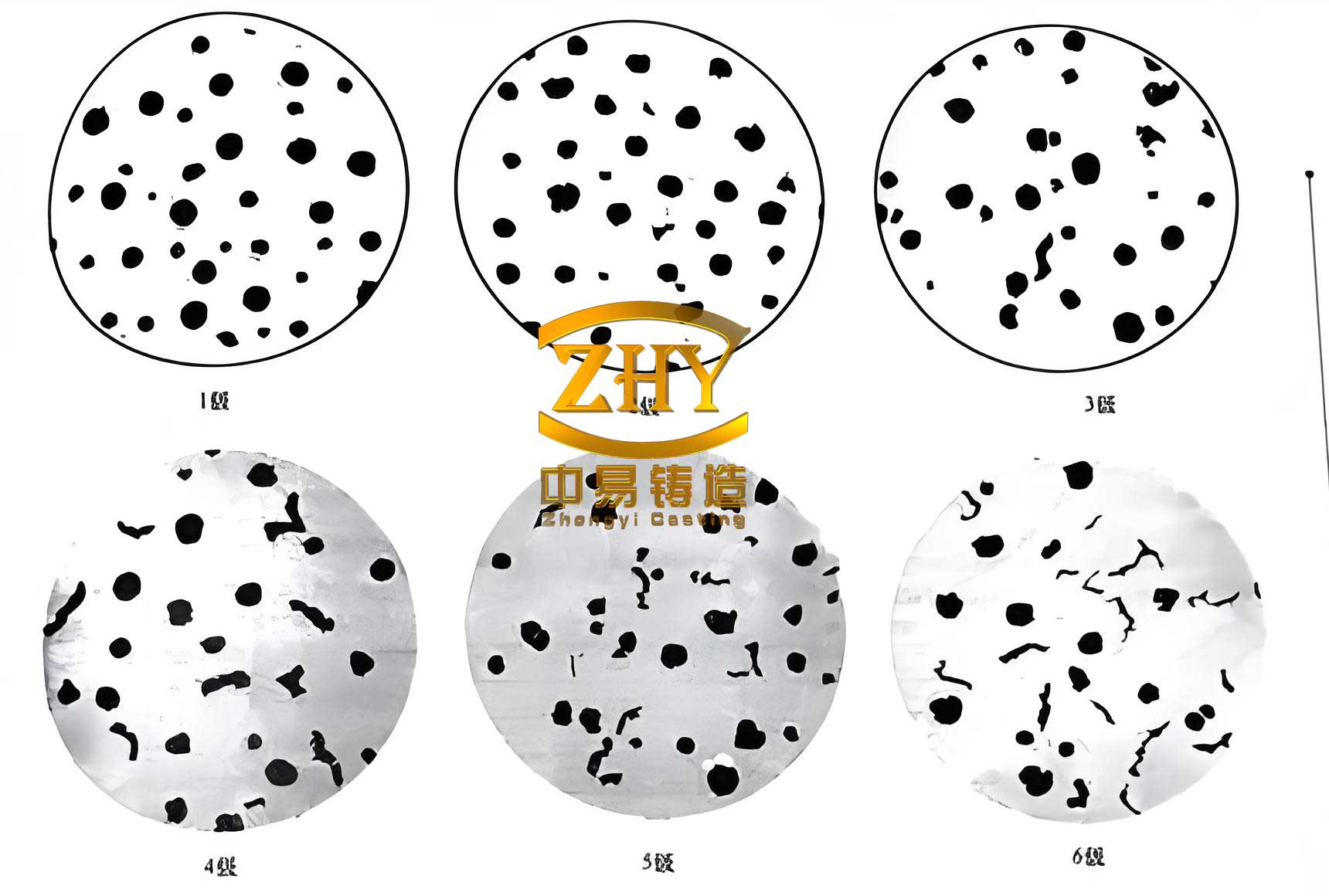
The micrograph shows numerous small, spherical graphite nodules within a ferritic matrix, confirming the effectiveness of the spheroidization and inoculation processes. The absence of degenerate graphite forms like chunky or flake graphite underscores the success in mitigating graphite distortion in heavy sections. This is achieved through the combined actions of light and heavy rare-earth spheroidizers, which stabilize graphite growth, and multiple inoculations that provide abundant nucleation sites. The inoculation in the transport ladle sets a foundation for subsequent treatments, while the ladle-to-ladle spheroidization allows precise temperature management and additional inoculation steps. The reactions involving silicon, barium, magnesium, and rare-earths reduce oxygen and sulfur levels, forming oxides and sulfides that act as heterogeneous nucleation substrates for graphite. Coupled with trace antimony, which refines graphite without promoting pearlite excessively, this process prevents graphite degeneration in thick sections.
The impact of these elements on graphite nucleation can be quantified by considering the interfacial energy between graphite and nucleation substrates. The critical radius for heterogeneous nucleation $r^*$ is given by:
$$ r^* = -\frac{2\gamma}{\Delta G_v} $$
where $\gamma$ is the interfacial energy and $\Delta G_v$ is the volumetric free energy change. Inoculants like barium and cerium lower $\gamma$, reducing $r^*$ and increasing nucleation rate. The number of effective nuclei $N_{\text{eff}}$ relates to inoculant addition and melt cleanliness:
$$ N_{\text{eff}} = C \cdot \exp\left(-\frac{Q}{RT}\right) \cdot (\%\text{Inoculant}) \cdot \frac{1}{(\%\text{O})(\%\text{S})} $$
where $C$ is a constant, $Q$ is an activation energy, and $R$ and $T$ have their usual meanings. This highlights the importance of low oxygen and sulfur for efficient inoculation in spheroidal graphite cast iron.
Furthermore, the prevention of graphite flotation in heavy sections can be analyzed via Stokes’ law, which describes the settling velocity of graphite nodules:
$$ v = \frac{2(\rho_{\text{iron}} – \rho_{\text{graphite}}) g r^2}{9\eta} $$
where $v$ is the settling velocity, $\rho$ are densities, $g$ is gravity, $r$ is graphite radius, and $\eta$ is melt viscosity. By keeping graphite nodules small (low $r$) through intense inoculation, flotation is minimized, ensuring uniform distribution.
In conclusion, the production of QT350-22AL heavy-section low-temperature spheroidal graphite cast iron requires an integrated approach encompassing precise chemical control, optimized temperature regimes, careful raw material selection, and advanced spheroidization and inoculation techniques. The ladle-to-ladle spheroidization process, combined with multiple inoculations using barium and cerium-bearing inoculants, along with the synergistic use of light and heavy rare-earth spheroidizers, proves effective in generating fine, spherical graphite nodules and a ferritic matrix. This results in castings that consistently meet mechanical property requirements, including high elongation and superior low-temperature impact toughness. The process not only addresses challenges like graphite distortion and flotation in thick sections but also provides a reliable framework for manufacturing high-performance spheroidal graphite cast iron components for demanding applications in wind energy and other critical industries. Future work could explore further refinements in inoculant compositions or real-time process monitoring to enhance consistency and efficiency in producing heavy-section spheroidal graphite cast iron.