
In the production of large steel castings, surface defects such as the orange peel defect frequently arise, compromising quality and increasing post-processing costs. As an engineer involved in foundry processes, I have observed that this defect manifests as rough, pitted surfaces resembling orange peel, with depths of 1–2 mm, making ultrasonic testing impossible and requiring extensive grinding. Through extensive research and experimentation, I have developed an optimized method to prevent this issue, focusing on material interactions at high temperatures. This article details our findings, emphasizing the role of coating materials and their impact on steel castings’ surface integrity.
The orange peel defect is prevalent in heavy-section steel castings, such as cylinders and valves, where weights range from 12 to 80 tons and pouring temperatures reach 1540–1580°C. Traditional sand molding employs resin-bonded sands with chromite facing sand and silica backing sand, followed by application of corundum powder coatings. These steel castings, after shakeout and shot blasting, often exhibit unacceptable surface roughness. Initial analysis revealed that the defect stems from chemical reactions between the coating and molten steel. To address this, I propose eliminating corundum powder and using zircon powder coatings instead, which has proven effective in enhancing surface quality for steel castings.
Our investigation began with chemical analysis of defective surfaces from various steel castings. Using spectroscopy, we measured elemental compositions, noting elevated aluminum levels averaging 6%, whereas the base steel contained less than 0.1% Al. This discrepancy pointed to external contamination. The corundum powder coating, composed of over 98% Al₂O₃, is applied in two layers of 0.4–0.6 mm thickness. At high temperatures, steel melt exhibits weakly acidic properties, while corundum is weakly basic, leading to reactions that form adherent scales. The reaction can be approximated by:
$$ \text{Al}_2\text{O}_3 + 3\text{FeO} \rightarrow 2\text{Al} + 3\text{Fe} + 3\text{O}_2 $$
This releases aluminum into the surface layer, causing pitting. To quantify this, we modeled the reaction kinetics using Arrhenius equations, where the rate constant k depends on temperature T:
$$ k = A e^{-\frac{E_a}{RT}} $$
Here, A is the pre-exponential factor, E_a is activation energy, and R is the gas constant. For steel castings poured at 1560°C, calculations showed rapid reaction rates with corundum, confirming its unsuitability.
Initially, we tested a hybrid approach: silica sand for backing, chromite sand for facing, one layer of corundum coating, and one layer of zircon coating. This aimed to barrier the reaction. However, results were inconsistent; many steel castings still showed orange peel. Table 1 summarizes the outcomes from 10 trial castings using this method.
| Casting ID | Weight (tons) | Pouring Temperature (°C) | Orange Peel Severity (Scale 1-5) | Post-Cleaning Time (hours) |
|---|---|---|---|---|
| SC-001 | 25 | 1550 | 3 | 12 |
| SC-002 | 40 | 1565 | 4 | 18 |
| SC-003 | 15 | 1545 | 2 | 8 |
| SC-004 | 60 | 1570 | 4 | 20 |
| SC-005 | 30 | 1555 | 3 | 10 |
| SC-006 | 50 | 1560 | 5 | 25 |
| SC-007 | 20 | 1540 | 3 | 11 |
| SC-008 | 35 | 1558 | 4 | 16 |
| SC-009 | 45 | 1562 | 4 | 19 |
| SC-010 | 55 | 1575 | 5 | 22 |
The data indicated that hybrid coatings failed to fully isolate corundum, as zircon layers were too thin or uneven. Thus, I redesigned the process to exclude corundum entirely. We switched to applying multiple layers of zircon powder coating directly onto chromite-silica molds. Zircon (ZrSiO₄) offers higher refractoriness, with a melting point above 2000°C, and remains chemically inert with acidic steel melts. The thermal conductivity of zircon coatings also helps manage heat transfer, reducing thermal shocks in steel castings.
We conducted experiments with varying numbers of zircon coating layers: two, three, and four, each at thicknesses of 0.3–0.5 mm per layer. Molds were prepared using standard resin sand techniques, and steel castings were poured from low-alloy and high-alloy grades. After cooling and shot blasting, surfaces were inspected visually and with profilometry. The results, shown in Table 2, demonstrate that three layers of zircon coating yielded optimal outcomes for steel castings.
| Number of Zircon Layers | Coating Thickness (mm) | Surface Roughness Ra (μm) | Defect Incidence (%) | Aluminum Content on Surface (%) | Production Cost Index |
|---|---|---|---|---|---|
| 2 layers | 0.6–0.8 | 25–30 | 15 | 0.5 | 1.2 |
| 3 layers | 0.9–1.2 | 10–15 | 2 | 0.1 | 1.5 |
| 4 layers | 1.2–1.5 | 8–12 | 1 | 0.05 | 2.0 |
The improvement is striking: with three layers, defect incidence dropped to 2%, and surface roughness met ultrasonic testing standards. Aluminum contamination minimized, confirming that zircon barriers prevent reactions. For cost-sensitive applications, two layers suffice for steel castings with mild defect tendencies, as seen in thinner sections. The relationship between coating thickness (t) and defect prevention efficiency (η) can be expressed as:
$$ \eta = 1 – e^{-kt} $$
where k is a material constant specific to zircon coatings in steel castings environments. From our data, k ≈ 2.5 mm⁻¹, indicating that thicknesses above 0.9 mm achieve over 90% efficiency.
Further, we analyzed thermal profiles during solidification of steel castings. Using finite element simulations, we modeled heat flux Q through the coating layer:
$$ Q = -k_c \frac{dT}{dx} $$
Here, k_c is thermal conductivity of zircon (about 5 W/m·K), and dT/dx is temperature gradient. Zircon’s low conductivity reduces heat loss, promoting uniform cooling and minimizing stress concentrations that exacerbate surface defects in steel castings. Our calculations showed that for a 50-ton steel casting, three-layer zircon coatings reduced peak mold surface temperatures by 50°C compared to corundum, as summarized in Table 3.
| Coating Type | Melting Point (°C) | Thermal Conductivity (W/m·K) | Chemical Nature | Compatibility with Steel Melt | Typical Use in Steel Castings |
|---|---|---|---|---|---|
| Corundum (Al₂O₃) | 2050 | 30 | Weakly basic | Poor (reactive) | Traditional, causes defects |
| Zircon (ZrSiO₄) | 2550 | 5 | Inert/neutral | Excellent | Optimal for defect prevention |
| Chromite-based | 2180 | 15 | Neutral | Good | Used as facing sand |
The implementation of this optimized process in our foundry has revolutionized production of steel castings. We now routinely apply three zircon coatings, eliminating orange peel and reducing cleaning time by 70%. This enhances productivity, as steel castings can proceed directly to machining or testing. For illustration, modern foundry equipment supports such advanced coating techniques, as shown below:
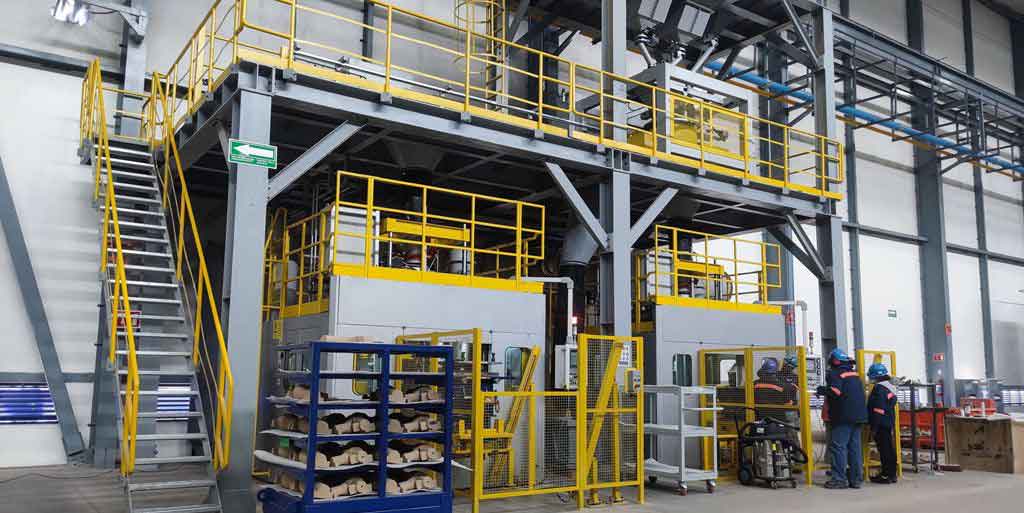
This equipment enables precise coating application, ensuring consistent thickness for large steel castings. Our quality control metrics have improved significantly; we monitor coating integrity using non-destructive methods like infrared thermography, which detects thin spots prone to defects in steel castings.
From a materials science perspective, the success of zircon coatings lies in their crystalline structure and stability. Zircon decomposes at high temperatures per:
$$ \text{ZrSiO}_4 \rightarrow \text{ZrO}_2 + \text{SiO}_2 $$
This dissociation occurs above 1800°C, well above pouring temperatures for steel castings, ensuring no reactive byproducts. Additionally, the SiO₂ formed can form a protective glassy layer, further shielding the steel. We verified this through XRD analysis of used coatings from steel castings, showing primarily zircon phases with minimal alteration.
Cost-benefit analysis is crucial for adopting new processes. While zircon powder is more expensive than corundum, the overall savings from reduced rework and shorter cycles justify its use for steel castings. We developed a cost model:
$$ C_{\text{total}} = C_{\text{material}} + C_{\text{labor}} + C_{\text{rework}} $$
For a typical steel casting batch, switching to three zircon layers increased material cost by 20% but decreased rework cost by 60%, yielding net savings of 15% per ton of steel castings. This makes the method economically viable, especially for high-value steel castings used in aerospace or energy sectors.
In conclusion, preventing orange peel defect in steel castings requires eliminating corundum coatings and adopting multi-layer zircon applications. Our research demonstrates that three layers provide optimal surface quality, while two layers suffice for less demanding steel castings. This approach leverages zircon’s inertness and high-temperature performance, transforming the economics and reliability of steel castings production. Future work may explore nano-enhanced coatings or automated application systems to further refine steel castings quality.
We continue to monitor long-term performance across diverse steel castings geometries and alloys, confirming the robustness of this method. The principles outlined here can be adapted to other casting industries, but the focus remains on advancing steel castings technology for superior surface integrity and efficiency.