
In our manganese steel casting foundry, we have extensive experience producing high manganese steel components, particularly for applications in rail transportation, mining machinery, military, and agricultural equipment. High manganese steel is renowned for its excellent mechanical properties, including the ability to rapidly harden on the surface under intense impact and挤压 conditions, while maintaining good toughness and plasticity in the core due to its austenitic structure. This makes it ideal for wear-resistant parts. Our foundry has been manufacturing high manganese steel railway crossings since 1961, with an annual production capacity of nearly 20,000 tons, covering a diverse range of products. However, in recent production using a magnesium olivine sand molding line, we encountered a significant issue: the appearance of numerous “wrinkles” on the surface of the castings, especially concentrated in thinner sections such as ear plates and wing rail tops. These wrinkles are hard and difficult to remove by grinding, severely affecting the surface quality of the products. This paper details our analysis of these oxide film defects and the effective preventive measures implemented in our manganese steel casting foundry.
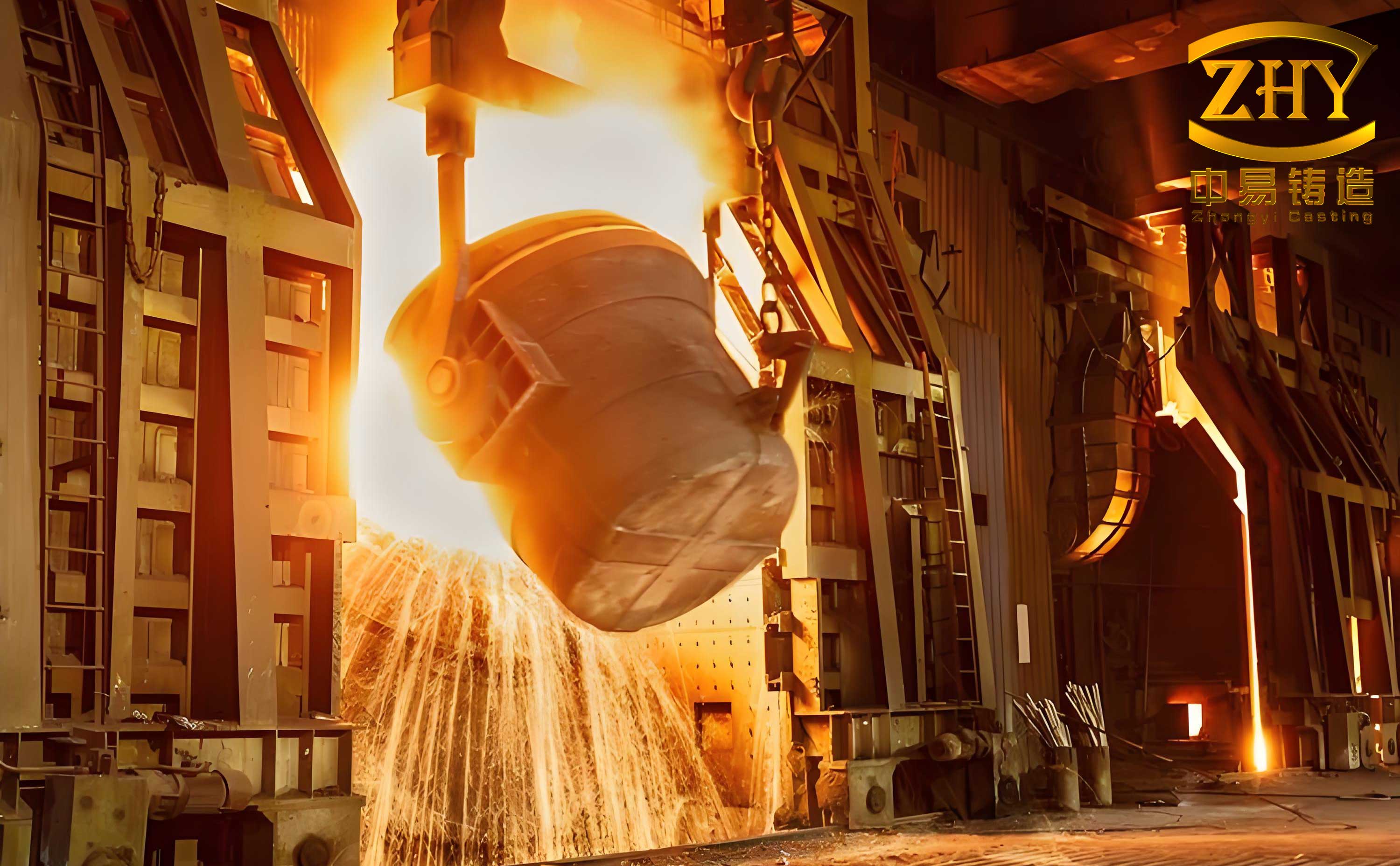
The defects, observed as folds or wrinkles, had depths ranging from less than 1 mm to 2–3 mm, posing a substantial threat to product integrity. To address this, we initiated a comprehensive investigation into our casting process and defect characteristics. Our standard casting process involves using magnesium olivine sand, sodium silicate binder, and organic ester hardener with CO2 gas hardening. For large-sized crossings, we employ a tilted pouring method with dual ingates at one end, with an angle of approximately 5°. The pouring temperature is set at 1470°C, followed by 2–3 top-ups. After shakeout and cleaning, the castings undergo heat treatment and water toughening. This process is typical in manganese steel casting foundries but was evidently prone to oxide formation under certain conditions.
To understand the defect, we sampled areas with concentrated wrinkles, such as the bottom plate, and analyzed them using scanning electron microscopy (SEM) and energy-dispersive X-ray spectroscopy (EDS). The results revealed that the defect regions contained high levels of iron (Fe), manganese (Mn), and oxygen (O), indicating oxidation of the molten steel. The microstructure resembled a “cold shut,” leading to stress concentration and crack initiation. Comparative metallographic examination between defective and non-defective areas confirmed that the oxide film defects not only impaired surface finish but also induced internal cracking, compromising the durability of the manganese steel casting.
Our analysis pinpointed the cause: during pouring, the molten steel contacts air, oxidizing active metals like Mn and Fe to form metal oxides, which create an oxide film. Due to the tilted pouring method, the molten steel flows rapidly into the mold cavity, dispersing the oxide film and causing it to adhere to the mold surface. Upon solidification, these oxide fragments become embedded in the casting surface, resulting in wrinkles. This phenomenon is particularly critical in manganese steel casting foundries where large castings are produced, as controlling oxidation is challenging. The oxidation reaction can be represented by the following equations, common in steelmaking processes:
$$ 2\text{Mn} + \text{O}_2 \rightarrow 2\text{MnO} $$
$$ 2\text{Fe} + \text{O}_2 \rightarrow 2\text{FeO} $$
These reactions are favored at high temperatures, such as the 1470°C pouring temperature used in our foundry. The partial pressure of oxygen in the mold cavity plays a key role, and minimizing it is essential to prevent defect formation in manganese steel casting production.
Based on this understanding, we developed and implemented a series of preventive measures in our manganese steel casting foundry. The core strategy was to eliminate oxygen from the mold cavity to prevent contact with the molten steel. Since increasing pouring speed to reduce exposure time was impractical for large castings, we focused on chemically removing oxygen. We applied a phenolic resin-based alcohol coating to specific areas prone to defects, such as the bottom plate, curved connections, and guard rails. Phenolic resin, a complex hydrocarbon, decomposes rapidly upon contact with high-temperature molten steel, producing高级烃 (higher hydrocarbons). These hydrocarbons combust in the presence of oxygen, effectively consuming the oxygen in the mold cavity. Even residual oxygen is insufficient to generate the necessary partial pressure for oxide film formation. Additionally, the hydrocarbon layer on the steel surface cracks into lower hydrocarbons, carbon, and hydrogen at extreme temperatures, with hydrogen helping to reduce any oxide films formed in the gating system. The reaction can be summarized as:
$$ \text{C}_n\text{H}_{2n+2} + \text{O}_2 \rightarrow \text{CO}_2 + \text{H}_2\text{O} \quad \text{(combustion)} $$
$$ \text{FeO} + \text{H}_2 \rightarrow \text{Fe} + \text{H}_2\text{O} \quad \text{(reduction)} $$
This approach fundamentally disrupts the conditions for oxide film generation in our manganese steel casting foundry operations.
However, the resin coating increases gas generation during pouring, necessitating enhanced venting. We optimized the mold design by placing排气 channels on the ear plate sides at intervals of 100–150 mm, with widths and depths of 10 mm. Additionally, we installed vertical vents extending to the atmosphere on the ear plates, acting as “chimneys” to release gases from resin combustion. This stabilizes cavity pressure and prevents mold lifting or incomplete filling, critical for quality in manganese steel casting foundries. The gas flow can be described by Darcy’s law for porous media:
$$ Q = \frac{kA}{\mu} \frac{\Delta P}{L} $$
where \(Q\) is the gas flow rate, \(k\) is the permeability of the sand, \(A\) is the cross-sectional area, \(\mu\) is the gas viscosity, \(\Delta P\) is the pressure difference, and \(L\) is the vent length. By increasing vent area and reducing pressure buildup, we ensure smooth pouring.
Furthermore, we introduced mold baking before pouring. Since the resin coating uses ethanol as a carrier, baking with a natural gas flame promotes ethanol evaporation, reducing gas generation and preventing pore defects. The baking temperature and time are controlled to maintain mold strength. This step is vital in manganese steel casting foundries to manage the trade-off between defect prevention and mold integrity. The heat transfer during baking can be approximated by Fourier’s law:
$$ q = -k \frac{dT}{dx} $$
where \(q\) is the heat flux, \(k\) is the thermal conductivity of the sand, and \(\frac{dT}{dx}\) is the temperature gradient. Proper baking ensures uniform temperature distribution, minimizing residual moisture and volatiles.
To quantify our process parameters and defect characteristics, we compiled the following tables. These summaries are essential for continuous improvement in manganese steel casting foundries.
| Parameter | Value | Unit |
|---|---|---|
| Pouring Temperature | 1470 | °C |
| Pouring Angle | 5 | degrees |
| Mold Material | Magnesium Olivine Sand | – |
| Binder | Sodium Silicate | – |
| Hardener | Organic Ester + CO2 | – |
| Number of Top-ups | 2–3 | – |
| Heat Treatment | Water Toughening | – |
| Defect Location | Depth Range | Primary Elements Detected (EDS) | Impact |
|---|---|---|---|
| Ear Plate | 1–3 mm | Fe, Mn, O | Surface wrinkles, crack initiation |
| Wing Rail Top | 0.5–2 mm | Fe, Mn, O | Poor finish, grinding difficulty |
| Bottom Plate | 1–2.5 mm | Fe, Mn, O | Stress concentration, internal cracks |
| Measure | Implementation Details | Mechanism | Expected Outcome |
|---|---|---|---|
| Resin Coating | Brush phenolic resin-alcohol coating on defect-prone areas | Oxygen consumption via hydrocarbon combustion | Elimination of oxide film formation |
| Enhanced Venting | 100–150 mm vent spacing, 10 mm depth, vertical vents | Pressure stabilization, gas escape | Prevention of mold lift and gas porosity |
| Mold Baking | Natural gas flame baking before pouring | Ethanol evaporation, reduced gas generation | Minimized pore defects, maintained strength |
After implementing these measures, we conducted trial productions and compared results with previous batches. The surfaces of castings treated with resin coating appeared smooth and flat, with no wrinkles even in untreated areas, indicating a systemic improvement. The defect rate due to oxide films dropped dramatically from 27% to nearly 0% in mass production, effectively eliminating this issue in our manganese steel casting foundry. Moreover, other common casting defects such as gas holes, sand inclusions, misruns, and mold lifting did not increase, demonstrating the robustness of our approach. This success underscores the importance of tailored process controls in manganese steel casting foundries to enhance product quality and reduce costs.
In conclusion, the prevention of oxide film defects in high manganese steel castings requires a multifaceted strategy focused on oxygen exclusion and gas management. Our experience in the manganese steel casting foundry shows that applying resin coatings, optimizing venting, and pre-baking molds can synergistically overcome oxidation challenges. These measures have proven effective in large-scale production, ensuring high surface integrity and mechanical performance. Future work may involve refining the resin composition or exploring inert atmosphere pouring to further optimize the process. The lessons learned are applicable to other manganese steel casting foundries facing similar issues, contributing to advancements in casting technology for wear-resistant components.
The economic and technical benefits of this improvement are significant. By reducing scrap rates and rework, our manganese steel casting foundry has achieved higher productivity and lower operational costs. The consistency in quality also enhances the reliability of our products in demanding applications like railways and mining. We continue to monitor and refine these practices, leveraging data from our foundry to drive continuous innovation. Ultimately, the integration of chemical, thermal, and mechanical principles is key to mastering the complexities of manganese steel casting, ensuring that our foundry remains at the forefront of the industry.