
In the development of advanced aerospace propulsion systems, the demand for lightweight, high-performance components has driven the adoption of thin-walled, large-size castings. As a researcher in the field of superalloy materials and investment casting, I have been deeply involved in the production of K424 alloy expansion flaps, which are critical parts of a ramjet tailpipe. These components are typical large thin-walled structures, with a minimum wall thickness of only 1 mm, and are produced by integral investment casting. During early production trials, we encountered severe metallurgical quality issues, including shrinkage porosity, cracks, and bottom plate expansion deformation. The reject rate was unacceptably high, and the production cost was prohibitive. This paper summarizes our systematic approach to controlling these defects, with a special emphasis on sand casting defects related to the molding process, although the primary process is investment casting combined with sand packing.
The expansion flap has a complex geometry: a base plate with an average thickness of 1.2 mm, an arc-shaped end face, and reinforcing ribs of 1–2 mm thickness on the back side. Two mounting lugs (8 mm and 3 mm thick) are located at the top and center, respectively. The large thickness differences create hot spots that are prone to defects. Initially, we designed a side-gating system based on conventional experience. However, after fluorescent penetrant inspection and X-ray examination, we found persistent shrinkage porosity at the top and center lugs, as well as cracks at the lug roots, and expansion deformation accompanied by porosity at the bottom edge of the plate. These sand casting defects (though partly attributable to the shell and sand mold system) needed urgent mitigation.
| Defect type | Location | Observed frequency (%) | Suspected cause |
|---|---|---|---|
| Shrinkage porosity | Top lug, center lug | 45 | Hot spot due to shell buildup; insufficient feeding |
| Hot tearing / cracks | Lug root | 30 | Thermal stress from differential solidification |
| Expansion deformation + porosity | Bottom plate end | 25 | Excessive insulation; inadequate mold support |
Experimental materials and methods
The alloy used is nickel-based cast superalloy K424, with high Al and Ti content (≈10%) for low density and good high-temperature strength. Wax patterns were made from medium-temperature wax E162Z on a ZLZ20II wax injection machine. After inspection and correction, the wax patterns were assembled into clusters. Shell molds were built by coating with a slurry of colloidal silica binder and zircon flour for the face coat, and colloidal silica with coal gangue powder for the backup layers (7–10 layers). After drying and dewaxing, the shells were fired at 900–1000 °C and then placed in a sand box using 10-mesh magnesia sand as the molding material. The mold assembly was preheated together with the shell and insulation blanket. Melting was done in a ZG0.025 vacuum induction furnace, with pouring temperatures between 1400–1500 °C. After casting, the parts were cut, ground, heat treated, and subjected to visual, fluorescent, X-ray, and dimensional inspection.
Influence of gating system on sand casting defects
We initially used a symmetrical side-gating system with two castings per cluster. Ingates were placed at the top lug, center lug, and the trailing edge of the base plate. The metal flow filled smoothly, but X-ray revealed frequent shrinkage at the lugs. The root cause was that the thick lugs acted as hot spots: the shell material accumulated at the lug corners, reducing heat dissipation, while the thin base plate solidifies faster. During solidification, the lug region remained in a mushy state longer, and the surrounding solid contraction generated tensile stresses, leading to micro-cracks and subsequent porosity.
We attempted to increase the ingate size at the lugs by 30% and raised the pouring temperature by 30 °C to improve feeding. The cracks at the lug roots were largely eliminated, but the shrinkage porosity persisted. This indicated that the problem was not solely feeding; the thermal gradient needed modification. The heat transfer during solidification can be described by:
$$ \Delta Q = h (T_1 – T_2) $$
where \(h\) is the interfacial heat transfer coefficient, and \(T_1, T_2\) are temperatures on either side of the interface. For the shell–insulation–sand system, the insulation blanket had the lowest \(h\), severely slowing heat extraction from the lugs. Thus, we turned to the molding process.
Molding process optimization to reduce sand casting defects
The molding process uses a 15 mm thick ceramic fiber blanket wrapped around the entire shell, placed inside a steel flask with magnesia sand. After preheating, the blanket acts as thermal insulation. However, excessive insulation at the lug regions caused a temperature plateau, preventing directional solidification. The lugs and the bottom plate end became hot spots, leading to expansion deformation of the thin base plate and porosity. This is a classic sand casting defect pattern when insulation is non-uniform.
We developed three variant molding schemes, as summarized in Table 2.
| Scheme | Insulation blanket coverage | Lug region treatment | Shrinkage porosity (%) | Expansion deformation (%) | Crack (%) |
|---|---|---|---|---|---|
| Original | Full wrap, 15 mm | Covered | 45 | 25 | 30 |
| Improved 1 | Reduced thickness to 10 mm only on base plate | No blanket; direct contact with sand | 12 | 8 | 5 |
| Final | Selective: blanket only on thin walls (8 mm), lugs exposed | Exposed; sand packed tightly around lugs | 3 | 2 | 1 |
The final scheme consisted of: (1) removing the insulation blanket entirely from the lug areas so that the shell directly contacts the magnesia sand; (2) using only 8 mm thick blanket on the thin base plate to maintain temperature for filling but not to overheat; (3) ensuring the sand is well compacted around all protruding features to provide mechanical support and enhance heat extraction. The heat transfer coefficient between shell and sand (without blanket) is roughly five times higher than with blanket, as expressed by:
$$ h_{sand} \approx 5 \, h_{blanket} $$
The cooling rate of the lug region increased significantly, and the hot spot disappeared. The solidification sequence became: lugs solidify first, followed by the base plate, reducing thermal stress and feeding demand. Consequently, shrinkage porosity at lugs and bottom plate end was virtually eliminated, and expansion deformation diminished.
Summary of defect mechanisms and control measures
Table 3 summarizes the relationship between process parameters and sand casting defects observed in this work.
| Defect | Mechanism | Control measure | Result |
|---|---|---|---|
| Lug root cracks | Tensile stress from differential solidification; inadequate feeding | Enlarge ingate size; increase pouring temperature | Eliminated |
| Lug shrinkage porosity | Hot spot caused by shell buildup and insulation blanket | Remove blanket from lugs; expose to sand | Reduced to <3% |
| Bottom plate expansion + porosity | Excessive insulation; delayed solidification; mold expansion mismatch | Reduce blanket thickness; selective coverage; compact sand around edges | Eliminated |
| General porosity | Non-directional solidification | Optimize insulation pattern to achieve directional solidification from lugs to thin walls | Castings sound |
One key lesson is that sand casting defects in investment castings are not limited to conventional sand molds; the interaction between the ceramic shell, insulation blanket, and sand backing creates a complex thermal system. By quantitatively analyzing the heat transfer and adjusting the insulation pattern, we achieved a dramatic improvement in yield. The final casting rejection rate dropped from over 70% to less than 5%.
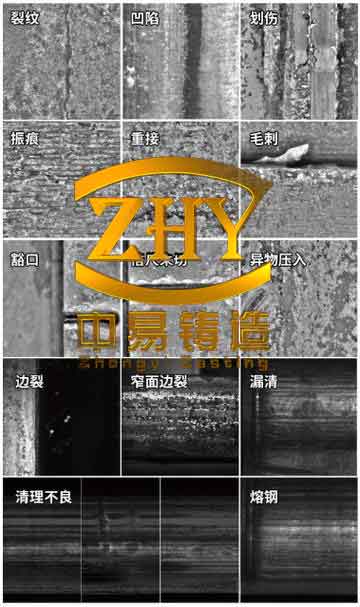
The image above illustrates typical sand casting defects including shrinkage, cracks, and deformation that we encountered. The final optimized process not only solved those issues but also provided a robust methodology for similar thin-walled superalloy castings.
Conclusion
Through systematic experimentation and thermal analysis, we successfully controlled the casting defects of K424 alloy thin-walled expansion flaps. The key findings are:
- Enlarging the ingate size and increasing pouring temperature effectively eliminated hot tearing at the lug roots.
- The insulation blanket pattern is critical: excessive insulation at thick sections creates hot spots. Exposing lugs to the sand backing accelerated cooling and eliminated shrinkage porosity.
- A selective insulation strategy, with reduced blanket thickness on thin walls and no blanket on thick features, allowed directional solidification and prevented expansion deformation.
- The overall yield increased from below 30% to above 95% after implementing these changes, demonstrating that proper control of sand casting defects in a hybrid investment/sand mold system is achievable.
This work provides a reference for the production of large thin-walled superalloy castings where both feeding and cooling uniformity must be optimized simultaneously. Future studies will focus on numerical simulation of the mold thermal field to further refine the insulation design.