
The production of heavy-section gray iron castings represents one of the most demanding challenges in a foundry. These components, often serving as bases, frames, or housings for heavy machinery, diesel engines, or test equipment, must possess superior mechanical properties, high dimensional stability, and absolute soundness, free from shrinkage cavities, porosity, or thermal cracking. The inherent characteristics of gray iron—its excellent damping capacity, wear resistance, and relatively good castability—make it the material of choice. However, its solidification behavior, particularly the balance between graphite expansion and liquid/micro-shrinkage, becomes critically difficult to manage in thick sections. As a foundry engineer with extensive experience, I have tackled numerous such projects. The following discussion delves into the comprehensive methodology required for the successful manufacture of massive gray iron castings, drawing from proven practices and fundamental metallurgical principles.
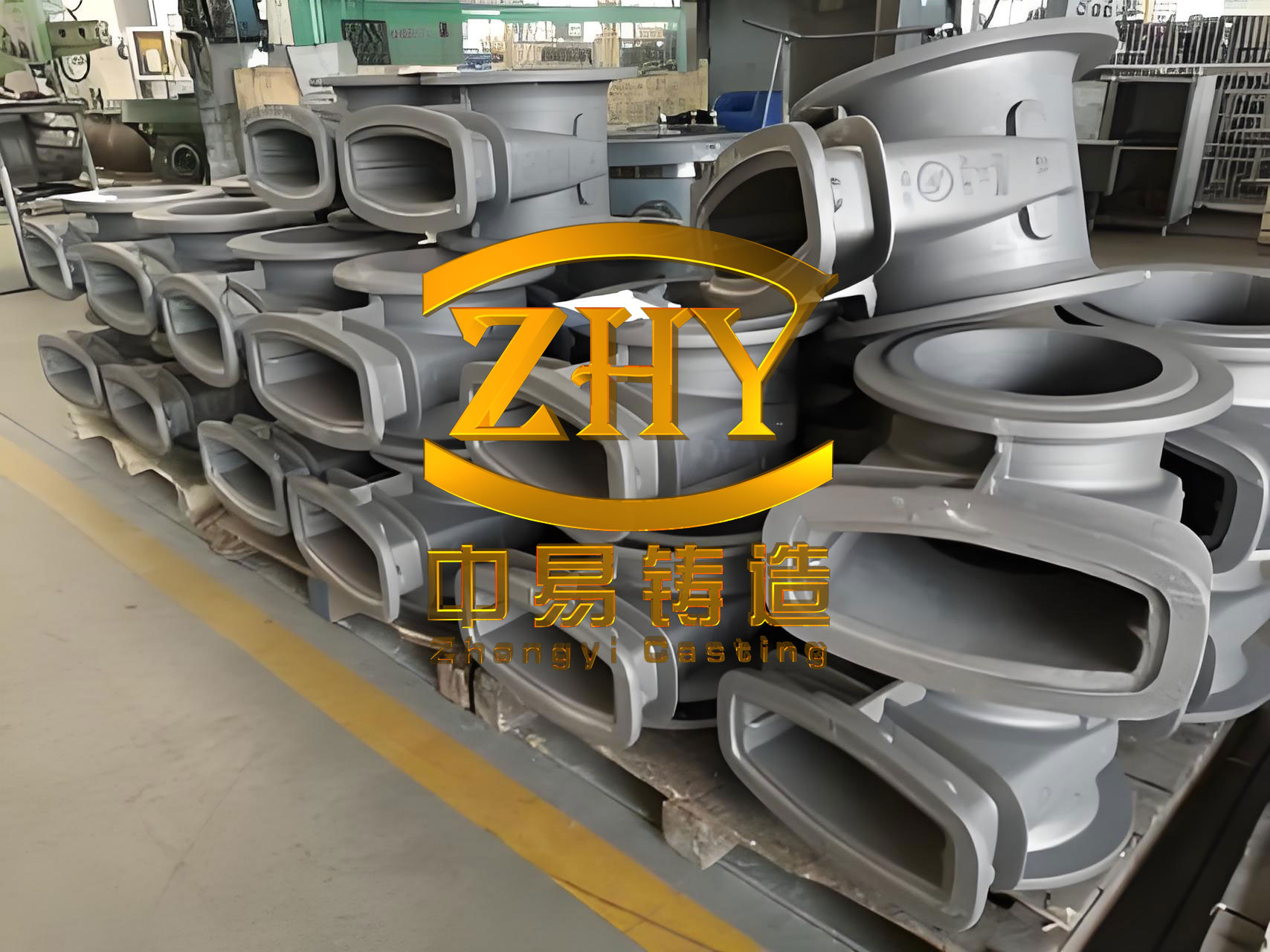
The core difficulty with heavy-section gray iron castings lies in controlling the thermal gradient and the subsequent feeding requirements. In sections exceeding 150-200 mm, the cooling rate is drastically reduced. This leads to prolonged solidification times, which can result in several defects:
- Shrinkage Cavities and Macro-Porosity: Although gray iron exhibits expansion due to graphite precipitation, the initial liquid contraction and the interdendritic shrinkage in the final stages of solidification can create significant voids if not properly fed or cooled.
- Micro-Shrinkage (Sponginess): Even in the absence of large cavities, the interior of the casting can develop a spongy, less-dense structure, severely compromising mechanical properties, especially fatigue strength.
- Dross and Slag Inclusions: The extended time the metal remains liquid allows more opportunity for oxidation reactions and slag formation to occur and become trapped.
- Dimensional Issues and Warping: Non-uniform cooling creates complex stress patterns, leading to distortion and difficulties in achieving machining tolerances.
- Undesired Microstructure: Slow cooling can promote the formation of coarse graphite flakes, ferritic matrix, or even mottled structures in critical areas, degrading strength and hardness.
Therefore, the entire foundry process, from pattern design to melting and pouring, must be orchestrated to accelerate cooling in strategic locations, ensure directional solidification where possible, and maintain the highest possible metallurgical quality. The following sections outline the key pillars of this approach.
1. Foundry Pattern and Molding Strategy
The journey to a sound casting begins with the pattern. For large, deep gray iron castings made with high-strength chemically-bonded sands (like furan no-bake), a solid, one-piece pattern is often impractical. The immense strength of the cured sand creates enormous frictional forces during draw, risking pattern damage, mold wall tear, and dimensional inaccuracy from excessive rapping.
The solution is a split-core box or segmented pattern approach. The master pattern is constructed as a central, tapered frame (reverse draft) surrounded by loose pieces or side segments that key into it. During molding, the entire assembly creates the cavity. When stripping, the central core is lifted first. Its tapered shape easily releases from the sand. This initial withdrawal creates space for the side segments to be removed inward, toward the vacated center, rather than straight up against the high sand strength. This method offers critical advantages:
- Minimal Draw Force & Pattern Longevity: Eliminates the need for heavy pounding, drastically extending pattern life.
- Superior Dimensional Accuracy: Allows for minimal draft angles, ensuring the final casting dimensions are much closer to the intended design.
- Reduced Fettling: Produces cleaner mold joints, minimizing flash and subsequent grinding work on the casting.
This careful attention to pattern engineering is the first, often overlooked, step in ensuring the manufacturability and quality of batch-produced heavy gray iron castings.
2. Gating System Design: Controlling the Flow
The gating system for a multi-tonne casting is its cardiovascular system. It must fulfill multiple roles: fill the mold smoothly, minimize turbulence and slag entrainment, establish a favorable temperature gradient, and allow for the escape of gases. For heavy-section gray iron castings, a bottom-gating, pressurised system is typically employed.
Pouring Time Calculation: The first critical parameter is the pour time, which balances the risk of cold shuts (if too slow) with the danger of excessive turbulence and mold erosion (if too fast). An empirical formula often used is:
$$ t = K \cdot \sqrt[3]{W} $$
where \( t \) is the pouring time in seconds, \( W \) is the casting weight in kg, and \( K \) is an empirical coefficient (typically 0.8-1.2 for heavy gray iron). For a 26,500 kg casting, this yields a target time of approximately 140-160 seconds.
Choke Area Sizing: Using the calculated pour time and principles of fluid mechanics, the total choke area (smallest cross-section, usually at the sprue base or ingates) is determined. The classic formula for a pressurized system (where the sprue is the choke) is:
$$ A_c = \frac{W}{\rho \cdot t \cdot C_d \cdot \sqrt{2gH_p}} $$
Where:
\( A_c \) = Choke area (m²)
\( W \) = Casting weight (kg)
\( \rho \) = Density of liquid iron (~7000 kg/m³)
\( t \) = Pouring time (s)
\( C_d \) = Discharge coefficient (~0.8 for iron)
\( g \) = Acceleration due to gravity (9.81 m/s²)
\( H_p \) = Effective metallostatic pressure head (m), calculated as \( H_p = H_0 – \frac{P^2}{2C} \), where \( H_0 \) is the height from ladle to choke, \( P \) is the height from choke to top of casting, and \( C \) is the total casting height.
From the choke area, the rest of the system is sized using proven ratios. For a bottom-gated system aimed at minimizing dross, a sprue:runner:ingate ratio of 1.0 : 1.2 : 1.1 is effective. This creates a slight pressurization in the runners, promoting a quicker, more uniform fill and helping to push slag toward the top of the mold cavity. The gates are distributed along the bottom of the casting’s long sides to ensure even metal distribution.
| Parameter | Symbol | Value | Unit |
|---|---|---|---|
| Total Casting Weight | W | 26,500 | kg |
| Target Pour Time | t | 150 | s |
| Effective Pressure Head | Hp | ~1.2 | m |
| Calculated Choke Area | Ac | ~0.0127 | m² (127 cm²) |
| Sprue Area (Choke) | Asprue | 127 | cm² |
| Total Runner Area | Arunner | ~153 | cm² |
| Total Ingate Area | Aingate | ~140 | cm² |
| System Type | – | Pressurized, Bottom-Gated | – |
3. Feeding and Cooling Strategy: Risers and Chills
This is the heart of the process for heavy-section gray iron castings. Relying solely on risers for feeding is ineffective due to the large thermal mass; the riser itself often remains hot and does not create a strong directional solidification toward itself. The synergistic use of chills and risers is mandatory.
The Role of Chills: Chills are blocks of high thermal conductivity material (cast iron, graphite, copper) placed in the mold. They act as local heat sinks, accelerating solidification at specific locations. For thick gray iron castings, we employ both external and internal chills.
External Chills are placed against the mold wall at heavy sections or hot spots (like junctions and internal corners). They create a steep thermal gradient, initiating solidification from the chill surface inward.
Internal Chills are pieces of clean, pre-heated metal (often the same grade as the base iron) suspended within the mold cavity. They are melted by the incoming metal but absorb a significant amount of superheat, effectively reducing the local solidification time. They are strategically placed in areas that are impossible to feed with risers, such as deep within heavy sections or under large flat tops.
Riser Design and Function: For these castings, risers serve a dual purpose: limited feeding and, more importantly, venting and thermal management. Large, conventional risers on the top of a thick section often create their own hot spot. A more effective approach is to use:
Small, Distributed Venting Risers: Numerous small-diameter (~45 mm) risers or “atmosphere vents” are placed across large top surfaces. These allow hot gases to escape, prevent surface boils from trapped moisture or resin gases, and, critically, they act as “cooling pins.” Their small mass solidifies quickly, drawing heat from the surrounding casting area and helping to stiffen the top crust.
Strategic Feeding Risers: Larger, properly sized risers are placed only at the extremities (ends) of the casting, away from the main thermal center. Their purpose is to provide liquid metal to compensate for the overall liquid contraction during the initial stages of cooling. Their effectiveness is greatly enhanced if used in conjunction with chills placed between the riser and the main casting body, ensuring a directional solidification path from the casting into the riser.
The cooling power of a chill can be approximated by its modulus, but practical experience is key. A typical arrangement for a 300 mm thick plate section might involve 100 mm thick graphite external chills on both the top and bottom mold faces, with supplemental internal chills arrayed in the thermal center. This combination creates a near-simultaneous solidification front from both surfaces, drastically reducing the size of the last-to-freeze zone and eliminating the risk of centerline shrinkage.
| Chill Type | Material | Typical Size/Placement | Primary Function |
|---|---|---|---|
| External Chill | Graphite, Cast Iron | 100mm thick, placed on cope & drag faces of thick sections | Accelerate cooling from mold surface, create steep thermal gradient. |
| External Chill (Shaped) | Cast Iron | Custom-shaped to fit internal fillets and corners (hot spots) | Prevent shrinkage at junctions, promote directional solidification. |
| Internal Chill | Same Grade Gray Iron | 55mm x 120mm bars, suspended in thermal center of heavy mass | Absorb superheat, reduce local solidification time, eliminate isolated hot spots. |
4. Metallurgical Control: Chemistry, Melting, and Inoculation
The desired microstructure for a high-strength, heavy-section gray iron casting (like HT300) is a fine, uniformly distributed Type A graphite in a fully pearlitic matrix. Achieving this in slow-cooling conditions requires precise chemical and thermal control.
Chemical Composition: The carbon equivalent (CE) must be carefully balanced. A lower CE promotes pearlite and strength but increases shrinkage tendency and reduces fluidity. For sections >250mm, a typical target is:
$$ CE = \%C + 0.33(\%Si + \%P) $$
Aiming for a CE in the range of 3.6-3.8 is common. Alloying elements are crucial:
Chromium (Cr): Added (~0.1-0.15%) to promote pearlite, increase hardness and strength, and refine graphite. However, excess Cr increases chilling tendency and hardness machinability issues.
Copper (Cu): Added (~0.3-0.4%) to promote pearlite formation without increasing chill, improve corrosion resistance, and enhance strength.
Manganese (Mn): Level is balanced with sulfur to form MnS, typically around 1.0-1.2%.
| Element | Target Range (wt.%) | Function & Rationale |
|---|---|---|
| Total Carbon (C) | 2.9 – 3.0 | Balances graphite formation, fluidity, and shrinkage tendency. Lower end for strength. |
| Silicon (Si) | 1.0 – 1.2 (base) 1.5 – 1.7 (final) |
Graphitizer. Lower base silicon for furnace melting, final adjusted via inoculation. |
| Manganese (Mn) | 1.0 – 1.2 | Counteracts sulfur, promotes pearlite, increases strength. |
| Phosphorus (P) | ≤ 0.10 | Kept low to avoid steadite and embrittlement, especially in thick sections. |
| Sulfur (S) | ≤ 0.12 | Necessary for inoculation response but kept low to minimize slag. |
| Chromium (Cr) | 0.10 – 0.15 | Pearlite promoter, refines graphite, increases hardness and strength. |
| Copper (Cu) | 0.30 – 0.40 | Pearlite promoter, improves strength and corrosion resistance without chill. |
| Carbon Equivalent (CE) | ~3.7 | Calculated as C + 0.33(Si+P). Indicates overall graphitizing potential. |
Inoculation Practice: Inoculation is non-negotiable for thick gray iron castings. Its purpose is to ensure a uniform, fine graphite structure and to prevent undercooled graphite (chill) at the surface or in moderately cooled areas. For large castings, a multiple-stage inoculation process is essential:
1. Ladle Inoculation: A primary addition of a strong, fade-resistant inoculant (e.g., FeSi containing Ba, Ca, Al) is made during tap or in the receiving ladle. This creates a high number of heterogeneous nucleation sites throughout the bulk liquid.
2. Stream or Pouring Box Inoculation: A secondary, late inoculation is performed as the metal flows from the ladle into the sprue. This is often done using an inoculant rod placed in the stream or by placing measured inoculant in the pouring basin. This stage introduces fresh, active nuclei just before the metal enters the mold, counteracting any fading that occurred during holding and transfer. The effectiveness of inoculation is often evaluated by the drop in undercooling during solidification, which can be monitored via thermal analysis:
$$ \Delta T_{eu} = T_{eu(steady)} – T_{eu(actual)} $$
where a larger \( \Delta T_{eu} \) indicates a more effective inoculation, shifting the eutectic temperature closer to the stable equilibrium.
Pouring Temperature: Contrary to intuition, the pouring temperature for heavy sections should be controlled on the lower side of the typical range, ideally between 1320°C and 1350°C. A lower superheat reduces the total heat content the mold must absorb, shortening the overall solidification time and reducing the severity of shrinkage. It also minimizes metal-mold reaction times and gas absorption.
5. Production Execution and Quality Assurance
All the careful planning culminates in the pour. For castings approaching the melt capacity of a foundry, coordination is vital. The metal must often be tapped from multiple furnaces into several ladles to achieve the required total weight. Consistency between heats is paramount. Key execution steps include:
- Synchronized Tapping: Ensuring all furnaces target the same chemistry and superheat temperature.
- Sequential Pouring: Coordinating the pour from multiple ladles to maintain a continuous, rising metal front in the mold without interruption.
- Hot Metal Topping: After the initial pour, the large exposed top surface will lose heat rapidly. It is a standard practice to reserve a small amount of very hot metal (~50-100 kg) to “top up” the risers and the casting surface several minutes after the main pour. This compensates for liquid level drop due to liquid shrinkage and pipe formation in the risers, preventing a concave surface on the casting.
- Controlled Cooling: The filled mold is left untouched for an extended period, often 48-72 hours for a 25+ tonne casting, before shakeout. This allows for complete transformation and stress relief within the mold, minimizing the risk of cracking.
Quality verification for such critical gray iron castings goes beyond standard coupon tests. While separately cast test bars confirm the general melt quality, the true test is the casting itself. This involves:
- Bore Machining and Inspection: The first machined surface on a heavy section, often a large bore, is meticulously inspected for any signs of subsurface shrinkage or porosity.
- Ultrasonic Testing (UT): Used to scan critical load-bearing areas for internal discontinuities.
- Hardness Mapping: Checking hardness at various locations on the casting to ensure uniform pearlitic matrix and the absence of soft spots.
- Dimensional Survey: A full check of all critical dimensions after rough machining to confirm the success of the pattern and molding strategy in controlling warpage.
| Defect Observed | Likely Cause | Corrective Action in Process Design |
|---|---|---|
| Centerline Shrinkage Porosity | Inadequate cooling in thermal center; lack of directional solidification. | Introduce internal chills; use external chills on opposing faces; revise riser/chill synergy. |
| Surface Sinks or Draw | Inadequate feeding of liquid contraction; top surface solidifying too fast. | Implement “hot topping”; increase size/number of top risers (vents); reduce top surface cooling slightly. |
| Cracking at Junctions | High thermal stress due to unequal cooling; mold rigidity. | Use shaped chills at fillets; ensure mold compaction is uniform and high; consider stress-relieving annealing. |
| Poor Graphite Structure (Coarse Flakes) | Excessive CE; ineffective inoculation; excessively slow cooling. | Lower base CE; implement multiple-stage inoculation; increase cooling via chills. |
| Slag Inclusions in Upper Sections | Turbulent filling; poor slag trapping in gating. | Switch to a bottom-gated, pressurized system; incorporate effective slag traps and dams in runners. |
In conclusion, the successful production of sound, heavy-section gray iron castings is a testament to systems thinking in foundry engineering. It requires the seamless integration of robust pattern design, a rigorously calculated and controlled filling system, a strategic and aggressive cooling plan using chills, precise metallurgical control, and flawless execution on the foundry floor. There is no single “silver bullet.” Rather, it is the cumulative effect of getting countless details right—from the design of a pattern segment to the timing of a late inoculant addition—that allows the foundry to consistently deliver these massive, high-integrity components. The methodology outlined here, centered on thermal management through chills and controlled solidification, provides a reliable framework for tackling the formidable challenge posed by these heavyweight gray iron castings.