
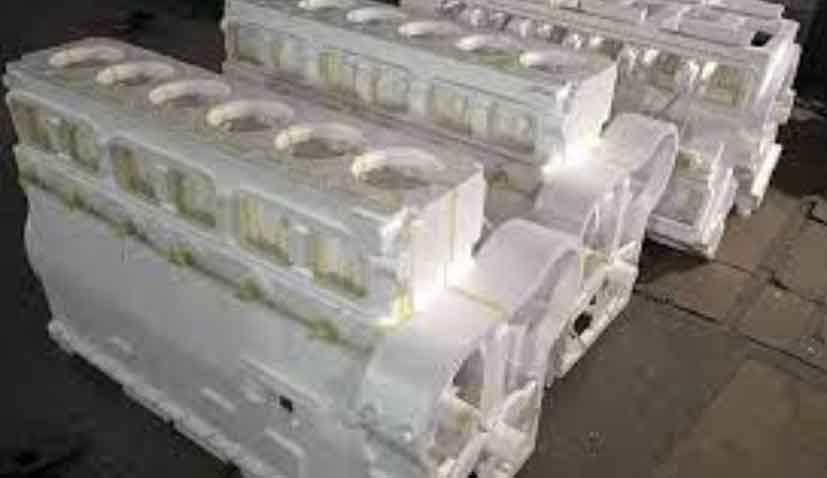
This study investigates the optimization of lost foam casting parameters for HT200 grey cast iron end caps to address porosity, slag inclusion, shrinkage, and other defects. Three gating systems (top, middle, and bottom pouring) were designed, with numerical simulations conducted using ProCAST software to analyze filling patterns, solidification behavior, and defect formation. Orthogonal experiments were performed to determine optimal process parameters, followed by production verification.
1. Gating System Design
The closed gating system for lost foam casting follows the proportional relationship:
$$
\sum F_{\text{inner}} : \sum F_{\text{runner}} : \sum F_{\text{sprue}} = 1 : 1.2 : 1.4
$$
Inner gate area calculation uses the hydraulic formula:
$$
\sum F_{\text{inner}} = \frac{G}{0.31\mu t \sqrt{H_p}}
$$
where $G$ represents molten metal mass (kg), $\mu$ is flow coefficient, and $H_p$ denotes average pressure head height.
| Pouring Type | Inner Gate (mm²) | Runner (mm²) | Sprue (mm²) |
|---|---|---|---|
| Top Pouring | 7×24 | 9×24 | 24×24 |
| Bottom Pouring | 10×35 | 12×35 | 35×35 |
| Middle Pouring | 11×11 | 11×27 | 27×27 |
2. Numerical Simulation Analysis
The lost foam casting process was simulated with ProCAST using EPS foam properties:
$$
\begin{aligned}
\text{Density} &= 22\ \text{kg/m}^3 \\
\text{Thermal Conductivity} &= 0.15\ \text{W/(m·K)} \\
\text{Specific Heat} &= 3.7\ \text{kJ/(kg·K)}
\end{aligned}
$$
| Pouring Type | Filling Time (s) | Total Solidification Time (s) |
|---|---|---|
| Top | 10.95 | 416.21 |
| Middle | 11.72 | 416.48 |
| Bottom | 12.97 | 556.22 |
3. Orthogonal Experiment Design
A $L_9(3^4)$ orthogonal array examined two critical parameters in lost foam casting:
$$
\begin{aligned}
\text{Pouring Temperature} &: 1,360-1,420^\circ\text{C} \\
\text{Negative Pressure} &: 0.02-0.06\ \text{MPa}
\end{aligned}
$$
| Run | Temp (°C) | Pressure (MPa) | Porosity (cm³) |
|---|---|---|---|
| 1 | 1,360 | 0.02 | 4.728 |
| 2 | 1,360 | 0.04 | 3.128 |
| 3 | 1,360 | 0.06 | 2.930 |
| 4 | 1,390 | 0.02 | 3.492 |
| 5 | 1,390 | 0.04 | 3.128 |
| 6 | 1,390 | 0.06 | 3.517 |
| 7 | 1,420 | 0.02 | 3.321 |
| 8 | 1,420 | 0.04 | 3.578 |
| 9 | 1,420 | 0.06 | 3.005 |
4. Results and Discussion
Range analysis revealed parameter significance:
$$
R_{\text{Pressure}} = 2.094 > R_{\text{Temperature}} = 0.882
$$
The optimal lost foam casting parameters were determined as:
$$
\begin{cases}
\text{Pouring Temperature} = 1,420^\circ\text{C} \\
\text{Negative Pressure} = 0.06\ \text{MPa}
\end{cases}
$$
| Factor | K₁ | K₂ | K₃ | R |
|---|---|---|---|---|
| Temperature | 10.786 | 10.137 | 9.904 | 0.882 |
| Pressure | 11.541 | 9.834 | 9.447 | 2.094 |
5. Production Verification
Implementing optimized lost foam casting parameters achieved:
$$
\begin{aligned}
\text{Porosity Volume} &= 3.005\ \text{cm}^3 \\
\text{Process Yield} &= 77.7\% \\
\text{Tensile Strength} &= 147-155\ \text{MPa}
\end{aligned}
$$
The bottom-pouring system demonstrated superior performance in lost foam casting due to its stable filling pattern and effective feeding through large runners. This study confirms that proper parameter selection in lost foam casting significantly reduces defects while maintaining mechanical properties.