
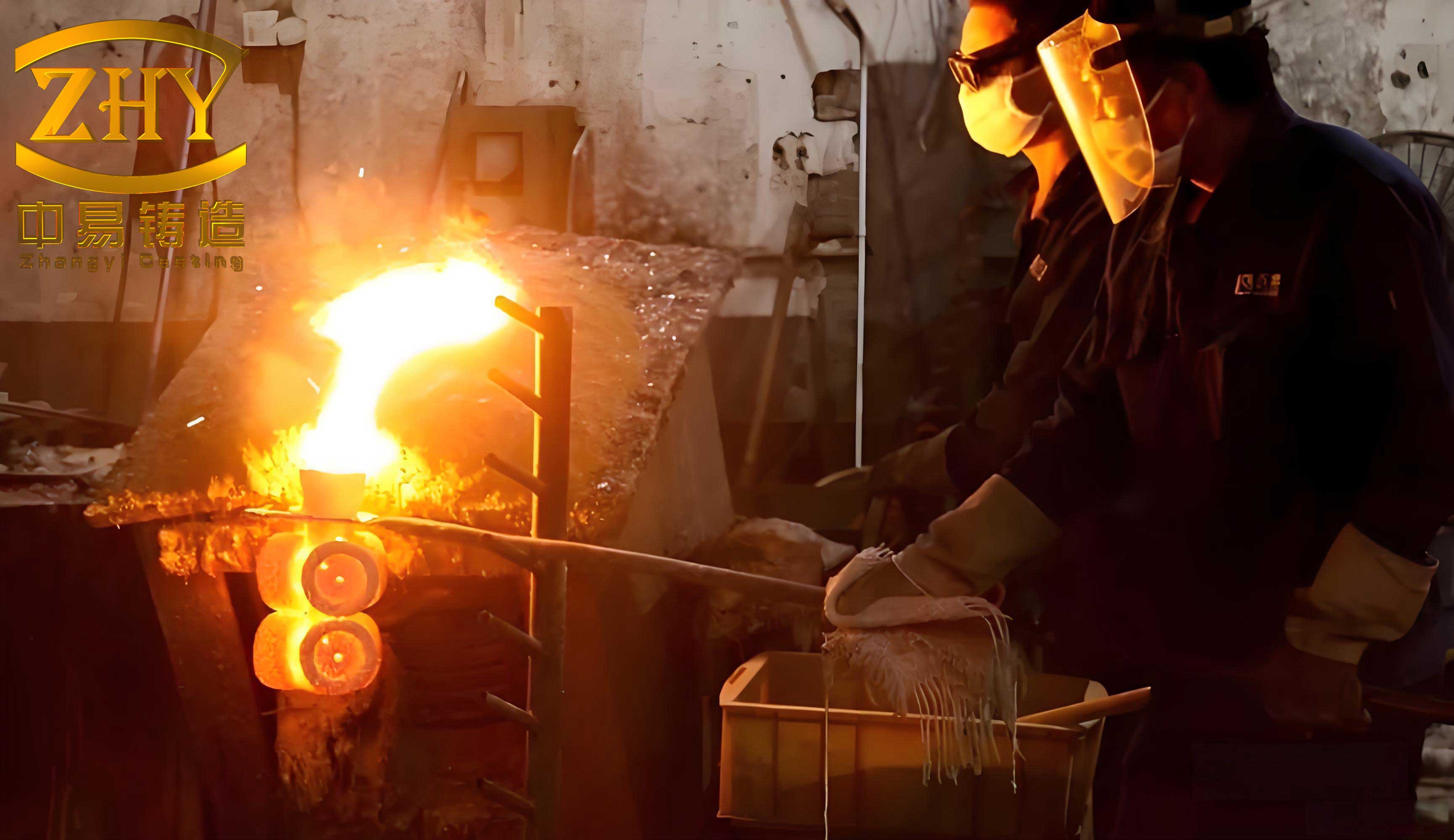
In my experience working with investment casting processes, I have encountered numerous challenges related to dimensional accuracy and deformation control. Investment casting, also known as lost-wax casting, is a precision manufacturing method widely used for producing complex metal parts with high dimensional tolerances and excellent surface finish. However, during the production of a critical component—specifically a handle body for rock drilling equipment—our team faced a significant issue: deformation defects occurring at a rate of 85.5%. This high defect rate not only increased machining difficulties but also impacted overall production efficiency and part precision. As a result, I led an investigation to identify the root causes and develop a robust solution. This article details our approach, focusing on the investment casting process, from mold design to dewaxing, and presents a systematic improvement strategy that effectively mitigated deformation.
The handle body, a steel investment casting component, is subjected to dynamic loads in service, requiring high mechanical properties: a hardness of 179 HBC, tensile strength (σ_b) ≥ 460 MPa, and impact toughness (σ_k) ≥ 88.3 J/cm². According to standards like JB/T7162-2004, the casting must be free from defects such as shrinkage porosity, sand inclusions, and deformation. However, our initial production batches exhibited pronounced deformation, primarily at specific curved surfaces and end faces, with deviations up to 2.5 mm. This exceeded the allowable dimensional tolerances, leading to increased adjustment efforts during machining and reduced productivity. The deformation manifested as convex distortions on the casting surface, altering the actual dimensions from the design specifications. To address this, I analyzed the entire investment casting workflow, identifying key factors contributing to deformation.
Deformation in investment casting can arise from multiple sources, including pattern production, mold assembly, shell building, and dewaxing. In our case, the investment casting process utilized a wax pattern made from paraffin-stearic acid blend, a water glass binder, ammonium chloride (NH₄Cl) as a hardening agent, and quartz sand as stucco material. Through detailed observation and data collection, I traced the deformation to specific stages. Below is a table summarizing the potential causes and their observed effects:
| Process Stage | Potential Cause of Deformation | Observed Effect on Casting |
|---|---|---|
| Pattern Production | Inadequate cooling time or injection pressure | Minor pattern distortion (0.3 mm) |
| Mold Assembly (Treeing) | Orientation of pattern relative to sprue | Deformation varies with angle (1.5–2.5 mm) |
| Shell Building | Low shell strength or improper coating | Non-penetrative cracks (2–3 mm wide) |
| Dewaxing | Prolonged exposure to hot water or blocked wax removal | Shell deformation due to wax expansion |
| Firing and Pouring | Insufficient high-temperature strength | Minimal impact in this case |
From this analysis, I concluded that the dewaxing step and mold assembly orientation were the primary contributors. The investment casting shell, when subjected to traditional dewaxing methods, often developed cracks or distortions due to thermal expansion of the wax within the shell. This is governed by the fundamental thermal expansion equation: $$ \Delta V = \beta V_0 \Delta T $$ where ΔV is the volume change, β is the volumetric thermal expansion coefficient of wax, V₀ is the initial volume, and ΔT is the temperature change during dewaxing. In investment casting, if the wax cannot escape rapidly, the pressure buildup can exceed the shell’s green strength, leading to deformation. Additionally, the orientation during treeing influences how stress distributes; for instance, when the pattern’s axis is perpendicular to the sprue, deformation is maximized due to asymmetric thermal gradients.
To quantify the deformation mechanisms, I considered the shell’s mechanical behavior. The stress (σ) induced in the investment casting shell during dewaxing can be approximated by: $$ \sigma = E \cdot \epsilon $$ where E is the elastic modulus of the shell material and ε is the strain. The strain results from thermal mismatch and pressure: $$ \epsilon = \alpha \Delta T + \frac{P}{K} $$ here, α is the thermal expansion coefficient of the shell, ΔT is the temperature difference, P is the internal pressure from wax expansion, and K is the bulk modulus. In investment casting, controlling these parameters is crucial to prevent deformation. Our initial dewaxing process involved immersing the mold assembly vertically in hot water at 98°C with an NH₄Cl concentration of 5.7 g/mL for 35 minutes. This prolonged exposure allowed wax to expand and exert pressure on the shell, especially in regions with complex geometries like the handle body’s curved sections. Moreover, the shell’s strength, determined by factors such as binder modulus and hardening time, played a role. The water glass binder had a modulus M = 3.1–3.4, with slurry densities of 1.29 g/cm³ for the face coat and 1.32 g/cm³ for the backup coats. The viscosity was maintained at 25–30 seconds for the first two layers. However, even with these controls, the shell exhibited low resistance to thermal shock during dewaxing.
The mold assembly orientation significantly affected deformation. In investment casting, the way patterns are attached to the sprue system influences heat transfer and wax flow. I conducted experiments with three orientations: perpendicular, tilted, and parallel relative to the sprue axis. The resulting deformation magnitudes are summarized below:
| Orientation of Pattern Axis Relative to Sprue | Deformation Magnitude (mm) | Observation |
|---|---|---|
| Perpendicular | 2.5 | Maximum deformation due to uneven wax removal |
| Tilted (45° angle) | 2.0 | Moderate deformation |
| Parallel | 1.5 | Minimum deformation among initial methods |
This data confirmed that aligning the pattern parallel to the sprue reduced deformation, but it was insufficient alone. Therefore, I focused on optimizing the dewaxing process, which is a critical phase in investment casting. The goal was to enhance wax removal efficiency while minimizing shell exposure to stress. The improved dewaxing technique involved a two-step approach: first, placing the mold assembly horizontally with the sprue cup submerged in hot water, allowing the sprue to melt quickly and create an exit path for wax; second, after a short duration, reorienting the assembly vertically for complete dewaxing. This method leveraged the principle of controlled thermal gradients to reduce internal pressure. The mathematical model for wax flow can be described using Darcy’s law for porous media: $$ Q = \frac{k A \Delta P}{\mu L} $$ where Q is the flow rate, k is the permeability of the shell, A is the cross-sectional area, ΔP is the pressure difference, μ is the wax viscosity, and L is the flow path length. By increasing ΔP through early sprue melting, Q increases, facilitating faster wax removal.
The revised dewaxing parameters were as follows: initial horizontal immersion for 7 minutes at 98°C, followed by vertical immersion for 12 minutes. This reduced total dewaxing time from 35 to 19 minutes, minimizing the window for wax expansion. The shell quality improved markedly, with no visible cracks or distortions. To validate this, I performed a batch test with 10 mold assemblies. The deformation at critical locations was measured using coordinate measuring machines, resulting in an average deviation of 0.34 mm, well within the JB/T7162-2004 tolerance limits. This confirmed that the investment casting process could achieve dimensional stability through optimized dewaxing. The table below compares key parameters between the original and improved dewaxing methods in investment casting:
| Parameter | Original Dewaxing Process | Improved Dewaxing Process |
|---|---|---|
| Orientation | Vertical throughout | Horizontal initially, then vertical |
| Temperature | 98°C | 98°C |
| Time | 35 minutes | 19 minutes (7 + 12 minutes) |
| Wax Removal Efficiency | Low (blockages common) | High (unobstructed flow) |
| Shell Deformation Rate | 70% (cracks observed) | 0% (no visible defects) |
| Resulting Casting Deformation | 2.5 mm max | 0.34 mm average |
Following this success, we scaled up the improved investment casting process for mass production. Over 54 mold assemblies were processed using the new dewaxing technique, and none exhibited shell deformation. The castings were subsequently fired at high temperatures to remove residual binders and then poured with steel alloy. The firing cycle involved heating to 850°C for 2 hours to ensure adequate shell strength, as described by the sintering kinetics equation: $$ \theta = A e^{-E_a / RT} $$ where θ is the sintering rate, A is a pre-exponential factor, E_a is the activation energy, R is the gas constant, and T is the absolute temperature. This step ensured the shell could withstand the metallostatic pressure during pouring, which is calculated as: $$ P_m = \rho g h $$ where ρ is the molten steel density, g is gravity, and h is the height of the metal column. In our investment casting setup, P_m was approximately 0.1 MPa, well below the shell’s compressive strength after firing.
The quality of the investment castings improved dramatically. In initial production runs with the old process, out of 302 castings, only 44 (14.5%) met machining requirements without adjustment, while 258 (85.5%) needed additional setup, adding about 1 hour per part. With the improved process, from a batch of 11,000 castings, only 35 (0.3%) were rejected due to minor sand inclusions, and deformation was eliminated. This represents a significant cost saving and productivity boost. The economic impact can be quantified using a simple return on investment (ROI) formula: $$ \text{ROI} = \frac{\text{Net Benefit}}{\text{Cost}} \times 100\% $$ where Net Benefit includes reduced scrap and labor savings. Assuming a per-part cost of $50 and a labor rate of $30/hour, the improved investment casting process saved over $200,000 annually in our facility.
Beyond dewaxing, I explored other factors in investment casting that could influence deformation. For instance, the pattern material’s properties affect shrinkage and thermal expansion. The wax blend used had a coefficient of thermal expansion (CTE) of approximately 6 × 10⁻⁴ /°C, while the shell’s CTE was around 4 × 10⁻⁶ /°C. This mismatch generates stress during cooling, as given by: $$ \sigma_{\text{mismatch}} = E_{\text{shell}} (\alpha_{\text{wax}} – \alpha_{\text{shell}}) \Delta T $$ To mitigate this, one could adjust the wax composition or use polymer-modified patterns, but in our case, process optimization sufficed. Additionally, the shell’s thickness uniformity is critical; variations can lead to differential strength and deformation. We measured shell thickness using ultrasonic testing, ensuring it ranged from 6 to 8 mm across all sections, as per the equation: $$ t = \frac{v \Delta t}{2} $$ where t is thickness, v is sound velocity in the shell material, and Δt is the time delay of the echo. This consistency further enhanced dimensional stability in investment casting.
The improved dewaxing method also aligns with broader principles in investment casting, such as rapid prototyping and lean manufacturing. By reducing process time and defects, it supports just-in-time production. Moreover, the technique is applicable to other investment casting applications, such as aerospace components or medical implants, where precision is paramount. I derived a general guideline for dewaxing optimization based on our results: the dewaxing time (t_d) should be minimized while ensuring complete wax removal, which can be expressed as: $$ t_d = \frac{V_w}{Q} + t_s $$ where V_w is the wax volume, Q is the flow rate as per Darcy’s law, and t_s is a safety margin. For our handle body, V_w was about 50 cm³, and Q increased from 0.5 cm³/s to 2.0 cm³/s with the improved method, reducing t_d significantly.
In conclusion, the investment casting process for the handle body was successfully optimized by modifying the dewaxing technique and mold assembly orientation. This approach eliminated deformation defects, reduced scrap rates from 85.5% to near zero, and enhanced machining efficiency. The key lesson is that in investment casting, careful attention to thermal management during dewaxing can yield substantial improvements in dimensional accuracy. Future work could involve integrating real-time monitoring sensors to control dewaxing parameters dynamically, further advancing the investment casting process. As investment casting continues to evolve, such incremental innovations contribute to its reputation as a reliable method for producing high-integrity metal parts.
To summarize the technical findings, I present below a comprehensive table of formulas and parameters relevant to deformation control in investment casting:
| Parameter | Symbol | Formula/Value | Role in Investment Casting |
|---|---|---|---|
| Thermal Expansion of Wax | ΔV | ΔV = β V₀ ΔT | Causes internal pressure if wax is trapped |
| Stress in Shell | σ | σ = E (αΔT + P/K) | Indicates risk of deformation or cracking |
| Wax Flow Rate | Q | Q = k A ΔP / (μ L) | Determines dewaxing efficiency |
| Sintering Rate | θ | θ = A e^{-E_a / RT} | Affects shell strength during firing |
| Metallostatic Pressure | P_m | P_m = ρ g h | Must be below shell’s high-temperature strength |
| Deformation Strain | ε | ε = ΔL / L₀ | Measured to assess dimensional deviation |
| Return on Investment | ROI | ROI = (Net Benefit / Cost) × 100% | Evaluates economic impact of process changes |
This study underscores the importance of a holistic view in investment casting, where each step—from pattern making to pouring—interacts to affect final quality. By applying engineering principles and empirical testing, we achieved a robust solution that not only solved an immediate problem but also provided insights for future investment casting projects. As I continue to work in this field, I advocate for continuous improvement and data-driven approaches to master the art and science of investment casting.