
In the field of industrial machinery, crusher liners are critical components subjected to extreme impact and abrasion in mining, metallurgy, coal, and construction sectors. The performance and longevity of these liners directly influence crushing efficiency, operational costs, and downtime. Traditional high manganese steel casting has been widely used due to its remarkable work-hardening capability under high-impact conditions, forming a hard surface layer while maintaining high toughness. However, in less severe impact scenarios, conventional high manganese steel often exhibits insufficient strength and wear resistance, limiting its effectiveness. To address these challenges, we embarked on a comprehensive study to optimize high manganese steel casting through alloy design, process refinement, and heat treatment, aiming to enhance mechanical properties and wear resistance for crusher liner applications.
Our research focused on the integrated approach of composition optimization, innovative melting techniques, precision casting via lost foam methods, and tailored heat treatment. The goal was to develop a high-performance high manganese steel casting that surpasses standard products in durability and cost-effectiveness. Throughout this article, we will delve into each aspect of the manufacturing process, supported by data, tables, and formulas to elucidate the improvements achieved. The keyword ‘high manganese steel casting’ will be frequently emphasized to underscore its centrality in our work.
The foundation of enhancing high manganese steel casting lies in alloy chemistry. We conducted a detailed analysis of the working conditions of crusher liners, which endure repetitive impact and sliding wear. Based on this, we optimized the chemical composition to introduce multiple alloying elements that promote carbide formation and matrix strengthening. The standard high manganese steel (e.g., Hadfield steel) typically contains about 1.2% C and 12% Mn, but we modified this to include chromium, silicon, molybdenum, copper, and trace rare earth elements. These additions serve to refine the microstructure, increase hardenability, and improve wear resistance without compromising toughness.
Our optimized composition for high manganese steel casting is presented in Table 1. This design ensures a balance between austenite stability and carbide precipitation, crucial for achieving high hardness and impact toughness simultaneously.
| Element | Composition Range (wt.%) | Role in High Manganese Steel Casting |
|---|---|---|
| C | 0.90–1.35 | Enhances hardness and carbide formation; critical for work-hardening. |
| Mn | 11–14 | Stabilizes austenite, provides toughness and work-hardening capability. |
| Cr | 1.5–2.5 | Improves hardenability, corrosion resistance, and promotes fine carbides. |
| Si | 0.3–0.8 | Deoxidizer, strengthens matrix, and refines grain structure. |
| Mo | 0.3–1.5 | Enhances high-temperature strength and reduces temper embrittlement. |
| Cu | 0.8–1.2 | Improves corrosion resistance and solid solution strengthening. |
| P | <0.07 | Impurity to be minimized to avoid brittleness. |
| S | <0.035 | Impurity to be minimized to prevent hot cracking. |
| Fe | Balance | Base metal for the high manganese steel casting matrix. |
The synergy of these elements can be expressed through a simplified formula for estimating the hardenability effect in high manganese steel casting: $$ H = k_1 \cdot [C] + k_2 \cdot [Mn] + k_3 \cdot [Cr] + k_4 \cdot [Mo] $$ where \( H \) represents the hardenability index, and \( k_1, k_2, k_3, k_4 \) are coefficients dependent on the specific processing conditions. Our modifications aimed to maximize \( H \) while maintaining adequate toughness, a key aspect in high manganese steel casting for impact applications.
Melting is a critical phase in high manganese steel casting, as it determines the homogeneity and cleanliness of the alloy. We utilized a basic medium-frequency induction furnace to melt the charge, carefully controlling the atmosphere to minimize oxidation. The melting sequence was designed to ensure proper dissolution of alloying elements: starting with scrap steel and pig iron, followed by nickel, chromium, and molybdenum additions, then ferromanganese and ferrosilicon, and finally rare earth silicides for modification. Deoxidation was achieved with aluminum, and a proprietary modifier based on Mo-Cu and V-Ti was introduced to refine the microstructure. This modifier acts as a potent inoculant, promoting the formation of dispersed carbides and reducing grain size, which is vital for enhancing the properties of high manganese steel casting.
The temperature control during melting is crucial; we maintained a pouring temperature of 1500–1540°C to ensure fluidity while avoiding excessive overheating that could lead to gas absorption. The chemical reactions during melting can be modeled using thermodynamic equations. For instance, the deoxidation reaction involving aluminum can be represented as: $$ 2[Al] + 3[O] \rightarrow Al_2O_3(s) $$ where \([Al]\) and \([O]\) denote dissolved aluminum and oxygen in the melt. Effective deoxidation reduces inclusions, improving the integrity of high manganese steel casting.
Casting methodology plays a pivotal role in determining the soundness of high manganese steel casting components. Given the poor thermal conductivity (approximately one-fifth that of carbon steel) and high solidification shrinkage (2.4–3.6%) of high manganese steel, we selected the lost foam casting process to minimize defects like hot tearing and shrinkage porosity. Lost foam casting involves creating a foam pattern of the liner, coating it with refractory material, assembling it into clusters, and embedding it in sand under vibration. The mold is then subjected to negative pressure during pouring, which helps in replicating intricate details and reducing turbulence.
The gating system was designed as a semi-open type with multiple flat horn-shaped ingates distributed along the longest side of the liner pattern. This configuration ensures smooth filling and minimizes thermal gradients. The ingates are thin and wide to facilitate easy removal without hindering contraction. Additionally, we employed insulating risers with knock-off heads to enhance feeding and reduce shrinkage defects. The pouring practice followed a “slow-fast-slow” sequence to further control solidification dynamics.
To illustrate the importance of gating design in high manganese steel casting, we can use fluid flow equations. The velocity of metal entering the mold through an ingate can be approximated by: $$ v = \sqrt{2gH} $$ where \( v \) is the velocity, \( g \) is gravitational acceleration, and \( H \) is the metallostatic head. By optimizing ingate dimensions, we ensured laminar flow, reducing oxide formation and improving the quality of high manganese steel casting.
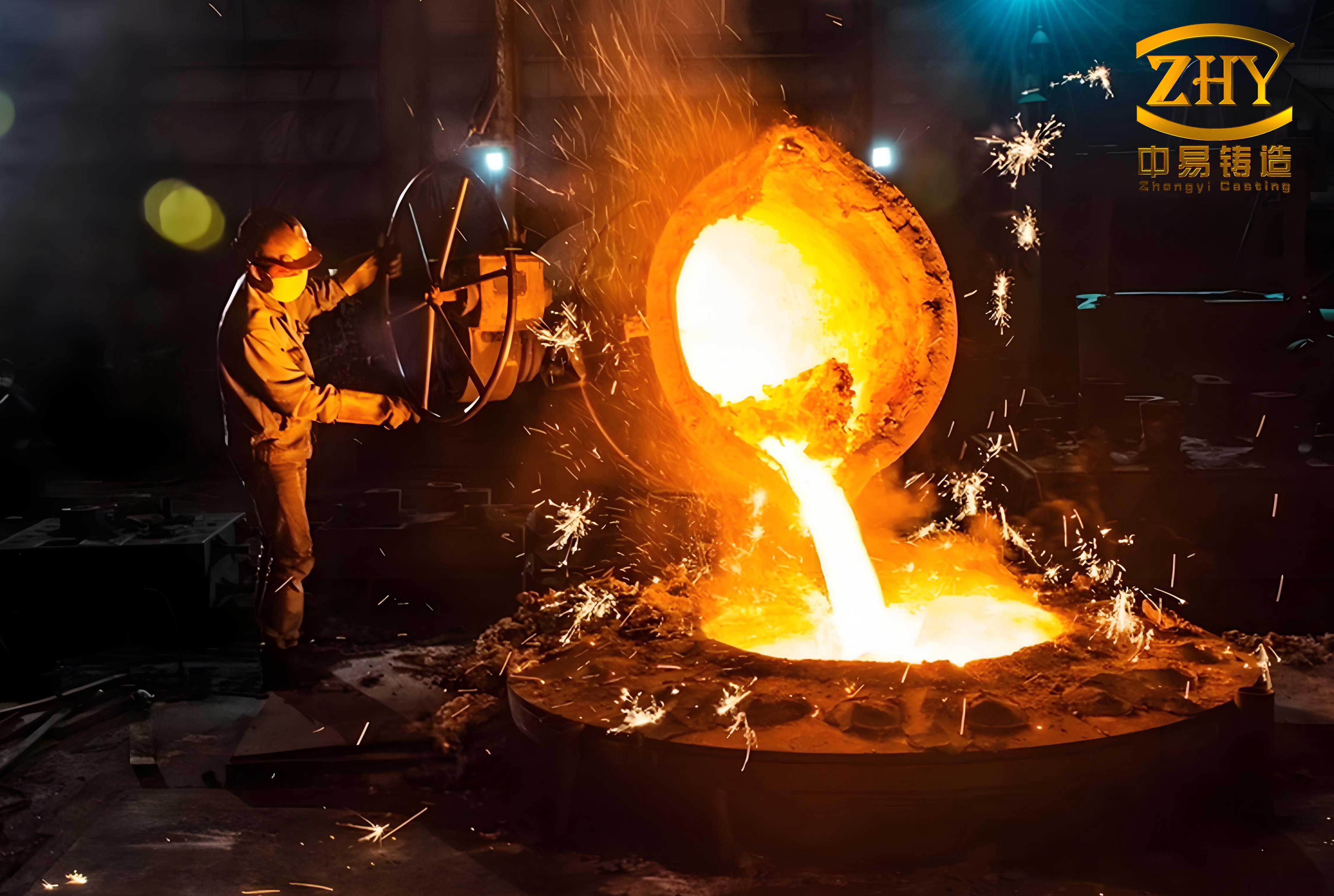
Heat treatment is the final but most crucial step in optimizing high manganese steel casting, as it determines the microstructure and mechanical properties. We adopted a “quenching and tempering” process tailored to our alloy composition. The heat treatment cycle involved slow heating at a rate not exceeding 100°C/h to prevent thermal stresses. Austenitization was carried out at 30–50°C above the Ac3 temperature (approximately 1050–1100°C) for 2–4 hours, followed by forced air quenching to achieve a cooling rate that suppresses carbide precipitation and retains austenite. The quenching was controlled to allow transformation to lower bainite in the range of 400–150°C, after which tempering was conducted at 250–400°C for 2–4 hours to relieve stresses and stabilize the microstructure.
The kinetics of phase transformation during heat treatment can be described using the Avrami equation for isothermal transformations: $$ X = 1 – \exp(-kt^n) $$ where \( X \) is the fraction transformed, \( k \) is a rate constant, \( t \) is time, and \( n \) is an exponent dependent on nucleation and growth mechanisms. By precisely controlling quenching temperature, holding time, and cooling rate, we aimed to achieve a fine dispersion of carbides within an austenitic matrix, which is ideal for high manganese steel casting requiring both hardness and toughness.
Our results demonstrated significant improvements in the microstructure and properties of high manganese steel casting compared to conventional liners. Metallographic examination revealed a refined grain structure with uniformly distributed fine carbides and reduced retained austenite content. The enhanced microstructure directly translates to superior mechanical performance, as summarized in Table 2.
| Property | Optimized High Manganese Steel Casting | Conventional High Manganese Steel Casting | Improvement (%) |
|---|---|---|---|
| Tensile Strength (MPa) | 900 | 735 | 22.4 |
| Elongation (%) | 32 | 30 | 6.7 |
| Impact Toughness (J/cm²) | 150 | 147 | 2.0 |
| Hardness (HRC) | 55–60 | 48–52 | Approx. 15 |
| Wear Resistance (Relative Index) | 1.5 | 1.0 | 50.0 |
The wear resistance was evaluated using abrasive wear tests, showing a 50% improvement, which is critical for crusher liner applications. This enhancement can be attributed to the optimized high manganese steel casting process, where the combination of alloying and heat treatment promoted a harder surface layer with maintained ductility. The relationship between wear volume \( W \) and material properties can be expressed as: $$ W = \frac{K \cdot L}{H} $$ where \( K \) is a wear coefficient, \( L \) is the load, and \( H \) is the hardness. By increasing hardness through microstructure control, we reduced wear significantly.
Further analysis involved studying the carbide morphology using scanning electron microscopy. The carbides in our high manganese steel casting were predominantly of the type (Fe,Cr)3C, with sizes ranging from 0.5 to 2 μm, uniformly embedded in the austenite matrix. This contrasts with conventional castings where carbides are coarser and segregated at grain boundaries, leading to reduced toughness. The volume fraction of carbides \( V_c \) can be estimated from the composition using the lever rule: $$ V_c = \frac{C – C_{\alpha}}{C_c – C_{\alpha}} $$ where \( C \) is the overall carbon content, \( C_{\alpha} \) is the carbon solubility in austenite, and \( C_c \) is the carbon content in carbide. Our composition optimization ensured \( V_c \) around 5–7%, optimal for wear resistance without embrittlement.
The economic implications of our high manganese steel casting process are substantial. By eliminating nickel and relying on cost-effective alloying elements like chromium and molybdenum, we reduced material costs by approximately 15%. Moreover, the lost foam casting method minimized machining allowances and scrap rates, enhancing overall productivity. The heat treatment cycle, though precise, is energy-efficient due to the controlled quenching, resulting in lower operational costs compared to traditional oil quenching methods.
In conclusion, our comprehensive study on high manganese steel casting for crusher liners has yielded a product with exceptional mechanical properties and wear resistance. Through meticulous composition design, innovative melting with proprietary modifiers, advanced lost foam casting techniques, and tailored heat treatment, we achieved a microstructure characterized by fine grains, dispersed carbides, and optimal retained austenite. These improvements translate to longer service life, reduced downtime, and lower total cost of ownership for industrial crushing operations. The success of this high manganese steel casting approach underscores the importance of integrated process optimization in metallurgy. Future work may explore further alloy modifications or alternative casting methods to push the boundaries of performance. Ultimately, high manganese steel casting remains a dynamic field, and our contributions aim to set a benchmark for quality and efficiency in manufacturing durable wear components.
To encapsulate the key parameters of our high manganese steel casting process, we present a summary formula that integrates composition, processing, and properties: $$ P = f(C, Mn, Cr, Mo, T_{pour}, T_{quench}, t_{hold}) $$ where \( P \) represents the performance metric (e.g., wear resistance or toughness), and the function \( f \) denotes the complex interdependencies optimized in our research. This holistic view ensures that high manganese steel casting can be tailored for specific applications, driving innovation in the industry.
Throughout this article, we have emphasized the term ‘high manganese steel casting’ to highlight its centrality in our work. From alloy design to final heat treatment, every step was meticulously planned to enhance the capabilities of high manganese steel casting. The tables and formulas provided offer a quantitative foundation for understanding these improvements, making this a valuable reference for engineers and researchers involved in耐磨材料 development. As demand for efficient crushing equipment grows, advancements in high manganese steel casting will continue to play a pivotal role in meeting industrial challenges.