
In my experience as a casting process engineer, producing high-strength thick-section gray iron castings for critical applications like energy and drainage systems has always been challenging. These components, such as bearing housings, must withstand severe operational stresses while being free from defects like shrinkage cavities, cracks, and porosity. The particular gray iron casting discussed here is a bearing housing with extreme wall thickness variations, where the base wall measures 250 mm, while other sections range from 30 mm to 80 mm. This disparity often leads to solidification issues, especially shrinkage defects, which I aimed to resolve through systematic process optimization. This article details my firsthand journey from problem identification to solution implementation, emphasizing the role of gray iron casting principles in achieving success.
The bearing housing, a key gray iron casting in water drainage energy systems, weighs 4000 kg and is made of HT300 gray iron. Its structural complexity arises from the massive base wall of 250 mm contrasting with thinner arcs of 30-80 mm. Such non-uniformity in gray iron castings typically induces thermal gradients during cooling, leading to high residual stresses, cracking at junctions, and difficulty in liquid feeding for thick sections. The primary machining surfaces include inner bore and seat faces, with the thick base being critical. Below, I outline the initial process that led to defects.
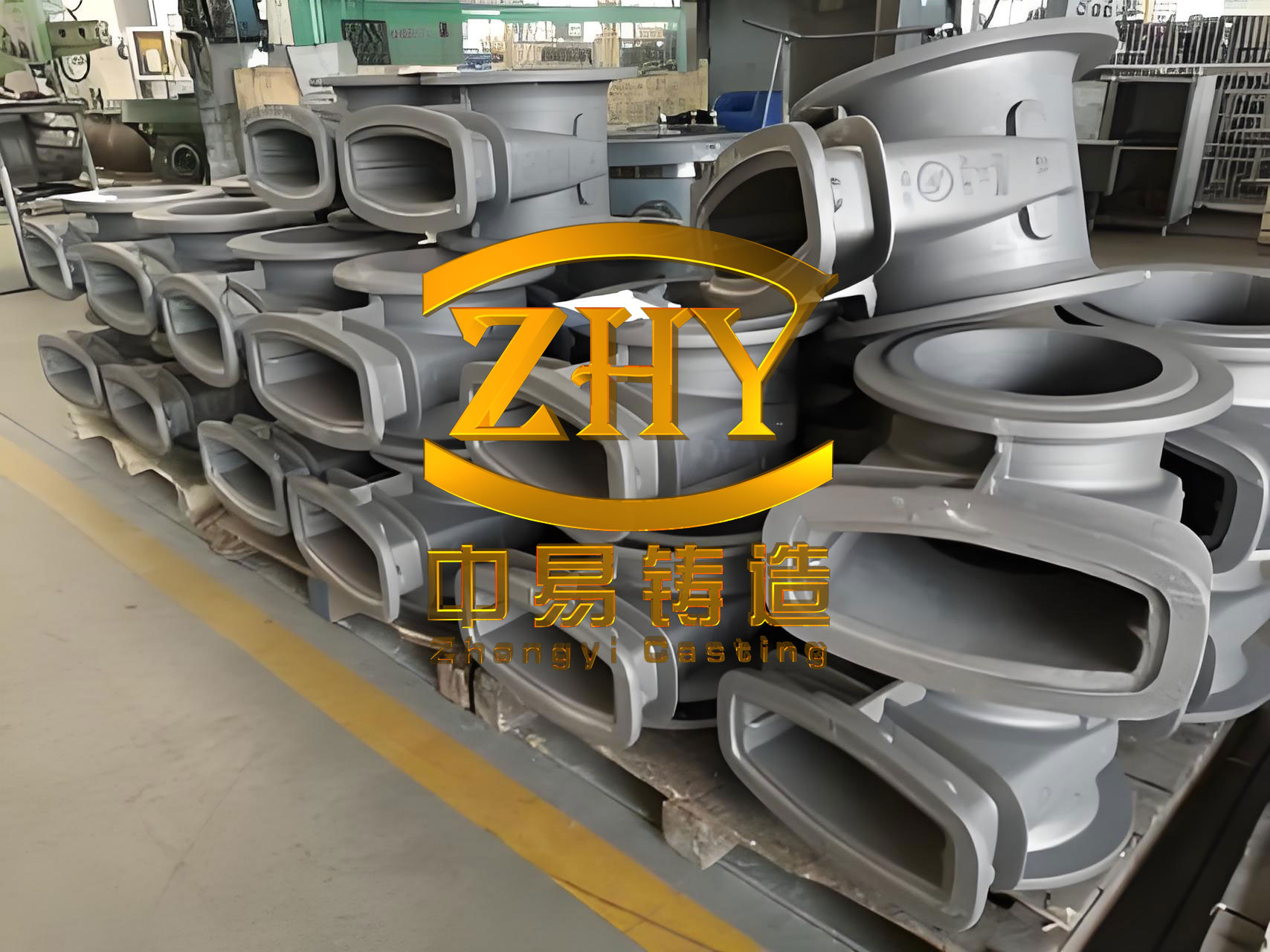
Originally, we employed a hand molding process using resin sand. The parting line was set at the top of the thick base, placing the entire gray iron casting in the upper mold. The thick machining surface was positioned at the bottom of the mold, while the bearing seat faces were on the sides. This orientation aimed to protect critical surfaces from slag and sand inclusions. The gating system was designed as a closed type with area ratios: $F_{\text{sprue}}: F_{\text{runner}}: F_{\text{ingate}} = 1:1.8:0.85$. Iron entered simultaneously from upper and lower side gates. Chills were placed on the thick base face, and duck-bill risers were added on the top surface for feeding. The molten iron composition and pouring temperature are summarized in Table 1.
| Element/Parameter | Value (wt.%) |
|---|---|
| Carbon (C) | 3.10 |
| Silicon (Si) | 1.68 |
| Manganese (Mn) | 0.86 |
| Phosphorus (P) | 0.028 |
| Sulfur (S) | 0.007 |
| Copper (Cu) | 0.45 |
| Carbon Equivalent (CE) | 3.66 |
| Pouring Temperature | 1320-1340°C |
Despite these measures, out of six gray iron castings produced, four exhibited severe shrinkage cavities and cracks near the riser roots and adjacent areas, leading to scrap. This was alarming, as gray iron castings of this size are costly. I analyzed the defects by considering solidification dynamics. The thick base, located at the mold bottom, was far from the top risers, creating a long feeding distance. During solidification, the liquid contraction required substantial feed metal, but the risers could not supply it adequately due to premature freezing. Moreover, the sprue was too close to the casting, causing localized overheating and delayed solidification at that spot. The fundamental issue lay in the feeding inefficiency inherent in such gray iron castings with large modulus variations.
To address this, I revised the entire process with a focus on directional solidification and improved feeding. First, I repositioned the casting: the thick base was placed at the top of the mold, while the bearing seat remained on the side. This allowed sequential solidification from thin sections at the bottom to the thick top, facilitating riser feeding. The sprue distance was increased to 200 mm to reduce thermal impact. The gating system was modified to a ratio of $F_{\text{sprue}}: F_{\text{runner}}: F_{\text{ingate}} = 1:1.5:0.85$, with ingates on the bearing seat face. Direct chills over 120 mm thick were applied on the top surface to accelerate cooling and minimize graphite coarseness. Riser placement was critical; I avoided locating them directly over the hottest spots to prevent shrinkage at riser necks. Instead, I considered using edge risers. Pouring temperature was lowered to 1300-1320°C, taking advantage of the thin sections filling first. Composition adjustments were made to enhance fluidity and reduce shrinkage tendency, as shown in Table 2.
| Element/Parameter | Value (wt.%) |
|---|---|
| Carbon (C) | 3.20 |
| Silicon (Si) | 1.85 |
| Manganese (Mn) | 0.90 |
| Phosphorus (P) | 0.025 |
| Sulfur (S) | 0.006 |
| Copper (Cu) | 0.58 |
| Carbon Equivalent (CE) | 3.85 |
| Pouring Temperature | 1300-1320°C |
The modulus concept is vital in gray iron casting design. For a section, modulus $M$ is given by the volume-to-surface area ratio: $$M = \frac{V}{A}$$. The thick base had a high modulus, requiring longer feeding. The required feed volume $V_{\text{feed}}$ can be estimated using: $$V_{\text{feed}} = \alpha \cdot V_{\text{casting}}$$ where $\alpha$ is the liquid shrinkage coefficient, typically around 4-6% for gray iron. For this gray iron casting, $V_{\text{casting}} \approx 0.5 \text{ m}^3$, so $V_{\text{feed}} \approx 0.02-0.03 \text{ m}^3$. The initial risers were inadequate, prompting redesign.
I used MAGMA simulation software to validate the new layout. The initial simulation with duck-bill risers still showed shrinkage risks at riser roots due to hot spot formation. This confirmed that riser neck contact with thick sections was problematic. I then optimized by removing the central duck-bill risers and introducing an edge riser at the far end from the sprue. The remaining risers had reduced neck dimensions to minimize thermal contact. The simulation results indicated sound solidification with no shrinkage, as the edge riser provided feeding without exacerbating hot spots. The final design ensured that the riser solidified before the end of graphite expansion, leveraging the innate properties of gray iron castings.
Upon implementation, the first two gray iron castings were defect-free. A batch of 30 units was produced subsequently with zero scrap, confirming process robustness. Machined surfaces met quality standards, as shown in the image. The metallurgical and mechanical properties were evaluated, and results are in Table 3. The graphite structure was Type A with length grade 5, and pearlite content exceeded 85%, meeting HT300 specifications. This success underscores the importance of holistic design in gray iron casting.
| Property | Value |
|---|---|
| Tensile Strength (from attached test bar) | 320 MPa |
| Hardness (HB) | 180 |
| Graphite Morphology | Type A |
| Graphite Length Grade | 5 |
| Pearlite Content | 85% |
| Defect Status | No shrinkage or cracks |
The feeding efficiency in gray iron castings can be modeled using Chvorinov’s rule for solidification time $t$: $$t = k \cdot M^2$$ where $k$ is a mold constant. For thick sections, $t$ is large, necessitating external feeds. The riser effectiveness depends on its modulus $M_r$ being greater than that of the casting section $M_c$: $$M_r > M_c$$. In this case, the edge riser met this criterion while avoiding thermal interference. Additionally, the use of chills altered the cooling rate, modifying the solidification front according to the heat transfer equation: $$\frac{\partial T}{\partial t} = \alpha \nabla^2 T$$ where $\alpha$ is thermal diffusivity. This controlled the gradient, reducing shrinkage tendency in the gray iron casting.
Further, I considered the role of composition in gray iron castings. Higher carbon equivalent improves fluidity but can increase graphite expansion, which aids self-feeding. The adjustment to CE=3.85% balanced strength and shrinkage resistance. Copper addition enhanced pearlite formation, contributing to strength. The relationship between composition and shrinkage propensity can be expressed empirically: $$S_{\text{index}} = f(\text{CE}, \text{Cu}, \text{P})$$ where a lower $S_{\text{index}}$ indicates reduced shrinkage. For this gray iron casting, the optimized composition yielded a favorable index.
In summary, addressing shrinkage in high-strength thick-section gray iron castings requires a multifaceted approach. Key lessons from this project include: prioritizing feeding orientation by placing thick sections at the top for directional solidification; using edge risers instead of conventional ones to avoid hot spots; integrating chills to modulate cooling rates; and fine-tuning melt chemistry to leverage graphite expansion. These principles are universally applicable to complex gray iron castings in heavy industry. Continuous simulation and validation are indispensable for refining processes, ensuring that gray iron casting technology meets ever-demanding specifications. Future work may explore advanced cooling techniques or alloy modifications for even better performance in gray iron castings.