
In the production of castings using the lost foam process, mold collapse during pouring or solidification is a critical defect. This phenomenon, where a portion or the entirety of the mold cavity caves in or disintegrates, results in either incomplete casting formation or unwanted excess material (fins). Because the mold relies on unbonded, compacted dry sand for support, it is particularly susceptible to collapse during the metal pour. This risk is significantly amplified when casting large, flat components or parts with enclosed or semi-enclosed cavities. Recently, while producing furnace splash guards for a steelmaking converter upgrade project, severe mold collapse was encountered, leading to a yield rate of less than 70%. Through systematic analysis and targeted improvements to the gating system, in-mold vacuum levels, and coating strength, this issue was effectively resolved, forming the core of this technical discussion.
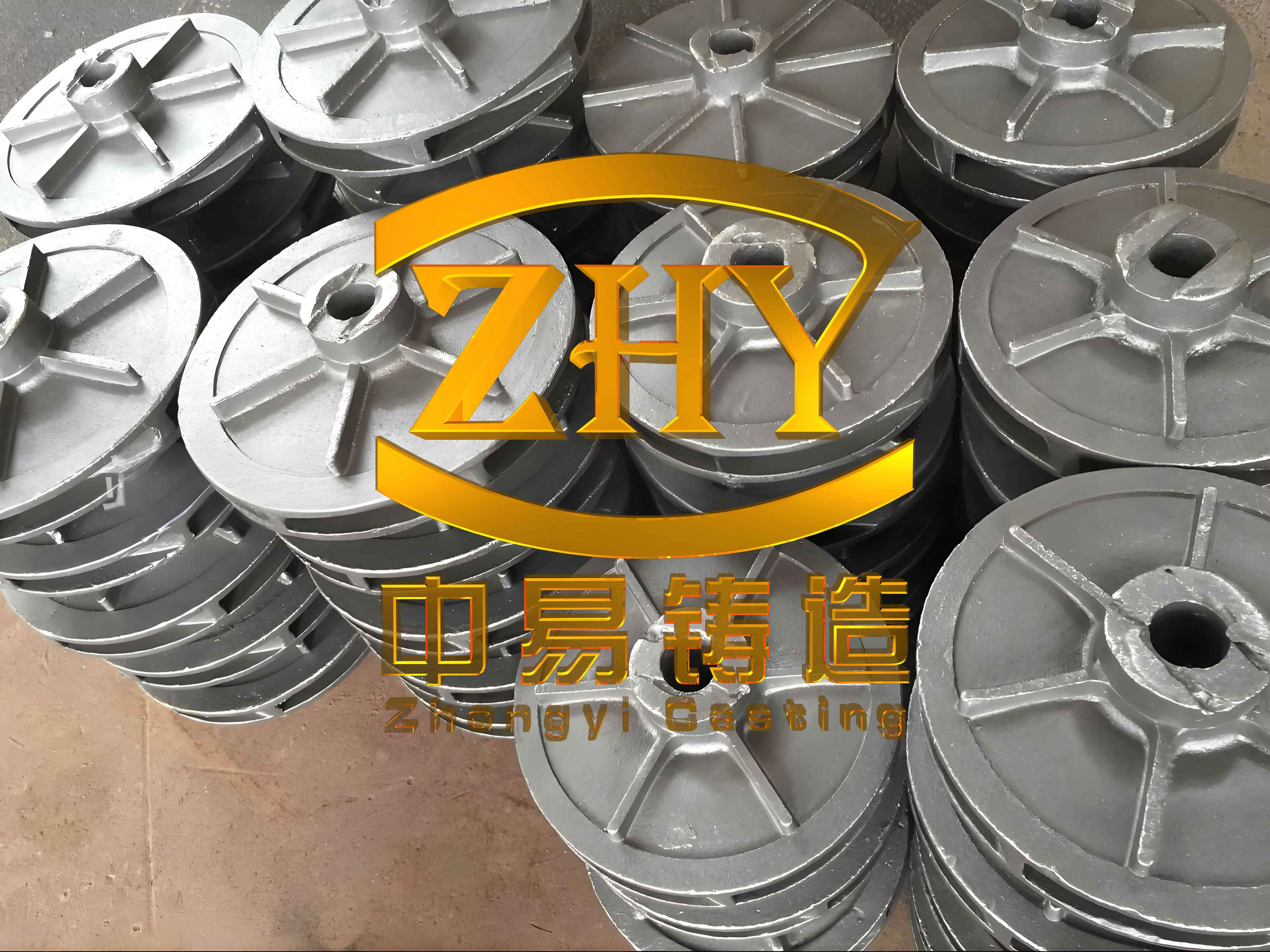
The production of large, flat components in grey cast iron presents unique challenges in lost foam casting. The expansive, thin geometry creates a large surface area of foam that must be vaporized almost simultaneously upon metal impingement. The rapid gas generation, if not properly managed, can overwhelm the permeability of the coating and the sand, leading to a pressure imbalance between the mold cavity and the surrounding flask. This pressure differential is the primary driver for sand movement and subsequent collapse. The metallurgical characteristics of grey cast iron, particularly its solidification behavior and the associated graphite expansion, can interact with the mold stability in complex ways, making the process window for successful casting narrower than for more compact geometries.
Initial Production Conditions and Process Setup
The component in question was a stationary splash guard plate, a critical safety element mounted on either side of a steelmaking converter. Its function is to contain slag and metal splatter during the refining process, protecting personnel and equipment. Unlike movable doors, these plates are fixed, allowing for a more robust and heavier design. The plates were substantial in size, typically 1626 mm x 1400 mm x 40 mm, with individual weights ranging from 240 kg to 380 kg. The specified material was HT150, a common grade of flake graphite grey cast iron.
The lost foam process was employed. Patterns were fabricated from Expanded Polystyrene (EPS) with a density of 18 kg/m³. To combat potential distortion or warping of the large flat grey cast iron plates during solidification, patterns were designed and assembled in pairs. Two pattern copies were spaced 250 mm apart and connected by six 40 mm x 40 mm reinforcing ribs, which would become integral parts of the casting. The initial gating system was positioned along one side of the pattern cluster. The key parameters of the original process are summarized in the table below:
| Process Parameter | Original Specification |
|---|---|
| Pattern Material & Density | EPS, 18 kg/m³ |
| Casting Arrangement | 2 patterns/cluster, 2 clusters/flask (4 castings total) |
| Ingate Total Cross-Sectional Area | 15 cm² (2 ingates, each 15mm x 50mm = 7.5 cm²) |
| Runner Cross-Section | 50 mm x 50 mm |
| Sprue Diameter | φ50 mm |
| Gating Orientation | Vertical step gating on one side |
| Flask Vacuum Setup | Perimeter vacuum wall in extension sleeve + one φ60 mm loose tube between patterns in a cluster |
| Pouring Temperature | 1360°C |
| Pouring Time (per cluster) | ~28 seconds |
| Vacuum Level (Gauge) | -0.060 MPa (pre-pour), -0.050 MPa (during/after pour) |
| Coating Thickness | 2.0 – 2.5 mm |
| Coating Ratio (High-alumina bauxite : #5 Silica Sand) | 10 : 1 by weight |
The pouring procedure involved filling the first cluster, returning to the furnace to tap more metal, and then pouring the second cluster. The vacuum was maintained for 8 minutes after the second pour before release. Despite this structured setup, the scrap rate due to mold collapse approached 30%, indicating fundamental flaws in the process design for this specific grey cast iron component.
Root Cause Analysis of Mold Collapse
A systematic investigation was conducted, focusing on the four pillars of lost foam stability: gating design, pouring dynamics, vacuum effectiveness, and coating integrity.
1. Gating System Design and Pouring Dynamics
The initial gating system was evaluated against established hydraulic principles for grey cast iron casting. The theoretical required ingate area was calculated to ensure a controlled fill rate that matches the foam degradation and gas evacuation capabilities.
The theoretical pouring time \( t \) (in seconds) for a grey cast iron casting can be estimated by:
$$ t = s \sqrt{G} $$
where \( G \) is the casting weight in kg (using the upper bound of 380 kg), and \( s \) is an empirical coefficient. For grey iron, a common value for \( s \) is 1.7. Therefore:
$$ t = 1.7 \times \sqrt{380} \approx 1.7 \times 19.49 \approx 33.1 \text{ seconds} $$
The effective metallostatic head \( H_p \) is approximately half the casting height. For a 40 mm thick plate gated on the side, the height used in the formula is its vertical dimension in the flask (1400 mm), so \( H_p = 0.5 \times 140 \text{ cm} = 70 \text{ cm} \).
The theoretical total ingate area \( A \) (in cm²) can be found using the fluid flow formula:
$$ A = \frac{G}{0.17 \cdot t \cdot \sqrt{H_p}} $$
Substituting the values:
$$ A = \frac{380}{0.17 \times 33.1 \times \sqrt{70}} \approx \frac{380}{0.17 \times 33.1 \times 8.37} \approx \frac{380}{47.0} \approx 8.1 \text{ cm}^2 $$
Accounting for the increased demand in lost foam due to foam decomposition (typically a 10-20% increase), the adjusted required area becomes:
$$ A_{required} \approx 8.1 \times 1.2 \approx 9.7 \text{ cm}^2 $$
Diagnosis: The original ingate area of 15 cm² was substantially larger (over 50%) than the calculated requirement of ~9.7 cm². This resulted in an excessively high pouring rate, causing a violent, rapid vaporization of the large foam pattern. The gas generation rate likely exceeded the evacuation capacity, creating a sudden pressure spike inside the cavity.
Furthermore, the vertical “step gating” configuration, with two ingates one above the other, promoted a detrimental “waterfall” or “flash flow” effect. Metal would preferentially flow through the upper ingate first, cascading down and potentially eroding unfilled foam sections, further destabilizing the mold before the lower sections were properly supported by solidified metal.
2. In-Mold Vacuum Level and Distribution
Vacuum is crucial for maintaining mold rigidity by consolidating the dry sand and, more importantly, for actively extracting the gaseous decomposition products from the pattern through the permeable coating. The gauge reading on the vacuum pump is not representative of the pressure inside the mold cavity, especially for large, dense pattern clusters.
To diagnose this, a probe was fabricated: a φ20 mm tube perforated with φ5 mm holes and wrapped with a stainless steel mesh. This probe was embedded into the sand between the pattern clusters during molding, connected to a separate vacuum gauge. With the main system gauge reading a steady -0.060 MPa (-0.6 bar), the in-mold probe readings were alarmingly higher:
$$ P_{gauge} = -0.060 \text{ MPa}, \quad P_{in-mold} \approx -0.035 \text{ to } -0.045 \text{ MPa} $$
This represents a significant loss of vacuum potential, meaning the sand consolidation force and gas extraction capability at the critical location were severely compromised. The single loose tube placed between the two patterns in a cluster was insufficient to overcome the flow resistance posed by the dense foam and coating.
3. Coating Strength and Permeability
The coating serves as the primary barrier between the decomposing foam and the sand, and it must have sufficient hot strength to withstand the metallostatic pressure and the friction of the advancing metal front until the sand itself is sintered or the metal solidifies. The original coating, while of adequate thickness, felt soft after drying. The binder content (determined by the ratio of high-alumina bauxite to finer #5 silica sand) was likely too low. A weak coating can lead to two failure modes: 1) mechanical failure/erosion when metal first enters, and 2) cracking under thermal stress, allowing liquid metal to penetrate into the sand and cause an instant local collapse.
The findings from the root cause analysis are consolidated below:
| Factor | Original State | Identified Problem | Consequence |
|---|---|---|---|
| Gating Design | Ingate Area = 15 cm²; Step Gating | Area 55% oversized; promotes flash flow. | Excessive pour rate, violent gas generation, flow instability. |
| Vacuum Efficacy | Gauge: -0.060 MPa; Single loose tube. | In-mold vacuum only -0.035 to -0.045 MPa. | Poor sand consolidation, inadequate gas evacuation from cavity core. |
| Coating Integrity | Thickness: 2.0-2.5 mm; Ratio 10:1; Felt soft. | Insufficient binder content, low green/dry strength. | Risk of erosion and thermal cracking, loss of cavity integrity. |
Implemented Process Improvements
The corrective actions were designed to directly address each root cause, creating a synergistic effect to stabilize the mold during the pouring of this large grey cast iron component.
1. Redesign of the Gating System
The ingate total cross-sectional area was reduced to align with the theoretical calculation. The new target was set at approximately 9 cm².
$$ A_{new} = 9.0 \text{ cm}^2 $$
This was achieved by using two ingates, each with dimensions 10 mm x 45 mm, providing a total area of:
$$ 2 \times (1.0 \text{ cm} \times 4.5 \text{ cm}) = 9.0 \text{ cm}^2 $$
To eliminate the “flash flow” effect, the orientation of the ingates was modified. The system was changed from a vertical step to a controlled bottom-up fill. The lower ingate remained perpendicular to the casting. The upper ingate was angled upward at 45 degrees. This geometry ensures that metal initially enters only through the bottom ingate. The upper ingate only begins to feed once the metal level in the cavity rises to its entrance point, ensuring a calm, progressive fill from the bottom upward. This minimizes turbulence and allows for a more uniform gas evolution and evacuation.
2. Enhancement of In-Mold Vacuum
To improve vacuum penetration and distribution within the mold, especially in the critical zone between the two large flat patterns, the vacuum tube arrangement was intensified. The single loose tube per pattern cluster was replaced with a dual-tube setup. Two permeable tubes were strategically placed within the sand between the patterns in each cluster. This effectively doubled the active vacuum extraction surface area in that region, reducing flow resistance and helping to maintain a vacuum level closer to the system gauge reading. The goal was to minimize the gradient:
$$ \Delta P = | P_{gauge} – P_{in-mold} | $$
A smaller \(\Delta P\) indicates more efficient vacuum application. Furthermore, routine inspection and cleaning of the vacuum ports on the flask walls were enforced to prevent blockages that degrade overall system performance.
3. Optimization of Coating Formulation and Application
The coating was strengthened through two complementary measures:
- Increased Thickness: The coating thickness was raised from 2.0-2.5 mm to a range of 2.5-3.0 mm. This provides a more robust barrier and increases its load-bearing capacity.
- Adjusted Formulation: The binder content was increased by altering the refractory blend ratio. The new mass ratio became:
$$ \text{High-alumina bauxite : #5 Silica Sand} = 10 : 1.1 $$
The additional fine silica sand increased the surface area for binder adhesion, thereby enhancing the dry strength and thermal shock resistance of the coating applied to the EPS patterns for the grey cast iron castings.
The summary of all improvements is presented in the following table for clear comparison:
| Factor | Original Process | Improved Process | Principle & Benefit |
|---|---|---|---|
| Ingate Area | 15 cm² (7.5 cm² each) | 9 cm² (4.5 cm² each) | Matches theoretical fill rate (≈33s). Controls foam gasification rate. |
| Gating Geometry | Vertical step gates. | Bottom gate (0°) + Angled top gate (45° upward). | Ensures bottom-up filling. Eliminates flash flow and associated turbulence. |
| Vacuum Setup | One loose tube per cluster. | Two loose tubes per cluster. | Improves vacuum distribution and in-mold level, enhancing sand strength and gas extraction. |
| Coating Thickness | 2.0 – 2.5 mm | 2.5 – 3.0 mm | Provides stronger mechanical barrier against metal penetration and erosion. |
| Coating Ratio (Binder) | 10 : 1 | 10 : 1.1 | Increased fines content improves dry strength and thermal integrity of the coating layer. |
Results and Confirmation
The implementation of these integrated improvements yielded immediate and stable results. The pouring time for each cluster naturally extended to the calculated range of 33 to 35 seconds, confirming the correct hydraulic sizing of the gating system. Metal entry was observed to be smooth and progressive. Crucially, the differential between the system vacuum gauge and the actual in-mold vacuum was minimized, indicating effective gas evacuation. The enhanced coating exhibited significantly higher dry strength, able to withstand handling without damage. Most importantly, the defect of mold collapse during pouring was completely eliminated for these large grey cast iron splash guard plates. The yield rate recovered to near 100% for this specific defect category, validating the technical approach.
Discussion and Generalized Methodology
The successful resolution of this collapse problem underscores a systematic methodology for troubleshooting lost foam casting defects, especially for challenging geometries like large flat plates in grey cast iron.
1. Quantify, Don’t Assume: Relying on past experience or rules of thumb is insufficient. Critical parameters must be calculated and measured.
- Gating: Always calculate the theoretical pouring time and ingate area using established formulas, applying the appropriate safety factor for lost foam (typically 1.1-1.3 for grey cast iron). The key equations are:
$$ t = s \sqrt{G} $$
$$ A_{theory} = \frac{G}{0.17 \cdot t \cdot \sqrt{H_p}} $$
$$ A_{lostfoam} = A_{theory} \times F_{safety} $$ - Vacuum: Do not trust the pump gauge alone. Use in-mold probes to map the actual vacuum profile within the sand, especially around and inside large pattern clusters. The pressure drop \(\Delta P\) across the coating and sand is a critical process variable:
$$ \Delta P = P_{atmosphere} – P_{cavity} $$
This \(\Delta P\) must be sufficient to hold the sand but not so high as to draw metal into the coating pores. Optimizing tube placement and number is essential to manage this.
2. Understand the Physics of Fill: The direction of metal advance is as important as the speed. For large flat areas, a bottom-up fill is almost always mandatory to provide immediate support to the degrading foam ceiling. Gating designs that cause top-first filling or waterfall effects are a primary suspect in collapse scenarios.
3. Coating as a Structural Component: The coating is not just a refractory layer; it is a load-bearing structure during the initial stages of the pour. Its strength must be engineered. Factors include:
- Binder type and content (affecting green/dry/hot strength).
- Refractory grain size distribution (affecting permeability and strength).
- Applied thickness (a primary determinant of its resistance to metal pressure \(F_{metal} \propto \rho_{iron} \cdot g \cdot h \cdot A\) ).
A simple qualitative strength test (e.g., thumbnail hardness) post-drying is a valuable quick check.
4. The Synergy of Factors: Collapse is rarely due to a single extreme deviation. More often, it is the result of multiple parameters operating at the poor end of their acceptable ranges. A moderately high pour rate combined with a moderately low vacuum and a moderately weak coating can lead to failure, whereas a significant issue in only one area might be survivable. Therefore, the improvement strategy should be holistic, addressing all identified weak links.
5. Material-Specific Considerations for Grey Cast Iron: The expansion associated with graphite precipitation during the eutectic solidification of grey cast iron can exert pressure on the mold walls. In a properly designed process, this expansion can help counteract the shrinkage from the liquid-to-solid phase change. However, if the mold is already weakened (e.g., by poor vacuum consolidation or a failing coating), this internal pressure can contribute to wall movement or sand incursion, manifesting as a collapse or a misshapen casting. Ensuring robust mold integrity is thus even more critical for grey cast iron to harness its natural expansion characteristics beneficially.
Conclusion
Mold collapse in lost foam casting, particularly for large, flat grey cast iron components, is a preventable defect. It arises from an imbalance between the forces attempting to destabilize the mold cavity—primarily from rapid gas generation and metallostatic pressure—and the forces maintaining its integrity—coating strength, sand consolidation via vacuum, and controlled metal fill dynamics. The case of the converter splash guard plate demonstrates that a methodical approach is required: using fundamental calculations to right-size the gating system, direct measurement to validate process conditions like in-mold vacuum, and practical tests to confirm material properties like coating strength. By treating the mold as a complex, interactive system and optimizing each element—from the sprue base to the vacuum pump—the inherent challenges of producing sound, large-format grey cast iron castings via the lost foam process can be consistently overcome. This systematic framework for analysis and improvement is applicable to a wide range of lost foam casting defects, promoting robust and reliable production.