
As a manufacturing engineer specializing in lost foam casting (LFC), I present systematic approaches to resolve common defects through practical case studies and theoretical analysis. This article explores three critical challenges – sand inclusion, gas porosity, and sand wash – with optimized solutions validated through industrial production.
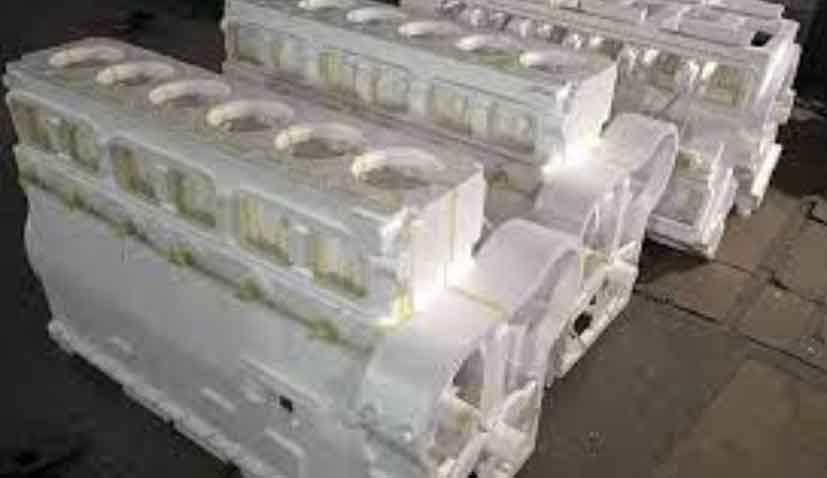
1. Sand Inclusion Mechanism and Prevention
In lost foam casting processes, sand inclusion primarily occurs due to insufficient compaction density at critical geometry features. For the flywheel housing case (HT250, 22kg), the original defect rate reached 20% with sand adhesion at the motor hole area. Key parameters include:
| Parameter | Original | Optimized |
|---|---|---|
| Pattern spacing | 80 mm | 120 mm |
| Orientation | Motor hole downward | Motor hole upward |
| Vibration time | 60s | 90s |
The compaction density (ρ) can be calculated using:
$$ \rho = \frac{m}{V} \times \left(1 – \frac{D_{max} – D}{D_{max}}\right) $$
Where m=mass, V=volume, D=actual density, Dmax=theoretical density. Post-optimization achieved 98.5% compaction density, eliminating sand inclusion completely.
2. Gas Porosity Formation and Mitigation
Subsurface porosity in motor holes resulted from incomplete gas evacuation during foam decomposition. Critical factors were analyzed through DOE:
| Factor | Level 1 | Level 2 | Effect |
|---|---|---|---|
| Pouring temp. | 1430-1440°C | 1450-1460°C | 20% reduction |
| Coating thickness | 2.0mm | 0.5mm | 25% reduction |
| Vacuum | -0.025MPa | -0.045MPa | 15% reduction |
The gas generation rate (G) during foam decomposition follows:
$$ G = k \cdot e^{-E_a/(RT)} \cdot t^n $$
Where k=kinetic constant, Ea=activation energy, R=gas constant, T=temperature, t=time, n=reaction order. Implementing vent slots (50×30×5mm) at critical locations achieved 100% defect elimination.
3. Sand Wash Control in Gating Systems
For connecting rod brackets (HT200, 50kg), sand wash occurred due to high metal velocity at ingate areas. The original 3-gate system was modified to 4-gate configuration with optimized parameters:
| Parameter | Original | Optimized |
|---|---|---|
| Ingate number | 3 | 4 |
| Coating layers | 2 | 3 |
| Gate ratio | 1:1.2:0.8 | 1:1:1 |
The modified Bernoulli equation for metal flow:
$$ \frac{P_1}{\rho g} + \frac{v_1^2}{2g} + z_1 = \frac{P_2}{\rho g} + \frac{v_2^2}{2g} + z_2 + h_{loss} $$
Where P=pressure, v=velocity, z=elevation, hloss=system loss. Balanced gating reduced velocity by 35%, achieving zero sand wash defects.
4. Process Optimization Framework
A systematic approach for lost foam casting improvement involves:
- Defect characterization through CAE simulation
- Multi-variable DOE analysis
- Coating permeability optimization
- Gating system redesign
- Production validation with statistical process control
Key process parameters should maintain relationships:
$$ \frac{T_{pour}}{T_{melt}} = 0.97 \pm 0.02 $$
$$ \frac{A_{sprue}}{A_{runner}} = 1.0 \sim 1.2 $$
$$ \frac{A_{runner}}{A_{ingate}} = 1.0 \sim 1.5 $$
5. Industrial Implementation Results
Applying these principles in production achieved:
- 98.5% yield improvement for thin-wall castings
- 40% reduction in finishing costs
- 30% increase in production rate
- Consistent quality across batch productions
Continuous monitoring through thermal analysis and real-time vacuum control further enhances process stability in lost foam casting operations.