
In the realm of industrial machinery, bearing housings serve as critical structural components. Their primary function is to support and precisely locate rolling element bearings, ensuring the outer race remains fixed while allowing the inner race to rotate with high accuracy and minimal friction. This directly influences the operational efficiency, reliability, and lifespan of the entire rotating assembly. The demand for high-integrity gray iron castings for such applications is paramount, as defects like shrinkage porosity or misruns can lead to catastrophic failure. Traditionally, foundry process development relied heavily on the iterative “trial-and-error” method, which is both time-consuming and resource-intensive. The advent of numerical simulation technology has revolutionized this practice. By complementing empirical knowledge with virtual prototyping, simulation enables engineers to visualize filling patterns, solidification sequences, and defect formation with remarkable clarity before any metal is poured. This approach not only conserves materials and labor but also significantly accelerates process development cycles, leading to more robust and reliable gray iron castings. This article details the first-person journey of optimizing the casting process for an HT250 bearing housing upper half, leveraging ProCAST simulation software to move from an initial design to a validated, high-quality production-ready process.
Part Analysis and Material Considerations
The component in question is the upper half of a sizable bearing housing. The overall envelope dimensions are approximately 1085 mm in length, 910 mm in width, and 380 mm in height. A critical characteristic of this part is the significant variation in wall thickness, ranging from a minimum of 20 mm to a maximum of 145 mm. This non-uniform geometry inherently creates pronounced thermal mass differentials, leading to isolated hot spots or “hot junctions” in the thicker sections. During solidification, these hot spots are the last to freeze, often resulting in shrinkage porosity if not properly fed. The part’s internal structure features a large cavity, and its bottom face is a major machining and load-bearing surface, making its soundness essential.
The material specified is gray iron grade HT250. This alloy is characterized by a pearlitic matrix with flake graphite. Its properties, including good strength, excellent damping capacity, wear resistance, and machinability, make it a standard choice for heavy-duty machinery components like bearing housings. A key metallurgical advantage of gray iron castings during solidification is graphitic expansion. The precipitation and growth of graphite flakes during the eutectic reaction create an internal volume expansion that can counteract the liquid shrinkage of the remaining metal. This self-feeding characteristic reduces, but does not eliminate, the need for external feed metal (risers), especially in sections with high thermal modulus.
The following table summarizes key material and process parameters for HT250 commonly used in such simulations.
| Parameter | Value / Description | Notes |
|---|---|---|
| Material Grade | HT250 (Gray Iron) | Pearlitic matrix with flake graphite (Type A). |
| Key Properties | Good tensile strength, damping, wear resistance. | Ideal for vibration-prone, load-bearing parts. |
| Liquidus Temperature | ~1200°C | Temperature at which solidification begins. |
| Solidus Temperature | ~1150°C | Temperature at which solidification ends. |
| Typical Pouring Temperature | 1320 – 1380°C | Superheat above liquidus for fluidity. |
| Pattern Material | Wood or Plastic | For single or low-volume production. |
| Molding Medium | Acid-Cured Furan No-Bake Sand | Good dimensional accuracy, suitable for jobbing. |
| Mold Coating | Alcohol-Based Graphite Paint | Improves surface finish and prevents metal penetration. |
Initial Casting Process Design
The initial process design is grounded in fundamental foundry principles, considering the part’s geometry, material behavior, and quality requirements.
Selection of Pouring Position and Parting Line
Three potential pouring positions were conceptually evaluated. The chosen orientation places the large, critical bottom face downward. This decision offers several advantages: it promotes the metallurgical quality of this primary machined surface, facilitates core placement and stabilization, and positions the heaviest sections (potential hot spots) in the upper regions of the mold cavity, which is favorable for the subsequent placement of feeding risers. While this choice may complicate pattern withdrawal slightly, its benefits for casting integrity are decisive. The parting line is consequently set at this bottom face, employing a simple two-part cope and drag mold, which maximizes dimensional accuracy by keeping the entire casting within a single mold half (the drag).
Gating System Design
A bottom-gating system was selected. This design introduces molten metal into the mold cavity at its lowest point, promoting a calm, progressive fill from the bottom upward. This minimizes turbulence, air entrapment, and oxide formation, which is crucial for producing sound gray iron castings. A pressurized gating system (choke at the sprue base) was chosen to ensure rapid filling and a tight skin. The cross-sectional area ratios for a typical pressurized system for gray iron are: Total Sprue Area : Total Runner Area : Total Ingate Area = 1.15 : 1.1 : 1.
The choke area (total ingate area) is calculated first using empirical formulas. For a casting of this size, the pouring time \( t \) (in seconds) is often estimated from the total poured mass \( G_L \) (in kg) using a formula like:
$$t = S_1 \sqrt[3]{G_L}$$
where \( S_1 \) is an empirical coefficient, typically between 1.7 and 2.0 for faster pouring of medium-sized castings. Assuming a casting weight of 566 kg and a total poured weight \( G_L \) of 680 kg (including gating), with \( S_1 = 1.8 \), the estimated pouring time is:
$$t = 1.8 \times \sqrt[3]{680} \approx 1.8 \times 8.75 \approx 15.8 \text{ seconds}.$$
A more traditional approach for iron castings in the 100-1000 kg range might use:
$$t = S_2 \sqrt{G_L}$$
where \( S_2 \) could be approximately 1.8, giving:
$$t = 1.8 \times \sqrt{680} \approx 1.8 \times 26.1 \approx 47 \text{ seconds}.$$
For a conservative, controlled fill to match the simulation parameters later, a pouring time of approximately 47 seconds is adopted. Using a standard fluidity calculation (e.g., based on a presumed flow velocity and fill height), the required choke area \( \sum A_{choke} \) is determined. For this exercise, let’s assume a calculated choke area of 8.75 cm².
From the pressurized system ratios:
$$\sum A_{sprue} = 1.15 \times \sum A_{choke} = 1.15 \times 8.75 = 10.06 \text{ cm}^2 \quad \Rightarrow \quad \text{Diameter} \approx 36 \text{ mm}$$
$$\sum A_{runner} = 1.1 \times \sum A_{choke} = 1.1 \times 8.75 = 9.63 \text{ cm}^2$$
$$\sum A_{ingate} = \sum A_{choke} = 8.75 \text{ cm}^2$$
The gating dimensions are summarized below:
| Gating Element | Calculated Area (cm²) | Designed Dimension |
|---|---|---|
| Sprue (Bottom) | 10.06 | ⌀ 36 mm (circular) |
| Runner (Total) | 9.63 | 30 mm x 32 mm (rectangular, divided) |
| Ingates (Total) | 8.75 | 4 ingates, each ~22 mm x 10 mm |
Numerical Simulation of the Initial Process
A 3D model of the casting, including the designed gating system, was created and meshed for simulation. The initial conditions were set: a pouring temperature of 1350°C, a pouring time of 47 seconds, and a mold initial temperature of 20°C. The simulation of the filling phase confirmed a tranquil, bottom-up fill without excessive turbulence. The temperature distribution at the end of filling showed the expected thermal gradient, with cooler metal at the bottom and hotter metal rising to the top.
The most critical analysis came from the solidification simulation and the resulting defect prediction. Without any feeding risers, the software’s shrinkage porosity module clearly highlighted several problematic zones. These defects were predominantly located in the thickest sections of the casting, precisely at the anticipated hot spots. The largest concentrated defect appeared in the massive central hub. This virtual result validated the initial concern: the natural solidification sequence, driven by geometry alone, led to isolated liquid pools that could not be fed, resulting in internal shrinkage. This is a common challenge in producing sound gray iron castings with varying wall thickness.
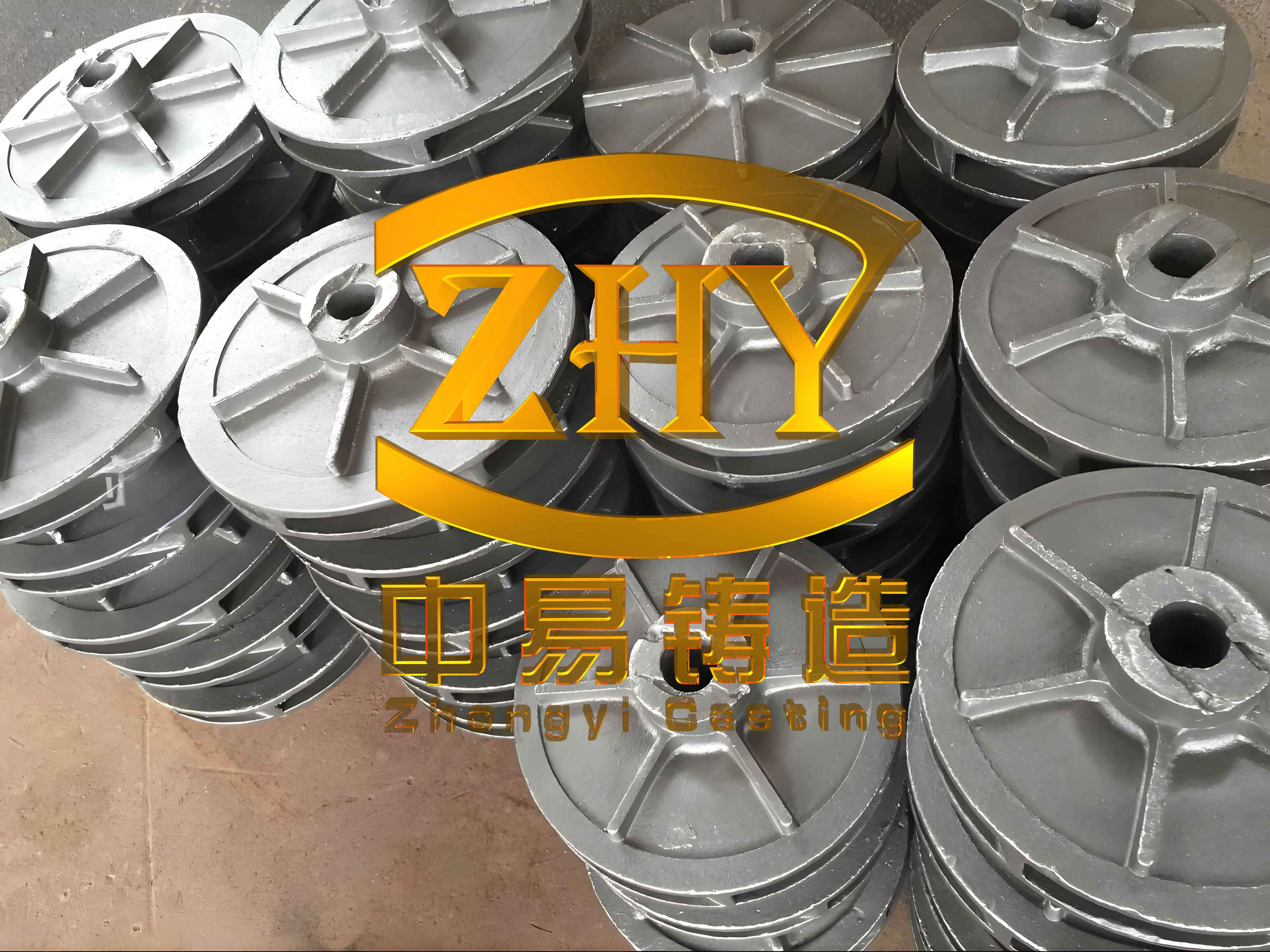
The figure above illustrates a typical high-quality gray iron casting, similar to the bearing housing, highlighting the importance of achieving a defect-free internal structure for such load-bearing components.
Process Optimization via Riser and Chill Design
Guided by the “directed solidification” principle, the optimization strategy aimed to establish a controlled thermal gradient, ensuring the thickest sections (hot spots) solidified last and were fed by strategically placed risers. Chills were employed to locally accelerate cooling and eliminate secondary hot spots, thereby extending the effective feeding range of the risers.
Riser Design Calculation
Open-top (side) risers were selected for their effectiveness and ease of manufacturing in a jobbing shop. Their dimensions were calculated based on the thermal modulus (volume-to-cooling-surface-area ratio) of the sections they were intended to feed. For a cylindrical riser feeding a simple body, a common heuristic is:
$$D_R = k \times T$$
where \( D_R \) is the riser diameter, \( T \) is the thickness or “hot spot diameter” of the feeding section, and \( k \) is a factor typically between 1.5 and 2.0 for gray iron, leveraging its graphitic expansion. The riser height \( H_R \) is usually set between 1.5 and 2.0 times \( D_R \).
For the main central hub (Hot Spot 1, with an equivalent modulus yielding \( T_1 \approx 66.5 \text{ mm} \)), with \( k = 1.6 \):
$$D_{R1} = 1.6 \times 66.5 \approx 106 \text{ mm} \quad \text{(rounded to 110 mm)}$$
$$H_{R1} = 1.8 \times D_{R1} \approx 198 \text{ mm} \quad \text{(rounded to 200 mm)}$$
For a smaller hub on the rear flank (Hot Spot 2, \( T_2 \approx 50 \text{ mm} \)):
$$D_{R2} = 1.6 \times 50 = 80 \text{ mm}$$
$$H_{R2} = 1.8 \times 80 = 144 \text{ mm} \quad \text{(rounded to 150 mm)}$$
The riser neck dimensions are designed to freeze after the casting section but before the riser body itself.
Chill Design and Placement
External chills, made of cast iron or steel, were designed to act as localized heat sinks. Their thickness is critical: too thin, and they saturate quickly; too thick, and they may cause undesirable chilling effects or fusion. A rule of thumb is to make the chill thickness equal to or slightly greater than the thickness of the casting section it contacts. For the various thinner ribs and walls adjacent to hot areas, six chills with thicknesses of 10-15 mm were designed. Their placement was informed by the solidification iso-surface plots from the initial simulation, targeting areas that began to solidify late but were not directly fed by the main risers.
| Optimization Element | Location Purpose | Designed Dimensions |
|---|---|---|
| Riser 1 (Main) | Feed central heavy hub (Hot Spot 1) | ⌀ 110 mm, H 200 mm |
| Riser 2 (Secondary) | Feed rear flank hub (Hot Spot 2) | ⌀ 80 mm, H 150 mm |
| Chills (6 pieces) | Accelerate cooling on ribs & thin-thick junctions | Rectangular, thickness = 10-15 mm |
Simulation of the Optimized Design
The modified model, incorporating the two risers and six chills, was simulated. The results showed a marked improvement. The solidification sequence became more orderly, progressing from the chilled areas and thinner sections toward the risers. The predicted shrinkage porosity volume decreased substantially and was largely relocated from the casting body into the riser heads—exactly the intended function of a feeder. This confirmed the effectiveness of the risers in feeding the targeted hot spots. However, a closer inspection of the temperature field and defect prediction revealed a remaining, smaller hot spot adjacent to Riser 1, indicating its feeding range was not fully covering that region.
Second-Stage Optimization and Final Results
To address the remaining hot spot, a seventh, larger chill was added to the thermal analysis. This chill was specifically sized for the moderate thickness of the problematic junction, with a thickness of 30 mm to ensure sufficient heat extraction capacity. A final simulation run was conducted with this enhanced layout (2 risers, 7 chills).
The outcome was highly satisfactory. The final defect prediction plot showed that virtually all macro-scale shrinkage porosity was successfully moved into the risers. The casting body itself was predicted to be sound, with any remaining porosity at a level considered acceptable for this grade of gray iron castings. The table below contrasts the key outcomes before and after the full optimization cycle.
| Evaluation Metric | Initial Design (No Risers/Chills) | Final Optimized Design |
|---|---|---|
| Primary Defect Location | Inside casting body (central hub, ribs) | Primarily inside riser heads |
| Relative Defect Volume in Casting | High | Very Low / Acceptable |
| Solidification Sequence | Disordered, multiple isolated hot spots | Directed, progressing from chills to risers |
| Feeding Efficiency | Poor (reliance on graphitic expansion only) | Excellent (effective pressure feed from risers) |
| Predicted Casting Yield | Higher (but with internal defects) | Moderately lower, but guaranteeing quality |
Conclusion
The systematic application of numerical simulation software, specifically ProCAST, has been instrumental in developing a robust casting process for a complex HT250 bearing housing. Beginning with a basic gating design, the simulation quickly identified the inherent solidification problems caused by wall thickness variations. Through an iterative virtual optimization process—involving the strategic design and placement of two open risers and seven external chills—a thermally efficient layout was achieved. This final design promotes a controlled, directional solidification front, effectively channeling shrinkage porosity into the designated feeder heads and thereby ensuring the internal soundness of the casting. This case underscores the indispensable role of simulation in modern foundry practice, transforming the art of producing reliable gray iron castings into a more predictable and engineering-driven science. It reduces development risk, saves significant cost in physical trials, and provides a deep, visual understanding of the process, ultimately leading to higher quality and more dependable cast components for demanding industrial applications.