
In the manufacturing of large machine tools, the box bed stands as a pivotal structural component, serving as the core skeleton that supports loads from other machine elements. The quality of these casting parts directly influences the precision, performance, and service life of the entire equipment. As an engineer deeply involved in foundry operations, I have encountered numerous challenges in producing such complex casting parts, particularly thin-walled oil tank sections prone to defects like poor core brace fusion and blowholes, which can lead to oil leakage and scrapping. This article, based on my firsthand experience, details a comprehensive process improvement initiative aimed at enhancing the reliability of these essential casting parts. Through methodical analysis and optimization of melting parameters, gating systems, and core assembly techniques, we successfully mitigated defects, ensuring consistent delivery of high-quality casting parts. The insights shared here underscore the importance of tailored process design in achieving defect-free casting parts for demanding applications.
The structural integrity of box bed casting parts is paramount, as they must withstand operational stresses while maintaining dimensional stability. Typically made from gray iron such as HT300, these casting parts feature variable wall thicknesses, ranging from 15 mm to 90 mm, with complex internal cavities for oil reservoirs. Any imperfection, especially in thin-walled zones, can compromise functionality. In our production line, initial attempts yielded unsatisfactory results, with defects like slag inclusion, blowholes, and hardness deficiencies plaguing the casting parts. This prompted a thorough investigation into the root causes, leading to a holistic process revamp. The journey from high rejection rates to near-zero defects highlights the critical role of precision in crafting durable casting parts. Below, I elaborate on the technical nuances, employing tables and formulas to summarize key data, ensuring clarity for practitioners seeking to optimize similar casting parts.
To begin, let’s examine the original process setup. The box bed casting parts had a轮廓尺寸 of 3100 mm × 1265 mm × 785 mm and a weight of 2989 kg. The casting orientation placed the guide rail surface downward and the oil tank face upward, with the entire cavity in the cope. A bottom-gating system was used, with filters installed beneath the runner to minimize slag entry. The gating ratio was set as follows: $$\Sigma F_{\text{sprue}} : \Sigma F_{\text{runner}} : \Sigma F_{\text{ingate}} = 1 : 1.56 : 1.53$$ where the sprue diameter was 90 mm, runner dimensions were (105 mm + 84 mm) × 105 mm, and ingates included four at 35 mm diameter and three at 50 mm diameter. The total ingate cross-sectional area was calculated as: $$A_{\text{ingate}} = 4 \times \pi \left(\frac{35}{2}\right)^2 + 3 \times \pi \left(\frac{50}{2}\right)^2 = 4 \times 962.11 \, \text{mm}^2 + 3 \times 1963.50 \, \text{mm}^2 = 3848.44 \, \text{mm}^2 + 5890.50 \, \text{mm}^2 = 9738.94 \, \text{mm}^2$$ Eight S100 mm and two S80 mm spherical risers were employed without chills. Melting parameters involved a charge mix as shown in Table 1, aiming for molten iron composition per Table 2. The pouring temperature was initially controlled at 1370–1390°C, with superheating to 1490–1510°C and inoculation using 0.5% FeSi.
| Material Type | Percentage (%) |
|---|---|
| Pig Iron | 5 |
| Machinery Iron | 35 |
| Steel Scrap | 60 |
| Carburizer | 2.0 |
| Ferrosilicon (FeSi) | 0.7 |
| Ferromanganese (FeMn) | 0.4 |
| Element | Target Range (wt%) |
|---|---|
| Carbon (C) | 3.12 ± 0.03 |
| Silicon (Si) | 1.40 ± 0.03 |
| Manganese (Mn) | 0.65 ± 0.03 |
| Phosphorus (P) | ≤ 0.04 |
| Sulfur (S) | 0.08–0.12 |
| Titanium (Ti) | ≤ 0.030 |
| Lead (Pb) | ≤ 0.0015 |
Despite this setup, the produced casting parts exhibited multiple issues. Hardness measurements fell below the required 183 HBN, with values as low as 164–176 HBN, indicating insufficient pearlite content (80–90%). Metallurgical analysis revealed that the carbon equivalent (CE) was偏高, promoting ferrite formation. The CE can be expressed as: $$\text{CE} = \text{C} + \frac{1}{3}(\text{Si} + \text{P})$$ For our initial composition, with C at 3.12% and Si at 1.75%, CE approximated 3.70%, which is conducive to graphitization, reducing hardness. Additionally, slag inclusions on the cope surface were prevalent, necessitating extensive welding repairs. Most critically, severe blowholes occurred during pouring, particularly near core numbers 10 and 11, leading to a rejection rate of 53.8% due to leaks and poor core brace fusion. These defects underscored the vulnerabilities in producing such intricate casting parts.
The root cause analysis pinpointed several factors. First, the open gating system and low pouring temperatures caused turbulent flow, promoting slag entrapment and cold shuts. The fluid dynamics can be modeled using the Bernoulli equation for incompressible flow: $$P + \frac{1}{2} \rho v^2 + \rho gh = \text{constant}$$ where \(P\) is pressure, \(\rho\) is density, \(v\) is velocity, and \(h\) is height. In our case, high velocity at ingates likely led to sand erosion and gas aspiration. Second, core supports were inadequate; cores 10 and 11 had limited fixation, causing movement during metal entry and resulting in blowholes. The pressure from molten iron can be estimated as: $$P_{\text{hydrostatic}} = \rho g h_{\text{metal}}$$ with \(\rho \approx 7000 \, \text{kg/m}^3\) for iron, a head height of 0.5 m yields ~34 kPa, enough to displace loosely held cores. Third, ordinary core braces failed to fuse properly due to localized chilling, exacerbated by inconsistent pouring temperatures. This highlighted the need for robust design in casting parts with thin sections.
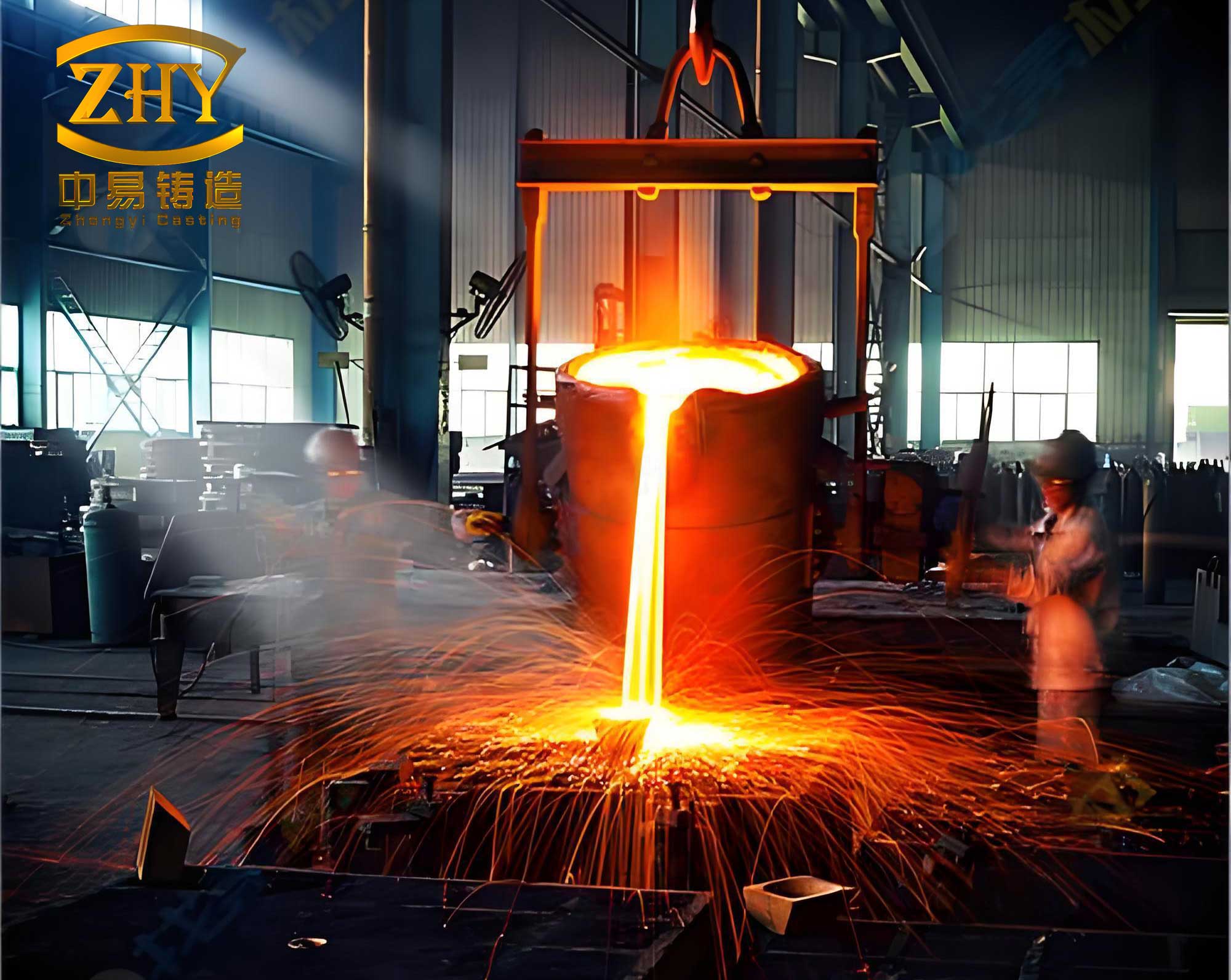
To address these challenges, we implemented multifaceted improvements, focusing on both metallurgical and geometrical aspects of the casting parts. In melting, we adjusted the charge to increase steel scrap content, enhancing hardness potential. The revised composition targets are summarized in Table 3, with Mn raised to promote pearlite and C lowered to reduce CE. The new CE calculation, with C at 3.07% and Si at 1.71%, gives: $$\text{CE} = 3.07 + \frac{1}{3}(1.71 + 0.04) \approx 3.65$$ slightly lower but still optimized for strength. Pouring temperature was elevated to 1380–1400°C to improve fluidity and reduce fusion issues. Inoculation remained at 0.5% FeSi, but we emphasized precise temperature control using pyrometers, adhering to the relationship between superheat and undercooling: $$\Delta T = T_{\text{pour}} – T_{\text{liquidus}}$$ where \(T_{\text{liquidus}}\) for HT300 is ~1150°C, so \(\Delta T \approx 230–250°C\) ensured adequate nucleation.
| Element | Revised Target (wt%) | Rationale |
|---|---|---|
| C | 3.07 ± 0.03 | Lower CE to curb ferrite |
| Si | 1.71 ± 0.03 | Balance graphitization |
| Mn | 0.95 ± 0.03 | Boost pearlite formation |
| P | ≤ 0.04 | Minimize brittleness |
| S | 0.08–0.12 | Aid inoculation |
Casting process modifications were more radical. We transitioned to a 3D-printed core assembly method, eliminating traditional core braces for critical sections. Cores 8 and 11 were redesigned with embedded studs, allowing secure fastening to adjacent cores via bolts. This “benchmark core” approach reduced reliance on supports, minimizing sand displacement and blowhole risks. The assembly clearance between cores was increased from 1 mm to 1.5 mm to accommodate thermal expansion, calculated using the coefficient of thermal expansion for silica sand: $$\alpha \approx 12 \times 10^{-6} \, \text{°C}^{-1}$$ For a temperature rise of 1000°C, the expansion \(\Delta L = \alpha L_0 \Delta T\) gives ~1.5 mm for a 125 mm core dimension, justifying the gap. Moreover, we added overflow risers on the cope, raising the count from 10 to 16, enhancing venting and slag trapping. The total vent area increased by 5850 mm², ensuring smoother gas escape. The gating system was fine-tuned to maintain a choked-pour profile, with the ratio adjusted to: $$\Sigma F_{\text{sprue}} : \Sigma F_{\text{runner}} : \Sigma F_{\text{ingate}} = 1 : 1.8 : 1.6$$ though具体 dimensions were similar, the focus was on平稳 filling. This holistic redesign aimed at producing flawless casting parts.
The results were transformative. Over 40 consecutive productions, the casting parts exhibited pearlite content exceeding 95%, tensile strength of 315–335 MPa, and hardness稳定的 at 183–192 HBN, meeting all specifications. Defect rates plummeted below 1.5%, with no blowholes or core brace fusion issues observed. The improved process also reduced cleaning efforts, as slag inclusions vanished. To quantify the enhancement, consider the quality index \(Q\) defined as: $$Q = \frac{H \times S}{D}$$ where \(H\) is hardness (HBN), \(S\) is strength (MPa), and \(D\) is defect density (defects per unit area). For initial casting parts, \(Q_{\text{old}} \approx 180 \times 300 / 0.5 = 108,000\), while for improved ones, \(Q_{\text{new}} \approx 190 \times 325 / 0.01 = 6,175,000\), showcasing a dramatic leap. This underscores the efficacy of targeted optimizations in manufacturing robust casting parts.
Further analysis involves solidification modeling. Using Fourier’s heat conduction equation: $$\frac{\partial T}{\partial t} = \alpha \nabla^2 T$$ where \(\alpha\) is thermal diffusivity, we simulated cooling rates in thin-walled zones. The Chvorinov’s rule for solidification time \(t\) is: $$t = k \left( \frac{V}{A} \right)^2$$ with \(k\) as a constant. For our 15 mm wall, \(V/A \approx 0.0075 \, \text{m}\), yielding \(t \approx 50 \, \text{s}\), necessitating rapid feeding to avoid shrinkage. The riser design was validated using the modulus method: $$M_{\text{riser}} \geq 1.2 \times M_{\text{casting}}$$ where modulus \(M = V/A\). For the thickest section (90 mm), \(M \approx 0.045 \, \text{m}\), so risers with \(M \geq 0.054 \, \text{m}\) were selected, ensuring adequacy. These theoretical underpinnings reinforced our practical adjustments for reliable casting parts.
| Metric | Original Process | Improved Process |
|---|---|---|
| Hardness (HBN) | 164–185 | 183–192 |
| Pearlite Content (%) | 80–90 | ≥95 |
| Tensile Strength (MPa) | 290–310 | 315–335 |
| Defect Rate (%) | 53.8 | <1.5 |
| Pouring Temperature (°C) | 1370–1390 | 1380–1400 |
| Core Fixation Method | Conventional Braces | 3D-Printed Stud Assembly |
In conclusion, the successful optimization of box bed casting parts demonstrates the interplay between metallurgy, geometry, and process control. Key takeaways include: elevating Mn and moderating C/Si to enhance pearlite; employing 3D-printed cores for precise assembly; and increasing pouring temperatures with better gating design. These steps collectively ensure that casting parts meet stringent quality benchmarks. For future work, integrating real-time monitoring and advanced simulation could further refine such casting parts. Ultimately, the journey underscores that meticulous attention to detail is indispensable in producing high-performance casting parts for critical applications, driving efficiency and reliability in industrial machinery.
Reflecting on this experience, I emphasize that every casting parts project demands a tailored approach. The principles outlined here—from composition tweaks to innovative core solutions—are adaptable to other complex casting parts. As foundries evolve, embracing technologies like 3D printing and data analytics will become standard for achieving defect-free casting parts. I encourage fellow engineers to continuously experiment and document their learnings, fostering a culture of improvement in crafting durable casting parts. Through such efforts, we can elevate the entire industry, ensuring that casting parts remain the backbone of modern manufacturing.