
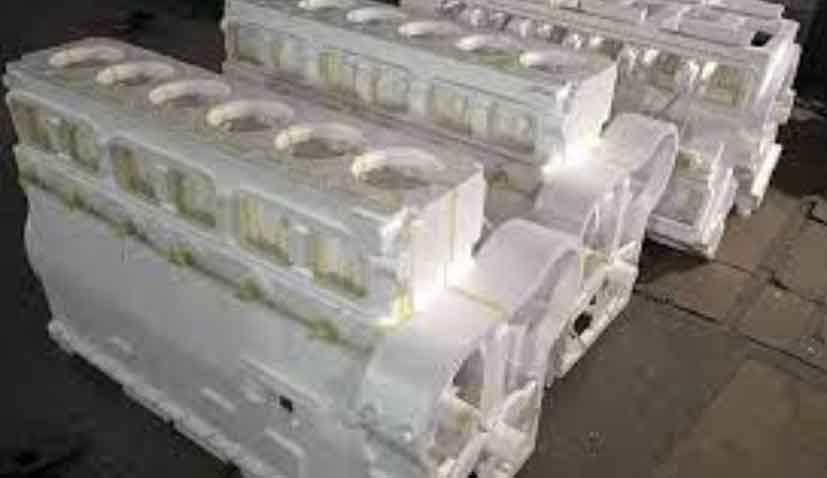
This study addresses surface wrinkles and shrinkage porosity defects in ductile iron (QT450-10) gearbox housings produced through lost foam casting. By redesigning the gating system and implementing innovative cooling strategies, we achieved significant improvements in casting quality while maintaining high process yield.
1. Defect Formation Mechanisms
1.1 Wrinkle Defect Analysis
Wrinkles predominantly occurred at the casting’s upper surfaces and sidewalls due to turbulent flow patterns in the original top-gating system. The decomposition of expanded polystyrene (EPS) patterns generated gas-liquid-solid residues that became trapped in slow-filling areas. The critical Reynolds number for laminar flow in lost foam casting can be expressed as:
$$Re_c = \frac{\rho v D}{\mu} < 2000$$
where:
ρ = molten metal density (7,100 kg/m³ for ductile iron)
v = flow velocity
D = characteristic diameter
μ = dynamic viscosity (0.0045 Pa·s at 1,370°C)
| Element | C | Si | Mn | P | S | Mg | RE |
|---|---|---|---|---|---|---|---|
| Content (%) | 3.5-4.0 | 2.0-3.0 | ≤0.45 | ≤0.05 | ≤0.025 | 0.02-0.06 | 0.015-0.04 |
1.2 Shrinkage Porosity Mechanism
Thermal analysis revealed that geometric hot spots (54mm thick sections) experienced insufficient cooling rates, leading to shrinkage defects. The solidification time differential between thick and thin sections follows Chvorinov’s rule:
$$t_{\text{solidification}} = k \left(\frac{V}{A}\right)^2$$
where:
k = mold constant (2.5 min/cm² for lost foam)
V = volume
A = surface area
2. Process Optimization Strategies
2.1 Gating System Redesign
The original top-gating system was replaced with a bottom-gating configuration to achieve laminar filling. Key parameters were calculated as:
$$A_g = \frac{W}{\rho \cdot t \cdot \sqrt{2gH_p}}$$
where:
Ag = total ingate area (12.8 cm²)
W = casting weight (112 kg)
t = filling time (24s)
Hp = effective metal head (34cm)
2.2 Thermal Management Innovation
A novel cooling fin technique was developed to address geometric hot spots:
- Fin dimensions: 50×30×7mm
- Quantity: 12 fins per casting
- Placement: Concentrated at thermal nodes
The enhanced cooling effectiveness follows Fourier’s law:
$$q = -k_{\text{eff}}A\frac{\Delta T}{\Delta x}$$
where:
keff = effective thermal conductivity (35 W/m·K with fins)
ΔT = temperature gradient
Δx = characteristic length
3. Experimental Verification
Process validation involved 2,000 production castings with the following quality metrics:
| Parameter | Original | Optimized |
|---|---|---|
| Wrinkle Defect Rate | 18.7% | 0% |
| Shrinkage Porosity | 12.3% | 0.4% |
| Process Yield | 81% | 93% |
4. Technical Advantages
The optimized lost foam casting process demonstrates:
- Reduced turbulence (Re < 1,500)
- Enhanced cooling rates (35% improvement)
- Simplified pattern assembly
- Minimal process modifications
This research confirms that proper gating design combined with strategic thermal management can effectively eliminate defects in lost foam casting of complex ductile iron components. The developed methodology provides valuable insights for improving production quality in automotive casting applications.