
In the field of modern engineering, the demand for advanced materials with superior mechanical properties has been steadily increasing. Among these, nodular cast iron, also known as ductile iron, has gained prominence due to its excellent combination of strength, ductility, and castability. However, traditional production methods often struggle to meet the stringent requirements of new standards, such as EN1563:2012, which introduces grades like EN-GJS-500-14 and EN-GJS-600-10. These grades demand high tensile strength, high yield strength, and high elongation simultaneously, which poses a significant challenge. In this article, I will explore a process research approach focusing on high-silicon solution strengthening to produce ferritic nodular cast iron that meets these standards. Through detailed analysis of chemical composition, melting practices, and treatment methods, I aim to demonstrate how this technology can enhance performance while optimizing cost-efficiency by increasing the use of recycled materials.
The core concept behind this research is solution strengthening, a mechanism where solute atoms are dissolved in a solvent matrix to enhance mechanical properties. In the context of nodular cast iron, silicon is employed as a key solute element to achieve this effect. Solution strengthening occurs when silicon atoms integrate into the ferritic lattice, causing lattice distortion. This distortion increases the resistance to dislocation movement, thereby strengthening the material without compromising ductility. The relationship can be expressed through a simplified model for solid solution strengthening stress, often given by: $$\Delta \tau = G \cdot \epsilon \cdot c^{1/2}$$ where $\Delta \tau$ is the increase in critical resolved shear stress, $G$ is the shear modulus, $\epsilon$ is the lattice strain parameter, and $c$ is the concentration of solute atoms. For nodular cast iron, this translates to improved tensile strength, yield strength, and elongation when silicon content is optimized within a specific range. This approach is particularly effective for producing grades like EN-GJS-500-14 and EN-GJS-600-10, where traditional methods might fall short.
To implement this process, a meticulous selection of chemical composition is paramount. The chemical elements must be controlled precisely to balance graphitization, mechanical properties, and castability. Below, I outline the key elements and their roles in high-silicon solution strengthened nodular cast iron, along with their recommended ranges based on extensive experimentation.
| Element | Role in Nodular Cast Iron | Control Range for EN-GJS-600-10 (wt%) | Control Range for EN-GJS-500-14 (wt%) |
|---|---|---|---|
| Carbon (C) | Promotes graphite formation, improves fluidity, and aids in shrinkage compensation. Excess can lead to graphite flotation. | 3.00–3.20 | 3.20–3.40 |
| Silicon (Si) | Strong graphitizer; provides solution strengthening. Enhances tensile and yield strength but must be limited to avoid brittleness. | 3.20–3.40 | 2.60–3.00 |
| Manganese (Mn) | Stabilizes austenite and promotes pearlite formation; kept low to maintain ferritic matrix. | < 0.20 | < 0.20 |
| Phosphorus (P) | Harmful impurity; forms phosphide eutectics that degrade mechanical properties. | ≤ 0.05 | ≤ 0.05 |
| Sulfur (S) | Detrimental to nodularization; consumes magnesium and rare earth elements. | ≤ 0.02 | ≤ 0.02 |
| Magnesium (Mg) | Essential for spheroidizing graphite; residual content critical for nodule formation. | 0.04–0.06 | 0.04–0.06 |
| Rare Earth (RE) | Assists in nodularization, counteracts interfering elements, and purifies molten iron. | 0.01–0.02 | 0.01–0.02 |
The carbon equivalent (CE) is a vital parameter for ensuring good fluidity and sound casting. It is calculated using the formula: $$CE = C + \frac{1}{3}Si$$ For optimal results, the CE should be maintained between 4.4% and 4.5%. This range facilitates proper filling of molds and reduces shrinkage defects, which is crucial for producing high-quality nodular cast iron components. By adhering to these compositional guidelines, the foundation for achieving the desired mechanical properties is laid.
Moving on to the melting and treatment processes, the production of high-silicon solution strengthened nodular cast iron involves several critical steps. Raw materials must be carefully selected to minimize impurities. I recommend using low-titanium pig iron, high-quality scrap steel, and increased amounts of returns (recycled material) to reduce costs. The charge composition typically consists of 50% pig iron, 10% scrap steel, and 40% returns, as shown in the table below. This blend not only supports the chemical targets but also enhances sustainability in nodular cast iron manufacturing.
| Material | Percentage (%) | Purpose |
|---|---|---|
| Pig Iron | 50 | Provides base iron with low impurity levels. |
| Scrap Steel | 10 | Adjusts carbon content and adds alloying elements. |
| Returns (Recycled Nodular Cast Iron) | 40 | Increases cost-efficiency and utilizes process waste. |
The melting process should ensure thorough dissolution and homogeneity. Charges are added in the order of pig iron, returns, and scrap steel to promote compactness and efficient melting. The molten iron temperature is controlled below 1500°C to prevent excessive burning of alloying elements. Once the melt is ready, the next crucial phase is nodularization, which transforms graphite into spheroidal form. A SiMgRe nodularizing agent, with composition around 44–47% Si, 5.5–6.5% Mg, and 1.8–2.4% RE, is used. The addition rate is 1.2–1.4%, depending on the initial sulfur content. The sandwich method (also known as the pouring-in method) is employed: the nodularizer is placed at the bottom of the ladle, covered with iron chips and steel plates, and then molten iron is poured. This delays the reaction until about two-thirds of the iron is added, ensuring effective nodularization for the nodular cast iron.
Following nodularization, inoculation is performed to refine the graphite structure and enhance mechanical properties. A BaSi inoculant, containing 70–75% Si and 2.0–3.0% Ba, is added at 0.8% via stream inoculation. The inoculant is introduced along with the remaining molten iron after nodularization, followed by stirring to ensure uniform distribution. This step is vital for achieving a fine graphite matrix and maximizing the solution strengthening effect in nodular cast iron. The entire process flow can be summarized as: melting → nodularization → inoculation → pouring → cooling. Each stage must be meticulously controlled to produce consistent high-silicon solution strengthened nodular cast iron.
To validate the process, multiple trials were conducted, involving the casting of Y25, Y50, and Y75 single test blocks according to standard practices. After cooling to below 100°C in sand molds, tensile specimens and metallographic samples were extracted for analysis. The results for both EN-GJS-500-14 and EN-GJS-600-10 grades are presented in the tables below, showcasing the mechanical properties and microstructural characteristics achieved through this high-silicon approach for nodular cast iron.
| Trial | Sample | C (%) | Si (%) | Rm (MPa) | Rp0.2 (MPa) | A (%) | Nodularity (%) | Ferrite (%) |
|---|---|---|---|---|---|---|---|---|
| 1 | Y25 | 3.21 | 3.51 | 543 | 426 | 14.5 | 91 | >95 |
| Y50 | 3.13 | 3.56 | 523 | 412 | 16.2 | 90 | >95 | |
| Y75 | 3.22 | 3.54 | 510 | 399 | 17.0 | 90 | >95 | |
| 2 | Y25 | 3.22 | 3.66 | 550 | 434 | 16.3 | 93 | >95 |
| Y50 | 3.23 | 3.56 | 524 | 412 | 18.2 | 91 | >95 | |
| Y75 | 3.14 | 3.58 | 510 | 404 | 18.5 | 92 | >95 | |
| 3 | Y25 | 3.24 | 3.62 | 545 | 422 | 18.1 | 92 | >95 |
| Y50 | 3.10 | 3.58 | 538 | 411 | 17.9 | 90 | >95 | |
| Y75 | 3.19 | 3.57 | 515 | 392 | 20.1 | 91 | >95 |
| Trial | Sample | C (%) | Si (%) | Rm (MPa) | Rp0.2 (MPa) | A (%) | Nodularity (%) | Ferrite (%) |
|---|---|---|---|---|---|---|---|---|
| 1 | Y25 | 3.08 | 4.25 | 650 | 546 | 16.2 | 93 | >95 |
| Y50 | 3.11 | 4.32 | 624 | 531 | 15.0 | 91 | >95 | |
| Y75 | 3.06 | 4.27 | 611 | 509 | 13.3 | 91 | >95 | |
| 2 | Y25 | 3.03 | 4.33 | 638 | 532 | 18.0 | 92 | >95 |
| Y50 | 3.06 | 4.35 | 620 | 512 | 13.5 | 93 | >95 | |
| Y75 | 3.04 | 4.38 | 618 | 504 | 12.5 | 91 | >95 | |
| 3 | Y25 | 2.97 | 4.42 | 642 | 523 | 16.1 | 90 | >95 |
| Y50 | 3.00 | 4.39 | 636 | 511 | 14.9 | 90 | >95 | |
| Y75 | 3.09 | 4.43 | 615 | 510 | 12.5 | 91 | >95 |
From the data, it is evident that the high-silicon solution strengthening approach successfully meets the EN1563:2012 requirements for nodular cast iron. For EN-GJS-500-14, the tensile strength (Rm) ranges from 510 to 550 MPa, yield strength (Rp0.2) from 392 to 434 MPa, and elongation (A) from 14.5% to 20.1%, all within or exceeding the standard specifications. Similarly, for EN-GJS-600-10, Rm values are between 611 and 650 MPa, Rp0.2 between 504 and 546 MPa, and A between 12.5% and 18.0%, satisfying the criteria for nodular cast iron grades. The nodularity consistently exceeds 90%, and the ferrite content is above 95%, indicating a predominantly ferritic matrix enhanced by silicon solution strengthening. These results underscore the effectiveness of the process in producing high-performance nodular cast iron.
The mechanism behind these improvements can be further elucidated through metallurgical principles. Silicon, as a solute in ferrite, increases the lattice parameter and induces solid solution strengthening. The strengthening contribution can be quantified using an empirical relationship for nodular cast iron: $$\sigma_y = \sigma_0 + k_{Si} \cdot [Si]^{n}$$ where $\sigma_y$ is the yield strength, $\sigma_0$ is the base strength of pure iron, $k_{Si}$ is a strengthening coefficient for silicon, [Si] is the silicon concentration, and $n$ is an exponent typically around 0.5 to 1. For the nodular cast iron studied, with silicon levels between 3.5% and 4.4%, this formula explains the notable rise in both tensile and yield strengths. Additionally, the high elongation is maintained due to the ferritic structure, which provides good ductility. This balance is crucial for applications requiring both strength and toughness in nodular cast iron components.
Another significant advantage of this high-silicon process is its economic and environmental impact. By allowing up to 40% returns in the charge, material costs are reduced, and waste is minimized. This aligns with green manufacturing initiatives, as highlighted by industry trends where nodular cast iron producers are increasingly adopting sustainable practices. The table below compares the cost implications of traditional versus high-silicon processes for nodular cast iron, demonstrating potential savings.
| Cost Factor | Traditional Process | High-Silicon Process | Savings (%) |
|---|---|---|---|
| Raw Materials (Pig Iron, Scrap) | $800 | $720 | 10 |
| Returns Usage | 20% | 40% | Increased recycling |
| Nodularizer/Inoculant | $50 | $55 (slightly higher due to Si content) | -10 |
| Total Estimated Cost | $850 | $775 | 8.8 |
This cost-effectiveness, coupled with superior properties, makes high-silicon solution strengthened nodular cast iron an attractive option for industries such as automotive, marine, and machinery. For instance, in diesel engine components where EN-GJS-500-14 and EN-GJS-600-10 are specified, this process can enhance durability and performance while lowering production expenses. Moreover, the consistency in results across multiple trials indicates robust process control, which is essential for large-scale manufacturing of nodular cast iron.
In conclusion, the research on high-silicon solution strengthened ferritic nodular cast iron presents a viable pathway to meet advanced material standards like EN1563:2012. Through careful chemical design—maintaining carbon equivalent at 4.4–4.5%, silicon at 3.5–4.4%, and limiting impurities—along with optimized melting, nodularization, and inoculation practices, grades such as EN-GJS-500-14 and EN-GJS-600-10 can be reliably produced. The process not only achieves the required mechanical properties and microstructure but also promotes sustainability by increasing the use of returns. As the demand for high-performance nodular cast iron grows, this technology offers a foundation for efficient and cost-effective production. Future work could explore variations in silicon content or additional alloying elements to further tailor properties for specific applications, continuing the evolution of nodular cast iron as a versatile engineering material.
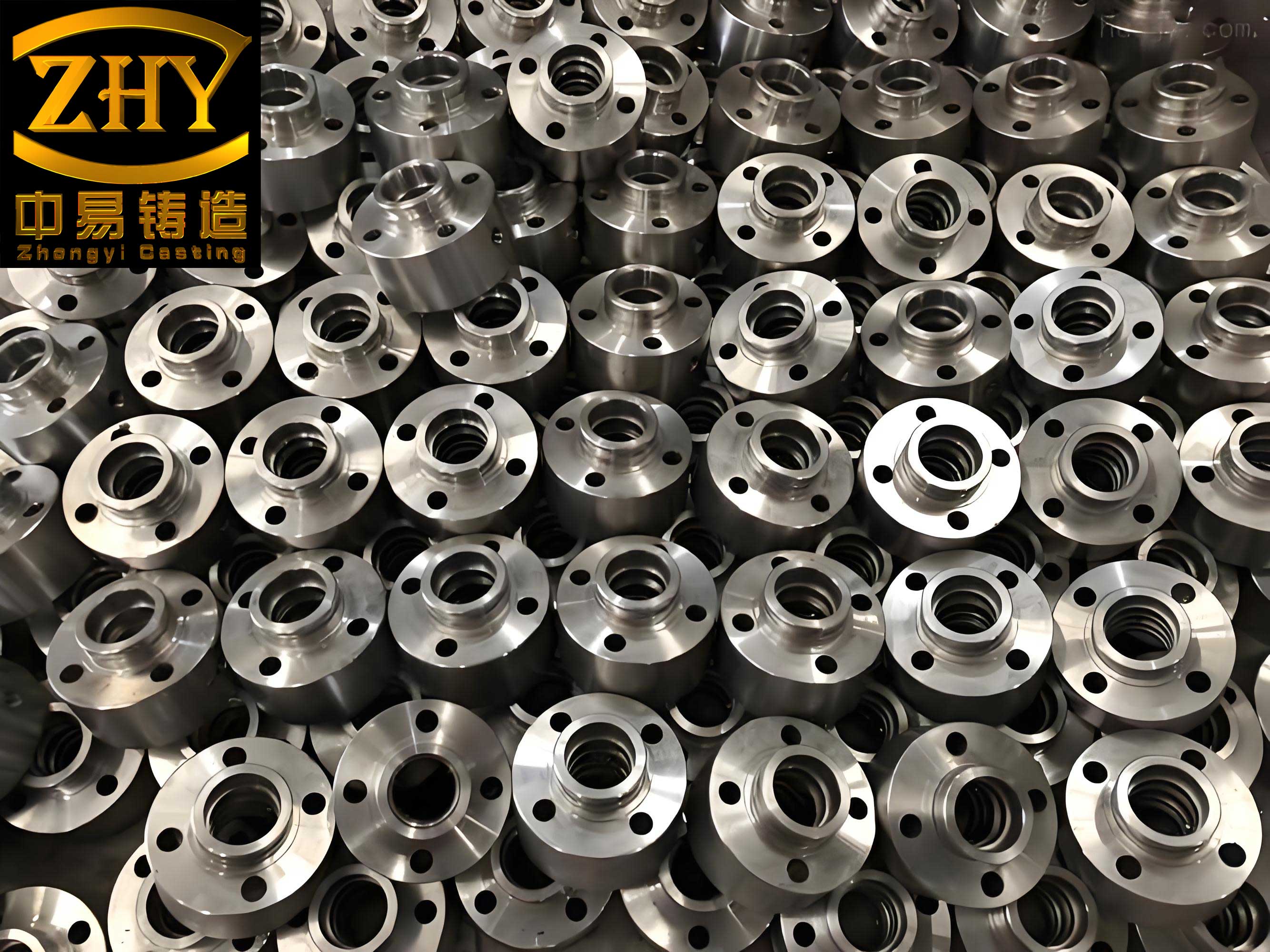
To support this discussion, the image above illustrates the typical microstructure of nodular cast iron, showcasing spheroidal graphite in a ferritic matrix—a key feature achieved through the described process. For those interested in deeper insights, the chemical kinetics of solution strengthening in nodular cast iron can be modeled using diffusion equations, such as Fick’s laws, to predict silicon distribution and its effects over time. For example, the diffusion of silicon in ferrite can be expressed as: $$\frac{\partial C}{\partial t} = D \nabla^2 C$$ where $C$ is concentration, $t$ is time, and $D$ is the diffusion coefficient. This theoretical framework complements practical observations, enhancing our understanding of how high-silicon nodular cast iron performs under various conditions. Ultimately, this research contributes to the broader field of metallurgy, offering a reproducible method for advancing nodular cast iron technology.