
In my extensive experience developing and manufacturing wear-resistant materials for industrial applications, the production of high-chromium cast iron parts stands out as a critical process for applications subjected to severe abrasive wear. The transition from traditional materials like Hadfield manganese steel or nickel-chromium white irons to high-chromium cast iron parts has been driven by their superior balance of hardness and toughness, achieved through precise control of composition, microstructure, and heat treatment. The performance and longevity of these cast iron parts are not inherent but are meticulously engineered through every step of the production chain. This article details the key considerations, from the influence of alloying elements to foundry and heat treatment practices, that govern the successful manufacture of high-quality, reliable cast iron parts.
Fundamentals: Alloying Elements and Microstructure
The exceptional wear resistance of high-chromium cast iron parts is fundamentally a function of their microstructure, which is primarily dictated by chemical composition. Understanding this relationship is paramount for designing parts for specific service conditions.
Role of Chromium and Carbon
The primary characteristic of these alloys is a high chromium content, typically above 10-12%. This level of chromium fundamentally changes the type of carbide present. In unalloyed or low-chromium white irons, the microstructure contains a continuous, brittle network of M3C-type carbides (e.g., cementite, Fe3C). In high-chromium variants, this is replaced by discontinuous, isolated, and blocky M7C3-type carbides. This change is transformative. The M7C3 carbides are significantly harder, providing better resistance to abrasion, and their non-continuous nature allows for a more continuous metal matrix, greatly improving the overall toughness of the cast iron parts.
The volume fraction of these hard carbides is primarily controlled by the carbon content. For a given chromium level, the amount of carbide increases with carbon. A common and useful parameter is the Chromium-to-Carbon ratio (Cr/C). This ratio influences the matrix composition, carbide morphology, and hardenability. An optimal balance is required; excessive carbides can lead to brittleness, while insufficient carbides reduce wear resistance. A general empirical relationship for estimating the carbide volume fraction (CVF) is often expressed as:
$$ CVF (\%) \approx 12.33(C\%) + 0.55(Cr\%) – 15.2 $$
This formula highlights the dominant role of carbon. Common commercial high-chromium cast iron parts for abrasive wear applications have carbon contents between 2.4% and 3.6% and chromium between 15% and 30%, with a Cr/C ratio typically ranging from 4 to 8.
| Carbide Type | Typical Composition | Crystal Structure | Approx. Microhardness (HV) | Prevailing Cr Range (%) |
|---|---|---|---|---|
| M3C | (Fe,Cr)3C | Orthorhombic | ~840 – 1100 | < 10 |
| M7C3 | (Cr,Fe)7C3 | Hexagonal | ~1200 – 1800 | > 10 – 20 |
| M23C6 | (Cr,Fe)23C6 | Face-Centered Cubic | ~1000 – 1150 | > 20 |
Matrix Structure and Its Significance
The metal matrix in high-chromium cast iron parts acts as the supportive “bed” for the hard carbides. Its properties are equally crucial for performance. The matrix can be austenite, pearlite, or martensite, often in combination in the as-cast state.
- Martensite: This is the hardest matrix structure (see Table 2) and provides the best support for carbides under high-stress grinding (gouging) abrasion with low-to-moderate impact. It is the desired matrix for most abrasive wear applications and is achieved through heat treatment.
- Austenite: This is a tough, ductile phase that can work-harden under severe impact (chipping or pounding abrasion). It is suitable for parts experiencing significant冲击负荷. However, under pure abrasion without significant impact, it is less wear-resistant than martensite.
- Pearlite: A mixture of ferrite and cementite, pearlite has moderate hardness but is generally not resistant to abrasive wear. It is often the structure present after an annealing heat treatment to facilitate machining of the cast iron parts.
| Matrix Structure | Approximate Microhardness (HV) |
|---|---|
| Ferrite | 70 – 200 |
| Pearlite | 250 – 400 |
| Austenite (High-Cr Cast Iron) | 300 – 600 |
| Martensite (High-Cr Cast Iron) | 500 – 900+ |
Alloying Elements for Hardenability and Performance
For sections beyond a certain thickness, plain high-chromium iron lacks sufficient hardenability to form martensite throughout the cross-section upon air cooling. This necessitates the addition of other alloying elements. Their primary role is to suppress the transformation of austenite to pearlite during cooling, allowing martensite to form.
- Molybdenum (Mo): This is the most effective and common hardenability agent. Additions of 0.5% to 3.0% Mo can enable air-hardening of sections several inches thick. Molybdenum also refines the as-cast structure and solid-solution strengthens the matrix.
- Copper (Cu) and Nickel (Ni): These elements stabilize austenite and enhance hardenability, often used in conjunction with molybdenum for heavy-section cast iron parts. Copper is more cost-effective than nickel. Typical additions range from 0.5% to 1.5%.
- Manganese (Mn): A potent austenite stabilizer, manganese can be used to enhance hardenability cost-effectively. However, it significantly lowers the martensite start (Ms) temperature, increasing the amount of retained austenite in the final structure. This can be detrimental for pure abrasion resistance but beneficial for impact toughness. Its content must be carefully controlled based on the desired final properties of the cast iron parts.
The synergistic effect of these elements is critical. The hardenability can be empirically related to composition. A simplified version of a hardenability factor (HF) might be expressed as:
$$ HF \approx 2.7(Mo\%) + 0.5(Cu\%) + 0.6(Ni\%) + 0.3(Mn\%) – 0.8 $$
A higher HF value indicates a greater ability to form martensite in thicker sections during air quenching.
Production Process for High-Chromium Cast Iron Parts
The manufacturing journey of high-chromium cast iron parts involves several critical stages where quality must be rigorously controlled. Each stage directly impacts the final microstructure and, consequently, the performance of the parts.
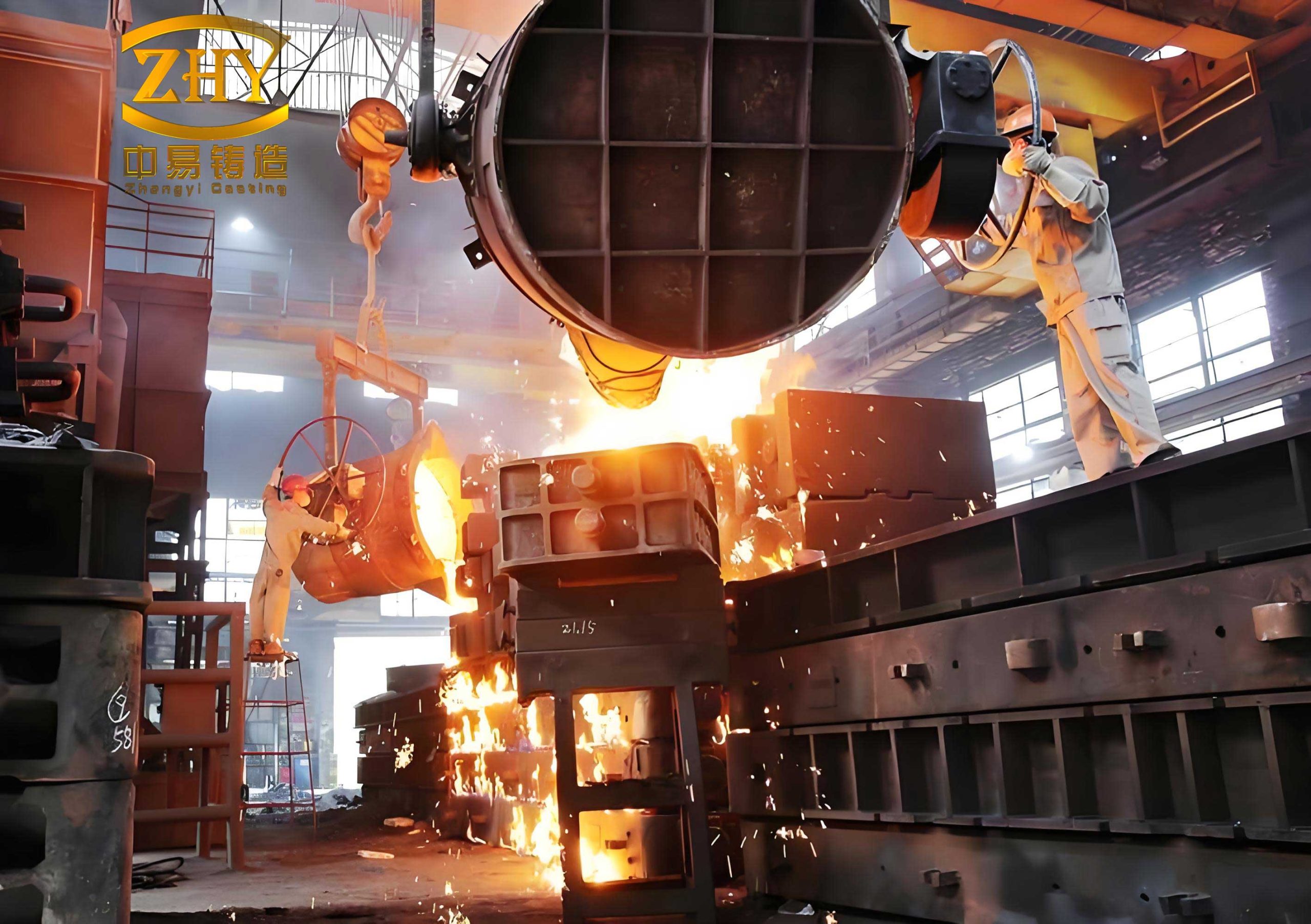
Melting and Pouring
Medium-frequency induction furnaces are preferred for melting high-chromium iron due to their excellent stirring action, precise temperature control, and minimal alloy loss. The charge typically consists of clean steel scrap or returns, with chromium added via high-carbon ferrochrome. Molybdenum, copper, and nickel are added as pure metals or master alloys.
Key melting practices include:
- Maintaining a slightly oxidizing atmosphere initially to remove impurities, followed by deoxidation with ferrosilicon (FeSi) or aluminum before tapping.
- Careful temperature control: Overheating leads to excessive oxidation of chromium, forming Cr2O3 slag inclusions. The pouring temperature is critical: 1420-1480°C for thin sections and 1350-1420°C for thick sections.
Due to the propensity of chromium to oxidize, the gating system must be designed to minimize turbulence and air entrainment. Gating cross-sectional areas are often 20-30% larger than for gray iron to ensure rapid, smooth filling. The production of sound, dense cast iron parts is paramount; shrinkage porosity, gas holes, or slag inclusions act as stress concentrators and dramatically reduce service life.
Casting and Solidification Challenges
High-chromium cast iron parts are prone to hot tearing and cracking due to their high elastic modulus, low thermal conductivity, and limited plasticity in the solid state. This risk is exacerbated for parts with complex geometries and varying section thicknesses. Foundry practices to mitigate this include:
- Using moulding and core sands with high collapsibility to minimize resistance to contraction.
- Implementing generous fillet radii and avoiding sharp corners in the pattern design.
- Employing chills and risers strategically to control solidification sequence and ensure directional feeding to prevent shrinkage defects.
The linear shrinkage is approximately 1.8-2.0%, similar to carbon steel. Post-casting, removing gates and risers should be done with care; flame cutting can induce thermal stresses and microcracks, making grinding or sawing preferable.
Heat Treatment: Unlocking Performance
Heat treatment is the most critical step for defining the final properties of high-chromium cast iron parts. The as-cast structure is usually a mixture of austenite, martensite, and pearlite, with a hardness of ~500-600 HB, which is difficult to machine and sub-optimal for wear resistance.
1. Annealing (for Machinability): To machine the cast iron parts, a full anneal is performed. This involves heating to 950-980°C (for 15-26% Cr grades), holding to fully austenitize and allow carbon redistribution, and then slowly cooling in the furnace (typically <30°C/hour) to below 600°C to transform the austenite to a soft pearlitic/ferritic matrix with a hardness of 350-450 HB. Uniformity of temperature throughout the furnace and during cooling is essential to achieve consistent machinability across all parts.
2. Hardening and Tempering (for Service): To achieve high wear resistance, the parts are hardened. The standard process involves:
- Austenitizing: Heating to a high temperature (950-1050°C, depending on composition) and holding. This dissolves carbon and alloying elements into the austenite. The time at temperature is crucial for achieving chemical homogeneity. An empirical relation for the austenitizing temperature (TA in °C) can be: $$ T_A \approx 900 + 25(Cr\%) – 40(Cr/C) $$ This highlights the complex interplay between composition and process.
- Quenching: Parts are rapidly removed from the furnace and cooled in air (or forced air for heavy sections). The alloy’s hardenability, ensured by Mo, Cu, etc., allows martensite formation during this cooling. Oil quenching is reserved for simple, small cast iron parts due to a higher risk of cracking.
- Tempering: The hardened parts are immediately tempered, typically at 200-300°C for 2-4 hours, and sometimes double-tempered. This relieves quenching stresses, improves toughness, and promotes the transformation of any retained austenite to martensite or bainite.
| Grade (Approx.) | Annealing Temp. (°C) | Hardening Temp. (°C) | Quench Medium | Tempering Temp. (°C) | Expected Hardness (HRC) |
|---|---|---|---|---|---|
| 15% Cr, 3% C | 950 – 970 | 970 – 990 | Air/Oil | 200 – 250 | 58 – 65 |
| 20% Cr, 2.8% C | 960 – 980 | 980 – 1010 | Air | 200 – 300 | 56 – 62 |
| 26% Cr, 2.8% C | 970 – 990 | 1010 – 1040 | Air | 220 – 320 | 55 – 60 |
Quality Control and Problem Solving
Despite careful planning, issues can arise during the production of high-chromium cast iron parts. A systematic approach to quality control and failure analysis is essential.
| Problem | Primary Causes | Corrective Actions |
|---|---|---|
| Low Hardness / Poor Wear Life |
|
|
| High Hardness After Annealing (Poor Machinability) |
|
|
| Brittle Fracture (Casting or In-Service) |
|
|
| Premature Wear Despite High Hardness |
|
|
Concluding Remarks on Optimizing Cast Iron Parts
The reliable production of high-performance high-chromium cast iron parts is a multidisciplinary challenge. It requires a deep understanding of metallurgical principles and their translation into robust manufacturing practices. The key takeaways from my experience are:
- The properties are not accidental but are engineered through precise control of composition—especially Cr, C, and hardenability additives—to tailor the carbide morphology, volume, and matrix structure.
- Heat treatment is not an optional step but the crucial process that unlocks the potential of the alloy, transforming it from a brittle casting into a tough, wear-resistant component. The cycle must be optimized for the specific grade and section size of the cast iron parts.
- Foundry practices, from melting to pouring and solidification control, are fundamental to achieving sound, defect-free castings. Internal flaws are often the root cause of in-service failures, regardless of optimal composition and heat treatment.
- A systematic approach to quality control and failure analysis is indispensable. Every failed part should be investigated to determine if the cause was compositional, processing-related, or a mismatch between material properties and service conditions. This feedback loop is essential for continuous improvement in the manufacturing of durable cast iron parts.
Ultimately, success lies in viewing the production of high-chromium cast iron parts as an integrated system where chemistry, process metallurgy, and foundry engineering converge to create components that reliably withstand some of the most demanding industrial environments.