
In the realm of internal combustion engines, the crankshaft stands as a pivotal component, bearing immense dynamic loads and torsional stresses. Its performance directly dictates engine durability, efficiency, and reliability. For decades, forged steel was the dominant material for high-power applications. However, the continuous evolution of casting technologies has ushered in a paradigm shift. Spheroidal graphite cast iron, commonly known as ductile iron, has emerged as a formidable alternative, offering a compelling combination of high rigidity, exceptional fatigue strength, excellent wear resistance, and superior damping capacity. Crucially, it presents significant advantages in manufacturing simplicity, cost-effectiveness, and insensitivity to surface cracks compared to its forged steel counterparts. The challenge we undertook was to develop a high-strength, high-ductility grade of spheroidal graphite cast iron—specifically QT850-4.5—in the as-cast condition for a heavy-duty six-cylinder crankshaft. This initiative aimed to eliminate the need for heat treatment processes like normalizing, thereby avoiding associated distortions, reducing energy consumption, simplifying production, and minimizing capital investment. This article details our comprehensive approach, from theoretical foundations and material design to practical process implementation and rigorous validation.
The fundamental superiority of spheroidal graphite cast iron lies in its unique microstructure. The graphite exists in the form of spheroids, which minimize stress concentration points that are inherent in flake graphite cast iron. This morphological transformation is achieved through the inoculation of molten iron with elements like magnesium and cerium (rare earth). The resulting material exhibits mechanical properties that can rival steel, especially when alloyed and processed correctly. For a crankshaft subjected to cyclic loading, key material properties include tensile strength (≥850 MPa), elongation (≥4.5%), and a favorable hardness profile. Achieving these targets in the as-cast state requires meticulous control over every facet of the production chain: raw material purity, chemical composition, melting practice, inoculation strategy, and solidification control.
Foundational Production Infrastructure and Raw Material Philosophy
Our production was anchored on a 1-ton medium-frequency induction furnace, chosen for its precise temperature control and efficient melting capabilities. The casting process employed was iron mold sand coating, a technique where a thin layer (4-8 mm) of resin-coated sand is formed against the internal cavity of a reusable metal mold. This method synthesizes the benefits of permanent mold and sand casting. The high thermal conductivity of the metal mold enables rapid heat extraction from the solidifying casting, promoting a fine-grained microstructure. Concurrently, the sand layer provides the necessary refractoriness and allows for intricate shape definition. This process leverages the graphitic expansion during the eutectic solidification of spheroidal graphite cast iron to achieve natural feeding, effectively minimizing shrinkage porosity and enhancing casting soundness. Additional benefits include high dimensional accuracy, excellent surface finish (reaching ~12.5 μm Ra after shot blasting), and improved yield rates.
Quality assurance was integrated through advanced analytical equipment: chemical titration and CS analyzers for fundamental elements, a 19-channel Baird optical emission spectrometer for full compositional analysis, a 300-kN hydraulic universal testing machine for tensile properties, and a Brinell hardness tester.
The quest for high-performance spheroidal graphite cast iron begins with the selection of pristine raw materials. Impurities and trace elements can severely impair graphite nodularity and matrix structure. Therefore, we mandated the use of high-purity pig iron or specially refined base iron. The specifications for key elements in the charge materials were stringent:
$$[Si]_{charge} < 1.0\%, \quad [Mn]_{charge} < 0.2\%, \quad [S]_{charge} < 0.01\%, \quad [P]_{charge} < 0.04\%$$
Particular attention was paid to trace elements known to interfere with graphite spheroidization, such as titanium, vanadium, tin, and tungsten. Titanium’s detrimental effect is pronounced, so its level was aggressively controlled below 0.04%. We aimed to keep the total content of such trace elements (∑T) under 0.1%. For steel scrap, we selected low-residual carbon steel with manganese content below 0.4%, ensuring minimal introduction of anti-nodularizing elements.
Precision Engineering of Chemical Composition
The chemical composition is the blueprint for the final microstructure and properties of spheroidal graphite cast iron. Each element plays a specific, often interactive, role. Our target composition was derived from extensive thermodynamic analysis and empirical trials, balancing strength, ductility, and castability.
Carbon Equivalent (CE): This parameter, a measure of the combined graphitizing power of carbon, silicon, and phosphorus, critically influences fluidity, shrinkage behavior, and the tendency for chill formation. A higher CE improves fluidity and reduces shrinkage but risks graphite flotation. For our heavy-section crankshaft, we targeted a CE range that ensured good feeding without flotation:
$$CE = C + \frac{Si + P}{3}$$
The operational window was set at 4.4% to 4.5%. This was slightly below the typical saturation point to guarantee a fully pearlitic matrix with no free ferrite, which is essential for achieving the 850 MPa tensile strength.
Carbon (C): Carbon is the primary source of graphite. A higher carbon content promotes a larger number of smaller, more rounded graphite nodules, enhancing mechanical properties and density. We controlled it between 3.6% and 3.8%.
Silicon (Si): Silicon is a potent graphitizer and ferritizer. It is primarily introduced via inoculation. Base silicon in the melt was kept low (1.3-1.4%) to allow for effective late-stage inoculation. The final silicon content, achieved through post-inoculation, was maintained at 2.1-2.5%. This level strengthens the ferrite but is carefully limited to avoid embrittlement at higher temperatures.
Manganese (Mn): Manganese is a pearlite stabilizer but has a strong tendency to segregate at cell boundaries, forming embrittling carbides. Its content was minimized, relying solely on the residual from charge materials, resulting in a range of 0.3-0.4%.
Phosphorus (P) and Sulfur (S): Phosphorus forms low-melting phosphide eutectics at grain boundaries, severely reducing toughness. Its content was suppressed below 0.04%. Sulfur is a powerful anti-spheroidizer; it reacts with magnesium during treatment. A small residual sulfur (0.015-0.020% in base iron) is beneficial as it aids in the formation of sulfide nuclei that can act as substrates for graphite precipitation. Post-treatment, sulfur was reduced to below 0.01%.
Magnesium (Mg) and Rare Earths (RE): These are the essential spheroidizing agents. Residual magnesium (0.035-0.045%) ensures nodular graphite formation, while rare earths (0.01-0.02%) help counteract the negative effects of trace impurities like lead and antimony.
Alloying Elements (Cu, Mo, Ni): To achieve the high strength in the as-cast pearlitic condition, we employed a synergistic alloying approach.
- Copper (Cu): Copper is a mild pearlite promoter and refiner. It exhibits negative microsegregation, enriching the last-to-freeze areas and strengthening the matrix uniformly. Added at 0.7-0.8%, it significantly enhances strength and hardness without markedly reducing ductility. Its effect can be modeled in terms of pearlite content increase: $$\%Pearlite \propto [Cu]^{0.5}$$
- Molybdenum (Mo): Molybdenum is a strong carbide former and solid solution strengthener. It refines the pearlite lamellar spacing and increases hardenability. However, excessive molybdenum can promote intercellular carbides. We limited it to 0.15-0.20%. Its contribution to yield strength follows a relationship akin to: $$\Delta \sigma_{y(Mo)} \approx k_{Mo} \sqrt{[Mo]}$$ where \(k_{Mo}\) is a strengthening coefficient.
- Nickel (Ni): Nickel is a graphitizer and pearlite refiner. It reduces section sensitivity (the variation in properties with casting thickness) and improves toughness. Added at 0.2-0.4%, it complements copper and molybdenum.
The finalized target composition for the spheroidal graphite cast iron is summarized in Table 1.
| Stage | C | Si | Mn | P | S | Mg | RE | Mo | Ni | Cu | CE |
|---|---|---|---|---|---|---|---|---|---|---|---|
| Base Iron | 3.6-3.8 | 1.3-1.4 | 0.3-0.4 | <0.04 | 0.015-0.020 | – | – | 0.15-0.20 | 0.2-0.4 | – | ~4.3 |
| Treated Iron | 3.6-3.8 | 2.1-2.5 | 0.3-0.4 | <0.04 | <0.010 | 0.035-0.045 | 0.01-0.02 | 0.15-0.20 | 0.2-0.4 | 0.7-0.8 | 4.4-4.5 |
The Integrated Melting and Treatment Protocol
The transformation of carefully selected charge materials into high-quality spheroidal graphite cast iron hinges on a meticulously sequenced melting and treatment protocol.
Charge Melting and Superheating: The charge, comprising high-purity pig iron and selected steel scrap, was melted in the induction furnace. To dissolve any undesirable carbides and homogenize the melt, the temperature was raised to a superheat level of 1540-1550°C and held for 2-3 minutes. This practice also aids in the removal of gaseous impurities. Prior to tapping, pre-conditioning additives like silicon carbide (SiC) were sometimes used to increase the number of potential nucleation sites for graphite.
Inoculation and Spheroidization Treatment: The treatment was performed using a sandwich method in a preheated ladle. A summary of the treatment materials is provided in Table 2.
| Material | Primary Function | Key Composition (wt.%) | Particle Size | Addition Rate (wt.%) |
|---|---|---|---|---|
| Spheroidizer | Graphite Nodularization | Mg: 5-7, RE: 2-3, Si: 40-45 | 15-25 mm | 1.1-1.3 |
| Inoculant (Primary) | Graphite Nucleation, Prevention of Chill | Si: 68-72, Ba: 3-6, Ca: 1-2 | 3-8 mm | 0.6-0.7 |
| Inoculant (Late-stream) | Instantaneous Graphite Nucleation | Si: 68-72, Ba: 3-6, Ca: 1-2 | 0.2-0.7 mm | 0.1-0.13 |
The spheroidizer was placed in the well of the ladle, covered with steel punchings, and then the primary inoculant was placed on top. The alloying elements copper, nickel, and molybdenum were added to the furnace shortly before tapping. The molten base iron was tapped directly onto the treatment alloys in the ladle. The reaction, vigorous due to magnesium vaporization, lasted approximately 1.5 minutes. After reaction cessation, slag was thoroughly removed.
Secondary and Tertiary Inoculation: To combat inoculation fade—the gradual dissolution of nucleation sites—a two-step inoculation strategy was employed. The primary inoculation occurred during the tap, as described. A crucial secondary, or late-stream, inoculation was performed during pouring. Fine-grained inoculant was added into the metal stream as it entered the mold cavity. This practice introduces fresh, active nuclei just before solidification, maximizing graphite count and nodularity. The effectiveness of inoculation can be conceptually related to the undercooling required for graphite nucleation: $$\Delta T_{n} \propto \frac{1}{\sqrt{N}}$$ where \(N\) is the number of effective nuclei. Effective inoculation increases \(N\), reducing undercooling \(\Delta T_n\), leading to a finer, more uniform distribution of graphite spheroids.
Process Dynamics and Solidification Control
Precision in the dynamic aspects of the process is as critical as static composition control.
Time-Temperature Management: The interval between the end of spheroidization and the completion of pouring was strictly controlled within 8-10 minutes. This window minimizes magnesium fade (re-oxidation and loss) and prevents the reversion of sulfur, which can degrade nodularity. The pouring temperature was optimized for the iron mold sand coating process, typically between 1350°C and 1380°C, ensuring adequate fluidity for mold filling without excessive erosion of the sand coat.
Solidification in Iron Mold: The iron mold sand coating process creates an ideal environment for sound solidification of spheroidal graphite cast iron. The high cooling rate initially promotes a fine, chilled skin. More importantly, the rigid mold constrains the casting, allowing it to utilize the volumetric expansion associated with graphite precipitation (approximately 4.2% volume increase) to internally feed subsequent shrinkage in the liquid and mushy zones. This natural feeding mechanism is described by the concept of “feeding demand” vs. “graphitic expansion pressure.” For a sound casting, the graphitic expansion must compensate for the total shrinkage: $$V_{exp(Graphite)} \geq V_{shrink(Liquid)} + V_{shrink(Mushy)}$$ The rigidity of the iron mold ensures this inequality holds, leading to dense, shrinkage-free castings.
Shakeout and Cooling: To prevent the development of excessive residual stresses and to lock in the desired pearlitic matrix, castings were shaken out from the molds as soon as they were solidified and had cooled to a temperature below the pearlite transformation range (around 600°C). This controlled cooling in air helped achieve the target as-cast microstructure.
Comprehensive Quality Evaluation and Results
The efficacy of our entire protocol was validated through destructive testing of samples machined from the crankpins and journals of actual cast crankshafts. The sampling locations were strategically chosen to represent both highly stressed sections and areas prone to microstructural variations.
Chemical Composition Verification: Spectroscopic analysis of samples from five different crankshafts confirmed precise adherence to the target ranges. The consistency is evident in Table 3, showcasing the stability of our process.
| Sample # | Si | Mn | P | S | Mg | RE | Mo | Ni | Cu |
|---|---|---|---|---|---|---|---|---|---|
| 1 | 2.20 | 0.30 | 0.037 | 0.010 | 0.038 | 0.015 | 0.163 | 0.222 | 0.75 |
| 2 | 2.15 | 0.28 | 0.036 | 0.009 | 0.037 | 0.018 | 0.181 | 0.225 | 0.72 |
| 3 | 2.10 | 0.34 | 0.036 | 0.008 | 0.038 | 0.017 | 0.165 | 0.254 | 0.78 |
| 4 | 2.35 | 0.33 | 0.037 | 0.010 | 0.036 | 0.015 | 0.168 | 0.291 | 0.77 |
| 5 | 2.27 | 0.31 | 0.036 | 0.010 | 0.035 | 0.017 | 0.187 | 0.291 | 0.75 |
Mechanical Properties Attainment: Tensile tests performed on specimens from the same locations yielded outstanding results, consistently exceeding the minimum requirements for QT850-4.5 spheroidal graphite cast iron. The data, presented in Table 4, demonstrates the successful integration of high strength and good ductility.
| Sample # | Tensile Strength (MPa) | Elongation (%) | Brinell Hardness (HBW) |
|---|---|---|---|
| 1 | 873 | 5.4 | 270 |
| 2 | 899 | 5.6 | 272 |
| 3 | 887 | 5.6 | 272 |
| 4 | 880 | 5.6 | 278 |
| 5 | 899 | 5.0 | 285 |
The average tensile strength was approximately 888 MPa, and the average elongation was 5.44%, comfortably surpassing the 850 MPa and 4.5% targets. The hardness values between 270 and 285 HB are ideal for machining and subsequent surface treatments like induction hardening for bearing journals.
Metallographic Analysis: The microstructure is the ultimate proof of quality for spheroidal graphite cast iron. Examination under an optical microscope revealed an exemplary structure. The graphite nodularity was rated at Grade 2 (excellent, with over 90% spheroids), and the nodule size was predominantly Grade 6 (number of nodules per mm² > 150). The matrix consisted of over 95% fine, well-dispersed pearlite, with negligible amounts of free ferrite, carbides (<0.05%), and phosphide eutectic (<0.05%). This fine pearlitic matrix, strengthened by copper, molybdenum, and nickel, is directly responsible for the high strength, while the high nodularity and cleanliness ensure the achieved ductility. The relationship between microstructure and tensile strength can be approximated by a rule of mixtures for the matrix, considering the graphite as voids: $$\sigma_{TS} \approx (1 – f_g) \cdot \sigma_{matrix}$$ where \(f_g\) is the graphite volume fraction and \(\sigma_{matrix}\) is the strength of the pearlitic matrix, which itself is a function of lamellar spacing \(\lambda\): $$\sigma_{matrix} \propto \frac{1}{\sqrt{\lambda}}$$ Our process yielded a very fine \(\lambda\), contributing to high \(\sigma_{matrix}\) and thus high \(\sigma_{TS}\).
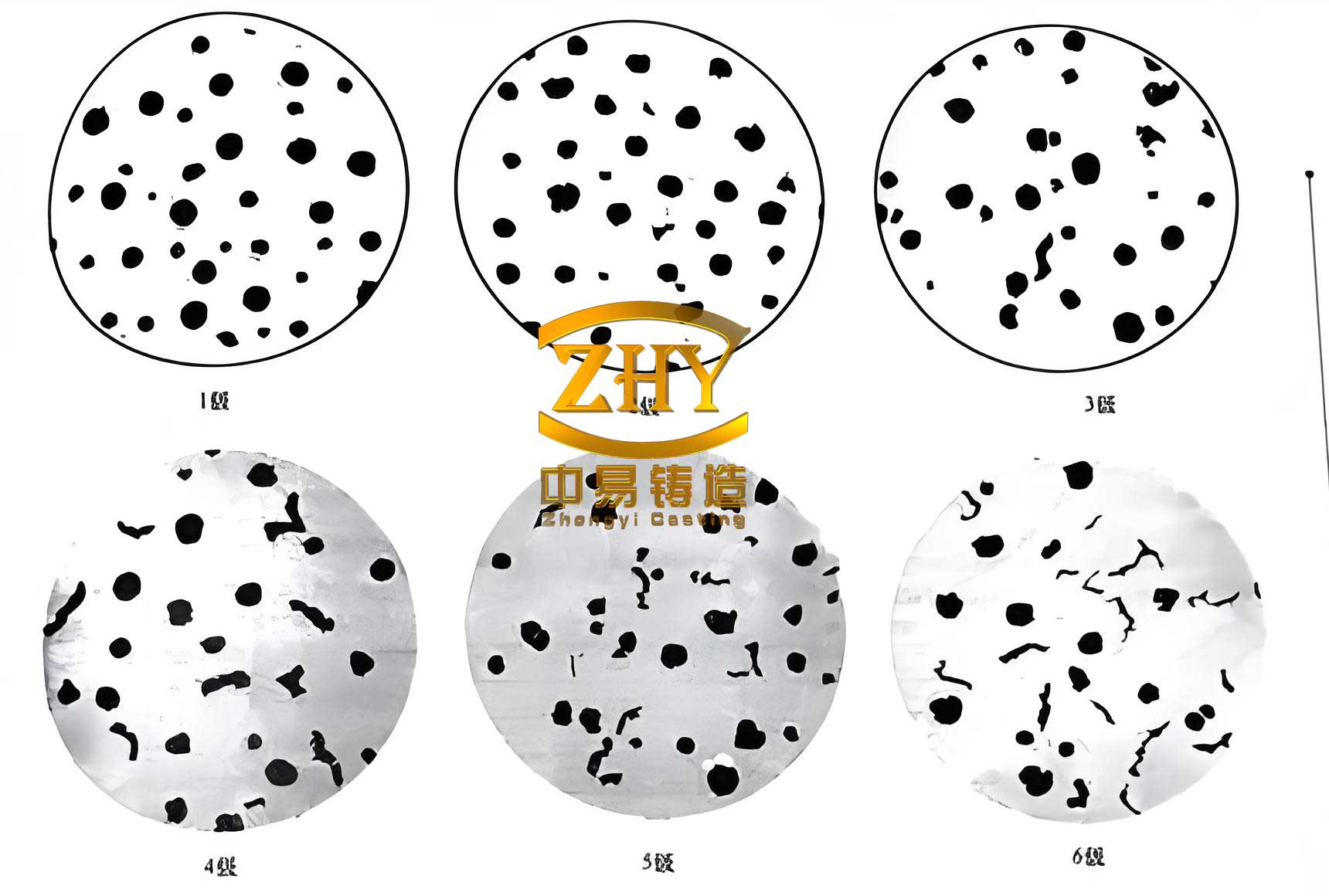
The image above provides a visual testament to the quality of the microstructure achieved in our spheroidal graphite cast iron, showcasing the spherical graphite nodules embedded in a fine, continuous pearlitic matrix.
Discussion and Concluding Synthesis
The successful production of as-cast QT850-4.5 spheroidal graphite cast iron for heavy-duty crankshafts is a multifaceted achievement. It underscores the principle that advanced material performance is not the result of a single “magic bullet” but the synergistic outcome of a holistic, well-understood process chain.
First, the absolute necessity of high-purity charge materials for high-performance spheroidal graphite cast iron cannot be overstated. Trace elements act as toxins, destabilizing graphite spheroidization and promoting undesirable micro-constituents. Second, chemical composition is a precise science. The balanced alloying system of Cu-Mo-Ni, within a tightly controlled carbon equivalent window, enabled the development of a fully pearlitic, fine-grained matrix directly from the mold, eliminating the need for a separate normalization heat treatment cycle. The roles of these elements are complementary: copper promotes pearlite, molybdenum refines it and increases hardenability, and nickel improves uniformity and toughness.
Third, the treatment methodology is critical. The use of a potent spheroidizer combined with a robust, multi-stage inoculation practice using a barium-bearing长效孕育剂 ensured a high nodule count and excellent nodularity throughout the casting section. The prevention of inoculation fade via late-stream inoculation was a key tactical success. Fourth, process dynamics, particularly the rigid mold constraint provided by the iron mold sand coating process, were essential in harnessing graphitic expansion to achieve sound, dense castings free from internal shrinkage defects—a common challenge in heavy-section spheroidal graphite cast iron castings.
In conclusion, we have demonstrated a viable, efficient, and reproducible industrial process for manufacturing heavy-duty six-cylinder crankshafts from high-strength, high-ductility spheroidal graphite cast iron in the as-cast condition. The mechanical properties consistently met and exceeded the demanding specification of QT850-4.5. This achievement validates the technical and economic advantages of using advanced spheroidal graphite cast iron over traditional forged steel for such applications, offering a superior balance of performance, manufacturability, and cost. The principles and practices detailed here—emphasizing purity, precise composition design, sophisticated treatment, and controlled solidification—form a robust framework for producing other high-integrity components from spheroidal graphite cast iron. The journey of optimizing spheroidal graphite cast iron continues, with future work potentially exploring further alloying refinements or alternative inoculation technologies to push the boundaries of strength and ductility even further.