
As a practitioner in the field of foundry engineering, I have extensive experience in manufacturing high-silicon corrosion-resistant cast iron parts. These cast iron parts are renowned for their excellent corrosion resistance, simplicity in production, and cost-effectiveness, making them ideal for applications in chemical, petrochemical, and marine industries. The corrosion mechanism of high-silicon cast iron has been well-documented in literature, primarily due to the formation of a protective silica-rich surface layer. In this article, I will delve into the practical aspects of producing these cast iron parts, focusing on key characteristics, defect mitigation, processing techniques, and quality control. I aim to provide a comprehensive guide that leverages tables and formulas to summarize critical data, ensuring a deep understanding of the production nuances. The goal is to enable manufacturers to achieve high-quality cast iron parts consistently.
High-silicon cast iron typically contains silicon in the range of 14.5% to 16.5%, which imparts superior corrosion resistance but also introduces challenges such as brittleness and high shrinkage. From my perspective, successful production hinges on mastering these material properties through careful design, controlled melting, and precise heat treatment. Throughout this discussion, I will emphasize the term “cast iron parts” to highlight the focus on the final product. Let’s begin by exploring the fundamental characteristics of high-silicon cast iron.
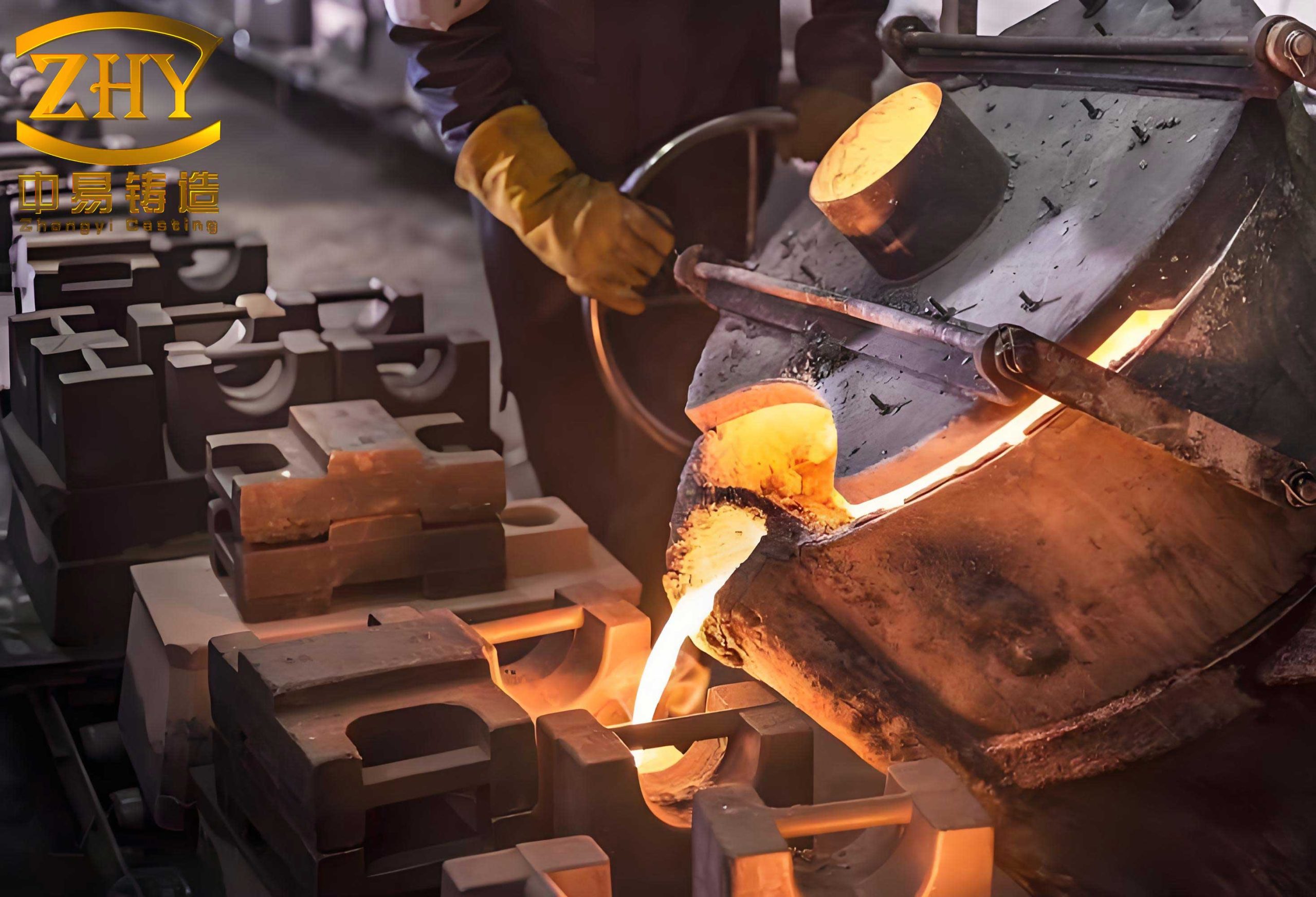
In my practice, I have observed that high-silicon cast iron parts exhibit distinct physical and mechanical properties due to their unique composition. The high silicon content significantly reduces carbon solubility, leading to a low carbon content, typically below 0.8%. This results in a microstructure dominated by ferrite and silicon-rich phases, contributing to both strength and corrosion resistance. However, the material’s brittleness and poor thermal conductivity pose significant challenges during casting. To quantify these properties, I often refer to the following table summarizing the key characteristics of high-silicon cast iron parts:
| Property | Typical Value | Impact on Cast Iron Parts Production |
|---|---|---|
| Silicon Content | 14.5% – 16.5% | Enhances corrosion resistance but increases brittleness. |
| Carbon Content | < 0.8% | Reduces strength but improves fluidity; requires controlled melting. |
| Linear Shrinkage | 1.6% – 2.5% | High shrinkage necessitates careful pattern design and riser placement. |
| Hardness (Brinell) | 400 – 500 HB | Limits machinability; grinding or hard alloy tools are preferred. |
| Thermal Conductivity | Low (~20 W/m·K) | Increases risk of thermal stress and cracking during cooling. |
| Tensile Strength | 120 – 180 MPa | Relatively low strength requires design for minimal stress concentration. |
The linear shrinkage of high-silicon cast iron parts is a critical parameter in design. I typically use a value of 1.8% for pattern allowances, which can be expressed mathematically as: $$ \text{Pattern dimension} = \frac{\text{Final dimension}}{1 – \text{Shrinkage factor}} $$ For instance, if the final dimension of a cast iron part is 100 mm, and the shrinkage factor is 0.018, the pattern dimension should be: $$ \text{Pattern dimension} = \frac{100}{1 – 0.018} \approx 101.83 \text{ mm} $$ This calculation ensures accurate sizing of cast iron parts after solidification.
When it comes to melting, I prefer using acid-lined induction furnaces due to their ability to control carbon pick-up. In cupola melting, carbon increase is excessive, which can degrade the corrosion resistance of cast iron parts. The silicon yield during melting is approximately 85%, which I account for when charging materials. To optimize the composition, I employ the following formula for silicon addition: $$ \text{Si required} = \frac{\text{Target Si\% – Initial Si\%}}{\text{Si yield}} $$ For example, to achieve 15% silicon in the final cast iron parts from an initial charge of 10% silicon, with an 85% yield: $$ \text{Si required} = \frac{15\% – 10\%}{0.85} \approx 5.88\% $$ This ensures precise control over the silicon content in the cast iron parts.
Defect prevention is paramount in producing high-quality cast iron parts. High-silicon cast iron is prone to gas porosity and pinholes, primarily due to hydrogen dissolution from molds or hydrocarbons. From my experience, hydrogen solubility in iron melts follows Sieverts’ law: $$ C_{\text{H}} = k \sqrt{P_{\text{H}_2}} $$ where \( C_{\text{H}} \) is the hydrogen concentration, \( k \) is a temperature-dependent constant, and \( P_{\text{H}_2} \) is the partial pressure of hydrogen. At high temperatures, solubility increases, leading to gas entrapment upon cooling. To mitigate this, I implement strict controls on aluminum content, as aluminum can act as a hydrogen source. The allowable aluminum content in the melt should be below 0.01%, as per my practice. Additionally, I use dry or self-hardening sands for molds to minimize moisture-related gas evolution. The table below outlines common defects and their solutions in high-silicon cast iron parts production:
| Defect Type | Causes | Preventive Measures for Cast Iron Parts |
|---|---|---|
| Gas Porosity | Hydrogen absorption from moist molds or contaminated charge. | Use dry charges; control mold moisture < 3%; employ degassing techniques. |
| Shrinkage Cracks | High thermal stress due to low conductivity and high shrinkage. | Design uniform wall thickness; use exothermic risers; apply slow cooling. |
| Silica Inclusions | Oxidation of silicon forming SiO₂ particles. | Optimize gating with slag traps; maintain reducing atmosphere during melting. |
| Hard Spots | Localized chilling or carbide formation. | Preheat molds to 200-300°C; control pouring temperature precisely. |
| Misruns | Poor fluidity due to low carbon or high silicon. | Increase pouring temperature moderately; design generous gating systems. |
Inoculation or modification treatment is a technique I frequently use to enhance the properties of cast iron parts. Adding rare earth silicide alloys, such as FeSiRE with 1-3% rare earth content, improves graphite morphology and reduces gas content. The addition rate is typically 0.1% of the melt weight, added during tapping. The rare earth residual should not exceed 0.01% to avoid embrittlement. The effect on grain refinement can be modeled using the Hall-Petch relationship: $$ \sigma_y = \sigma_0 + \frac{k}{\sqrt{d}} $$ where \( \sigma_y \) is the yield strength, \( \sigma_0 \) and \( k \) are constants, and \( d \) is the grain diameter. By reducing grain size through inoculation, the strength of cast iron parts increases, mitigating brittleness to some extent.
Heat treatment is essential for relieving residual stresses in high-silicon cast iron parts. Due to their low ductility, these cast iron parts are susceptible to cracking if stresses are not managed. I follow a specific thermal cycle: after casting, parts are shaken out while still hot (above 750°C) to reduce thermal shock. They are then placed in a preheated furnace at 500°C, slowly heated to 750-850°C at a rate of 25°C per hour, held for 2-8 hours depending on thickness, and furnace-cooled to below 100°C. The holding time \( t \) can be estimated based on section thickness \( T \) in millimeters: $$ t (\text{hours}) = 2 + 0.1 \times T $$ For a cast iron part with a 50 mm thickness, the holding time would be: $$ t = 2 + 0.1 \times 50 = 7 \text{ hours} $$ This ensures thorough stress relief without inducing new cracks.
To further optimize the production of cast iron parts, I consider the thermodynamic aspects of solidification. The cooling rate \( \frac{dT}{dt} \) influences microstructure and defect formation. For high-silicon cast iron, I aim for a controlled cooling rate to avoid thermal gradients. Using Fourier’s law of heat conduction: $$ q = -k \frac{dT}{dx} $$ where \( q \) is the heat flux, \( k \) is thermal conductivity, and \( \frac{dT}{dx} \) is the temperature gradient. By designing molds with insulating materials, I reduce \( q \), promoting uniform cooling of cast iron parts. Additionally, the Chvorinov’s rule helps in designing risers for feeding: $$ t_s = B \left( \frac{V}{A} \right)^n $$ where \( t_s \) is solidification time, \( V \) is volume, \( A \) is surface area, \( B \) is a mold constant, and \( n \) is an exponent (typically 2). For high-silicon cast iron parts, I use a higher \( B \) value due to low thermal conductivity, ensuring adequate riser sizing to prevent shrinkage cavities.
In terms of metallurgical control, the phase diagram of Fe-Si-C system is crucial. The high silicon shifts the eutectic point, affecting solidification behavior. I often refer to the following simplified phase relationships for cast iron parts with 15% Si: $$ \text{Liquidus temperature} \approx 1250°C $$ $$ \text{Solidus temperature} \approx 1150°C $$ This narrow freezing range contributes to the formation of fine microstructures but also increases hot tearing tendency. To compensate, I adjust pouring temperature \( T_p \) based on section thickness \( S \) (in mm): $$ T_p (°C) = 1300 – 5 \times S $$ For a thin-section cast iron part of 10 mm, \( T_p = 1300 – 50 = 1250°C \), while for a thick section of 100 mm, \( T_p = 1300 – 500 = 800°C \), though in practice, I never go below 1200°C to ensure fluidity.
Quality assurance for cast iron parts involves non-destructive testing and mechanical evaluation. I routinely perform hardness tests using Brinell or Rockwell scales, and corrosion tests in acidic environments. The corrosion rate \( R \) can be expressed as: $$ R = \frac{k \cdot A \cdot t}{W} $$ where \( k \) is a constant, \( A \) is area, \( t \) is time, and \( W \) is weight loss. For high-silicon cast iron parts, \( R \) is typically below 0.1 mm/year in sulfuric acid, demonstrating their durability. To summarize the overall production parameters, here is a table of optimal process conditions for manufacturing high-silicon corrosion-resistant cast iron parts:
| Process Parameter | Recommended Range | Rationale for Cast Iron Parts Quality |
|---|---|---|
| Melting Temperature | 1450°C – 1500°C | Balances fluidity and gas solubility; avoids excessive oxidation. |
| Pouring Temperature | 1250°C – 1350°C | Ensures complete filling while minimizing thermal shock. |
| Mold Preheating Temperature | 200°C – 300°C | Reduces chilling and stress in cast iron parts. |
| Inoculant Addition Rate | 0.05% – 0.15% | Enhances graphite formation without over-treatment. |
| Heat Treatment Soak Temperature | 750°C – 850°C | Relieves stresses without causing phase transformations. |
| Cooling Rate After Casting | 10°C/hour – 50°C/hour | Prevents cracking in brittle cast iron parts. |
From a practical standpoint, managing raw materials is key to consistent production of cast iron parts. I source low-aluminum ferrosilicon grades like FeSi75Al1 or FeSi75Al2 to minimize hydrogen pick-up. The charge composition is calculated using mass balance equations. For example, to produce 1000 kg of high-silicon cast iron parts with 15% Si and 0.7% C, I start with scrap steel, pig iron, and ferrosilicon. Let \( x \) be the mass of ferrosilicon (75% Si), \( y \) be the mass of pig iron (4% C, 1% Si), and \( z \) be the mass of scrap steel (0.2% C, 0.1% Si). The equations are: $$ x + y + z = 1000 $$ $$ 0.75x + 0.01y + 0.001z = 150 $$ $$ 0.04y + 0.002z = 7 $$ Solving these yields precise charge weights, ensuring the desired composition for cast iron parts.
In conclusion, producing high-quality high-silicon corrosion-resistant cast iron parts requires a holistic approach that integrates material science, process engineering, and meticulous quality control. By understanding the unique characteristics of these cast iron parts, such as high brittleness and shrinkage, and implementing strategies like controlled melting, defect prevention, inoculation, and stress-relief heat treatment, manufacturers can achieve reliable performance in corrosive environments. The use of tables and formulas, as demonstrated throughout this article, aids in standardizing production and optimizing parameters. As a foundry specialist, I advocate for continuous improvement through data-driven practices, ensuring that every batch of cast iron parts meets stringent standards. With proper attention to detail, high-silicon cast iron parts can be produced efficiently, offering a cost-effective solution for demanding industrial applications.
Ultimately, the success in manufacturing these cast iron parts lies in adapting to their inherent challenges. By leveraging advanced modeling techniques, such as computational fluid dynamics for gating design or finite element analysis for stress simulation, we can further enhance the reliability of cast iron parts. I encourage practitioners to document their experiences and share insights, fostering innovation in the field. The journey of producing high-silicon cast iron parts is one of precision and perseverance, but the results—durable, corrosion-resistant components—are well worth the effort.