
In my extensive experience within the foundry industry, the production of large-scale ductile iron castings, particularly for heavy machinery applications, presents a unique set of challenges. The V-process, or vacuum sealed molding process, offers distinct advantages in terms of surface finish, dimensional accuracy, and environmental friendliness. However, applying it to thick-section ductile iron castings, such as a loader backseat, requires meticulous planning and innovation to overcome inherent issues like mold wall movement, shrinkage defects, and dimensional instability. This article delves deeply into the methodologies and technical considerations I have employed to successfully produce a large, complex ductile iron casting using the V-process, with a focus on the loader backseat component. The term ‘ductile iron casting’ will be central to our discussion, as understanding its behavior under V-process conditions is paramount.
The component in question is a substantial ductile iron casting designed as a counterweight and structural element for a large loader. Its primary material specification is QT400-18, indicating a ferritic matrix with minimum tensile strength of 400 MPa and elongation of 18%. The geometry is notably challenging: an approximate U-shaped structure with significant mass and varying wall thicknesses. Producing such a ductile iron casting via V-process demands a holistic approach, integrating specialized tooling, optimized gating and feeding systems, precise metallurgical control, and robust process execution.
Component Specifications and Inherent Challenges
The loader backseat ductile iron casting possesses the following critical attributes, which directly influence the casting process design:
| Parameter | Value | Implication for V-Process |
|---|---|---|
| Overall Dimensions (mm) | 3195.6 x 1352.55 x 993.78 | Exceeds standard V-process line capacity; requires custom tooling. |
| Cast Weight (kg) | 5906 | Large thermal mass affects solidification and feeding dynamics. |
| Average Wall Thickness (mm) | 120 | Promotes slow cooling, increasing risk of shrinkage and graphite flotation. |
| Maximum Wall Thickness (mm) | 203 | Creates pronounced thermal hotspots requiring effective feeding. |
| Material Grade | QT400-18 | Requires strict control over graphite nodularity and ferrite content. |
| Key Mechanical Requirements | Tensile ≥400 MPa, Elongation ≥18%, Hardness 149-187 HB | Dictates specific chemical composition and heat treatment (or as-cast) practices. |
The principal technical difficulties in producing this ductile iron casting with the V-process can be summarized as follows:
- Mold Wall Movement: The transient nature of vacuum pressure during casting can lead to insufficient and variable mold rigidity. During the solidification of ductile iron, the significant graphite expansion pressure can cause mold wall movement, leading to dimensional inaccuracies and internal shrinkage defects in the final ductile iron casting.
- Shrinkage Porosity and Cavities: The thick sections and slow cooling rate inherent in such a large ductile iron casting create a prolonged feeding demand. Without a rigid mold and efficient feeding system, macro- and micro-shrinkage are highly probable.
- Dimensional Distortion: The U-shaped geometry is prone to warping during cooling due to uneven thermal stresses.
- Graphitization Control: The large mass of iron requires careful management of the melt treatment process to prevent fade of nodularizing and inoculating effects, which would degrade the properties of the ductile iron casting.
- Logistical Handling: The sheer size complicates operations like molding, pouring, and shakeout.
Process Design and Engineering Solutions
To address these challenges, a comprehensive process was designed, focusing on enhancing mold stability, optimizing solidification control, and ensuring metallurgical quality.
Tooling and Equipment Development
The first step was designing and fabricating non-standard equipment capable of handling this oversized ductile iron casting.
- Custom V-Process Flask: A specially manufactured flask with dimensions 4000 mm x 2260 mm x 650/950 mm was created. Its key features included:
- Dense network of reinforcing ribs (bars) to increase overall stiffness.
- Hollow ribs connected to the side vacuum chambers, with filter screens installed on the ribs to ensure uniform vacuum draw across the entire mold face.
- Rib heights were contoured to follow the pattern shape with a 150-200 mm offset, ensuring consistent sand compaction and vacuum stability around the complex geometry of the ductile iron casting pattern.
- Ladle System for Melt Treatment: Given the absence of standard ladles exceeding 7-ton capacity for ductile iron treatment, a sequential approach was adopted. Two 3-ton treatment ladles were used for the nodularizing process. The treated iron from these was then transferred into a single 8-ton pouring ladle for casting. This required precise coordination and elevated pouring temperatures to compensate for heat loss.
Gating and Feeding System Design
The design of the gating and risering system is critical for achieving a sound ductile iron casting. The primary goals were to achieve a smooth, rapid fill to prevent cold shuts and to establish directional solidification toward the risers.
- Parting Line and Molding Strategy: To maximize appearance quality and minimize parting line mismatch, the entire external profile of the ductile iron casting was formed in the drag (bottom) flask. The sides of the U-shape were created using sand ram-ups in the cope. This allowed for easy finishing of the rammed surfaces while leaving critical external surfaces clean.
- Gating System Design: A semi- pressurized gating system was employed to ensure non-turbulent filling. The choke was placed at the sprue base. The area ratios were carefully calculated to control metal velocity and pressure. A common relationship used for such systems is:
$$
\Sigma A_{sprue\;exit} : \Sigma A_{runner} : \Sigma A_{ingate} = 1 : 0.8 : 1.5
$$
Where $\Sigma A$ represents the total cross-sectional area. This ratio helps achieve a gradual reduction in velocity, minimizing turbulence and slag entrainment in the molten ductile iron. - Riser Design and Enhancement: Two main risers were positioned at the heaviest sections (the ends of the U-shape). These were designed as top-poured, “inverted bottle” shaped open risers with dimensions of φ200 mm x 500 mm, connected via necks of φ80 mm x 60 mm. Due to flask height restrictions, the risers could not be made tall enough for optimal thermal feeding efficiency. To compensate, exothermic heating compounds were added to the risers during pouring. The exothermic reaction generates heat, significantly extending the feeding life of the riser. The heat generation can be approximated by reactions like:
$$
\text{Si} + \text{O}_2 \rightarrow \text{SiO}_2 + \text{Heat}
$$
or more complex mixtures involving aluminum. Additionally, nine vent/atmospheric risers (φ60 mm) were placed at strategic locations (six on the sides, three on the bottom) to aid in mold cavity exhaust and to provide additional feeding points for isolated sections.
The feeding distance for a ductile iron casting can be estimated using empirical rules based on section thickness. For a 120 mm wall, the effective feeding distance $L_f$ from a riser can be approximated by:
$$
L_f = k \cdot T
$$
where $T$ is the section thickness and $k$ is a factor dependent on the mold rigidity and alloy. For ductile iron in a rigid mold, $k$ can be between 4 and 6. For $T = 120$ mm, $L_f$ could be 480-720 mm, which informed riser placement.
Pattern Design and Manufacture
A high-precision wooden pattern was essential. It was machined in two halves using 5-axis CNC technology to ensure dimensional accuracy and excellent surface finish, critical for the high-definition surface replication of the V-process. After machining, the halves were joined into a single, stable pattern. To counteract the anticipated thermal distortion of the U-shaped ductile iron casting during cooling, reinforcing ribs (ties) were incorporated into the pattern design at the open end of the “U”. These ribs also served as part of the runner system, fulfilling a dual purpose.
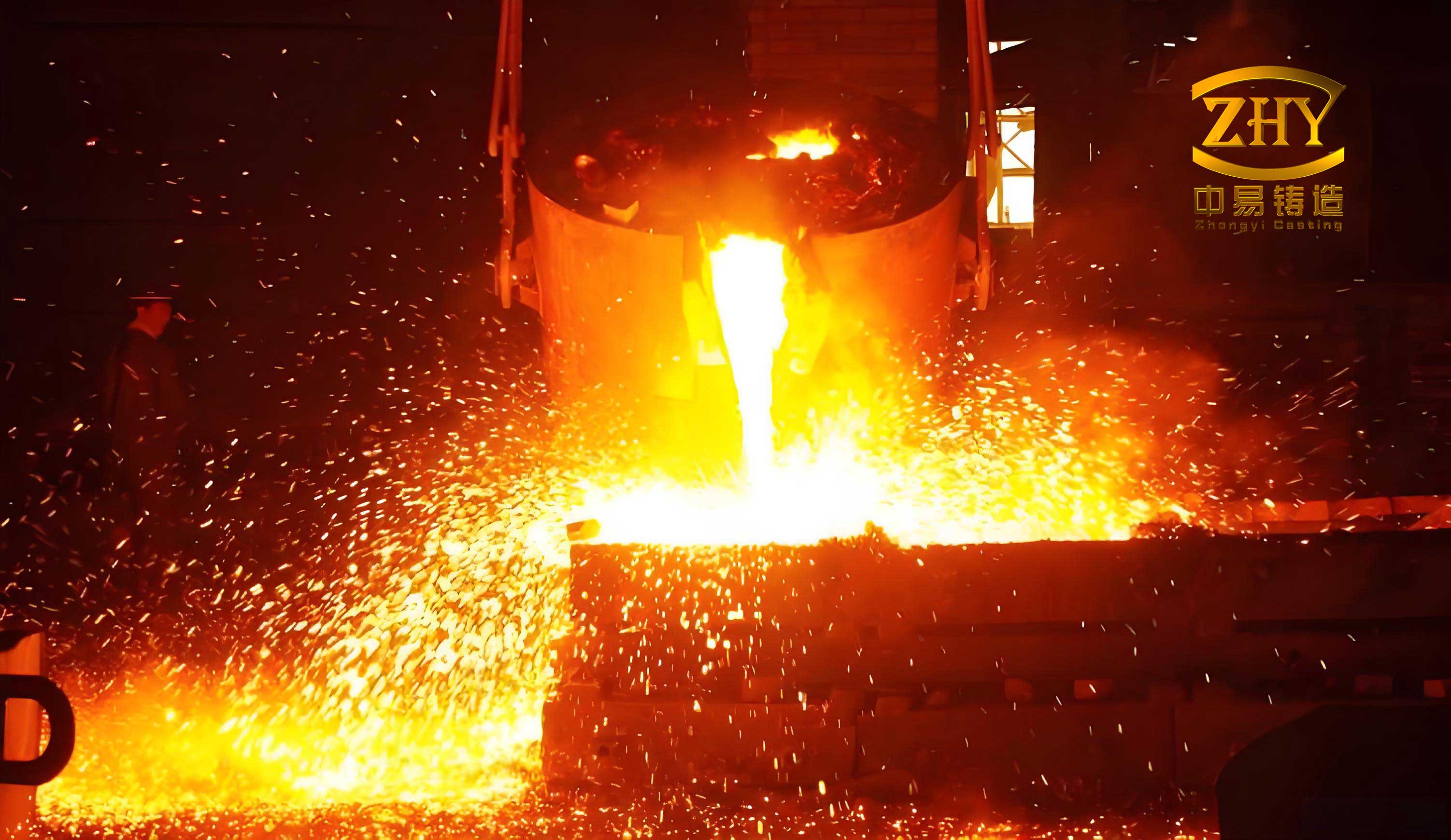
Metallurgical Process Control for Ductile Iron
The production of a high-integrity ductile iron casting of this size hinges on precise melt chemistry control and treatment.
| Process Stage | Key Parameters & Actions | Scientific Rationale |
|---|---|---|
| Base Iron Melting | Furnace: 12.5t Induction. Target Chemistry:
High Carbon Equivalent (CE) promotes graphite precipitation, reducing shrinkage tendency. CE is calculated as: |
A hypereutectic composition encourages early graphite precipitation during solidification, utilizing the associated expansion to counteract shrinkage. Low sulfur is critical for effective magnesium treatment. |
| Nodularizing Treatment | Method: Sandwich process in 3t ladles.
Three treatments were conducted, and iron was combined into an 8t ladle. |
The treatment aims to achieve a residual Mg level of ~0.04-0.06% and rare earths ~0.02-0.03% to ensure spherical graphite formation. High temperature and sequential treatment combat fading. The reaction is: $$ \text{Mg (in alloy)} + \text{S} \rightarrow \text{MgS} $$ $$ \text{Mg (residual)} \rightarrow \text{Spheroidizes Graphite} $$ |
| Inoculation | Stream inoculation during pouring using a FeSi-based inoculant (e.g., Incoude 900) at 0.1% of pouring weight. | Late inoculation enhances graphite nucleation, counteracts undercooling, promotes a uniform ferritic matrix, and improves nodule count in the final ductile iron casting. This is crucial for achieving the required elongation in thick sections. |
| Pouring Parameters |
Exothermic compound added to risers when half full. |
Sufficient superheat ensures fluidity to fill the thin sand molds completely. Controlled pour time balances thermal gradient establishment and metal velocity. The exothermic addition boosts riser efficiency mathematically by adding energy $Q_{exo}$ to the riser thermal budget, extending its solidification time $t_{riser}$ according to: $$ t_{riser} \propto \frac{(V_{riser} \cdot \rho \cdot C_p \cdot \Delta T) + Q_{exo}}{A_{riser} \cdot h} $$ where $V$ is volume, $\rho$ density, $C_p$ specific heat, $\Delta T$ superheat, $A$ surface area, and $h$ heat transfer coefficient. |
Molding and Solidification Control
The V-process molding parameters were tightly controlled to maximize mold rigidity, which is the cornerstone for producing sound thick-section ductile iron castings.
- Sand Compaction: Vibration time was extended to approximately 2.5 minutes to achieve a high and uniform bulk density of the unbonded silica sand.
- Vacuum Level: The molding vacuum was maintained at a minimum of 0.06 MPa (abs. ~0.04 MPa). This high vacuum is essential to provide the cohesive strength to the sand mold, resisting the metallostatic pressure and graphite expansion forces.
- Mold Hardness: The achieved mold hardness was greater than 90 on a standard scale, indicating excellent compaction and stiffness. The pressure differential $\Delta P$ across the mold wall provides the holding force. The effective mold strength $\sigma_{mold}$ can be related to vacuum and sand properties:
$$
\sigma_{mold} \propto \mu \cdot \Delta P \cdot \left(\frac{1-\epsilon}{\epsilon}\right)
$$
where $\mu$ is the coefficient of friction between sand grains and $\epsilon$ is porosity. High compaction reduces $\epsilon$, increasing strength. - Local Cooling: In areas adjacent to the main risers, chills or cooling fins were considered in the design phase to accelerate solidification and create a more favorable temperature gradient, further promoting directional solidification toward the riser in the ductile iron casting.
Production Outcomes and Quality Validation
The implementation of the above integrated strategy yielded highly positive results for the production of this large ductile iron casting.
| Aspect | Result | Analysis |
|---|---|---|
| Internal Soundness | No shrinkage cavities or porosity detectable by NDT (Ultrasonic Testing). | The combination of a rigid mold (resisting wall movement), efficient risers with exothermic aids, and controlled chemistry promoting graphitic expansion successfully compensated for solidification shrinkage in the ductile iron casting. |
| Dimensional Accuracy | Within drawing tolerances; minimal distortion observed. | The use of pattern ties/ribs and uniform mold cooling prevented warping of the U-shape. The high precision of the CNC-machined pattern was faithfully replicated by the stable V-process mold. |
| Surface Quality | Excellent, with sharp definition and minimal finishing required. | Inherent characteristic of the V-process due to the smooth plastic film and dry sand interface. |
| Mechanical Properties (From Separately Cast Keel Blocks) |
|
All values meet and exceed the QT400-18 specification. The effective inoculation and controlled low manganese content facilitated a ferritic matrix, providing high ductility. The consistent properties validate the effectiveness of the melt treatment process against fading for this large mass ductile iron casting. |
| Process Efficiency | Significant improvement over traditional green sand molding. | Reduced labor intensity, better working environment (no binders, less dust), and higher yield. Estimated material savings >4% and molding sand cost savings >60%. |
The successful batch production of this loader backseat ductile iron casting demonstrates the viability of the V-process for large, high-quality ductile iron components. The integration of mechanical, thermal, and metallurgical controls is the key. The ductile iron casting exhibited the desired combination of strength, ductility, and geometric integrity.
In-Depth Discussion: The Science Behind the Process
The success of this project can be analyzed through fundamental casting principles applied to ductile iron.
1. The Mold Rigidity Challenge: In ductile iron solidification, there is a unique expansion phase due to graphite precipitation (mushy stage expansion). If the mold yields (wall movement), this expansion is absorbed locally, and subsequent liquid contraction cannot be fed, leading to shrinkage porosity. The design equation for the critical mold pressure $P_{crit}$ needed to resist this expansion can be conceptualized as:
$$
P_{crit} \geq \alpha \cdot \Delta V_{graphite} \cdot E_{iron}
$$
where $\alpha$ is a factor relating expansion to pressure, $\Delta V_{graphite}$ is the volumetric change from graphite formation, and $E_{iron}$ is the modulus of the partially solid metal. Our custom flask with enhanced ribs and maintained high vacuum ensured $P_{mold} > P_{crit}$ throughout solidification.
2. Feeding and Solidification Modeling: While not detailed in the original case, modern simulation software would use the Fourier heat transfer equation to model solidification:
$$
\rho C_p \frac{\partial T}{\partial t} = \nabla \cdot (k \nabla T) + \dot{Q}_{latent}
$$
where $\dot{Q}_{latent}$ is the latent heat release rate, which for ductile iron has a complex form due to the eutectic reaction and graphite expansion. The riser design, aided by exothermic material, ensures that the thermal gradient $\nabla T$ points toward the riser until the end of solidification, fulfilling the condition for soundness in the ductile iron casting.
3. Metallurgical Kinetics: The fading of inoculation and nodularization is a time-temperature dependent phenomenon. The rate of loss of active nuclei or Mg can be described by an Arrhenius-type equation:
$$
\text{Fade Rate} \propto \exp\left(-\frac{Q}{RT}\right)
$$
Where $Q$ is the activation energy for the deactivation process, $R$ is the gas constant, and $T$ is the melt temperature. By using stream inoculation and combining treated iron quickly into a large thermal mass for pouring, the time at high temperature was minimized, preserving the treated state for the ductile iron casting.
Comparative Advantages and Economic Impact
Adopting the V-process for such large ductile iron castings offers measurable benefits beyond quality:
| Factor | V-Process (This Study) | Traditional Green Sand (Typical) |
|---|---|---|
| Mold Material Cost | Very Low (dry, unbonded sand, reusable >95%) | Moderate-High (bonded sand, lower reclamation rate) |
| Energy for Sand Preparation | Low (no mixing, no moisture control) | High (mulling, moisture control, cooling) |
| Emission & Waste | Minimal (no binder fumes, less waste sand) | Significant (organic fumes, spent sand disposal) |
| Casting Yield | Higher (precise molds, less cleaning) | Lower (more extensive gating/risering often needed) |
| Dimensional Tolerance | Excellent (±0.5 mm or better on critical dimensions) | Good (±1.5-2.0 mm typical) |
| Surface Finish (Ra) | ~6.3-12.5 μm | ~25-50 μm |
The economic equation favors the V-process for high-value, large ductile iron castings despite higher initial tooling costs. The net saving per casting can be expressed as:
$$
S_{net} = (S_{material} + S_{processing} + S_{environmental}) – C_{tooling\_amortization}
$$
Where the savings ($S$) in material, processing, and environmental compliance often outweigh the amortized cost of custom tooling over a production run.
Conclusion
Producing a large, thick-section ductile iron casting like a loader backseat using the V-process is a demanding but achievable task. It requires a systems engineering approach that addresses the interconnected challenges of mold mechanics, thermal management, and metallurgy. The key conclusions from this technical exploration are:
- Mold Rigidity is Paramount: For ductile iron castings, designing flasks with enhanced structural integrity and maintaining a high, stable vacuum level are non-negotiable to counteract graphite expansion pressure and prevent wall movement-induced defects.
- Integrated Feeding Strategy: A well-designed gating system coupled with risers enhanced by exothermic materials is essential to manage the prolonged feeding requirements of slow-solidifying sections in a large ductile iron casting. Empirical formulas and solidification modeling are valuable tools for optimization.
- Metallurgical Precision: Successful production hinges on precise control of base chemistry, robust nodularizing treatment (even via sequential ladling), and effective late-stage inoculation to ensure consistent graphite nodularity and a ferritic matrix throughout the heavy-section ductile iron casting.
- Geometric Stability: Anticipating and counteracting thermal distortion through pattern design features like ties or ribs is critical for maintaining the dimensional accuracy of complex-shaped ductile iron castings.
In essence, the V-process presents a highly viable method for manufacturing premium-quality large ductile iron castings. The process benefits of excellent surface finish and dimensional precision can be fully realized for ductile iron only when the unique solidification behavior of this material is meticulously managed through tailored tooling, process design, and metallurgical control. This case study exemplifies how engineering innovation in flask design, feeding techniques, and melt treatment logistics can overcome the traditional limitations, enabling the reliable and economical production of massive, high-performance ductile iron castings for the most demanding applications. The journey of producing each ductile iron casting becomes a testament to the synergy between traditional foundry knowledge and modern process engineering.