
In my extensive experience in foundry engineering, the development of high-performance diesel engine components has always been a challenging endeavor. Cylinder blocks, as critical parts, demand materials that can withstand extreme operational conditions such as high temperatures, pressures, and cyclic loading. Traditionally, high-grade gray cast iron or alloyed cast iron has been used, but these materials often suffer from limitations like low elongation and susceptibility to thermal fatigue cracking. This is where spheroidal graphite cast iron, commonly known as ductile iron, presents a superior alternative. The spheroidal graphite cast iron offers an excellent combination of strength, ductility, and fatigue resistance, making it ideal for demanding applications like cylinder blocks. In this article, I will detail the comprehensive trial production process for an as-cast ferrite spheroidal graphite cast iron cylinder block, focusing on the structural design, technical requirements, melting and casting methodologies, and the resultant properties. Throughout this discussion, the term spheroidal graphite cast iron will be emphasized to highlight its pivotal role in achieving the desired outcomes.
The cylinder block in question was designed for a C500 diesel engine intended for military applications. This spheroidal graphite cast iron component has overall dimensions of 2,650 mm × 1,160 mm × 870 mm, with a rough casting weight of 3.2 tonnes. It features 20 cylinder bores arranged in a V-configuration, with wall thicknesses ranging from a minimum of 8 mm to a maximum of 62 mm. Such variations in thickness pose significant challenges in terms of solidification control and defect prevention. The technical specifications for this spheroidal graphite cast iron casting were stringent, as summarized in the table below:
| Parameter | Requirement |
|---|---|
| Chemical Composition | S ≤ 0.02%, P ≤ 0.05% |
| Impact Toughness | Average of 14 J/cm², minimum individual 11 J/cm² |
| Metallographic Structure | Nodularity grade 1-2, graphite size 5-6, ferrite volume ≥ 90% |
| Pressure Testing | Water pressure 0.5 MPa for 10 min, oil pressure 1.2 MPa for 15 min, no leakage |
| Internal Defects | No shrinkage defects in critical areas per ultrasonic testing |
To meet these requirements, a meticulous approach was adopted for the melting process. The spheroidal graphite cast iron was produced using a duplex melting system involving a cupola furnace followed by a holding furnace. This method ensures consistent temperature control and composition homogeneity. The charge composition consisted of 78% Q10 pig iron and 22% steel scrap, selected to maintain low impurity levels. The target chemical composition for the spheroidal graphite cast iron was carefully controlled, as shown in the following table:
| Element | Weight Percentage (%) |
|---|---|
| Carbon (C) | 3.51 |
| Silicon (Si) | 2.70 |
| Manganese (Mn) | 0.20 |
| Phosphorus (P) | 0.03 |
| Sulfur (S) | 0.009 |
| Magnesium (Mg) | 0.052 |
| Rare Earth (RE) | 0.041 |
The low sulfur and phosphorus contents are crucial for enhancing the ductility and impact toughness of spheroidal graphite cast iron. The magnesium and rare earth additions facilitate graphite nodulization, which is essential for achieving the desired spheroidal graphite morphology. The melting temperatures were strictly monitored: the tapping temperature from the holding furnace was maintained between 1,480°C and 1,490°C, while the pouring temperature was controlled within 1,360°C to 1,380°C. These temperatures are critical for ensuring proper fluidity and reducing casting defects in spheroidal graphite cast iron.
The nodulization treatment was performed using a conventional sandwich method in a ladle. A spheroidizing agent, primarily composed of magnesium ferrosilicon, was placed at the bottom of the ladle, accounting for 1.7% of the total iron weight of 4.3 tonnes. This agent was covered with 0.1% barium-silicon inoculant (5-15 mm granules). As the iron was tapped, approximately two-thirds of the total volume initiated the spheroidizing reaction, which lasted about 60 seconds. At the end of this reaction, an additional 0.4% inoculant was added at the tapping stream, followed by the remaining iron to complete the ladle fill. After slag removal, another 0.4% inoculant was added on the surface. During pouring, a final inoculation with 0.1% fine-grained inoculant (0.2-0.7 mm) was administered stream-wise. This multi-stage inoculation process is vital for refining graphite nodules and increasing their count in spheroidal graphite cast iron, which can be represented by the following empirical relationship for nodule count enhancement:
$$ N = k \cdot I^n $$
where \( N \) is the graphite nodule count per unit area, \( I \) is the inoculation intensity, and \( k \) and \( n \) are material constants. For spheroidal graphite cast iron, effective inoculation significantly boosts \( N \), leading to improved mechanical properties.
The casting process for such a large and complex spheroidal graphite cast iron component required a robust gating and feeding system design. A three-part molding system (top, middle, and bottom boxes) was employed to facilitate core placement and dimensional accuracy. The gating system was designed as a closed type with a choke ratio of \( \Sigma F_{\text{sprue}} : \Sigma F_{\text{runner}} : \Sigma F_{\text{ingate}} = 1.18 : 1.04 : 1 \). A stopper-controlled pouring basin was used to manage the flow sequence: initially, the lower ingates introduced iron, and after three-quarters of the mold was filled, the upper ingates were opened to simultaneously feed the top sections. This two-tiered gating approach, with 22 ceramic tubes (φ25 mm) at the lower level and 16 flat gates (55/50 mm × 9 mm) at the upper level, ensured a calm and rapid filling suitable for resin sand molds, minimizing turbulence and oxide formation in the spheroidal graphite cast iron melt.
Feeding and solidification control are paramount for spheroidal graphite cast iron due to its pronounced shrinkage characteristics. The volume change during solidification of spheroidal graphite cast iron can be described by:
$$ \Delta V = V_{\text{liquid}} \cdot \alpha_{\text{contraction}} – V_{\text{graphite}} \cdot \beta_{\text{expansion}} $$
where \( \Delta V \) is the net volume change, \( \alpha_{\text{contraction}} \) is the liquid contraction coefficient, and \( \beta_{\text{expansion}} \) is the graphite expansion coefficient. To counteract potential shrinkage defects, eight φ180 mm exothermic insulating risers were strategically placed on the top cope. These risers utilize exothermic materials to sustain high temperatures in the feeder heads, creating a favorable thermal gradient that promotes directional solidification toward the risers. The efficiency of such risers, denoted as \( \eta \), can be approximated by:
$$ \eta = \frac{V_{\text{useful}}}{V_{\text{riser}}} \times 100\% $$
For conventional risers, \( \eta \) is typically 6-10%; for insulating risers, it rises to 20-25%; and for exothermic insulating risers, it can reach up to 45%. This high efficiency is crucial for feeding thick sections in spheroidal graphite cast iron castings. Additionally, chilling was applied to heavy sections like cylinder bores and bolt holes using shaped chills to accelerate cooling and enhance density, thereby preventing micro-shrinkage. The solidification time \( t_s \) for a casting can be estimated using Chvorinov’s rule:
$$ t_s = k \cdot \left( \frac{V}{A} \right)^2 $$
where \( V \) is volume, \( A \) is surface area, and \( k \) is a constant dependent on mold material and casting properties. For spheroidal graphite cast iron, controlling \( t_s \) through chills and risers is essential to achieve soundness.
After the trial production, the spheroidal graphite cast iron cylinder block was subjected to thorough evaluation. Metallographic analysis revealed a nodularity grade of 90%, graphite size of 6, and a ferritic matrix exceeding 90%, which aligns perfectly with the specifications. The mechanical properties, as measured from samples extracted from the casting, are summarized below:
| Property | Value |
|---|---|
| Tensile Strength | 442 MPa |
| Yield Strength | 305 MPa |
| Elongation | 22% |
| Impact Absorbed Energy | 15 J, 15 J, 16 J (average 15.3 J) |
| Hardness | 160 HBW |
These results confirm that the spheroidal graphite cast iron achieved the required balance of strength and ductility. Non-destructive testing via ultrasonic inspection complied with JB/T 5439-1991 Grade 2 standards, indicating no significant internal flaws. Pressure tests showed no leakage under both water and oil pressures, validating the integrity of the spheroidal graphite cast iron casting. Furthermore, destructive analysis of critical zones confirmed the absence of shrinkage porosity, underscoring the effectiveness of the feeding design.
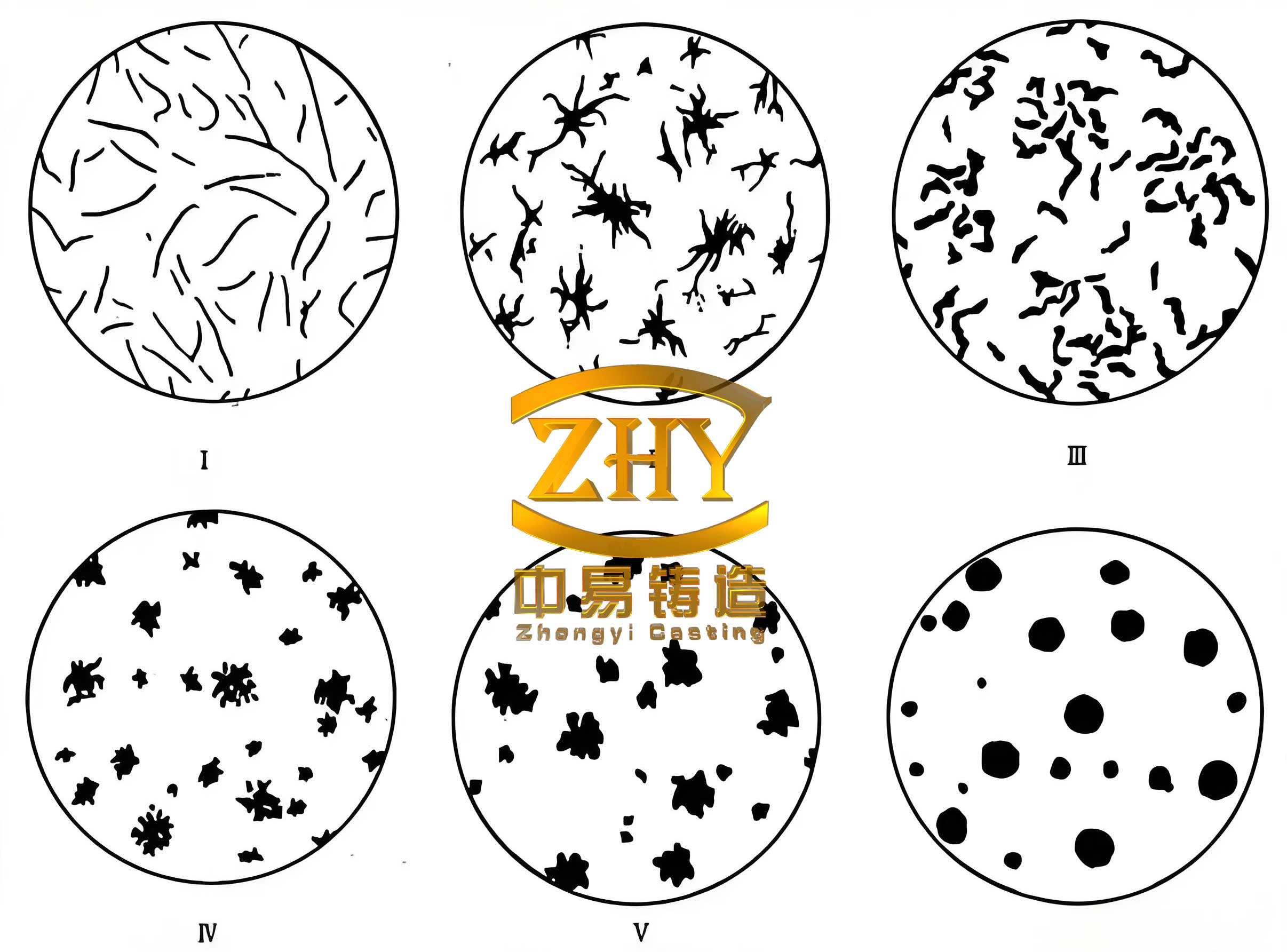
The successful trial production of this spheroidal graphite cast iron cylinder block can be attributed to several key factors. First, the rigorous control of chemical composition, particularly low sulfur and phosphorus, laid the foundation for high ductility. Second, the multi-stage inoculation process was instrumental in refining the graphite structure, which is central to the performance of spheroidal graphite cast iron. The inoculation effect can be quantified by the increase in nodule count, often expressed as nodules per square millimeter. For high-quality spheroidal graphite cast iron, a nodule count above 150 nodules/mm² is desirable, and our process achieved this through optimized inoculant additions. Third, the casting工艺 design, with its emphasis on thermal gradient management via exothermic risers and chills, ensured adequate feeding and minimized shrinkage defects. The theoretical basis for this involves the modulus method for riser sizing, where the riser modulus \( M_r \) should exceed the casting modulus \( M_c \):
$$ M_r > M_c = \frac{V_c}{A_c} $$
For complex geometries like cylinder blocks, computer simulations can aid in optimizing these parameters for spheroidal graphite cast iron.
In conclusion, the production of as-cast ferrite spheroidal graphite cast iron cylinder blocks represents a significant advancement in foundry technology. The combination of enhanced mechanical properties, such as superior fatigue resistance and elongation, makes spheroidal graphite cast iron an ideal material for heavy-duty engine components. Throughout this trial, every aspect—from melting and inoculation to gating and feeding—was tailored to harness the benefits of spheroidal graphite cast iron. The results demonstrate that with precise control over process variables, spheroidal graphite cast iron can meet stringent performance criteria while offering cost advantages over alloyed cast irons. Future work could explore further optimizations, such as the use of advanced simulation tools to predict solidification patterns in spheroidal graphite cast iron, or the incorporation of alloying elements like copper or nickel to tailor properties for specific applications. Nonetheless, this trial underscores the viability of spheroidal graphite cast iron for critical castings, paving the way for broader adoption in the automotive and military sectors.
To further elaborate on the technical nuances, let’s delve into the metallurgical aspects of spheroidal graphite cast iron. The formation of spheroidal graphite involves the nucleation and growth of graphite in a spherical morphology, which is promoted by magnesium and rare earth elements. The nodulization efficiency can be expressed as:
$$ E_{\text{nod}} = \frac{N_{\text{actual}}}{N_{\text{theoretical}}} \times 100\% $$
where \( N_{\text{actual}} \) is the measured nodule count and \( N_{\text{theoretical}} \) is the maximum achievable based on composition. For our spheroidal graphite cast iron, the high nodularity grade of 90% indicates excellent nodulization. Additionally, the ferritic matrix is achieved through controlled cooling and silicon content, which promotes ferrite formation. The ferrite volume fraction \( f_{\text{ferrite}} \) can be estimated using empirical relations tied to silicon content and cooling rate:
$$ f_{\text{ferrite}} = a \cdot \text{Si} \% – b \cdot \log(R) $$
where \( R \) is the cooling rate in °C/s, and \( a \) and \( b \) are constants. In our case, the slow cooling in thick sections, moderated by risers and chills, allowed for sufficient ferrite formation, exceeding 90% as required.
The economic implications of using spheroidal graphite cast iron are also noteworthy. Compared to alloyed cast irons, spheroidal graphite cast iron often reduces material costs while offering better performance. A comparative analysis of material properties is presented below:
| Material | Tensile Strength (MPa) | Elongation (%) | Fatigue Limit (MPa) | Relative Cost |
|---|---|---|---|---|
| High-Grade Gray Iron | 250-350 | < 1 | 100-150 | 1.0 |
| Alloyed Cast Iron | 400-500 | 2-5 | 150-200 | 1.5 |
| Spheroidal Graphite Cast Iron | 400-600 | 10-25 | 200-250 | 1.2 |
This table highlights the advantage of spheroidal graphite cast iron in terms of elongation and fatigue resistance, which are critical for cylinder blocks subjected to cyclic loads. Moreover, the casting yield, defined as the ratio of casting weight to total poured weight, is an important metric for efficiency. For our process, the yield was optimized through riser design, achieving approximately 75%, which is favorable for large spheroidal graphite cast iron castings.
In summary, the trial production of the C500 cylinder block from spheroidal graphite cast iron was a resounding success. The integration of advanced melting, inoculation, and casting techniques enabled the achievement of all technical specifications. The consistent use of spheroidal graphite cast iron throughout the process ensured a homogeneous structure with excellent properties. As foundry technology evolves, further refinements in processing spheroidal graphite cast iron will continue to enhance its applicability for critical components. This project serves as a testament to the capabilities of modern foundry practices in leveraging the full potential of spheroidal graphite cast iron.