
In this comprehensive study, I investigate the relationship between microstructure and mechanical properties of low-chromium white cast iron cast in metal molds with varying wall thicknesses. White cast iron, known for its high hardness and wear resistance, is widely used in applications requiring durability against abrasion. The addition of chromium enhances these properties by promoting the formation of hard carbides. However, the toughness of white cast iron is often limited due to the continuous network of carbides. This research aims to explore how metal mold casting, particularly with different wall thicknesses, can modify the carbide morphology and thereby improve the toughness of low-chromium white cast iron while maintaining hardness. The findings are expected to contribute to optimizing casting processes for enhanced performance in industrial settings.
The white cast iron used in this study was melted in a medium-frequency induction furnace. The chemical composition, as determined by spectroscopic analysis, is presented in Table 1. The composition was carefully controlled to ensure consistency across all samples, with chromium content kept low to focus on the effects of mold design. Key elements include carbon, silicon, manganese, and chromium, which influence carbide formation and matrix structure.
| Element | Content (wt.%) |
|---|---|
| C | 2.8–3.2 |
| Si | 0.5–0.8 |
| Mn | 0.6–1.0 |
| Cr | 1.5–2.5 |
| P | < 0.1 |
| S | < 0.05 |
| Fe | Balance |
Metal molds with wall thicknesses of 10 mm, 20 mm, 30 mm, and 40 mm were prepared, along with a sand mold as a control (represented as 0 mm wall thickness). The molds were designed to produce standard specimens for mechanical testing. After casting, the white cast iron samples were divided into two groups: as-cast and heat-treated. The heat treatment involved austenitizing at 950°C for 2 hours, followed by oil quenching, and then tempering at 250°C for 2 hours to relieve stresses and achieve a tempered martensite matrix. This process is critical for enhancing the toughness of white cast iron while preserving hardness.
Mechanical properties were evaluated using impact toughness and hardness tests. The impact toughness was measured via Charpy impact tests, with values reported as the average of five specimens per condition to ensure statistical reliability. Hardness was measured using a Rockwell scale, and similarly averaged. The data are summarized in Table 2, which illustrates the effects of mold wall thickness and heat treatment on the properties of low-chromium white cast iron.
| Mold Wall Thickness (mm) | As-Cast Impact Toughness (J/cm²) | As-Cast Hardness (HRC) | Heat-Treated Impact Toughness (J/cm²) | Heat-Treated Hardness (HRC) |
|---|---|---|---|---|
| 0 (sand mold) | 8.2 | 58 | 12.5 | 62 |
| 10 | 9.5 | 58 | 14.0 | 62 |
| 20 | 11.0 | 58 | 15.5 | 62 |
| 30 | 12.8 | 57 | 17.2 | 61 |
| 40 | 14.5 | 57 | 19.0 | 61 |
The results clearly show that as the wall thickness of the metal mold increases, the impact toughness of the white cast iron improves significantly, both in as-cast and heat-treated conditions. For instance, with a 40 mm wall thickness, the as-cast impact toughness increased by approximately 77% compared to the sand mold sample. In contrast, hardness remained relatively constant, with only minor variations, indicating that the chemical composition predominantly governs hardness, while mold cooling rate affects toughness. This behavior can be modeled using a simplified relationship for hardness in white cast iron: $$ H = H_m + k_c \cdot V_c $$ where \( H \) is the overall hardness, \( H_m \) is the matrix hardness, \( k_c \) is a constant dependent on carbide type, and \( V_c \) is the volume fraction of carbides. Since \( V_c \) is largely determined by composition, hardness changes are minimal with varying mold wall thickness.
Microstructural analysis revealed that the improvement in toughness is directly linked to changes in carbide morphology. In sand-cast white cast iron, carbides typically form a continuous network, which acts as stress concentrators and reduces toughness. With metal molds, the faster cooling rate modifies solidification kinetics, leading to discontinuous carbide structures. As wall thickness increases, the cooling rate becomes more controlled, promoting the transformation of carbides from a networked to isolated plate-like, and eventually to short rod-like or spheroidal particles. This evolution enhances energy absorption during impact, as described by the following empirical formula for impact toughness: $$ K = K_0 + \alpha \cdot \lambda^{-1/2} $$ where \( K \) is impact toughness, \( K_0 \) is a baseline toughness, \( \alpha \) is a material constant, and \( \lambda \) is the mean free path between carbides. A larger \( \lambda \) due to isolated carbides results in higher \( K \).
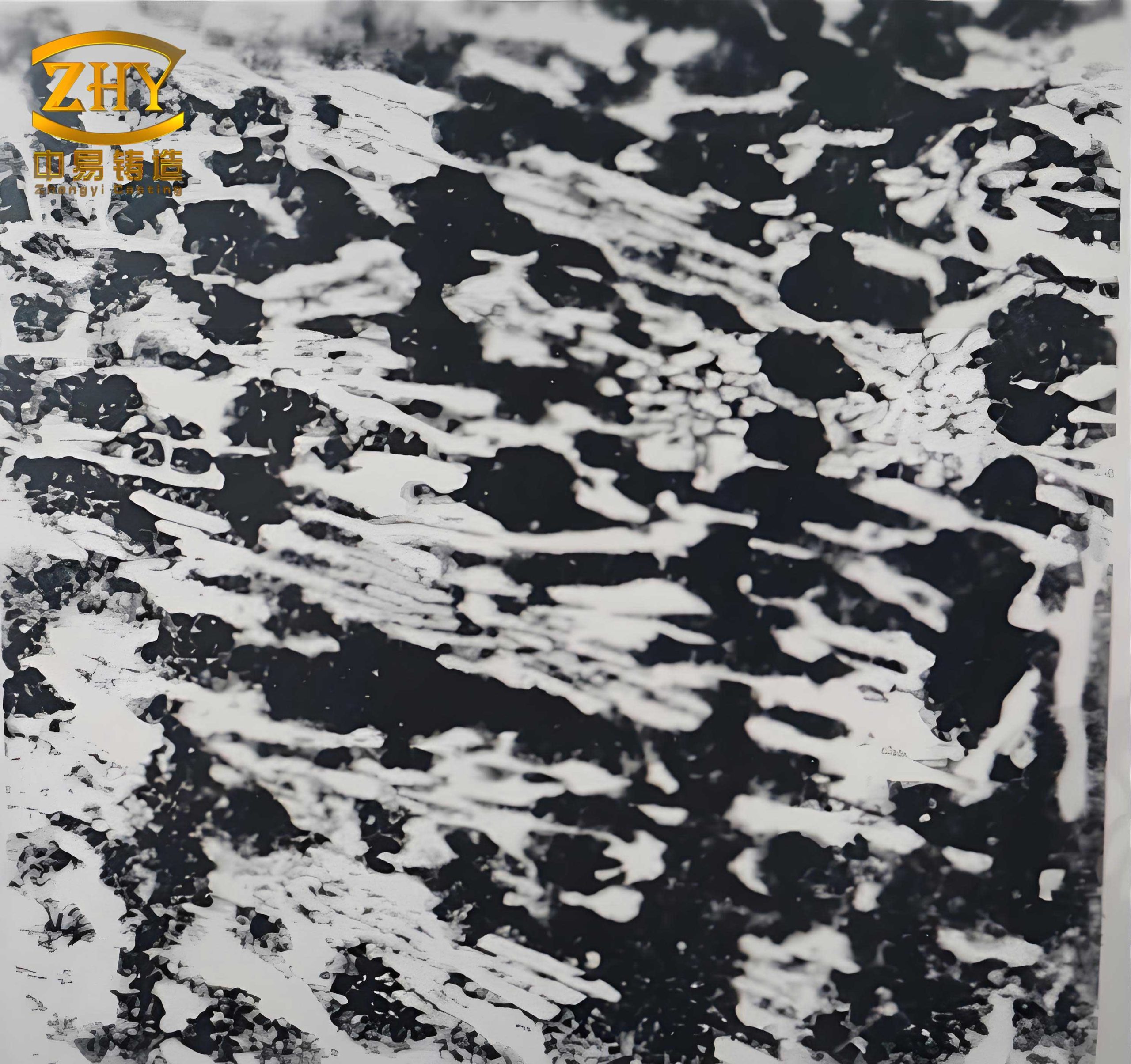
The image above illustrates a typical microstructure of white cast iron, highlighting carbide distributions that are relevant to this discussion. In our study, for as-cast samples, carbide morphology varied systematically: sand mold samples showed interconnected networks, while metal mold samples exhibited progressively isolated plates. After heat treatment, carbides further spheroidized, with edges becoming blunter, contributing to additional toughness gains. This is consistent with theories on carbide coarsening and matrix transformation, where tempering allows carbide redistribution. The martensitic matrix in heat-treated white cast iron also contributes to higher hardness, as seen in Table 2.
To quantify the effect of mold wall thickness on cooling rate, we can use the Chvorinov’s rule for solidification time: $$ t = B \cdot \left( \frac{V}{A} \right)^n $$ where \( t \) is solidification time, \( B \) is a mold constant, \( V \) is volume, \( A \) is surface area, and \( n \) is an exponent (typically around 2). For metal molds, increased wall thickness reduces heat extraction, leading to longer solidification times and modified carbide growth. This relationship explains why thicker molds produce more favorable carbide morphologies in white cast iron. Additionally, the secondary dendrite arm spacing (SDAS) can be correlated with cooling rate: $$ \text{SDAS} = a \cdot (\dot{T})^{-b} $$ where \( \dot{T} \) is cooling rate, and \( a \) and \( b \) are constants. A lower cooling rate (from thicker molds) increases SDAS, which influences carbide precipitation sites.
Further analysis involves the role of chromium in carbide formation. In low-chromium white cast iron, chromium primarily forms (Fe,Cr)₃C carbides, which are harder than cementite but less continuous than in high-chromium varieties. The volume fraction of carbides can be estimated using the Lever rule for binary systems, though white cast iron is multicomponent. For simplicity, we approximate: $$ V_c \approx \frac{C_{\text{total}} – C_{\alpha}}{C_{\text{carbide}} – C_{\alpha}} $$ where \( C_{\text{total}} \) is total carbon content, \( C_{\alpha} \) is carbon in ferrite, and \( C_{\text{carbide}} \) is carbon in carbide. With our composition, \( V_c \) is roughly 25–30%, explaining the high hardness.
The impact of heat treatment on white cast iron cannot be overstated. Quenching from 950°C results in a martensitic matrix, which increases hardness, while tempering at 250°C relieves stresses and improves toughness. The combined effect yields a superior balance of properties. We observed that heat-treated samples consistently outperformed as-cast ones in impact toughness, with improvements ranging from 30% to 50% across mold thicknesses. This underscores the importance of post-casting processing for white cast iron applications.
In practical terms, these findings suggest that for components requiring high wear resistance and moderate toughness, such as mill liners or crusher parts, using metal molds with thicker walls can enhance performance without sacrificing hardness. The white cast iron industry can benefit from this by optimizing mold designs to control cooling rates. Future work could explore other alloying elements or mold coatings to further refine carbide morphology.
To summarize, this study demonstrates that metal mold casting significantly improves the toughness of low-chromium white cast iron by altering carbide distribution. As mold wall thickness increases, carbides transition from networked to isolated forms, boosting impact toughness while hardness remains stable. Heat treatment further enhances these properties through matrix strengthening and carbide spheroidization. The results provide a foundation for advancing casting techniques for white cast iron, ensuring better material performance in demanding environments.