
Abstract
The failure of the steel castings in the excavation chain of the ballast cleaning machine, focuses on the analysis of the fracture morphology, mechanical properties, and metallographic structure of the failed parts, determines the cause of the failure, investigates and analyzes the casting production process, and determines the specific cause of the failure. The process improvement plan was formulated, and the test results were verified. The technical indicators were better than the technical requirements, which effectively improved the product quality.
1. Introduction
In recent years, with the rapid development of railway equipment technology, ballast cleaning operations for line overhaul and medium maintenance have achieved mechanization and automation. The full-section ballast cleaning machine is one of the mechanized line equipment, and the excavation chain is its main device. The excavation chain is composed of steel castings equipped with rakes, intermediates, and chain pins, and its working conditions are relatively harsh. During the use of a certain type of excavation chain after delivery to customers, a fracture failure occurred before the operating mileage met the customer’s requirements. The fracture was located on the steel casting produced by a certain foundry. To identify the cause, the fracture morphology, mechanical properties, and metallographic structure of the failed steel casting were analyzed, combined with the casting process, to determine the root cause of the fracture and take measures for improvement.
2. Failure Analysis
2.1 Fracture Morphology Analysis
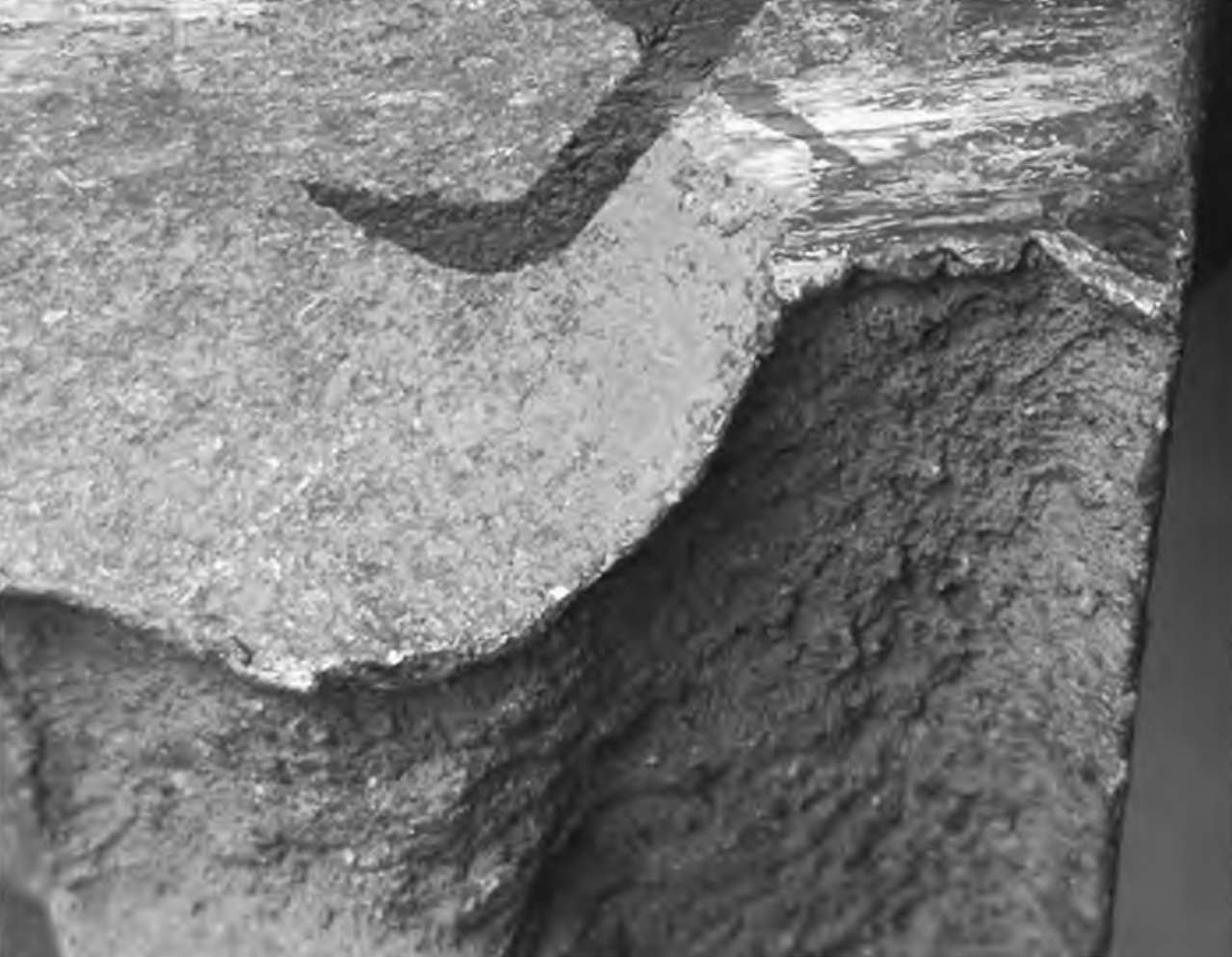
Upon observing the macroscopic morphology of the fracture, it was found that the fracture surface was gray with no signs of oxidation or corrosion. The convergence direction of the crack propagation patterns indicated that the crack source was located at the edge of the fracture surface. No visible inclusions, porosity, or holes were found near the crack source. The edge area near the crack source exhibited signs of wear and extrusion deformation.
After cleaning the fracture, the microscopic morphology was observed. The fracture morphology was mainly composed of dimples and quasi-cleavage, with multiple small areas of skeletal morphology. Additionally, casting porosity was visible on the fracture, locally distributed along the dendrites.
2.2 Mechanical Properties Analysis
Samples were taken from the body of the failed part for mechanical property and hardness testing. The reduction of area of the steel casting was below the technical requirements; the impact absorption energy was also low, at the lower limit of the technical requirements; and the Rockwell hardness was above the technical requirements.
Table 1. Mechanical Properties of the Failed Steel Casting
| Property | Measured Value | Technical Requirement |
|---|---|---|
| Reduction of Area (%) | Below Requirement | As per Specification |
| Impact Absorption Energy (J) | Low, at Lower Limit | As per Specification |
| Rockwell Hardness (HRC) | Above Requirement | As per Specification |
2.3 Metallographic Structure Analysis
Samples were taken near the crack source for analysis, and the test results are as follows:
- According to the standard TB/T 2942.1-2020 Technical Requirements and Inspection for Steel Castings for Rolling Stock – Part 1, the non-metallic inclusions were rated. The results showed that Types I and III fine inclusions were rated 2-3, Types I and III coarse inclusions were rated 2, Type II inclusions were rated 3, and Type IV inclusions were rated 1.
- Local porosity was visible (see Figure 4), which was consistent with the porosity morphology observed in the microscopic morphology.
- According to GB/T 6394-2017 Metal Average Grain Size Determination Method, the grain size of the steel casting matrix could be rated as 3-4.
- After etching, local areas exhibited dendrite segregation, and the matrix structure was tempered martensite + bainite.
2.4 Analysis Conclusion
In summary, the strength indicators of the fractured steel casting met the technical requirements, but the impact absorption energy was relatively low, the reduction of area was below the technical requirements, and the Rockwell hardness was above the technical requirements. Combined with the fracture morphology and metallographic analysis results, the matrix near the fracture of the steel casting contained numerous Types II and IV non-metallic inclusions, local porosity, coarse grains, and bainite growing along the grain boundaries. These factors reduced the material’s impact resistance.
3. Cause Analysis
3.1 Casting Process Analysis
By analyzing the casting process of a certain foundry, the existing production process had the following shortcomings:
- Pouring was conducted using a ladle method, which allowed the oxidized slag in the molten steel to easily enter the mold cavity, resulting in relatively poor purity of the molten metal.
- The top-pouring method was used, and when the molten metal entered the mold cavity, the linear velocity was relatively high, which easily caused turbulence in the molten metal, forming casting defects such as oxide inclusions and slag pores.
- The pouring system and risers were limited, and the feeding effect of the casting process was relatively poor, prone to shrinkage defects.
3.2 Production Process Quality Analysis
By reviewing the casting and heat treatment processes, the following issues were found in the quality control of the production process:
- During production, aspects such as raw material control, process records, and in-furnace batch transfer for castings were not managed in batches, making traceability management impossible and resulting in relatively poor product quality consistency.
- Issues such as oily and rusty scrap steel used in the melting process, unclean shot-blasted return materials, and excessive slag on the pouring ladle surface affected the inclusion grade of the castings to some extent.
4. Improvement Plan and Results
4.1 Casting Process Optimization
- A sand casting process scheme was adopted, using coated sand shell molds with core assembly, designing a reasonable pouring system and risers, optimizing the feeding effect of the castings, and improving the density of the casting structure.
- A bottom-pouring method was used to improve the slag-rejecting ability of the pouring ladle and increase the purity of the molten steel.
- The middle and lower parts of the mold were filled with molten steel, which entered the mold cavity relatively smoothly, with fewer defects such as gas and slag entrapment.
4.2 Production Process Quality Improvement
- Castings were transferred in batches from the same melting furnace, and products poured from the same melting furnace underwent the same batch preparation and heat treatment processes to improve the consistency of product performance.
- The quality control of raw materials such as scrap steel and alloys used in the melting process was strengthened, and procurement and acceptance requirements for raw materials were formulated to reduce harmful elements such as P and S. Additionally, the melting process required the baking of added alloys to improve the purity of the molten steel.
Products were poured according to the improvement plan, and the mechanical properties, non-metallic inclusions, metallographic structure, and grain size of the castings were tested. The test results of all indicators were better than the technical requirements, and the product quality was effectively improved. The test results of non-metallic inclusions are shown in Table 2, and images of non-metallic inclusions and metallographic structures.
Table 2. Test Results of Non-Metallic Inclusions
| Inclusion Type | Fine Grade | Coarse Grade |
|---|---|---|
| Type I | 2-3 | 2 |
| Type II | 3 | – |
| Type III | 2-3 | 2 |
| Type IV | 1 | – |
5. Conclusion
(1) By conducting failure analysis on the faulty area of the casting, the specific cause can be quickly and effectively pinpointed. The direct reasons for the fracture are the high presence of Type II and Type IV non-metallic inclusions, localized porosity, and relatively coarse grain structure.
(2) There are numerous factors that can affect the quality of casting products during the casting process. Improvements can be made through refining casting techniques, controlling raw material quality, and managing casting batches to produce consistent and qualified products.