
In the manufacturing industry, sand casting remains a pivotal process due to its flexibility and cost-effectiveness for producing complex metal components. However, ensuring high quality in sand casting products is challenging due to the influence of numerous factors, including process parameters and three-dimensional (3D) structural design. Traditionally, quality analysis has relied heavily on structured process data, often neglecting the impact of 3D morphology because of difficulties in quantifying non-structured data like 3D models. This limitation hinders the ability to understand why defects occur in specific geometric regions of sand casting products. To address this, my research focuses on developing a data-driven approach that integrates multi-source heterogeneous data—combining structured process parameters with extracted 3D features—to predict defects in complex sand casting products. By leveraging advanced deep learning techniques, this study aims to enhance quality control and reduce defect rates in sand casting production, ultimately improving the reliability and performance of sand casting products across various applications.
The core of this work involves three main steps: first, collecting structured process data and 3D models of sand casting products from sand mixing, molding, melting, and pouring stages; second, extracting quantitative features from the complex 3D structures using a deep convolutional autoencoder; and third, building a predictive model that fuses these heterogeneous data sources to accurately forecast common defects such as cold shuts, porosity, sand inclusions, and shrinkage cavities. Through this integrated approach, I demonstrate that incorporating 3D morphological analysis significantly boosts prediction accuracy, offering a more comprehensive understanding of quality issues in sand casting products. This research not only advances the field of casting digitization but also provides practical tools for industries reliant on high-integrity sand casting products.
Introduction to Sand Casting and Quality Challenges
Sand casting is a versatile manufacturing process used to produce a wide range of metal parts, from small components to large industrial machinery. Its popularity stems from advantages such as low cost, adaptability to complex shapes, and suitability for various alloys. In sand casting, molten metal is poured into a mold made from compacted sand, which forms the desired shape upon solidification. However, the quality of sand casting products is highly susceptible to variations in process conditions and geometric design. Defects like cold shuts (caused by improper metal flow), porosity (from gas entrapment), sand inclusions (due to mold erosion), and shrinkage cavities (resulting from inadequate feeding) are common issues that compromise the integrity of sand casting products. These defects often lead to increased scrap rates, higher production costs, and potential safety risks in end-use applications.
Historically, quality prediction in sand casting has primarily relied on monitoring structured process parameters, such as sand properties, pouring temperature, and chemical composition. While these factors are critical, they overlook the influence of 3D product geometry on defect formation. The 3D structure of sand casting products—characterized by features like wall thickness variations, internal cavities, and surface contours—can significantly affect heat transfer, fluid flow, and solidification patterns during casting. For instance, thin sections may cool too quickly, leading to cold shuts, while thick sections might promote shrinkage cavities. Despite this, quantifying 3D morphology has been a persistent challenge due to the non-structured nature of 3D model data, making it difficult to integrate into traditional data-driven analyses. Previous studies have explored 3D shape retrieval and feature extraction methods, but their application to sand casting products has been limited, often failing to capture the intricate relationships between geometry and defects.
To bridge this gap, I propose a multi-source heterogeneous data-driven framework that combines both structured process data and 3D structural features for quality prediction. By employing deep learning techniques, specifically a 3D deep convolutional autoencoder (3D-DCAE), I extract meaningful features from the 3D models of sand casting products. These features are then fused with process parameters to train a convolutional neural network (CNN)-based defect prediction model. This holistic approach allows for a more accurate and interpretable analysis of quality issues in sand casting products, enabling proactive defect prevention and optimized process design. In the following sections, I detail the sand casting process analysis, data acquisition methods, 3D feature extraction, model construction, and validation results, emphasizing the importance of integrating 3D morphology for enhancing the quality of sand casting products.
Sand Casting Process Analysis and Defect Mechanisms
The sand casting process involves multiple sequential steps, each contributing to the final quality of sand casting products. A typical production line includes sand preparation, mold making, core manufacturing, metal melting, pouring, and post-casting operations. Understanding these steps is crucial for identifying sources of defects and collecting relevant data. Below, I outline the key stages and their impact on sand casting products.
| Process Stage | Description | Potential Defects in Sand Casting Products |
|---|---|---|
| Sand Mixing | Blending sand, clay, coal dust, and additives to achieve desired mold properties like strength and permeability. | Sand inclusions if mold integrity is poor; gas porosity from excessive moisture. |
| Mold Making | Compacting sand around a pattern to form the mold cavity; often done via high-pressure squeezing. | Cold shuts due to improper gating design; sand erosion leading to inclusions. |
| Core Manufacturing | Creating sand cores to define internal features of sand casting products. | Gas porosity from core binders; core shift causing dimensional errors. |
| Metal Melting | Melting alloys in furnaces, with control over temperature and composition. | Shrinkage cavities from improper chemistry; slag inclusions. |
| Pouring | Transferring molten metal into molds at controlled rates and temperatures. | Cold shuts from low pouring temperature; turbulence-induced porosity. |
| Solidification | Cooling and solidification of metal within the mold. | Shrinkage cavities in thick sections; hot tears from thermal stresses. |
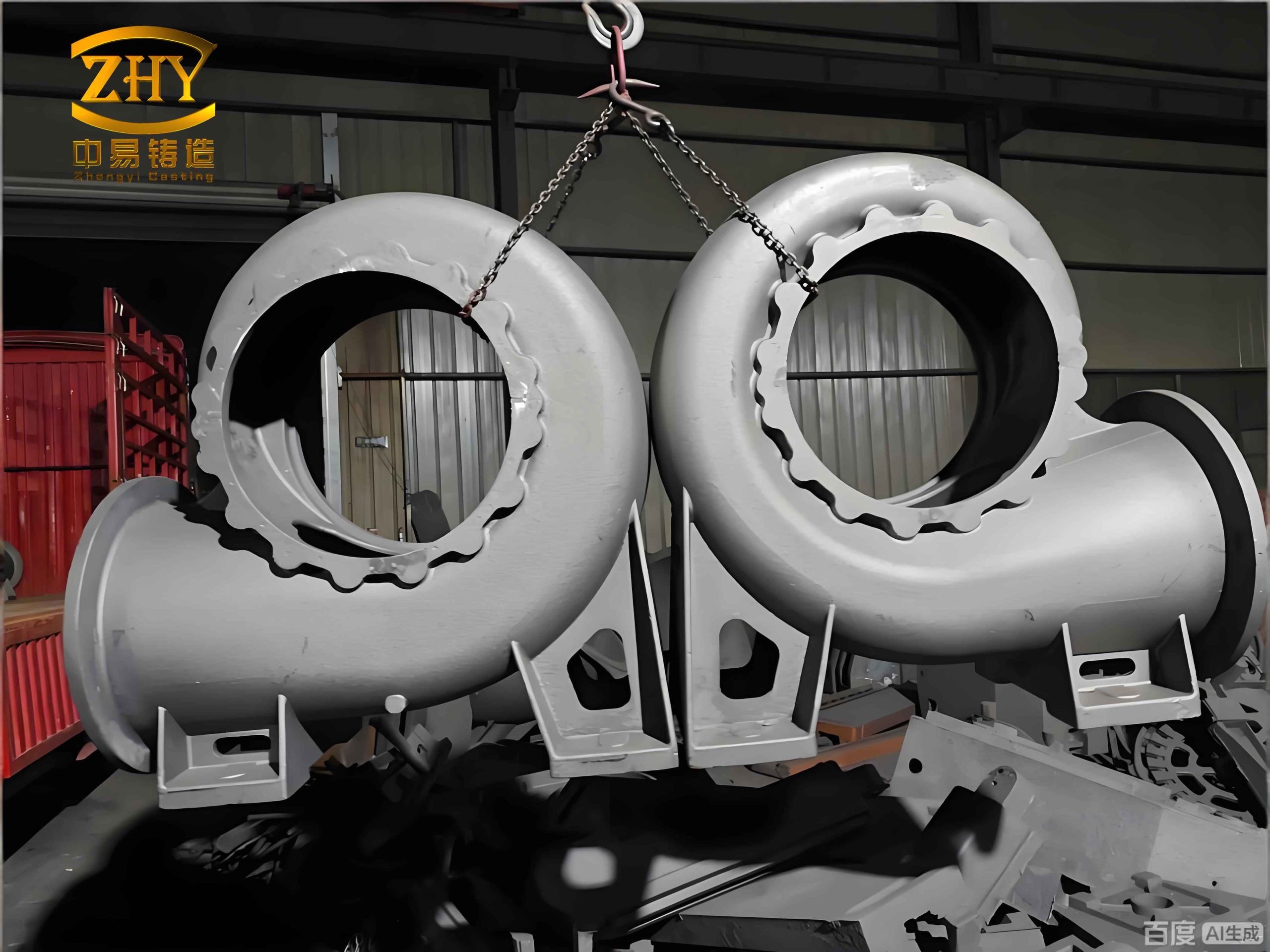
Defects in sand casting products arise from complex interactions between process parameters and geometric factors. For example, cold shuts occur when molten metal streams fail to fuse properly, often due to low pouring temperatures or inadequate gating systems in complex geometries. Porosity can result from gas evolution during solidification, influenced by sand moisture or alloy composition. Sand inclusions happen when mold surfaces erode, contaminating the metal—a risk exacerbated by intricate mold cavities. Shrinkage cavities form in isolated thick sections where insufficient feeding leads to voids during solidification. These defects are particularly prevalent in complex sand casting products like steering axles, rotary frames, and axle housings, which feature varying wall thicknesses, internal passages, and curved surfaces. To mitigate such issues, a data-driven approach must account for both process variables and 3D structural characteristics of sand casting products.
Mathematically, the relationship between defects and influencing factors can be expressed as a function of multiple variables. Let \( D \) represent the defect occurrence (e.g., binary indicator for cold shuts), \( P \) denote the set of process parameters (e.g., pouring temperature \( T_p \), sand compactness \( C_s \)), and \( G \) represent the 3D geometric features (e.g., volume \( V \), surface area \( S \), thickness variations \( \Delta t \)). The defect probability can be modeled as:
$$ D = f(P, G) + \epsilon $$
where \( f \) is a non-linear function capturing interactions, and \( \epsilon \) is random error. Traditional models often simplify this by ignoring \( G \), leading to incomplete predictions. My work aims to incorporate \( G \) through feature extraction, enhancing the accuracy of defect forecasts for sand casting products.
Data Acquisition from Multi-Source Heterogeneous Systems
To build a robust quality prediction model, I collected data from various sources in a sand casting production environment. This includes structured process data from manufacturing execution systems (MES) and non-structured 3D model data from product design files. The focus is on achieving single-piece traceability, where each sand casting product is associated with its unique process history and geometric design. This traceability is essential for linking defects to specific causes in complex sand casting products.
The structured data encompasses parameters from key process stages. For sand mixing, measurements like moisture content, compactability, permeability, and green strength are recorded batch-wise. During melting and pouring, data such as furnace temperature, alloy composition (e.g., carbon equivalent \( CE \)), pouring time \( t_p \), and inoculation amounts are captured per heat or ladle. Additionally, inspection results from spectrometers and hardness testers provide quality metrics. These parameters are stored in databases with timestamps and product identifiers, enabling correlation with individual sand casting products. To illustrate, Table 2 summarizes the critical process variables collected for sand casting products.
| Process Stage | Parameters | Units | Impact on Sand Casting Products |
|---|---|---|---|
| Sand Mixing | Moisture content, Compactability, Permeability, Green strength | %, %, m², MPa | Affects mold stability and gas venting; influences sand inclusion risk. |
| Melting | Temperature, Chemical composition (C, Si, Mn), Carbon equivalent \( CE = C + \frac{Si}{3} \) | °C, wt.% | Determines fluidity and shrinkage behavior; crucial for defect formation. |
| Pouring | Pouring temperature \( T_p \), Pouring time \( t_p \), Inoculant amount | °C, s, kg | Controls metal flow and solidification rates; impacts cold shuts and porosity. |
| Inspection | Spectrometer readings, Hardness, Defect labels (cold shut, porosity, etc.) | Varies | Provides ground truth for model training and validation. |
For 3D data, I obtained CAD models of sand casting products in standard formats like STL or STEP. These models represent the geometric design of components such as steering axles, rotary frames, and axle housings. To make this non-structured data usable for analysis, I converted the 3D models into voxel grids—a 3D array of binary values indicating material presence—using a resolution of \( 64 \times 64 \times 64 \) voxels. This voxelization process standardizes the input for feature extraction, allowing comparison across different sand casting products. The voxel grid can be denoted as \( V(x,y,z) \), where \( V = 1 \) for solid regions and \( V = 0 \) for empty space. By integrating these voxelized 3D models with process data, I create a heterogeneous dataset that captures both parametric and geometric aspects of sand casting products.
The data integration involves aligning process records with 3D models based on unique product identifiers (e.g., casting ID, heat number). For instance, using MES modules like core setting logs and spectroscopic records, I map each sand casting product to its corresponding process parameters and defect outcomes. This results in a comprehensive dataset where each sample \( i \) is represented as \( X_i = \{ P_i, G_i \} \) with label \( Y_i \) indicating defect types. Here, \( P_i \) is a vector of process parameters, and \( G_i \) is the voxelized 3D model. This multi-source approach forms the foundation for training predictive models that account for the full complexity of sand casting products.
3D Feature Extraction Using Deep Convolutional Autoencoders
Extracting meaningful features from the 3D geometry of sand casting products is a critical step in linking morphology to quality. Traditional methods like principal component analysis (PCA) are limited to linear transformations and struggle with the high-dimensional, non-linear nature of voxel data. Instead, I employ a deep convolutional autoencoder (3D-DCAE), an unsupervised deep learning model that learns compact representations of 3D shapes by reconstructing input data. This approach effectively quantifies the 3D structure of sand casting products, enabling the derivation of features that correlate with defect formation.
An autoencoder consists of an encoder that compresses input data into a latent space representation, and a decoder that reconstructs the original data from this representation. For 3D voxel grids, I use convolutional layers to capture spatial hierarchies, making the model a 3D-DCAE. The encoder reduces the input dimensions through 3D convolutions and pooling, while the decoder uses transposed convolutions to upsample back to the original size. The latent vector \( h \) at the bottleneck layer serves as the extracted feature vector for each sand casting product. The reconstruction loss, typically mean squared error (MSE), guides training to ensure \( h \) retains essential geometric information.
Mathematically, let the input voxel grid be \( X \in \mathbb{R}^{d \times h \times w} \), where \( d, h, w \) are depth, height, and width. The encoder function \( E \) maps \( X \) to latent vector \( h \):
$$ h = E(X; \theta_E) $$
where \( \theta_E \) are encoder parameters. The decoder function \( D \) reconstructs \( \hat{X} \):
$$ \hat{X} = D(h; \theta_D) $$
The model is trained to minimize the reconstruction error:
$$ \mathcal{L}_{recon} = \frac{1}{N} \sum_{i=1}^{N} \| X_i – \hat{X}_i \|^2 $$
where \( N \) is the number of sand casting products. After training, \( h \) provides a low-dimensional feature vector (e.g., 128 dimensions) that encapsulates key shape characteristics like volume distribution, curvature, and connectivity—all relevant for defect analysis in sand casting products.
I implemented the 3D-DCAE with four convolutional layers in the encoder, each followed by max-pooling, and symmetric layers in the decoder. The network uses ReLU activations and batch normalization for stability. Training was performed on a dataset of voxelized sand casting products using the Adam optimizer with a learning rate of 0.001 over 100 epochs. The model achieved a reconstruction accuracy of 99.76%, indicating its ability to preserve geometric details. To demonstrate effectiveness, I compared 3D-DCAE with a 2D-DCAE that treats voxel depth as channels; 3D-DCAE outperformed significantly due to its retention of spatial relationships across all three dimensions. This superiority is quantified in Table 3, highlighting the value of 3D convolutions for sand casting products.
| Model | Reconstruction Accuracy (%) | Feature Dimension | Advantages for Sand Casting Products |
|---|---|---|---|
| 3D-DCAE | 99.76 | 128 | Captures full 3D spatial features; better for complex geometries like thin walls and cavities. |
| 2D-DCAE | 95.34 | 128 | Treats depth as channels; may lose inter-slice correlations, reducing accuracy. |
| PCA (baseline) | 88.21 | 50 | Linear method; fails to model non-linear shape variations in sand casting products. |
The extracted features \( h \) from 3D-DCAE serve as quantitative descriptors of 3D morphology. For example, features might correlate with geometric properties such as sphericity \( \Psi = \frac{\pi^{1/3}(6V)^{2/3}}{A} \), where \( V \) is volume and \( A \) is surface area, or local thickness variations. By incorporating these into quality prediction, I can assess how specific shape attributes influence defects in sand casting products. This approach moves beyond traditional qualitative assessments, enabling data-driven insights into geometry-quality relationships.
Defect Prediction Model Integrating Heterogeneous Data
With structured process parameters and extracted 3D features, I construct a defect prediction model for sand casting products. This model fuses heterogeneous data sources to classify defects like cold shuts, porosity, sand inclusions, and shrinkage cavities. The architecture combines convolutional neural networks (CNNs) for processing 3D features and fully connected layers for integrating process data, followed by a multi-class output layer. This design ensures that both geometric and parametric factors contribute to predictions for sand casting products.
The model input consists of two parts: a vector of process parameters \( P \) (e.g., 20 dimensions after normalization) and the 3D feature vector \( h \) (128 dimensions from 3D-DCAE). These are concatenated into a combined feature vector \( F = [P, h] \). To handle the sequential nature of some process data, I apply one-dimensional convolutional layers to \( F \), which scan for local patterns and interactions. This is followed by max-pooling to reduce dimensionality and highlight salient features. The output is flattened and passed through dense layers before a softmax layer produces probabilities for each defect class. The overall model, termed Fusion-based Regularized CNN (FR-CNN), employs dropout and L2 regularization to prevent overfitting, crucial given the limited dataset size for complex sand casting products.
Mathematically, the model can be described as follows. Let \( F \) be the concatenated input. The first 1D convolutional layer applies filters of size 3:
$$ C_1 = \text{ReLU}(W_1 * F + b_1) $$
where \( * \) denotes convolution, \( W_1 \) and \( b_1 \) are weights and biases. This is followed by max-pooling with stride 2:
$$ P_1 = \text{MaxPool}(C_1) $$
After two such layers, the output is flattened to vector \( v \), and passed through dense layers:
$$ v’ = \text{ReLU}(W_d v + b_d) $$
Finally, the softmax layer gives class probabilities \( \hat{Y} \):
$$ \hat{Y}_k = \frac{e^{z_k}}{\sum_{j=1}^{K} e^{z_j}}, \quad z = W_s v’ + b_s $$
where \( K = 5 \) (four defects plus no-defect class) for sand casting products. The model is trained using categorical cross-entropy loss with a cost-sensitive regularization term to address class imbalance:
$$ \mathcal{L}_{pred} = -\sum_{i=1}^{N} \sum_{k=1}^{K} w_k Y_{ik} \log(\hat{Y}_{ik}) + \lambda \| \theta \|^2 $$
Here, \( w_k \) are class weights inversely proportional to defect frequencies in sand casting products, and \( \lambda \) is the regularization coefficient. Training uses mini-batch gradient descent with a batch size of 64, learning rate 0.01, and 80 epochs.
To validate the model, I split the dataset of sand casting products into 80% training and 20% testing. Performance metrics include accuracy, precision, recall, and F1-score. The FR-CNN model achieved a test accuracy of 93.7%, significantly outperforming baseline models like multilayer perceptron (MLP) and standard CNN that use only process data. This improvement underscores the importance of integrating 3D features for predicting defects in sand casting products. Table 4 summarizes the comparative results.
| Model | Training Accuracy (%) | Test Accuracy (%) | F1-Score (Weighted) | Remarks on Sand Casting Products |
|---|---|---|---|---|
| FR-CNN (Proposed) | 96.5 | 93.7 | 0.932 | Integrates process and 3D data; best overall for complex geometries. |
| Standard CNN | 93.9 | 90.7 | 0.901 | Uses only process data; misses geometric effects on defects. |
| MLP | 92.6 | 86.1 | 0.854 | Fully connected network; limited capacity for non-linear patterns. |
| Random Forest | 91.2 | 88.3 | 0.876 | Traditional ML; struggles with high-dimensional 3D features. |
Furthermore, I conducted ablation studies to assess the contribution of 3D features. Removing the 3D feature vector \( h \) reduced test accuracy by 7-10%, confirming that morphology plays a vital role in defect formation for sand casting products. For instance, cold shuts were better predicted in products with thin, extended sections, while shrinkage cavities correlated with features indicating bulky regions. These insights can guide designers to modify geometries or adjust process parameters proactively, enhancing the quality of sand casting products.
Conclusion and Implications for Sand Casting Industry
This research presents a comprehensive framework for quality prediction in sand casting products by leveraging multi-source heterogeneous data. By combining structured process parameters with quantitative 3D features extracted via a deep convolutional autoencoder, I developed a defect prediction model that achieves high accuracy in identifying common issues like cold shuts, porosity, sand inclusions, and shrinkage cavities. The key contributions include: (1) a method for single-piece data acquisition that links process history to individual sand casting products; (2) a 3D-DCAE model that effectively quantifies complex geometries of sand casting products; and (3) an FR-CNN model that fuses heterogeneous data for robust defect forecasting. These advancements address the longstanding challenge of integrating 3D morphology into quality analysis, offering a more holistic view of factors affecting sand casting products.
The practical implications are significant for the sand casting industry. Manufacturers can use this approach to predict defects early in the production cycle, allowing for timely adjustments in process settings or geometric designs. This can reduce scrap rates, lower costs, and improve the reliability of sand casting products in critical applications such as automotive and machinery. Moreover, the extracted 3D features provide interpretable insights into how specific shape characteristics influence defects, enabling designers to optimize product geometries for better castability. Future work could extend this framework to real-time monitoring systems or incorporate additional data sources like thermal imaging for even more accurate predictions. Overall, this study demonstrates the power of data-driven methods in advancing the quality and efficiency of sand casting products, paving the way for smarter manufacturing in the foundry sector.
In summary, the integration of multi-source heterogeneous data—encompassing both process and 3D structural information—proves essential for understanding and predicting quality issues in sand casting products. As industries continue to demand high-performance cast components, such predictive capabilities will become increasingly valuable, driving innovation and sustainability in sand casting production.