
As researchers engaged in foundry process optimization, we recognize the pressing need to quantify carbon emissions from individual sand castings. The sand casting foundry is a cornerstone of traditional manufacturing, yet its energy efficiency remains low (15–25%) and its waste production is significantly higher than developed countries. In this paper, we present a hybrid method combining input-output analysis with process-based life cycle assessment to compute the carbon footprint of a single casting produced in a sand casting foundry. The model covers material, energy, and waste emissions across four production stages: molding, melting, sand reclamation, and finishing. A case study of a locking disk casting (11 MW wind power component) demonstrates the applicability of our approach. The results show that material emissions dominate, especially from scrap steel and pig iron in the melting stage, providing clear targets for emission reduction in a sand casting foundry.
1. Introduction
Carbon dioxide emissions from industrial activities have become a global concern. China emitted 9.825 billion tons of CO₂ in 2019, ranking first worldwide. The sand casting foundry, as a fundamental sector of the manufacturing industry, consumes huge amounts of energy and raw materials, producing significant direct and indirect emissions. Current studies on carbon quantification in sand casting foundry often focus on the overall process, lacking a method to allocate emissions to individual castings. To fill this gap, we develop a quantitative model based on life cycle theory, enabling the calculation of carbon emissions per casting in a batch production environment of a typical sand casting foundry.
Our model divides the sand casting foundry process into four phases: molding, melting, reclamation, and finishing. For each phase, we categorize emissions into three types: material-related (indirect from consumed raw materials), energy-related (indirect from electricity consumption), and waste-related (from treatment of fumes, slag, etc.). By combining input-output allocation for fixed consumables and process-based calculation for variable inputs, we can accurately compute the carbon footprint of any given casting. The proposed methodology is validated with real production data from a sand casting foundry manufacturing a locking disk for wind turbines.
2. System Boundary and Carbon Sources
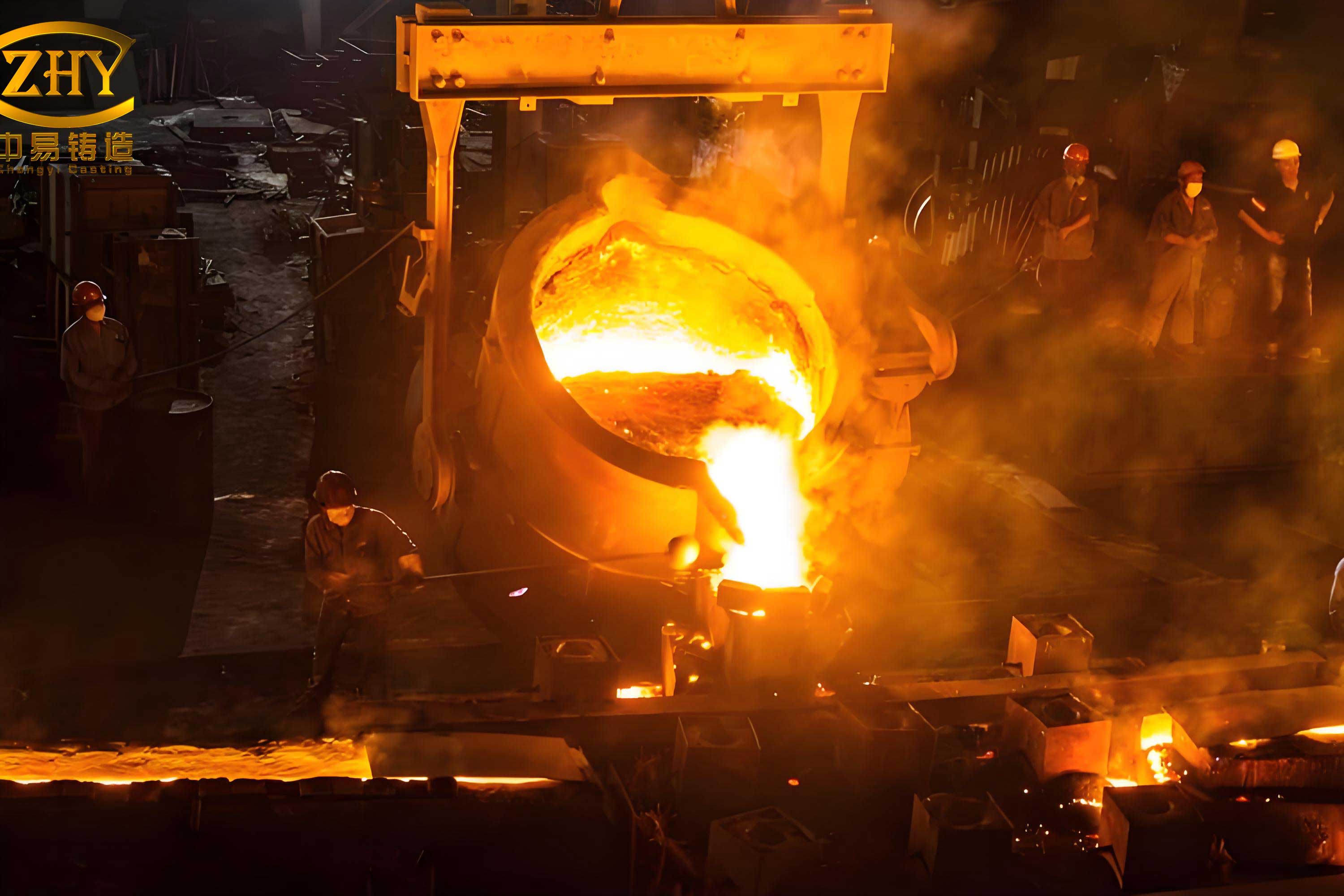
In a sand casting foundry, the system boundary for carbon accounting includes all activities from raw material preparation to the finished casting before heat treatment. Figure 1 illustrates the carbon flow within a typical sand casting foundry. (The image is inserted below.)
The carbon sources are classified as:
- Material carbon emissions: Emissions from the consumption of resin sand, steel scrap, pig iron, returned sand, carburizer, ferrosilicon, etc. These are indirect emissions embodied in the raw materials.
- Energy carbon emissions: Emissions from electricity used by sand mixers, induction furnaces, cranes, shot blasting machines, and sand reclamation lines.
- Waste carbon emissions: Emissions from treating fumes, dust, slag, and spent sand, mainly through electricity consumption in dust collectors and material handling equipment.
In the following sections, we detail the mathematical models for each emission category.
3. Quantitative Carbon Emission Model for a Sand Casting Foundry
3.1 Material Carbon Emissions
Material emissions are split into variable and fixed parts. Variable material consumption (e.g., resin sand and molten iron raw materials) is directly proportional to the casting weight and can be computed from process parameters. Fixed material consumption (e.g., refractory coatings, methanol, steel shots) is allocated based on input-output data over a production period.
Molding stage – The variable material is resin sand. Let \( M_d \) be the casting weight (kg), \( R_1 \) the sand-to-iron ratio (mass of sand required per mass of casting), \( \eta \) the sand reclamation rate (typically 93%), and \( f_b \) the carbon emission coefficient of resin sand (0.02543 kg CO₂/kg). The variable material emission \( C_{VR,d}^1 \) is:
$$ C_{VR,d}^1 = M_d \cdot R_1 \cdot (1 – \eta) \cdot f_b $$
The sand-to-iron ratio \( R_1 \) is calculated from the mold volume and casting volume:
$$ R_1 = \frac{V_x – V_d}{\rho_b \cdot V_d} $$
where \( V_x \) is the flask volume, \( V_d \) the casting volume, and \( \rho_b \) the resin sand density (1.48 g/cm³). Fixed material emissions in the molding stage, such as refractory coatings and methanol, are given by:
$$ C_{ST,d}^1 = \sum_{c=1}^{c_0} \frac{I_c^1}{O_d} \cdot f_c $$
where \( I_c^1 \) is the consumption of fixed material \( c \) over a period, \( O_d \) the total output of castings in that period, and \( f_c \) its emission coefficient. Thus total material emission in molding is:
$$ C_{M,d}^1 = M_d \cdot R_1 \cdot (1 – \eta) \cdot f_b + \sum_{c=1}^{c_0} \frac{I_c^1}{O_d} \cdot f_c $$
Melting stage – All raw materials (scrap steel, pig iron, returned material, carburizer, silicon carbide, ferrosilicon) are variable. Let \( MIR \) be the pouring allowance ratio (excess molten iron relative to casting weight, here 0.1). The weight of molten iron required is \( M_d (1 + MIR) \). The proportion of raw material \( g \) in the melt is \( R_g^2 \). Then the material emission in melting is:
$$ C_{M,d}^2 = M_d (1 + MIR) \sum_{g=1}^{g_0} R_g^2 \cdot f_g $$
Reclamation and finishing stages – These stages mainly involve fixed materials (e.g., steel shots in shot blasting). Their emissions are:
$$ C_{M,d}^3 = \sum_{c=1}^{c_0} \frac{I_c^3}{O_d} \cdot f_c \quad \text{(reclamation)} $$
$$ C_{M,d}^4 = \sum_{c=1}^{c_0} \frac{I_c^4}{O_d} \cdot f_c \quad \text{(finishing)} $$
Aggregating all stages, the total material carbon emission for casting \( d \) in a sand casting foundry is:
$$ C_{M,d} = M_d R_1 (1 – \eta) f_b + M_d (1 + MIR) \sum_{g=1}^{g_0} R_g^2 f_g + \sum_{a=1}^4 \sum_{c=1}^{c_0} \frac{I_c^a}{O_d} f_c $$
3.2 Energy Carbon Emissions
Energy emissions derive from electricity consumed by equipment. Power consumption is estimated by the power rating and operating time. For each stage, we include both processing machines and cranes for material handling.
| Stage | Equipment | Power (kW) | Efficiency/Speed | Energy emission model |
|---|---|---|---|---|
| Molding | Sand mixer (l) | \( p_l \) | \( v_l \) (kg/s) | \( E_{mix} = \frac{M_d R_1}{v_l} p_l f_e \) |
| Crane (m1) | \( p_{m1} \) | \( v_{m1} \) (m/min) | \( E_{crane,m1} = \frac{s_{m1}}{v_{m1}} p_{m1} \cdot \frac{1}{m_1^0?} f_e \) | |
| Melting | Induction furnace (n) | \( E_n \) (kWh/t iron) | – | \( M_d(1+MIR) E_n f_e \) |
| Crane (m2) | \( p_{m2} \) | \( v_{m2} \) | \( \frac{s_{m2}}{v_{m2}} p_{m2} \cdot \frac{1}{m_2^0?} f_e \) | |
| Reclamation | Sand reclamation line (o) | \( E_o \) (kWh/t sand) | – | \( M_d R_1 E_o f_e \) |
| Crane (m3) | \( p_{m3} \) | \( v_{m3} \) | \( \frac{s_{m3}}{v_{m3}} p_{m3} \cdot \frac{1}{m_3^0?} f_e \) | |
| Finishing | Shot blasting (u) | \( p_u \) | \( t_u \) (min) | \( p_u t_u f_e \) |
| Crane (m4) | \( p_{m4} \) | \( v_{m4} \) | \( \frac{s_{m4}}{v_{m4}} p_{m4} \cdot \frac{1}{m_4^0?} f_e \) |
Note: In a batch production, the crane energy per casting is allocated by dividing the total crane energy consumption during a period by the number of castings produced. For simplicity, the model uses the distance traveled per casting. Since the sand casting foundry in our case uses stationary mold pits, the crane distance for molding is taken as 0 m. The complete energy emission for casting \( d \) becomes:
$$ C_{E,d} = \left[ \frac{M_d R_1}{v_l} p_l + \frac{s_{m1}}{v_{m1}} p_{m1} \cdot n_{crane1} \right] f_e + M_d(1+MIR)E_n f_e + \left[ \frac{s_{m2}}{v_{m2}} p_{m2} \cdot n_{crane2} \right] f_e + M_d R_1 E_o f_e + \left[ \frac{s_{m3}}{v_{m3}} p_{m3} \cdot n_{crane3} \right] f_e + \left[ p_u t_u + \frac{s_{m4}}{v_{m4}} p_{m4} \cdot n_{crane4} \right] f_e $$
Here \( n_{crane} \) is the number of cranes involved per casting (assumed 1 for simplicity), and \( f_e = 0.93 \) kg CO₂/kWh is the emission factor for electricity.
3.3 Waste Carbon Emissions
Wastes in a sand casting foundry include fumes (from molding, melting, reclamation, finishing) and solid slag (from melting). The emissions from treating these wastes are due to electricity consumption in dust collectors and moving equipment. The waste emission for stage \( a \) is modeled as:
$$ C_{U,d}^a = \left( \frac{M_d \cdot M_{U1}^a}{v_{wa}} \right) p_{wa} f_e + \text{solid waste treatment} $$
where \( M_{U1}^a \) is the mass of fume generated per ton of casting in stage \( a \), \( p_{wa} \) the dust collector power (7.5 kW), and \( v_{wa} \) the treatment speed (14.2515 kg/h). For solid slag in the melting stage:
$$ C_{U,d}^{slag} = \frac{M_d \cdot M_{U2}^2}{M_{i2}} \cdot \frac{s_{i2}}{v_{i2}} p_{i2} f_e $$
where \( M_{U2}^2 \) is slag per ton casting (0.054 kg), \( M_{i2} \) the batch capacity of the slag transporter (500 kg), \( s_{i2} \) transport distance (126.25 m), \( v_{i2} \) speed (16 m/min), and \( p_{i2} \) power (unknown; we assume small). Summing over stages gives total waste emission \( C_{U,d} \).
3.4 Total Carbon Emission per Casting
Combining all components, the total carbon emission from a sand casting foundry for casting \( d \) is:
$$ C_d = C_{M,d} + C_{E,d} + C_{U,d} $$
This formula allows the sand casting foundry to calculate the carbon footprint of any single casting based on production parameters and input-output data.
4. Case Study: Locking Disk Casting in a Wind Power Sand Casting Foundry
4.1 Process Parameters
We apply our model to an 11 MW locking disk casting (material: QT500-14, weight 6932 kg) produced in a real sand casting foundry. The key parameters are summarized in Table 2 and Table 3.
| Parameter | Value |
|---|---|
| Casting weight \( M_d \) | 6932 kg |
| Sand density \( \rho_b \) | 1.48 g/cm³ |
| Iron density | 7.08 g/cm³ |
| Flask size | 6000×6000×550 mm |
| Sand-to-iron ratio \( R_1 \) | 8.25 |
| Sand reclamation rate \( \eta \) | 93% |
| Pouring allowance ratio \( MIR \) | 0.1 |
| Material | Proportion \( R_g^2 \) (%) | Emission factor \( f_g \) (kg CO₂/kg) |
|---|---|---|
| Steel scrap | 58.19 | 8.2 |
| Pig iron | 24.69 | 2.13 |
| Returned material | 14.26 | 2.67 |
| Carburizer | 2.20 | 4.2 |
| SiC | 0.49 | 14.68 |
| FeSi | 0.17 | 2.3 |
Fixed material flows over the production period (60 t of castings) are: refractory coating 94.07 t, methanol 141.11 t, steel shots 0.129 t. Their emission factors are respectively 6.0232, 2.5, and 8.2 kg CO₂/kg.
Energy data: sand mixer power 11.5 kW, efficiency 6.2855 kg/s; induction furnace specific energy 500 kWh/t iron; sand reclamation line specific energy 0.0119 kWh/t sand; shot blasting machine power 80 kW, time 20 min per casting; crane power 20.5 kW, speed 16 m/min, distances: melting 70 m, reclamation 40 m, finishing 110 m, molding 0 m. Waste generation per ton casting is given in Table 4.
| Stage | Waste type | Mass (kg/t casting) |
|---|---|---|
| Molding | Fume | 0.586 |
| Melting | Fume | 0.500 |
| Reclamation | Fume | 1.050 |
| Finishing | Fume | 0.011 |
| Melting | Slag | 0.054 |
4.2 Calculation Results
Substituting the data into our models, we compute the carbon emissions for the single locking disk casting. The detailed breakdown is presented in Table 5.
| Category | Item | Consumption | Unit | CO₂ (kg) | Share (%) |
|---|---|---|---|---|---|
| Material | Resin sand | 4001.13 | kg | 101.75 | 0.21 |
| Refractory coating | 10.87 | kg | 65.46 | 0.13 | |
| Methanol | 16.3 | kg | 40.76 | 0.08 | |
| Steel scrap | 4437.1 | kg | 36384.25 | 74.19 | |
| Pig iron | 1882.66 | kg | 4010.07 | 8.18 | |
| Returned material | 1087.35 | kg | 2906.5 | 5.93 | |
| Carburizer | 167.75 | kg | 704.57 | 1.44 | |
| SiC | 37.36 | kg | 548.5 | 1.12 | |
| FeSi | 12.96 | kg | 29.81 | 0.06 | |
| Steel shots | 0.01 | kg | 0.12 | 0.00 | |
| Energy | Sand mixer electricity | 29.05 | kWh | 27.03 | 0.06 |
| Crane (molding) | 0 | kWh | 0 | 0.00 | |
| Induction furnace | 3812.6 | kWh | 3545.72 | 7.23 | |
| Crane (melting) | 0.85 | kWh | 0.79 | 0.00 | |
| Sand reclamation line | 680.19 | kWh | 632.91 | 1.29 | |
| Crane (reclamation) | 2.35 | kWh | 2.18 | 0.00 | |
| Shot blasting + crane | 26.67+4.28 | kWh | 28.79 | 0.06 | |
| Waste | Fume treatment (molding) | 0.286 | kWh | 0.27 | 0.00 |
| Fume treatment (melting) | 0.244 | kWh | 0.23 | 0.00 | |
| Fume treatment (reclamation) | 0.513 | kWh | 0.48 | 0.00 | |
| Fume treatment (finishing) | 0.005 | kWh | 0.005 | 0.00 | |
| Slag handling | 0.002 | kWh | 0.002 | 0.00 | |
| Total | 49041.16 | 100 | |||
The total carbon emission of the locking disk casting is approximately 49,041 kg CO₂. Material emissions constitute about 90% of the total, with steel scrap alone accounting for 74%. Energy emissions contribute about 8.6%, dominated by the induction furnace. Waste emissions are negligible. This highlights that in a sand casting foundry, the biggest lever for carbon reduction lies in the melting stage – either by reducing the pouring allowance \( MIR \), optimizing the scrap-to-pig iron ratio, or using lower-carbon raw materials.
5. Discussion
Our model allows a sand casting foundry to pinpoint the emission sources for any individual casting. The case study shows that the material emissions from steel scrap and pig iron are overwhelming. A potential improvement is to increase the proportion of returned material (which has a lower emission factor than scrap? Actually returned material has 2.67 vs scrap 8.2 – so increasing returns would help). However, metallurgical constraints must be respected. Another approach is to reduce the pouring system weight (\( MIR \)) through better gating design, which directly reduces the amount of molten iron needed. The sand casting foundry can also use renewable electricity to cut energy emissions, though they are relatively small.
6. Conclusion
We have developed a quantitative carbon emission model for individual castings in a sand casting foundry, integrating input-output and process analysis. The model accounts for material, energy, and waste emissions across all four production stages. Application to a locking disk casting reveals that over 74% of the total carbon footprint comes from steel scrap consumption in the melting stage, indicating a clear priority for emission reduction. This work provides a practical tool for any sand casting foundry to measure its carbon performance and identify improvement opportunities. Future research can extend the model to include heat treatment and machining stages, as well as to incorporate dynamic emission factors for electricity.
Our findings emphasize that the carbon footprint of a casting is not simply proportional to its weight, but heavily depends on the material selection and process efficiency within the sand casting foundry. By adopting the proposed methodology, foundries can systematically track their emissions and move towards greener production.