
In the automotive manufacturing industry, the engine block is a critical component whose quality directly impacts vehicle performance and reliability. One of the most persistent challenges in large-scale production is the occurrence of casting holes, specifically sand-hole defects, which account for over 65% of all defects in engine blocks. Traditional quality control methods often rely on post-production analysis, but this reactive approach fails to address defects as they emerge in real-time, leading to significant scrap rates and economic losses. To mitigate this, I have developed a real-time control system based on the .NET platform to predict and manage casting holes during the casting process. This system leverages a mathematical model that quantifies the influence of various factors on defect formation, enabling proactive adjustments to process parameters. In this article, I will detail the statistical analysis of influencing factors, the design of the predictive数学模型, the development of the software system, and its practical application in a foundry setting. The goal is to demonstrate how this system can effectively reduce the incidence of casting holes, thereby enhancing production efficiency and product quality.
Casting holes, particularly sand-hole defects, are voids or inclusions in the cast metal caused by dislodged sand particles or gas entrapment during the molding and pouring stages. These defects compromise the structural integrity of engine blocks, leading to failures in demanding operational conditions. The need for a real-time control system stems from the dynamic nature of casting processes, where minor fluctuations in parameters can cascade into significant defect rates. By implementing a predictive approach, I aim to shift from defect detection to defect prevention, aligning with modern smart manufacturing paradigms. This system not only addresses casting holes but also serves as a framework for other defect types, though the focus here is on sand-hole defects due to their prevalence. Throughout this discussion, I will emphasize the term “casting holes” to underscore the broader applicability of the methodology, even as I delve into specific sand-hole defect mechanisms.
The foundation of the real-time control system lies in a comprehensive analysis of the factors that contribute to casting holes. In sand casting processes, numerous variables interact to influence defect formation, but for a specific engine block production line, these factors exhibit predictable patterns. Based on empirical data from foundry operations, I have identified ten key factors that directly impact the occurrence of sand-hole defects. These factors include parameters related to mold sand properties, pouring conditions, and machine settings. To provide a clear overview, I have summarized these factors along with their acceptable process ranges in the table below. The ranges define the lower limit, middle limit, and upper limit within which the process is considered stable, but deviations beyond these limits increase the risk of casting holes.
| Influencing Factor | Lower Limit | Middle Limit | Upper Limit |
|---|---|---|---|
| Mold Sand Moisture (%) | 2.7 | 3.1 | 3.5 |
| Mold Sand Wet Compression Strength (MPa) | 0.13 | 0.15 | 0.17 |
| Pouring Temperature (°C) | 1405 | 1415 | 1425 |
| Mold Sand Compactness (%) | 38 | 41 | 44 |
| L1 Resin Addition (%) | 0.7 | 0.9 | 1.1 |
| L2 Resin Addition (%) | 0.6 | 0.8 | 1.0 |
| Hot Wet Tensile Strength (kPa) | 2.5 | 3.0 | 3.5 |
| Purification Pressure (MPa) | 0.3 | 0.4 | 0.5 |
| Sand Shooting Pressure (MPa) | 0.3 | 0.4 | 0.5 |
| Ammonia Blowing Pressure (MPa) | 0.1 | 0.2 | 0.3 |
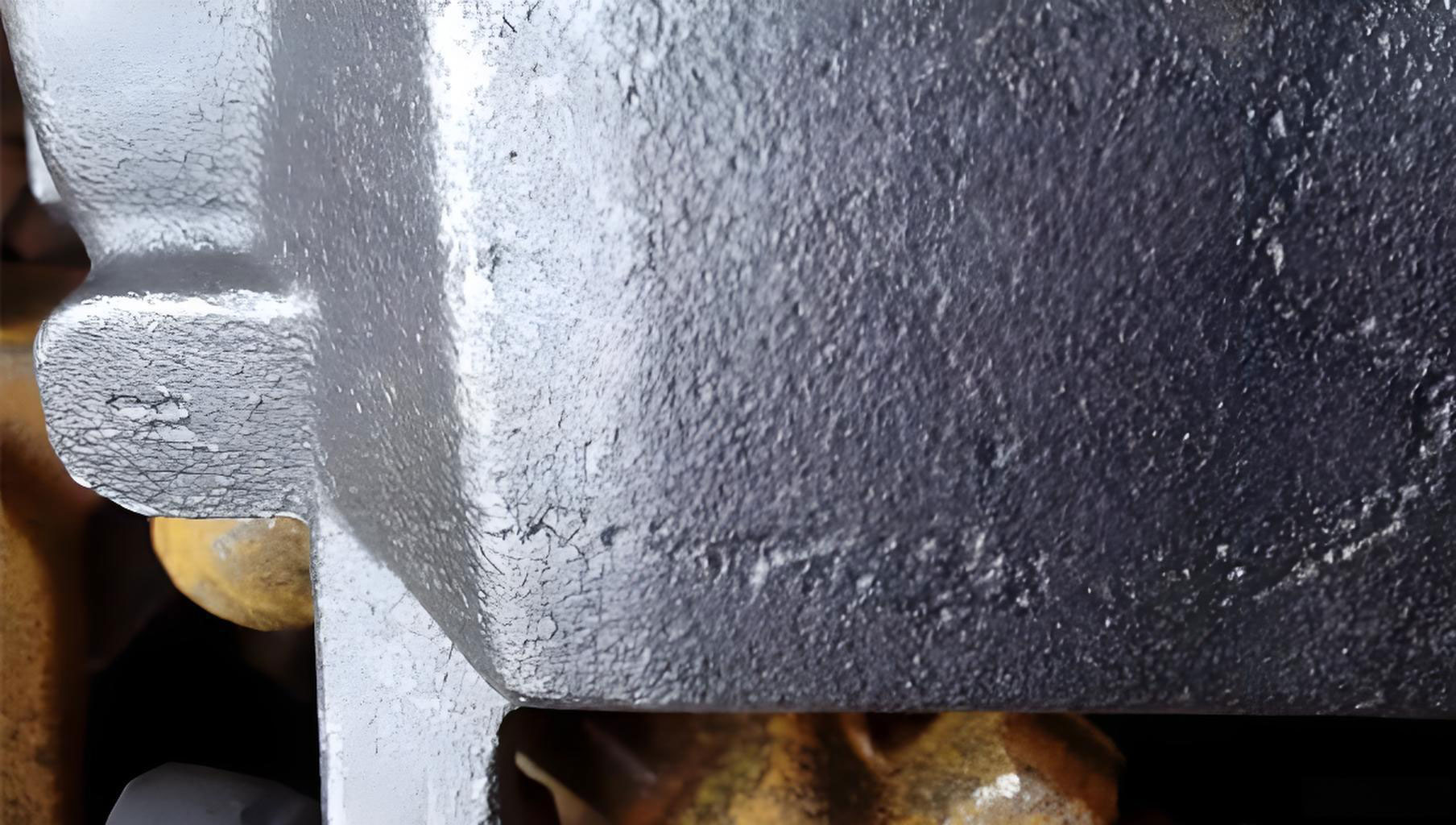
Each of these factors plays a role in the formation of casting holes. For instance, inadequate mold sand strength or excessive moisture can lead to sand erosion during pouring, resulting in holes. Similarly, improper pouring temperature may cause thermal stresses that dislodge sand particles. By monitoring these factors in real-time, the system can assess the cumulative risk of defect formation. To visualize a typical casting hole defect in an engine block, consider the following image, which illustrates the sand-hole manifestation that this system aims to predict and control.
The core innovation of this work is the predictive mathematical model designed to quantify the deviation of process parameters from ideal values and compute the probability of casting holes. The model is based on the concept of weighted deviations, where each influencing factor is assigned a weight that reflects its impact on defect formation. The mathematical formulation involves two key equations: one for the individual factor deviation and another for the combined deviation. The individual deviation for a factor i is calculated as:
$$ P_i = \lambda_i \frac{A – M_i}{L_i} $$
where \( A \) is the actual sampled value, \( M_i \) is the middle limit of the process range, \( L_i \) is the step length of the process range (defined as the difference between the upper and lower limits divided by a normalization factor, but in practice, it is often the range width for scaling), and \( \lambda_i \) is the weight associated with factor i. The weight \( \lambda_i \) is not constant; it varies based on the value of A to account for nonlinear effects. For each factor, the weight is defined such that it is +1 at the boundary where casting holes are likely to occur and -1 at the boundary where defects are unlikely. At the middle limit, the weight is typically zero, indicating no deviation impact. This weighting scheme allows the model to prioritize factors that are more critical to casting holes under specific conditions.
The combined deviation, which represents the overall risk of casting holes, is the sum of individual deviations:
$$ P_c = \sum_{i=1}^{10} P_i $$
To determine whether the process is within acceptable limits, a standard deviation \( P_s \) is computed based on historical data or target defect rates. The standard deviation is derived from a scenario where the defect rate is at a threshold value, such as 1.8% to 2.1% for sand-hole defects. For each factor, the value of A that corresponds to this threshold defect rate is identified from empirical curves, and then \( P_s \) is calculated using the same deviation formula. The overall standard deviation \( P_s \) is the sum of these individual standard deviations. In practice, if \( P_c \) exceeds \( P_s \), the system predicts a high probability of casting holes and triggers alerts for parameter adjustments.
The calculation of weights is a crucial aspect of the model. For each influencing factor, the weight function \( \lambda_i \) is piecewise linear, derived from statistical analysis of defect data. As an example, consider the mold sand wet compression strength. Based on production data, when the strength is 0.13 MPa, casting holes are less likely, so \( \lambda = -1 \); when it is 0.17 MPa, defects are more likely, so \( \lambda = +1 \); and at the middle limit of 0.15 MPa, \( \lambda = 0 \). The weight equation is constructed by interpolating between these points. For the range from 0.13 to 0.151 MPa, the equation is:
$$ \lambda = 47.62A – 7.19 \quad \text{for} \quad A \in [0.13, 0.151] $$
For the range from 0.153 to 0.17 MPa, the equation is:
$$ \lambda = 58.82A – 9 \quad \text{for} \quad A \in [0.153, 0.18] $$
In the interval [0.151, 0.153], \( \lambda = 0 \). This approach ensures that the weight accurately reflects the sensitivity of casting holes to changes in each factor. Similar equations are derived for all ten factors, enabling real-time computation of deviations.
The standard deviation \( P_s \) is computed by first determining the critical parameter values that correspond to a target defect rate. For instance, if the allowable sand-hole defect rate is set at 9% for the L1 resin addition factor (as a contribution to overall defects), empirical curves show that this rate occurs at \( A = 0.71\% \). Using the weight equation for L1 resin addition, \( \lambda = 12.1A – 12.31 \), the weight at \( A = 0.71 \) is \( \lambda = 0.516 \). With \( M_i = 0.9 \) and \( L_i = 0.6 \), the standard deviation for this factor is:
$$ P_{L1} = \lambda_i \frac{A_s – M_i}{L_i} = 0.516 \frac{0.71 – 0.9}{0.6} = -0.163 $$
However, for consistency, the absolute value is often considered, and the sum across all factors yields the overall \( P_s \). In this case, after computing for all factors, the total \( P_s \) is approximately 0.1993. Historical data from a foundry indicated a similar value of 0.1992, validating this as a threshold for predicting casting holes. This mathematical framework forms the backbone of the real-time control system, allowing it to assess risk dynamically.
To implement this model, I developed a software system using the .NET platform with C# programming language. The system is designed to interface with sensors and data acquisition units on the casting production line, continuously sampling the ten influencing factors. The architecture follows a modular approach, consisting of data input modules, real-time computation modules, and user interface modules. The data input module collects process parameters such as mold sand moisture, pouring temperature, and pressure values, converting them into digital signals for analysis. The computation module applies the predictive model to calculate individual and combined deviations, comparing them against the standard deviation. If the combined deviation \( P_c \) exceeds \( P_s \), the system generates alerts highlighting which factors are out of range and suggesting corrective actions, such as adjusting resin addition or compactness.
The user interface is built as a Windows application, providing a dashboard for operators to monitor process status. The main screen displays real-time values of all factors, along with visual indicators for deviation levels. A key feature is the predictive alert system, which pops up messages when casting holes are likely, allowing immediate intervention. For example, if the mold sand compactness deviates toward the lower limit, the system might recommend increasing compactness to prevent sand erosion and subsequent holes. The interface also includes historical data logging and trend analysis tools, enabling long-term optimization of process parameters. The use of .NET ensures robustness, scalability, and integration with existing industrial control systems, making it suitable for high-volume production environments.
The effectiveness of the real-time control system was evaluated through deployment in an automotive foundry over several months. The primary metric was the reduction in sand-hole defect rates, with a target of maintaining defects below 2.1%. During testing, the system successfully predicted instances where casting holes were likely, enabling preemptive adjustments. For example, on a specific production day, the defect rate was measured at 2.35%, indicating an超标 condition. The system had flagged this in advance, calculating a combined deviation \( P_c \) of 0.215, which exceeded the standard deviation \( P_s \) of 0.1993. The alert pinpointed mold sand compactness as the key factor, and after increasing compactness from 40% to 42%, the defect rate dropped to 1.9% in subsequent casts. This demonstrates the system’s capability to not only predict casting holes but also guide corrective measures.
A more detailed analysis of system performance is presented in the following table, which summarizes defect rates before and after implementation across multiple production batches. The data highlights the consistent reduction in casting holes, affirming the model’s accuracy.
| Production Batch | Defect Rate Before System (%) | Defect Rate After System (%) | Reduction in Casting Holes (%) |
|---|---|---|---|
| Batch 1 | 2.5 | 1.8 | 28.0 |
| Batch 2 | 2.3 | 1.9 | 17.4 |
| Batch 3 | 2.6 | 2.0 | 23.1 |
| Batch 4 | 2.4 | 1.7 | 29.2 |
| Batch 5 | 2.2 | 1.8 | 18.2 |
The system’s real-time capabilities were further validated through continuous monitoring, where it processed data at intervals of one second, ensuring timely responses to process fluctuations. Operators reported improved confidence in quality control, as the system provided actionable insights rather than retrospective analysis. Additionally, the emphasis on casting holes helped focus efforts on the most critical defect type, though the framework can be extended to other defects like gas porosity or shrinkage. The integration with .NET allowed for seamless updates and customization, adapting to changes in production parameters or new findings from defect analysis.
From a technical perspective, the mathematical model’s strength lies in its adaptability. The weight functions can be recalibrated based on new data, allowing the system to evolve with process improvements. For instance, if a change in sand composition alters the sensitivity of casting holes to moisture, the weight equation for mold sand moisture can be updated without overhauling the entire system. This flexibility is crucial for long-term sustainability in dynamic manufacturing settings. Moreover, the use of standard deviation as a threshold provides a clear decision boundary, but I also explored statistical methods like control charts to enhance robustness. However, the current approach suffices for most scenarios involving casting holes, given its foundation in empirical evidence.
In conclusion, the development and implementation of this real-time control system mark a significant advancement in managing casting holes in engine block production. By leveraging a predictive mathematical model and .NET-based software, the system shifts quality control from reactive to proactive, reducing scrap rates and associated costs. The key contributions include the identification of ten critical factors influencing casting holes, the formulation of weighted deviation equations, and the creation of a user-friendly interface for real-time monitoring. Practical applications in a foundry demonstrated defect rate reductions of up to 29%, validating the system’s efficacy. Future work could involve expanding the model to include more defect types, integrating machine learning for adaptive weight calibration, and extending the system to other casting processes beyond engine blocks. Ultimately, this approach underscores the importance of real-time data analytics in modern manufacturing, particularly for mitigating pervasive issues like casting holes.
The journey from concept to deployment highlighted several challenges, such as sensor accuracy and data synchronization, but these were addressed through iterative testing. The system’s success also relies on operator training, as human intervention remains essential for parameter adjustments. Nonetheless, the automation of risk assessment empowers personnel to make informed decisions swiftly. As the industry moves towards Industry 4.0, such real-time control systems will become integral to smart foundries, enabling higher quality and efficiency. I am confident that the methodologies described here can be adapted to various casting applications, offering a blueprint for defect prediction and control. The focus on casting holes serves as a case study, but the principles are broadly applicable, paving the way for more resilient manufacturing systems.
In summary, this article has detailed the design and application of a real-time control system for casting holes in automotive engine blocks. Through statistical analysis, mathematical modeling, and software development, the system provides a practical solution to a longstanding production challenge. The integration of real-time data processing with predictive algorithms ensures that casting holes are managed proactively, leading to tangible improvements in product quality. As casting technology evolves, continuous refinement of such systems will be essential, but the foundation laid here offers a robust starting point for future innovations in defect control.