
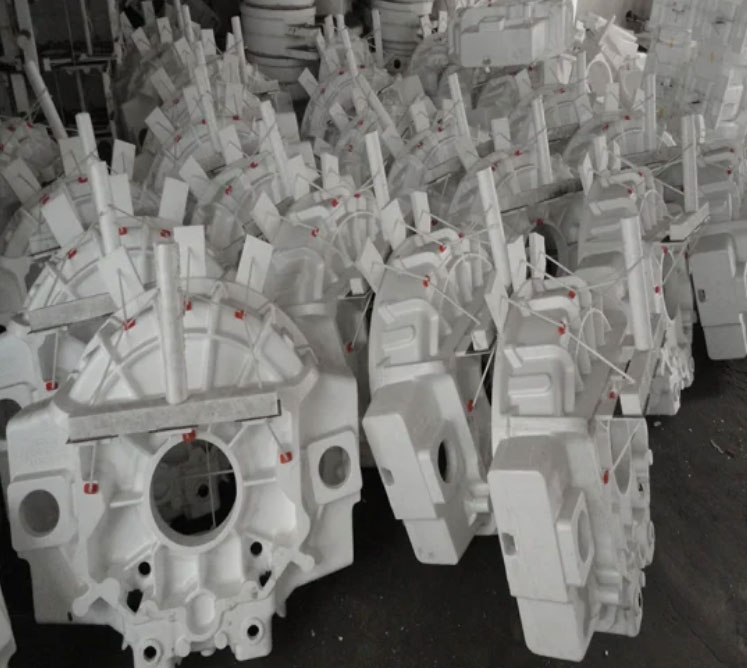
Lost foam casting, also known as evaporative pattern casting, is a manufacturing process where a foam pattern replicating the final part geometry is assembled into clusters, coated with a refractory layer, dried, and embedded in dry sand for vibration compaction. Metal is then poured under vacuum negative pressure, causing the foam to vaporize and be replaced by the molten metal, which solidifies into the desired casting. This method offers significant advantages, such as the ability to produce complex internal structures with high dimensional accuracy and reduced machining requirements. However, a common issue in lost foam casting is the formation of carbon defects, which manifest as black, tar-like inclusions on or within the cast surface, leading to uneven machining surfaces and potential performance failures. In our production of a 3-ton gearbox for forklifts, which involves high annual volumes exceeding 100,000 units, carbon defects account for approximately 15% of production issues, necessitating effective control strategies.
Carbon defects in lost foam casting arise from the thermal decomposition of the foam pattern during metal pouring. Under high temperatures, the foam undergoes pyrolysis, producing gaseous, liquid, and solid byproducts. If these byproducts are not efficiently expelled from the mold cavity, they can become trapped within the metal, forming carbonaceous residues. These defects typically appear as random black clusters, often localized in thick sections or remote areas of the casting where metal flow is sluggish. For instance, in gearbox castings, carbon defects are frequently observed on flange faces and window areas after machining, compromising surface integrity. Statistical analysis of defect distribution in such components reveals a non-uniform pattern, with certain zones like the upper regions and flow endpoints being more prone to inclusions.
The formation mechanism involves the interaction of pyrolysis products with the coating and sand mold. During pouring, gaseous decomposition products transport through the coating into the sand, while liquid products may wet and penetrate the coating layer. The overall expulsion pathway for these byproducts includes the coating, sand matrix, and vacuum system. Ensuring a high-flow, unobstructed pathway is critical to minimizing carbon defect incidence. In lost foam casting, vacuum negative pressure plays a dual role: it reinforces mold strength and facilitates the removal of decomposition gases. However, excessive negative pressure can induce turbulent flow during mold filling, entrapping pyrolysis residues in the metal. Conversely, insufficient negative pressure may lead to inadequate gas evacuation, exacerbating defect formation.
To investigate the impact of vacuum negative pressure on mold filling behavior and carbon defects, we conducted high-speed camera observations under varying negative pressure conditions. At a negative pressure of -0.04 MPa, the initial metal entry exhibited a “jetting” phenomenon, characterized by an irregular,锯齿-shaped front and chaotic flow patterns. This turbulence promotes the entrapment of pyrolysis products, resulting in randomly distributed carbon defects. The relationship between negative pressure and flow instability can be approximated by the Reynolds number for fluid flow in porous media: $$Re = \frac{\rho v d}{\mu}$$ where $\rho$ is the metal density, $v$ is the flow velocity, $d$ is the characteristic length, and $\mu$ is the dynamic viscosity. Higher negative pressures increase $v$, leading to elevated $Re$ and turbulent flow. At -0.02 MPa, filling became more stable, but a wall-adhesion effect was evident, where metal prematurely solidified along mold walls, blocking expulsion channels. At zero negative pressure, the flow transitioned to laminar, with metal advancing layer by layer, which reduced defect entrapment but required optimal vacuum support for byproduct removal.
Further experiments focused on the role of vacuum flow rate in mitigating carbon defects. Originally, the vacuum system used an 80 mm diameter interface. By enlarging this to 125 mm, we increased the flow capacity, enhancing the evacuation of pyrolysis products. Comparative trials involved casting 50 gearboxes each under identical conditions with both interface sizes, and post-machining defect counts were recorded. The results demonstrated that a larger flow diameter consistently reduced carbon defects across different negative pressure levels, as summarized in the table below.
| Negative Pressure (MPa) | Defect Count (80 mm interface) | Defect Count (125 mm interface) |
|---|---|---|
| -0.02 | 156 | 117 |
| -0.03 | 177 | 132 |
| -0.04 | 228 | 199 |
The synergy of low negative pressure and high flow rate was evaluated through batch production trials. We poured 100 gearbox castings each at negative pressures of -0.05, -0.04, -0.03, and -0.02 MPa, with half using the 125 mm interface and half the 80 mm. Defect distribution analysis confirmed that lower negative pressures concentrated defects in predictable areas, such as the highest points and metal flow extremities, while higher flow rates further diminished overall defect counts. For example, at -0.02 MPa, defects were primarily localized, allowing for targeted mitigation. The defect distribution proportions under optimized conditions are presented in the following table, highlighting how low negative pressure reduces random occurrences.
| Location | Defect Proportion (%) | Defect Count |
|---|---|---|
| Flange Face A | 7.39 | 19 |
| Flange Face B | 14.01 | 36 |
| Flange Face C | 15.56 | 40 |
| Window Area D | 7.00 | 18 |
| Window Area E | 3.89 | 10 |
| Window Area F | 14.79 | 38 |
| Window Area G | 15.18 | 39 |
| Window Area H | 17.51 | 45 |
| Other I | 0.39 | 1 |
| Other J | 4.55 | 10 |
| Other K | 5.45 | 12 |
To complement low negative pressure and high flow rate, we incorporated slag collection risers at high-probability defect sites, such as the top sections and flow endpoints of the gearbox. This approach further decreased defect rates to around 5%, demonstrating the effectiveness of integrated solutions in lost foam casting. The risers function by providing additional pathways for slag and pyrolysis residues to float and be captured, reducing their incorporation into the solidifying metal. The implementation of these risers in both mechanical and hydraulic gearbox designs has shown consistent improvements in product quality.
Beyond vacuum parameters, other factors influence the expulsion efficiency in lost foam casting. For instance, sand grain size distribution affects permeability, which is crucial for maintaining a high-flow environment. Regular analysis of sand granules ensures optimal void spaces for gas transmission. Similarly, coating permeability determines how easily pyrolysis products pass through the refractory layer. We monitor these properties through standardized tests, as illustrated in the following tables for sand grain size and coating air permeability.
| Sample No. | 20 Mesh (%) | 30 Mesh (%) | 40 Mesh (%) | 50 Mesh (%) | 70 Mesh (%) | 100 Mesh (%) | 140 Mesh (%) | 200 Mesh (%) | 270 Mesh (%) | Pan (%) |
|---|---|---|---|---|---|---|---|---|---|---|
| 1 | 18.28 | 47.70 | 23.48 | 6.46 | 2.04 | 0.72 | 0.14 | 0.06 | 0.00 | 0.00 |
| 2 | 17.10 | 46.62 | 22.38 | 7.08 | 2.54 | 1.22 | 0.30 | 0.08 | 0.02 | 0.00 |
| 3 | 17.60 | 40.42 | 22.02 | 7.34 | 3.12 | 3.96 | 2.74 | 1.40 | 0.38 | 0.68 |
The permeability of coatings is equally vital; higher permeability values facilitate better gas escape. We routinely test coatings like EP9511, with results indicating that maintaining permeability above a threshold (e.g., 70 units) correlates with reduced carbon defects. The table below summarizes coating permeability measurements, emphasizing the need for consistent quality control in lost foam casting processes.
| Batch No. | Permeability 1 | Permeability 2 | Average Permeability | Baumé Degree |
|---|---|---|---|---|
| 9C12D171 | 95.00 | 93.20 | 94.10 | 75 |
| 9C12D173 | 94.50 | 93.10 | 93.80 | 75 |
| 0C12J211 | 75.70 | 79.54 | 77.62 | 75 |
In practice, achieving low negative pressure and high flow rate requires a holistic approach. This includes selecting vacuum pumps with adequate capacity, ensuring clean and unobstructed pipelines, and maintaining sand and coating properties. For example, the vacuum system should be designed to minimize resistance, with regular inspections to prevent blockages. The relationship between flow rate and pipe diameter can be described by the Hagen-Poiseuille equation for laminar flow: $$Q = \frac{\pi \Delta P r^4}{8 \mu L}$$ where $Q$ is the flow rate, $\Delta P$ is the pressure difference, $r$ is the pipe radius, $\mu$ is the dynamic viscosity, and $L$ is the pipe length. Enlarging $r$ significantly increases $Q$, enhancing byproduct evacuation in lost foam casting.
Moreover, process optimization involves balancing negative pressure to avoid turbulence while ensuring sufficient vacuum to maintain mold integrity. Based on our experiments, a negative pressure of -0.02 to -0.03 MPa combined with high flow rates yields the best results. This setup promotes laminar filling, reduces wall-adhesion effects, and supports efficient pyrolysis product removal. The integration of slag risers at critical locations further addresses residual defects, making the process robust for high-volume production.
In conclusion, the combination of low negative pressure and high flow rate is a highly effective strategy for reducing carbon defects in lost foam casting. This approach minimizes turbulent flow and enhances the expulsion of decomposition byproducts, leading to more predictable defect distributions and lower overall incidence. By also focusing on auxiliary factors like sand granulometry and coating permeability, manufacturers can achieve significant improvements in casting quality. For the 3-ton gearbox application, these measures have cut defect rates to approximately 5%, underscoring the practicality of this methodology in industrial lost foam casting operations. Future work could explore dynamic vacuum control systems to adapt parameters in real-time, further optimizing the process for complex geometries.