
In my experience within the foundry industry, the issue of slag inclusion in nodular iron castings, particularly for critical components like diesel engine crankshafts, has been a persistent and costly challenge. This article details the comprehensive measures we implemented to significantly reduce the occurrence of slag inclusion defects. Slag inclusion, a non-metallic impurity entrapped within the casting, severely compromises the mechanical integrity and reliability of the final product. Our focus was on a series of diesel engine crankshafts, which are solid castings produced in pairs per engine type, with a material specification close to QT800-2. Over a specific period, the scrap rate due to slag inclusion exceeded 5%, with magnetic particle inspection revealing numerous fine, dispersed indications on the main journal surfaces. In severe cases, large-area slag inclusion on the crank arms led to batch rejections, threatening production schedules and product dependability. Through rigorous process audits, we identified key deviations in melting, spheroidization, covering, and pouring practices that correlated with the spike in slag inclusion rates. The subsequent corrective actions brought the scrap rate down to a stable level below 1%.
The production conditions for these crankshafts involved melting in a large dual-blast acid-lined cupola furnace. The tapping temperature was maintained between 1420°C and 1450°C, with a pouring temperature range of 1320°C to 1350°C. The chemical composition, both of the base iron and after treatment, is critical in understanding the metallurgical behavior that influences slag formation. The table below summarizes the typical chemical composition targets.
| Item | C (%) | Si (%) | Mn (%) | P (%) | S (%) | Mg (Residual, %) | RE (Residual, %) | Nodularity | As-cast Pearlite |
|---|---|---|---|---|---|---|---|---|---|
| Base Iron | 3.6-3.8 | 1.4-1.6 | 0.5-0.7 | <0.06 | <0.02 | – | – | – | – |
| After Treatment | 3.5-3.7 | 2.3-2.6 | 0.5-0.7 | <0.06 | <0.015 | 0.03-0.05 | 0.02-0.04 | ≥ 4级 (≥80%) | ≥ 80% |
Spheroidization was achieved using a bell jar method with a proprietary Fe-Si-Mg-RE alloy. For each ladle of 1000-1200 kg, dehydrated sodium carbonate was added in the tapping stream for desulfurization. After initial slag removal, the spheroidization treatment was performed.
The formation mechanism of slag inclusion is multifaceted. Primarily, slag inclusion consists not only of sulfides but also a multitude of non-metallic inclusions and oxides generated during the spheroidization process, such as MgO, SiO2, FeO, and Al2O3. The propensity for slag inclusion in nodular iron is notably high due to the vigorous reaction with magnesium. Even after careful primary slag skimming and the use of covering agents, the melt surface continuously generates secondary slag or oxide dross. This is because nodular iron melt is highly prone to surface oxidation in air. Therefore, controlling slag inclusion is fundamentally about managing both primary and secondary oxidation. The primary slag is mainly composed of magnesium oxide and other oxides, while the secondary slag predominantly consists of silicates. Correspondingly, primary slag inclusion is rich in MgO, and secondary slag inclusion contains complex compounds of SiO2, MgO, and RE oxides.
Our process audit pinpointed three specific changes that exacerbated the slag inclusion problem. First, the charge makeup was altered. Historically, sintered cast iron chips were used as a steel substitute. This sintered iron had a consistent carbon content and minimal ferrous oxide (FeO). The shift to using scrap steel introduced variables: rust (hydrated iron oxides), inconsistent sizing, and weight. The rust and oxidation on the scrap significantly increased the oxygen potential of the melt, raising the FeO content and providing nuclei for slag inclusion formation. The reaction can be summarized as:
$$ \text{Fe (from scrap)} + \frac{1}{2}\text{O}_2 \rightarrow \text{FeO} $$
This FeO then participates in complex slag-forming reactions with other elements like Si and Mg.
Second, the covering practice was modified. Previously, rice husk ash was used to cover the ladle after skimming. Rice husk ash, primarily composed of potassium carbonate (K2CO3), is moisture-free and possesses a reducing character. It effectively isolates the melt from air, prevents re-oxidation, and even aids in desulfurization. This was changed to a proprietary “nodular iron covering agent.” This agent contained about 5% moisture and had a high SiO2 content. Covering with this material actually promoted oxidation and slag formation at the melt surface, as the moisture decomposed to provide oxygen, and the silica could react with MgO to form low-melting-point slags. The contrast in behavior is stark. The use of an unsuitable covering agent directly increased the driving force for secondary slag inclusion.
Third, the casting orientation was changed. Earlier practice involved pouring horizontally but solidifying vertically (with the riser on top). Given the density difference between the nodular iron melt (≈7.1 g/cm³) and the non-metallic slag particles (≈2.5-3.5 g/cm³), vertical solidification promoted the buoyant rise and collection of slag inclusions in the riser, away from the critical casting sections. Changing to a horizontal pouring and horizontal solidification (flat) layout drastically reduced this beneficial flotation effect, trapping slag inclusions within the crank arms and journals. This geometrical factor alone caused a sharp increase in slag inclusion defects.
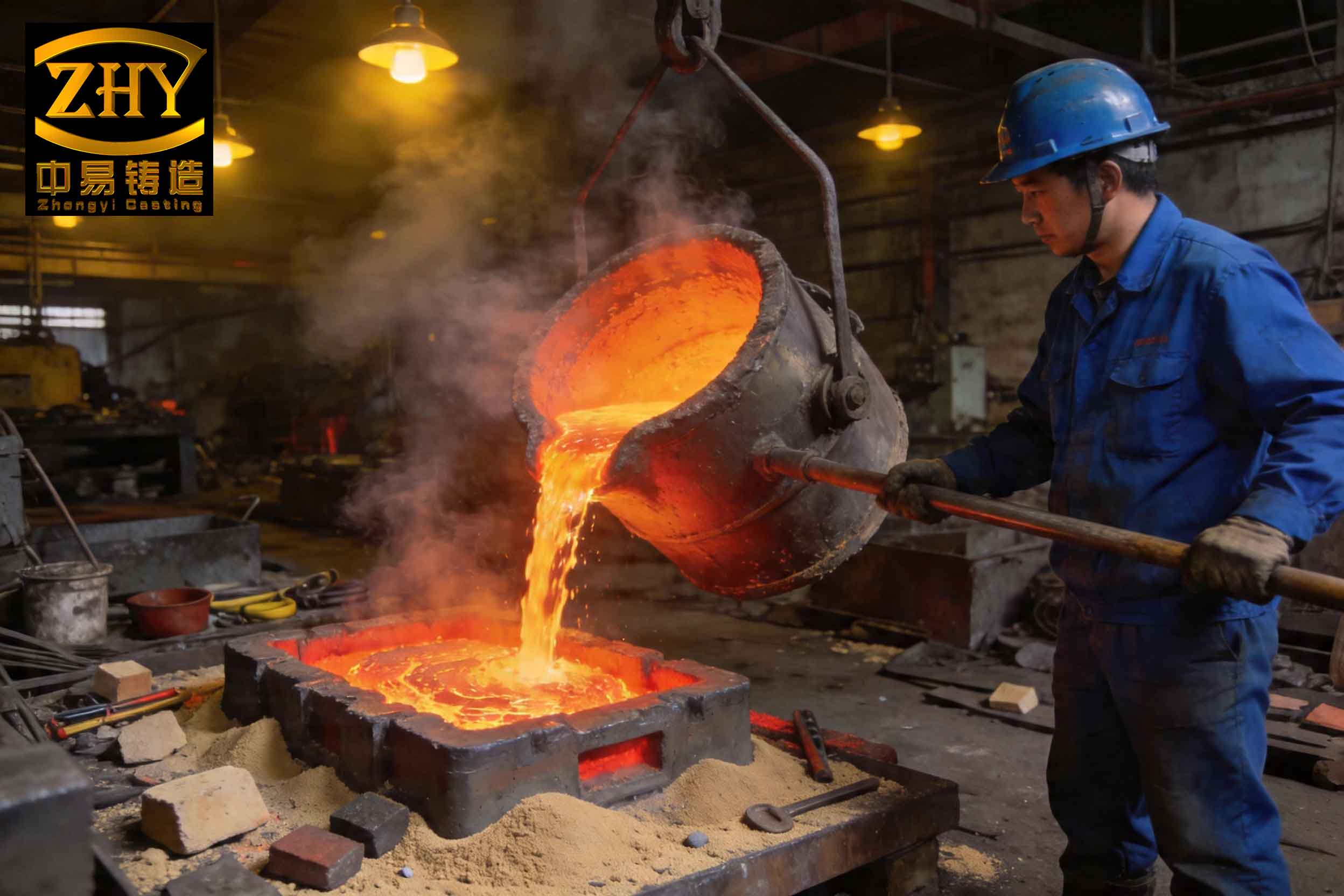
The image above illustrates a typical manifestation of slag inclusion in a cast component, highlighting the surface and sub-surface defects that can originate from the factors discussed. In our crankshafts, such defects were identified as magnetic particle indications or, upon machining, as visible patches of non-metallic material.
To combat these issues, we devised and implemented a multi-pronged strategy focused on minimizing oxidation and facilitating slag removal. The core of our countermeasures involved addressing each root cause identified.
1. Charge Material Control: We mandated the use of only clean, rust-free scrap steel in the charge for melting the crankshaft iron. This directly reduced the initial FeO input into the furnace, lowering the oxygen potential of the base iron. The thermodynamic driving force for subsequent slag formation during treatment was thereby diminished.
2. Optimized Slag Covering and Treatment: This was the most critical intervention. After the primary slag skimming following spheroidization, we introduced a two-layer covering practice on the ladle. First, a layer of cryolite powder (Na3AlF6) was applied onto the melt surface. Cryolite plays a transformative role. The slag in nodular iron melts typically has a high melting point and high surface tension, making it viscous and difficult to remove completely. The addition of cryolite powder lowers both the melting point and surface tension of the slag. The mechanism can be related to the formation of complex fluoro-aluminates. The cryolite thermally decomposes:
$$ \text{Na}_3\text{AlF}_6 \rightarrow 3\text{NaF} + \text{AlF}_3 $$
AlF3 has a significant vapor pressure at casting temperatures, creating a protective atmosphere. More importantly, it reacts with oxides like Al2O3 and MgO to form lower-melting-point compounds:
$$ x\text{MgO} + y\text{Al}_2\text{O}_3 + z\text{Na}_3\text{AlF}_6 \rightarrow \text{Low-melting Slag (complex fluorides and oxyfluorides)} $$
This results in a fluid, easily removable slag. Furthermore, the generated AlF3 vapor helps protect the melt surface from air oxidation. After applying cryolite and performing a final, efficient slag-off, a layer of dry rice husk ash was added as a secondary cover during pouring. This combined approach ensured minimal re-oxidation and effective slag separation. The properties of the slag at different stages are contrasted below.
| Stage | Melting Point Range (°C) | Surface Tension (10-3 N/m) | Characteristics |
|---|---|---|---|
| Base Iron Slag | 1350-1450 | ~1100 | Relatively fluid |
| After Mg Treatment | ~2000 | ~1300 | Viscous, high MgO content |
| After Inoculation | ~1700 | ~1200 | Still viscous |
| After Cryolite Addition | 1000-1100 | ~900 | Fluid, easily removable |
The dramatic reduction in melting point and surface tension after cryolite addition is key to mitigating slag inclusion. The fluid slag readily coalesces and separates from the iron.
3. Restoration of Favorable Solidification Orientation: We reverted to the original “horizontal pour, vertical solidification” process. This utilizes natural buoyancy to float slag inclusion particles towards the riser, which is subsequently removed from the finished casting. The effectiveness of this simple geometric change in reducing trapped slag inclusion cannot be overstated.
4. Increased Pouring Temperature: We raised the tapping temperature to 1470-1500°C and the pouring temperature to 1350-1380°C. Temperature plays a crucial role in slag inclusion formation kinetics. As temperature decreases, the affinity of magnesium and rare earth elements for oxygen increases, leading to thicker oxide films. Conversely, at higher temperatures, the activity of carbon increases, which can have a deoxidizing effect to some extent. Higher temperature also reduces the melt’s viscosity, aiding slag flotation and separation. The relationship between temperature and the thermodynamic tendency for oxide formation for element ‘M’ (e.g., Mg) can be considered via the standard Gibbs free energy of formation:
$$ \Delta G^\circ_{\text{M}_x\text{O}_y} = \Delta H^\circ – T\Delta S^\circ $$
While $\Delta G^\circ$ for MgO formation is highly negative at all these temperatures, the kinetic rates of oxidation and slag agglomeration are slower at higher temperatures, allowing more time for slag removal before solidification. Therefore, elevated pouring temperature is a potent measure against slag inclusion.
The combined effect of these measures was profound and immediate. The table below summarizes the impact on the scrap rate due to slag inclusion before and after implementation.
| Period | Key Process Conditions | Approximate Scrap Rate due to Slag Inclusion (%) | Remarks |
|---|---|---|---|
| Before Improvements | Rusty scrap, proprietary covering agent, horizontal solidification. | > 5.0 | Frequent batch rejections. |
| After Improvements | Clean scrap, cryolite + rice husk ash cover, vertical solidification, higher pouring temp. | < 1.0 | Stable, low-level defect rate. |
The success of this campaign underscores several fundamental principles in nodular iron foundry practice for preventing slag inclusion. First, strict control of charge materials to minimize initial oxygen input is essential. Second, the chemistry and physics of the slag must be actively managed; using agents like cryolite to modify slag properties is highly effective for slag inclusion control. Third, solidification design should leverage metallostatic principles to aid impurity removal. Finally, process temperatures must be optimized not just for fluidity but also for oxidation control.
In conclusion, the battle against slag inclusion in heavy-section nodular iron castings like diesel crankshafts requires a holistic approach. It is not a single-factor problem. By systematically analyzing each process step—from the furnace charge to the mold filling and solidification—we identified the specific vulnerabilities that led to a high incidence of slag inclusion. The implementation of targeted countermeasures, particularly the innovative use of cryolite for slag conditioning coupled with revised covering and solidification practices, resulted in a dramatic and sustainable reduction in scrap rates. The keyword throughout this entire endeavor is ‘slag inclusion’—understanding its origins, its behavior, and methods for its prevention. The lessons learned are broadly applicable to any foundry producing high-integrity nodular iron castings where slag inclusion poses a quality and reliability threat. Continuous vigilance in maintaining these improved practices is paramount to ensuring the long-term elimination of slag inclusion defects.