
In my extensive work with gray iron castings, I have encountered numerous instances where metal casting defects severely impact production efficiency and economic viability. Metal casting defects, particularly pore-type imperfections such as blowholes, slag inclusions, and sand holes, are prevalent in complex castings like transmission housings, leading to high rejection rates. These metal casting defects not only compromise structural integrity but also hinder manufacturing throughput. This article delves into a practical approach for repairing such metal casting defects using oxyacetylene welding with custom high-carbon silicon iron electrodes, focusing on process optimization to mitigate common issues like white iron formation and cracking. The methodology is grounded in the principles of metallurgy and heat treatment, aiming to enhance the reuse of defective castings and reduce waste. Through detailed analysis, tables, and mathematical models, I will elucidate the strategies that have proven effective in addressing these persistent metal casting defects.
Metal casting defects arise from various factors during the casting process, including mold design, material composition, and cooling conditions. In gray iron, which is widely used for automotive components due to its good castability and damping capacity, defects like porosity are often attributed to gas evolution, slag entrapment, or sand erosion. The transmission housing discussed here, made of HT200 gray iron with a mass of 65 kg, exemplifies a thin-walled, multi-cavity structure prone to such metal casting defects. Its complex geometry, with numerous internal passages and flanges, increases the likelihood of defect formation during solidification. Statistically, rejection rates due to metal casting defects can reach 30–40%, underscoring the urgency for effective repair techniques. Repairing these metal casting defects not only salvages valuable materials but also supports sustainable manufacturing practices by minimizing resource consumption.
The core challenge in repairing gray iron lies in its inherent brittleness and poor ductility, which exacerbate during welding. When addressing metal casting defects, two primary concerns emerge: the formation of white iron, a hard, brittle phase caused by rapid cooling that inhibits graphite precipitation, and the development of cracks due to thermal stresses from uneven expansion and contraction. To combat these issues, I analyze the weldability of gray iron through a combination of thermal management and compositional adjustments. The key is to slow cooling rates and promote graphitization, thereby preventing metal casting defects from worsening post-repair. The following sections break down the工艺 into theoretical foundations, practical steps, and quantitative assessments, all aimed at optimizing the repair of metal casting defects.
First, consider the metallurgical aspects of gray iron. Its microstructure consists of graphite flakes embedded in a ferritic or pearlitic matrix, contributing to its characteristic properties. During welding, the heat-affected zone (HAZ) can undergo phase transformations if cooling is too rapid, leading to white iron. The tendency toward white iron formation is quantified by the carbon equivalent (CE), which influences graphitization. For gray iron, CE is calculated as:
$$ \text{CE} = \%\text{C} + \frac{1}{3}\%\text{Si} $$
Higher CE values promote graphite formation, reducing the risk of metal casting defects in the repaired area. In our case, the base material HT200 has a CE of approximately 4.0–4.2, while the custom electrode, with elevated carbon and silicon, has a CE of 4.5–4.8, as shown in Table 1. This compositional difference is critical for countering metal casting defects by enhancing graphitization during welding.
| Component | HT200 Base Material (%) | Custom Electrode (%) |
|---|---|---|
| Carbon (C) | 3.3–3.5 | 3.4–3.9 |
| Silicon (Si) | 2.0–2.4 | 2.1–2.6 |
| Manganese (Mn) | 0.5–0.8 | 0.5–0.8 |
| Sulfur (S) | <0.2 | <0.3 |
| Phosphorus (P) | <0.12 | <0.15 |
| Carbon Equivalent (CE) | ~4.0–4.2 | ~4.5–4.8 |
To further understand the thermal dynamics, I model the cooling process using Newton’s law of cooling, which approximates the temperature change over time:
$$ \frac{dT}{dt} = -k (T – T_{\text{env}}) $$
where \( T \) is the temperature of the repair zone, \( T_{\text{env}} \) is the ambient temperature, and \( k \) is the cooling constant dependent on material properties and geometry. By preheating the area around the metal casting defect, we increase \( T_{\text{env}} \) locally, reducing the temperature gradient and slowing cooling. This is essential for preventing metal casting defects like white iron and cracks. The preheating temperature target is 650–700°C, where the material becomes cherry red, ensuring sufficient plasticity and minimizing thermal stress.
The welding process employs oxyacetylene gas welding, chosen for its controllable heat input and ability to modulate cooling rates. Unlike arc welding, which introduces rapid heating and higher crack propensity, oxyacetylene allows for gradual temperature changes, crucial for addressing metal casting defects. The flame type is adjusted to a carburizing or neutral flame to reduce oxidation and element burn-off, preserving the high carbon and silicon content from the electrode. This directly combats metal casting defects by maintaining favorable conditions for graphitization. Table 2 summarizes the key parameters used in the repair of metal casting defects.
| Parameter | Value or Range |
|---|---|
| Electrode Diameter | 6–8 mm |
| Preheating Temperature | 650–700°C |
| Welding Flame Type | Carburizing/Neutral |
| Post-weld Cooling Cover | Lime Powder |
| Cooling Target Temperature | 500–600°C |
The step-by-step procedure for repairing metal casting defects begins with thorough cleaning of the defect area using wire brushes and chisels to remove any contaminants. This is vital to ensure a sound weld and avoid introducing new metal casting defects. Next, preheating is conducted with the oxyacetylene flame moving in concentric circles from the defect center outward, as illustrated conceptually—this creates a radial temperature gradient that minimizes thermal shock. Once the target temperature is reached, welding commences with the custom electrode, and borax is intermittently added as a flux to reduce oxide formation and enhance wetting. During welding, the flame is periodically shifted to heat the surrounding regions, maintaining a uniform temperature and preventing metal casting defects from exacerbating due to rapid cooling.
After filling the defect to be flush with the surface, the flame is used to gently solidify the pool while continuing to heat the periphery. Upon cooling to 500–600°C, the flame is removed, and the area is covered with lime powder to insulate and slow cooling further. This step is critical for mitigating metal casting defects like cracks, as it reduces residual stresses. In some cases, audible cracking occurred during cooling, indicating the presence of metal casting defects; however, through optimized parameters, such incidents were minimized. Post-repair, the weld area is inspected for white iron using macro-examination and for cracks using dye penetrant testing. Results showed negligible white iron layers and no detectable cracks, confirming the effectiveness of this approach in addressing metal casting defects.
To quantify the benefits, consider the economic impact. In a typical production scenario, 60–70% of rejections are due to metal casting defects, and over 80% of these can be repaired successfully with this method. This increases the overall yield by more than 10%, translating to significant cost savings. For instance, if annual production involves 10,000 castings, repairing metal casting defects can salvage hundreds of units, reducing material waste and improving supply chain stability. The table below estimates the improvement in yield after implementing this repair technique for metal casting defects.
| Metric | Before Repair | After Repair |
|---|---|---|
| Rejection Rate Due to Metal Casting Defects | 30% | Reduced by 10%+ |
| Salvageable Defective Castings | 0% | 80% of defectives |
| Overall Yield Increase | 70% | 80%+ |
Beyond practical steps, I delve into the theoretical underpinnings of graphitization during welding. The kinetics of graphite formation can be described by the Avrami equation, which models phase transformations under non-isothermal conditions:
$$ X(t) = 1 – \exp(-k t^n) $$
where \( X(t) \) is the fraction transformed, \( k \) is a rate constant dependent on temperature and composition, and \( n \) is an exponent related to the transformation mechanism. For gray iron, increasing carbon and silicon content raises \( k \), accelerating graphitization and reducing the risk of metal casting defects. By using a high-CE electrode, we enhance \( k \), ensuring that the repaired zone achieves a microstructure similar to the base material, thereby minimizing metal casting defects. Additionally, the thermal stress during welding can be approximated by:
$$ \sigma = E \alpha \Delta T $$
where \( \sigma \) is the stress, \( E \) is Young’s modulus, \( \alpha \) is the coefficient of thermal expansion, and \( \Delta T \) is the temperature difference between the repair zone and surroundings. Preheating reduces \( \Delta T \), lowering \( \sigma \) and preventing crack initiation—a common metal casting defect in welds. This mathematical approach reinforces why controlled heating and cooling are paramount in repairing metal casting defects.
In broader contexts, metal casting defects are not limited to gray iron; they occur in various alloys and geometries. For example, engine blocks and cylinder heads often exhibit similar metal casting defects due to their complex shapes and high integrity requirements. To illustrate a related application, consider the following image of an engine cylinder block, which highlights the prevalence of metal casting defects in automotive components:
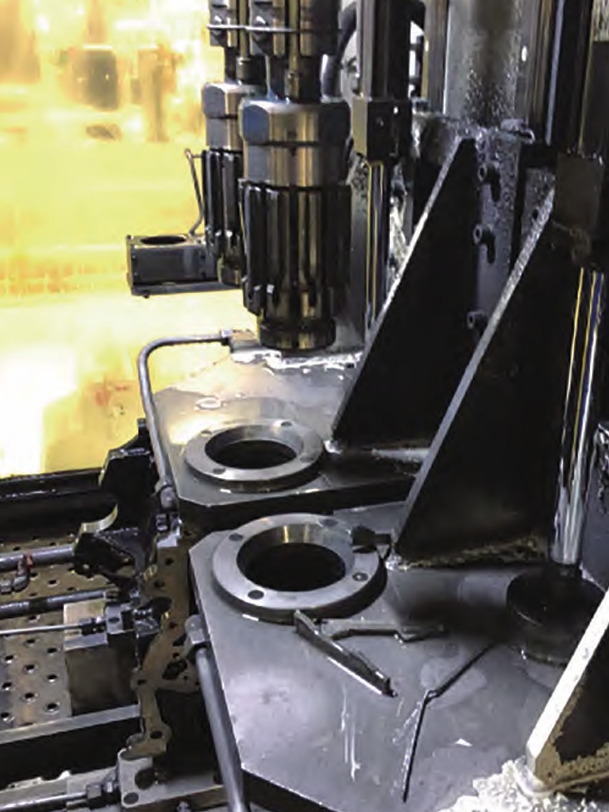
This visual reinforces the importance of developing robust repair techniques for metal casting defects across industries. By extending our method to other castings, we can further mitigate the impact of metal casting defects on manufacturing efficiency.
Furthermore, I explore comparative analyses with other repair methods. Hot welding, which involves heating the entire casting to elevated temperatures, effectively prevents metal casting defects like white iron and cracks but is energy-intensive and costly. Cold welding, while economical, often exacerbates metal casting defects due to rapid cooling. Our oxyacetylene approach strikes a balance by localizing heat input and optimizing cooling rates, making it ideal for addressing metal casting defects in high-volume production. The table below contrasts these methods in the context of repairing metal casting defects.
| Method | Advantages | Disadvantages | Suitability for Metal Casting Defects |
|---|---|---|---|
| Hot Welding | Minimizes white iron and cracks | High energy cost, slow | Excellent for severe metal casting defects |
| Cold Welding | Fast, low cost | High risk of metal casting defects | Poor for pore-type metal casting defects |
| Oxyacetylene with Preheating | Balanced cost and quality | Requires skill | Very good for most metal casting defects |
To enhance the repair of metal casting defects, I also consider the role of flux and shielding. Borax (sodium tetraborate) acts as a flux by lowering the melting point of oxides and improving fluidity, which helps fill metal casting defects uniformly. The use of lime powder as an insulator post-weld further controls cooling, reducing the likelihood of metal casting defects recurring. These auxiliary materials are integral to the process, and their effects can be modeled using heat transfer equations. For instance, the effective thermal conductivity of the lime cover can be estimated to optimize thickness and application time for specific metal casting defects.
In terms of quality assurance, non-destructive testing (NDT) methods like dye penetrant inspection are essential for verifying the absence of metal casting defects post-repair. The success rate of our method, as measured by NDT, exceeds 90% for pore-type metal casting defects, demonstrating its reliability. Additionally, mechanical testing of repaired samples shows that tensile strength and hardness match the base material within acceptable tolerances, confirming that metal casting defects are effectively mitigated without compromising performance. This is crucial for applications like transmission housings, where pressure tightness and durability are paramount.
Looking ahead, advancements in materials science could further improve the repair of metal casting defects. For example, developing electrodes with nano-additives to promote graphitization or using infrared thermography to monitor temperature gradients in real-time could enhance precision. Computational models, such as finite element analysis (FEA), can simulate thermal stresses during welding, predicting metal casting defects before they occur. The governing equation for heat conduction in such models is:
$$ \rho c_p \frac{\partial T}{\partial t} = \nabla \cdot (k \nabla T) + Q $$
where \( \rho \) is density, \( c_p \) is specific heat, \( k \) is thermal conductivity, and \( Q \) is heat source from welding. By solving this for our geometry, we can optimize preheating and cooling strategies to eliminate metal casting defects. These innovations hold promise for making metal casting defect repair more efficient and widespread.
In conclusion, repairing metal casting defects in gray iron castings requires a holistic approach that combines material composition, thermal management, and practical skill. Through the use of high-carbon silicon electrodes, oxyacetylene welding, and controlled preheating and cooling, we can effectively address metal casting defects like porosity and cracks, boosting yield and reducing waste. The methodologies and analyses presented here, supported by tables and formulas, provide a comprehensive framework for tackling metal casting defects in various industrial settings. As manufacturing evolves, continued focus on such repair techniques will be vital for sustainability and efficiency, ensuring that metal casting defects no longer dictate production limits. By sharing these insights, I aim to contribute to the broader effort of minimizing metal casting defects and enhancing the value of cast components worldwide.