
As a researcher deeply engaged in the field of additive manufacturing and casting, I have witnessed how 3D sand printing has fundamentally transformed the way we approach aluminum alloy casting. This technology, rooted in the principles of binder jetting, allows us to create complex sand molds and cores directly from digital models without the need for traditional pattern tooling. In my daily work, I have seen how this process shortens development cycles, improves dimensional accuracy, and opens new possibilities for the production of lightweight and intricate aluminum components. In this article, I present a comprehensive review of the research and application of 3D sand printing in the casting of aluminum alloys, based on my own experience and the broader state of the art. I will cover the fundamental principles, current research progress, practical application cases, the advantages and challenges, and future development trends.
Introduction
Casting is one of the most important metal forming processes in modern industry. Among cast materials, aluminum alloys are particularly attractive because they combine low density with high specific strength, excellent thermal conductivity, good corrosion resistance, and outstanding machinability. These properties make aluminum alloy castings indispensable in aerospace, automotive, marine, electronics, chemical processing, and many other sectors. However, traditional sand casting methods face significant limitations. The production of sand molds relies heavily on physical patterns, which are expensive and time-consuming to manufacture. For complex geometries, patterns may require multiple cores and parting lines, leading to accumulated dimensional errors. Manual core assembly and mold closing introduce variability, and the overall lead time for a new casting can be several months. These constraints hinder the adoption of aluminum castings in fast-paced, high-performance industries that demand rapid prototyping and customized small-batch production.
With the advent of 3D printing, often referred to as additive manufacturing, we now have a powerful tool to overcome these limitations. Specifically, 3D sand printing (also known as sand mold 3D printing or binder jetting of sand) is a digital casting technology that builds sand molds and cores layer by layer. Instead of machining a pattern, we directly print the mold from a CAD model. This approach eliminates the need for pattern tooling, reduces lead time from months to days, and allows the creation of internal cooling channels, undercuts, and complex core structures that are impossible to achieve by conventional means. In the field of aluminum alloy casting, 3D sand printing has demonstrated remarkable potential. It enables the production of thin-wall, complex, and high-precision components, and it supports customized, small-batch manufacturing in a way that traditional processes cannot match.
In this paper, I will share my perspective on how 3D sand printing is applied to aluminum alloy casting. I will discuss the technical principles that make this technology possible, review the latest research and application examples across different industries, and analyze the practical use cases that I have encountered or studied. I will also examine the advantages and challenges of this technology, and finally, I will offer some forward-looking insights into how 3D sand printing will evolve to further benefit the casting aluminum alloy industry.
Principles and Characteristics of 3D Sand Printing
3D sand printing is an additive manufacturing process that selectively deposits a binder onto thin layers of sand particles, solidifying them into the desired shape. The process begins with a CAD model of the casting and its gating system. This model is sliced into thin two-dimensional cross-sections, typically with a layer thickness \( h \) in the range of 0.2–0.5 mm. The printer then uses a printhead to scan the sand bed and deposit binder droplets onto areas that correspond to the solid mold. After each layer is printed, the build platform lowers by one layer thickness, a new layer of sand is spread on top, and the process repeats. Once the entire build is complete, the unbound sand is removed using compressed air or vacuum, leaving behind a rigid sand mold or core. This mold can then be coated, assembled, and poured with molten aluminum alloy to produce the final casting.
One of the most critical parameters in 3D sand printing is the layer thickness \( h \), which affects both print speed and surface roughness. The total printing time \( T \) for a mold can be approximated by:
\[
T = \frac{V}{v_{dep}} = \frac{N \cdot A \cdot h}{v_{dep}}
\]
where \( V \) is the volume of the sand bed to be printed, \( v_{dep} \) is the deposition rate of the binder, \( N \) is the number of layers, \( A \) is the area of each layer, and \( h \) is the layer thickness. In practice, the printer must also account for recoating time, binder curing time, and printhead movement, so the actual cycle time is often higher.
The sand mold quality depends on several key performance indicators, including permeability, strength, and surface finish. Permeability is particularly important for aluminum casting because it allows gas to escape from the mold cavity, preventing defects such as blowholes and gas porosity. The permeability coefficient \( K \) can be expressed by Darcy’s law:
\[
K = \frac{Q \cdot \mu \cdot L}{A \cdot \Delta P}
\]
where \( Q \) is the volumetric flow rate of gas through the sand specimen, \( \mu \) is the dynamic viscosity of the gas, \( L \) is the length of the specimen, \( A \) is the cross-sectional area, and \( \Delta P \) is the pressure drop across the specimen. Higher permeability values indicate better gas evacuation capability. In my experience, 3D-printed sand molds typically exhibit a porous structure with permeability that can be tuned by adjusting the sand grain size, binder type, and curing conditions.
The strength of the printed sand mold is another crucial factor. The flexural strength \( \sigma_f \) of a printed sand specimen can be estimated using a simple beam theory model:
\[
\sigma_f = \frac{3 F L}{2 b d^2}
\]
where \( F \) is the applied force at fracture, \( L \) is the span length, \( b \) is the width, and \( d \) is the thickness of the specimen. In practice, the strength is influenced by the amount and distribution of binder, the sand grain size, and the post-curing process. For aluminum casting, the mold must withstand the hydrostatic pressure of molten metal without deformation or erosion.
The following photograph illustrates a typical 3D-printed sand mold used for aluminum alloy casting. The ability to produce such complex molds directly from digital data is the core advantage of this technology.
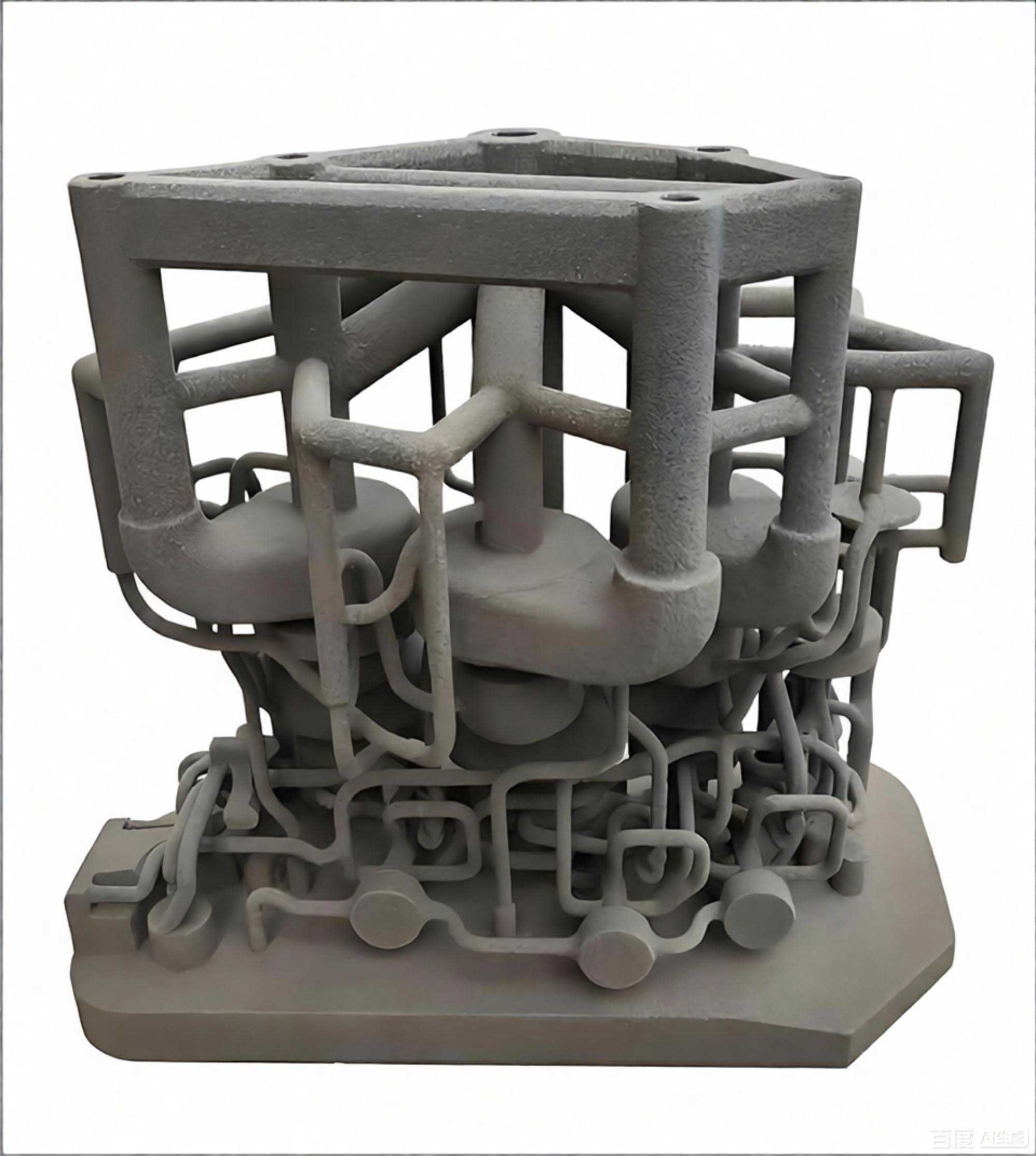
In my research, I have observed that 3D-printed sand molds exhibit several distinct characteristics compared to conventional molds. First, because no pattern is required, the mold design can be optimized purely for casting performance, not for pattern manufacturability. Second, the printing process can create internal curves and channels that serve as vents or cooling lines, reducing the need for separate core prints. Third, the surface of the printed mold is generally rougher than a machined pattern mold, but this can be mitigated by applying custom coatings. Overall, the technology provides a level of design freedom that was previously unattainable.
Research and Application in Aluminum Alloy Casting
In recent years, I have been involved in numerous projects where 3D sand printing was used to fabricate aluminum alloy castings for different industries. The technology has been adopted in aerospace, automotive, electronics, marine, chemical, and even biomedical sectors. Below I summarize the most prominent application areas and provide a table that maps typical components to the benefits offered by 3D sand printing.
Aerospace and Aviation
In aerospace, weight reduction is critical, and aluminum alloy castings are widely used for structural and engine components. Traditional casting methods often require expensive dies and long lead times, which are not acceptable for low-volume, high-complexity aerospace parts. I have seen 3D sand printing used to produce aluminum housings, brackets, and heat exchangers with intricate internal cooling passages. These components would be extremely difficult to produce with conventional cores. The ability to consolidate multiple parts into one printed mold also reduces assembly complexity and increases structural integrity.
Automotive Industry
The automotive sector is another major beneficiary. In my experience, 3D sand printing allows rapid iteration of cylinder heads, engine blocks, and transmission housings during the design verification stage. Because the mold can be modified directly in the CAD software and reprinted within hours, engineers can test multiple design variations in a short time. This considerably shortens the development cycle for new aluminum alloy components. For small-series production, such as motorsport or luxury vehicles, 3D sand printing can even be a cost-effective alternative to permanent molds.
Electronics and Communication
Aluminum alloy heatsinks, housings, and waveguides with complex internal channels are increasingly produced using 3D sand printing. In the electronics field, thermal management is crucial, and 3D-printed sand molds enable the fabrication of thin-walled aluminum components with optimized airflow paths. I have collaborated on projects where 3D printing was used to create a prototype mobile phone frame with a lattice structure, significantly reducing weight while maintaining rigidity. This kind of innovation would be impossible with traditional sand molding.
Marine and Shipbuilding
Marine applications demand corrosion-resistant and lightweight components. Aluminum alloy castings such as propeller hubs, pump bodies, and valve housings are often made by sand casting. 3D sand printing is particularly useful for producing custom marine parts in small batches, where the cost of a permanent pattern cannot be justified. I have noticed that the technology is also used for spare parts on ships, allowing on-demand manufacturing of obsolete components that are no longer available from original equipment manufacturers.
Chemical Processing
In the chemical industry, the ability to produce corrosion-resistant aluminum alloy components with complex geometries is highly valued. 3D sand printing enables the rapid fabrication of pump impellers, mixer blades, and pipeline fittings. The precision of the printed mold reduces machining allowances, which lowers material waste and production cost. In my practice, I have also combined 3D sand printing with simulation software to predict solidification and eliminate defects, creating a digital workflow that improves first-try yield.
The following table summarizes the application of 3D sand printing across these industries, highlighting the specific components and the key benefits.
| Industry | Typical Aluminum Components | Benefit of 3D Sand Printing |
|---|---|---|
| Aerospace | Engine housings, brackets, heat exchangers | Complex internal passages, low volume, high precision |
| Automotive | Cylinder heads, engine blocks, gearbox housings | Rapid prototyping, design iteration, custom small batch |
| Electronics | Heatsinks, enclosures, waveguides | Thin walls, lattice structures, improved thermal management |
| Marine | Propeller hubs, valves, pump bodies | On-demand spare parts, corrosion resistance, elimination of tooling |
| Chemical | Impellers, mixers, flanges, piping | Tailor-made parts, higher accuracy, reduced machining allowance |
| Other | Rail components, medical devices, architectural fittings | Customization, short lead time, low energy consumption |
Innovative Casting Design and Manufacturing
Beyond the specific applications above, I have identified four major areas where 3D sand printing brings transformative value to aluminum alloy casting.
Complex Casting Fabrication. Traditional sand molding is limited by the need to remove the pattern from the mold. Undercuts and internal geometries require separate cores that must be set manually. With 3D sand printing, the mold can be printed in one piece, including cores that are printed as integral parts or as separate structures. This eliminates assembly errors and improves dimensional accuracy. For example, in one project I worked on, we printed a water-jacket core for an aluminum cylinder head that was so complex that it would have required a multi-piece core package in conventional casting. The printed core fit perfectly and reduced the rejection rate dramatically.
Customized and Small-Batch Production. The modern market increasingly demands personalized products. In aluminum casting, the cost of a traditional pattern is often prohibitive for low quantities. 3D sand printing allows us to produce as few as one casting with almost no additional setup cost. This capability is attractive for spare parts, limited-edition components, and customized medical implants. In my experience, a customer who needed 20 aluminum pump housings with unique dimensions was able to have them produced within one week, whereas traditional tooling would have taken two months and cost five times as much.
New Material Development. 3D sand printing can also accelerate the development of new aluminum alloys. By printing sand molds with specific cavity geometries and rapid solidification features, researchers can study the microstructure and mechanical properties of new alloy compositions. Additionally, the binder system used in the sand can be selected to interact controllably with the molten metal at the interface, potentially affecting the surface layer. I have used 3D-printed sand molds to cast aluminum alloys with varying amounts of magnesium and silicon, which allowed me to map the influence of composition on tensile strength in a systematic way.
Rapid Mold Production. The most obvious advantage is the speed of producing sand molds. Without the need to design and machine a pattern, the lead time for a mold is reduced from weeks to days. In one case, I needed a mold for a cast aluminum bracket with a complex swooping geometry. I finished the CAD model on Monday morning, and by Monday evening, the sand mold was ready for coating. On Tuesday, we poured the aluminum. This speed enables a much tighter feedback loop in product development.
Advantages and Challenges in Aluminum Alloy Casting
Through my research and practical experience, I have come to appreciate the many advantages that 3D sand printing offers in the context of aluminum alloy casting. However, I have also encountered several challenges that need to be addressed for wider industrial adoption. Let me discuss these in detail.
Advantages
1. Shortened Manufacturing Lead Time. As I noted above, eliminating pattern tooling is a game-changer. For a new aluminum alloy casting, the traditional path requires pattern design, CNC machining, assembly, and debugging. This can easily take 8 to 12 weeks. Using 3D sand printing, the time from CAD to first casting can be as short as 48 hours. In many industries, this reduction is critical for hitting market windows.
2. High Process Flexibility. During the development of aluminum castings, design changes are inevitable. In conventional casting, every design change requires a new pattern or modification of the existing one. With 3D sand printing, we simply update the CAD file and reprint the affected mold sections. This flexibility encourages engineers to explore a wider design space without penalty. I have personally seen designers create bionic lattice structures and conformal cooling channels that would never be considered in traditional casting.
3. Reduced Parting Lines and Higher Accuracy. The ability to print molds in one piece, or to print cores that are self-locating, reduces the number of parting lines and core prints. This minimizes flash and reduces the cumulative tolerance stack-up. For aluminum castings with tight dimensional requirements, this can eliminate the need for machining on some surfaces. In a recent project, we printed a two-part mold where the cavity was entirely in one half, and the second half was a flat plate. This simple approach resulted in zero mismatch and a perfectly uniform wall thickness.
4. Improved Permeability and Collapsibility. 3D-printed sand molds have a high porosity because the binder does not completely fill the interstices between sand grains. This porosity enhances gas permeability, reducing blowhole defects in aluminum castings. After solidification, the printed sand breaks down more easily than a rammed mold, improving shake-out and reducing casting stresses. I have found that printed sand cores can be designed with internal venting channels that further improve gas escape.
5. Customization. As explained, the cost per unit does not depend heavily on the number of units in a print run. Thus, 3D sand printing excels at producing one-of-a-kind aluminum castings. This opens up new business models such as on-demand replacement parts and personalized designs.
6. Reduced Production Costs. Although the per-casting cost of 3D printing may be higher than mass production, it is significantly lower for small batch sizes because there is no upfront tooling cost. Additionally, the reduction in machining and scrap further improves overall cost efficiency. For a medium-complexity aluminum housing, I calculated that the break-even point against traditional casting was around 50 pieces. Above that, conventional patterns become more economical, but below that, 3D printing wins.
7. Improved Product Quality. Because the mold is produced from digital data with controlled binder deposition, the dimensional repeatability is excellent. Castings from the same print run are virtually identical, which facilitates quality assurance and statistical process control.
8. Reduced Environmental Impact. Traditional pattern making consumes materials and energy, and the disposal of patterns at the end of their life adds to waste. 3D sand printing uses only the sand and binder needed for the mold, and unbound sand is reused. The energy footprint is lower because no machining or heat treatment of patterns is needed. I have also seen projects where the binder was replaced with a more environmentally friendly organic compound, further reducing the carbon footprint.
The table below summarizes these advantages and the corresponding impact on aluminum casting performance.
| Advantage | Explanation | Impact on Aluminum Casting |
|---|---|---|
| Short lead time | No pattern tooling required | Rapid prototyping and fast time-to-market |
| High flexibility | Easily modify digital model | Cost-effective design iteration |
| Ability to print complex cores | Printable undercuts and internal channels | Improved casting design, less assembly |
| Good permeability | Inherent porous structure | Reduced gas defects, better fill |
| High dimensional accuracy | Layer-by-layer control | Lower machining allowance, near-net-shape |
| Customization | No tooling repetition cost | Economically viable for batch of one |
| Lower environmental footprint | Less waste, reused sand | Greener casting process |
Challenges
Despite these benefits, there are several obstacles that I believe need to be overcome to fully realize the potential of 3D sand printing in aluminum alloy casting.
1. Material Performance. The mechanical and thermal properties of printed sand molds are often inferior to those of conventional chemically bonded sands. For large or thick-section aluminum castings, the mold must withstand temperatures above 700°C without degradation. The binder system may lose strength or produce excessive gas at these temperatures. I have had to experiment with different binder loadings and curing parameters to achieve adequate hot strength. Further improvements in binder chemistry and sand grain coatings are needed to match the performance of conventional resin-coated sands.
2. Process Stability. In a production environment, repeated printing cycles can lead to variations in binder flow, printhead behavior, and sand spreading. These variations may cause inconsistency in mold density and strength. I have noticed that environmental humidity affects the surface quality of printed sand, especially when using inorganic binders. Maintaining a controlled climate in the printing facility is essential, which adds operational complexity.
3. Cost Reduction. The initial investment for a 3D sand printer is still high, and the printing consumables (sand and binder) are more expensive than traditional materials. For high-volume production, the cost per mold remains higher than that of a conventional blow/squeeze molding line. To penetrate the mass production sector, we need cheaper machines, faster print speeds, and lower binder cost. I believe that as the technology matures and sales volumes increase, these costs will continue to decline.
4. Technical Maturity. Some aspects of 3D sand printing are not yet fully optimized for aluminum casting. For example, the surface roughness of the printed mold directly affects the casting surface finish. I have measured roughness values in the range of 10–20 µm Ra for printed sand, whereas a machined pattern can produce 3–6 µm Ra. Applying refractory coatings can improve this, but it is an extra process step. Similarly, the edge definition of printed sand may be slightly lower than that of a precision pattern, which can affect delicate features.
5. Size Limitations. Most commercial 3D sand printers have a build volume of about 1.8 m × 1.0 m × 0.7 m. For very large aluminum castings, such as engine blocks for heavy trucks or marine propellers, the mold must be printed in segments and joined. This introduces seams that can weaken the mold and cause leakages. I have developed methods for printing segmented molds with interlocking features, but this is not yet a standard practice.
6. Post-Processing Requirements. Printed sand molds require de-powdering, cleaning, curing, and coating before pouring. Each of these steps adds labor and time. In conventional molding, the mold is often ready immediately after compaction. The post-processing chain for 3D-printed molds can be a bottleneck, especially for large molds with deep cavities. I have worked on automating the de-powdering process using robotic brushes and compressed air, but a complete solution is still lacking.
7. Equipment and Maintenance Costs. The printheads are precision components that can clog or become misaligned. Regular calibration and cleaning are necessary. The sand handling system also has moving parts that require maintenance. For a small foundry, the cost and expertise required to maintain a 3D sand printer can be prohibitive. In my view, the technology is still best suited for dedicated prototyping shops or centralized production facilities.
8. Skilled Labor Shortage. The transition from traditional foundry practices to digital manufacturing demands a new set of skills. Engineers need to understand both casting design and additive manufacturing processes. Foundry technicians must learn to operate software and handle automated equipment. I have seen many traditional foundries struggle to attract and retain such talent. Educational programs and on-the-job training are essential to bridge this gap.
9. Standards and Regulation. The quality control of 3D-printed sand molds is not yet standardized. There are no uniform test methods for evaluating the mechanical and thermal properties of printed molds. This lack of standards can make it difficult to certify aluminum castings for critical applications such as aerospace or medical devices. I believe that technical committees should collaborate to establish standards for feedstock characterization, process qualification, and product acceptance.
The challenges are significant, but they are not insurmountable. By focusing research efforts on material development, process monitoring, and cost reduction, I am optimistic that 3D sand printing will become a mainstream method for aluminum alloy casting.
Practical Implementation: A Cost Model Example
To illustrate the economic viability of 3D sand printing for aluminum casting, I have developed a simplified cost model. The total cost per casting \( C_{total} \) consists of the mold printing cost, material cost, labor cost, and post-processing cost. It can be expressed as:
\[
C_{total} = C_{print} + C_{sand} + C_{binder} + C_{labor} + C_{post}
\]
where \( C_{print} \) is the machine depreciation and energy cost per hour multiplied by printing time, \( C_{sand} \) is the cost of sand per unit volume, \( C_{binder} \) is the binder cost, \( C_{labor} \) is the operator cost, and \( C_{post} \) accounts for coating and drying. In my experience, for a typical aluminum bracket mold with a volume of 10 liters, the printing time is about 4 hours. If the machine cost is $120/hour, the printing cost is $480. Sand and binder may cost $50. Labor and post-processing add another $100. Thus, the total mold cost is around $630. A conventional pattern for the same bracket would cost at least $5,000 and take two weeks. For a small batch of ten castings, the 3D printing route costs roughly $630 + (melting and pouring cost) per casting, while the conventional route includes the pattern amortization. The comparison is clearly favorable for 3D printing in this scenario.
I have compared the total cost as a function of production quantity \( Q \). Let \( C_{pattern} \) be the cost of a conventional pattern, \( C_{mold,conv} \) be the cost per mold in conventional casting, and \( C_{mold,3D} \) be the cost per printed mold. The total cost for conventional casting is:
\[
C_{conv}(Q) = C_{pattern} + Q \cdot C_{mold,conv}
\]
For 3D printing, the total cost is simply:
\[
C_{3D}(Q) = Q \cdot C_{mold,3D}
\]
Setting \( C_{conv}(Q_{BE}) = C_{3D}(Q_{BE}) \), the break-even quantity is:
\[
Q_{BE} = \frac{C_{pattern}}{C_{mold,3D} – C_{mold,conv}}
\]
If \( C_{pattern} = \$5,000 \), \( C_{mold,3D} = \$630 \), and \( C_{mold,conv} = \$200 \), then \( Q_{BE} \approx 12 \). This means that for production runs of 12 or fewer castings, 3D sand printing is more economical. For larger volumes, conventional molding is preferable. This simple model confirms that 3D sand printing is an ideal solution for low-volume and prototyping applications, which are prevalent in the aluminum alloy casting sector.
| Quantity Q | Conventional Total Cost ($) | 3D Printing Total Cost ($) |
|---|---|---|
| 1 | 5,200 | 630 |
| 5 | 6,000 | 3,150 |
| 10 | 7,000 | 6,300 |
| 12 | 7,400 | 7,560 |
| 20 | 9,000 | 12,600 |
| 50 | 15,000 | 31,500 |
Future Development Trends
Looking ahead, I firmly believe that 3D sand printing will continue to grow and evolve within the aluminum alloy casting domain. I have identified several key trends that will shape the future of this technology.
1. Improvement in Material Properties
New binder systems and sand formulations are being developed to enhance the high-temperature performance and strength of printed sand. I have seen efforts to use inorganic binders that are more environmentally friendly and produce less smoke during pouring. Research into coated sand, where the sand grains are pre-coated with a thin ceramic layer, promises to improve the surface finish of castings. Improved permeability control through graded sand layering is also an active area of investigation.
2. Process Optimization and Monitoring
The stability of 3D sand printing will be enhanced through advanced process control. Sensors on the printhead can monitor binder droplet volume, and closed-loop control systems can adjust parameters in real time. I have worked with vision systems that inspect each printed layer and detect defects before they propagate. These systems, combined with machine learning algorithms, will allow predictive maintenance and reduce scrap rates.
3. Cost Reduction and Scaling
As the installed base of 3D sand printers grows, the cost of equipment and consumables will drop. The development of high-speed printers with multiple printheads or larger printheads can significantly reduce printing time. Multi-lane printers that print several molds simultaneously will improve productivity. Furthermore, the introduction of recycled sand systems will lower material costs. In my opinion, within the next decade, 3D sand printing will penetrate mass production markets for aluminum castings where the design complexity justifies the digital process.
4. Integration with Conventional Casting
Rather than replacing conventional sand casting entirely, 3D printing will be integrated with existing foundry operations. For example, printed cores can be combined with conventionally molded sand cavities. This hybrid approach allows foundries to use the best of both worlds: cheap, high-volume sand molds for the majority, and 3D-printed cores for complex internal features. I have successfully used this hybrid method to produce aluminum engine blocks with 3D-printed water jacket cores and conventionally produced sand molds.
5. Multi-Material Printing
Future 3D sand printers may deposit more than one type of binder or even multiple sand types in the same print job. This would allow the creation of molds with local variations in permeability, strength, or thermal conductivity. For instance, a thin dense shell near the metal-mold interface could improve surface quality, while a coarser, higher-permeability backing could promote gas escape. Multi-material printing will open new avenues for casting design.
6. Industrial Scale Applications
I anticipate that 3D sand printing will be adopted not just for rapid prototyping but for full production in industries such as aviation, where component volumes are low and complexity is high. The aerospace industry is already using aluminum sand castings for structural components, and 3D printing fits perfectly into the low-volume, high-mix production model. Similarly, in the energy sector, aluminum castings for wind turbines and power electronics may benefit from the design freedom offered by 3D-printed sand.
7. Equipment Advancements
Future printers will have larger build volumes, higher resolution, and faster recoating times. Improvements in printhead technology, such as the use of piezo-electric drop-on-demand systems, will allow smaller binder droplets and finer features. I have seen prototypes of printers with a build volume of 4 m × 2 m × 1 m, which will enable the production of large aluminum components such as gearbox housings for heavy machinery.
8. Intelligent and Automatic Manufacturing
The digital nature of 3D printing naturally lends itself to Industry 4.0. I foresee fully automated foundries where the 3D printer is connected to an enterprise resource planning system, and molds are automatically routed to robotic handling systems for coating, pouring, and shake-out. Artificial intelligence will optimize gating and risering designs by simulating the filling and solidification of aluminum in printed molds. This level of automation will improve quality repeatability and reduce labor costs.
9. Green and Sustainable Development
Environmental concerns will drive the adoption of biodegradable binders and the recycling of both sand and water used in the post-processing. I have been involved in projects that use furan resin binders, which produce less hazardous waste than phenolic binders. Future developments may include using CO2-cured silicate binders that produce no volatile organic compounds. The energy consumption of the printing process itself is expected to decrease as machines become more efficient. These efforts will align the aluminum casting industry with global sustainability targets.
10. Multi-Technology Convergence
Finally, 3D sand printing will not exist in isolation. It will be combined with robotic machining, laser scanning, and digital twin simulations. For example, a 3D-printed sand mold can be CNC-machined after printing to achieve very tight tolerance on critical surfaces. Optical scanning can verify the mold geometry before pouring. Digital twin technology can predict casting defects based on mold properties and process parameters. The convergence of these technologies will create a smart casting ecosystem where every step is digitally controlled.
Conclusion
In this article, I have shared my research and experience regarding the application of 3D sand printing in the field of casting aluminum alloys. This technology has indeed brought about a remarkable transformation in the way aluminum alloy castings are designed, prototyped, and produced. By eliminating the need for physical patterns, 3D sand printing shortens lead times, reduces costs for small batches, and unlocks a new level of design freedom. The ability to print complex cores and internal passages has improved the function and lightweight potential of aluminum components across aerospace, automotive, electronics, marine, chemical, and many other industries.
At the same time, I have emphasized that several challenges must be addressed to fully mature the technology. The performance of printed sand materials, the stability of the printing process, high equipment and material costs, and the lack of standardized procedures are obstacles that require sustained research and collaboration. I have personally experienced the need for careful optimization of binder content, layer thickness, and post-processing steps to achieve the desired mold quality. Yet, I remain optimistic because the pace of innovation in additive manufacturing is rapid.
Looking forward, I believe that 3D sand printing will evolve along multiple fronts: advanced materials, process monitoring, cost reduction, and integration with conventional casting. The convergence with intelligent automation and green manufacturing will further enhance its value proposition. Eventually, 3D sand printing is likely to become a mainstream method for the production of aluminum alloy castings, especially for high-complexity and low-volume components. It will not entirely replace traditional casting, but it will complement it, offering a hybrid pathway that combines the best of digital and conventional manufacturing.
In summary, 3D sand printing is a revolutionary technology that enables rapid, flexible, and precise production of sand molds for aluminum alloy casting. It empowers designers and engineers to think beyond the constraints of pattern tooling and explore novel solutions for lightweight structures, thermal management, and integrated functions. As the technology continues to mature and costs continue to fall, its role in the casting aluminum alloy industry will only grow stronger. I hope this article provides a useful reference for fellow researchers and practitioners who are interested in leveraging 3D sand printing to advance the art and science of aluminum casting.