
In my extensive research on abrasive wear-resistant materials, I have focused on developing cost-effective alternatives for ball mill liners, which are critical components in mining and mineral processing industries. Abrasive wear accounts for over 50% of industrial wear losses, leading to significant economic costs globally. Ball mill liners are particularly susceptible to this wear due to continuous impact and grinding actions. Traditional materials like high-manganese steel often underperform because their work-hardening capability is not fully utilized under typical ball mill conditions, where impact forces are indirect and insufficient to achieve optimal hardness. Consequently, there has been a shift towards more durable materials such as nickel-hard cast iron and high-chromium cast iron, but these are expensive due to their reliance on costly alloying elements like nickel and chromium. This drove me to explore the potential of tungsten alloy white cast iron, a material known for its excellent wear resistance, but traditionally limited by high costs when using pure tungsten or ferro-tungsten. In my work, I leveraged a by-product from tungsten smelting—tungsten slag iron alloy—as the primary alloying source to reduce expenses. Furthermore, I investigated the modification of this tungsten alloy white cast iron with rare earth (RE) elements to enhance its mechanical properties and durability. Through systematic experimentation, I demonstrated that RE modification significantly improves the microstructure, impact toughness, and wear resistance, making it a viable, low-cost alternative for industrial applications. This article details my findings, methodologies, and the practical implications of using modified tungsten alloy white cast iron in ball mill liners, with an emphasis on microstructural analysis, performance metrics, and economic benefits.
My study began with a comprehensive review of the challenges in abrasive wear. In ball mills, the grinding media and ore particles are lifted and cascaded, creating a repetitive impact environment. However, the liners experience only indirect shocks through accumulated layers, limiting the effectiveness of materials that rely on work-hardening. For instance, high-manganese steel typically achieves a hardness of only HB230–300 in such settings, far below its potential of HB500. This inefficiency prompted the adoption of white cast iron variants, which derive their wear resistance from hard carbide phases embedded in a metallic matrix. Among these, tungsten alloy white cast iron stands out due to the incorporation of tungsten, which forms hard carbides that resist abrasion. However, the high cost of conventional tungsten sources hindered its widespread use. I identified tungsten slag iron alloy as a low-cost alternative, with a typical composition including 4.5–8.5% W, 13–15% Mn, 0.5–0.8% Nb, 0.05–0.15% Ta, 0.12–0.15% Ti, 5.5–6.5% C, 0.15–0.45% S, and balance Fe. This by-product not only reduces material expenses but also introduces multiple alloying elements that can synergistically enhance properties. To further optimize the tungsten alloy white cast iron, I applied RE modification, a technique known to refine microstructures and alter carbide morphology in cast irons. My hypothesis was that RE treatment could transform the carbide distribution from a continuous network to a discontinuous or isolated form, thereby improving toughness and wear performance. This approach aligns with broader efforts in materials science to develop sustainable and economical solutions for industrial wear problems.
In my experimental methodology, I prioritized reproducibility and precision. The base composition of the tungsten alloy white cast iron was designed to include 2.5–3.5% C, 0.6–1.2% Si, and 0.8–1.6% Mn, supplemented with 6–8% tungsten slag iron alloy. I melted the alloys in a 50 kg acid-lined medium-frequency induction furnace, ensuring an outlet temperature of 1500–1550°C to achieve proper fluidity and homogeneity. For RE modification, I used Baotou 1# rare earth ferrosilicon as the modifier, containing 40.3% RE, 27.4% Si, and balance Fe. This modifier was crushed to particles smaller than 5 mm, dried, and placed at the bottom of the ladle. The treatment involved a ladle inoculation method, where the molten white cast iron was poured onto the modifier, followed by stirring, slag removal, and a brief holding period of 1–2 minutes before casting. I varied the RE addition levels to study their effects, as summarized in Table 1. The molten metal was poured into dry quartz sand molds at a temperature range of 1380–1420°C to produce standard specimens with dimensions of 22 mm × 22 mm × 115 mm for subsequent analysis. After casting, I subjected the samples to a tailored heat treatment process to optimize the microstructure: heating to 950–980°C for 2 hours, followed by air cooling (normalizing) and then tempering at 250–300°C for 4 hours with subsequent air cooling. This treatment aimed to stabilize the matrix and enhance the carbide distribution in the white cast iron.
| Sample ID | RE Addition (wt%) | RE Residual (wt%) |
|---|---|---|
| W0 | 0 | 0 |
| W1 | 0.6 | 0.058 |
| W2 | 1.2 | 0.120 |
| W3 | 1.8 | 0.177 |
To evaluate the mechanical properties, I conducted Charpy impact tests using a single-pendulum impact machine with a 147 N load and a 70 mm span. The specimens, machined to 20 mm × 20 mm × 110 mm, were tested in triplicate, and the average impact energy was recorded in J/cm². Hardness measurements were performed on polished sections cut from impact test blocks, using a Rockwell hardness tester with a minimum of five indents per sample to ensure accuracy. For wear resistance assessment, I employed an MLD-10 dynamic impact abrasion tester. The test setup involved specimens of 10 mm × 10 mm × 30 mm, abraded against a 40Cr steel counterface (hardness 58.7 HRC) with quartz sand (0.5–1.5 mm) as the abrasive medium. The conditions included an abrasive flow rate of 1 kg/min, an impact frequency of 150 cycles/min, and an impact energy of 3 J. Prior to data collection, I ran a 5-minute run-in period, and the weight loss after 3000 impacts was measured using an analytical balance with a precision of 10⁻⁴ g. The relative wear resistance, denoted as β, was calculated to compare the performance of the white cast iron variants against a standard material. The formula is central to quantifying wear behavior:
$$ \beta = \frac{\text{Weight loss of reference sample (mg)}}{\text{Weight loss of test sample (mg)}} $$
In my tests, normalized 40Cr steel served as the reference, providing a baseline for evaluating the enhanced durability of the modified white cast iron. This methodological framework allowed me to systematically correlate microstructural changes with performance metrics, offering insights into the efficacy of RE modification.
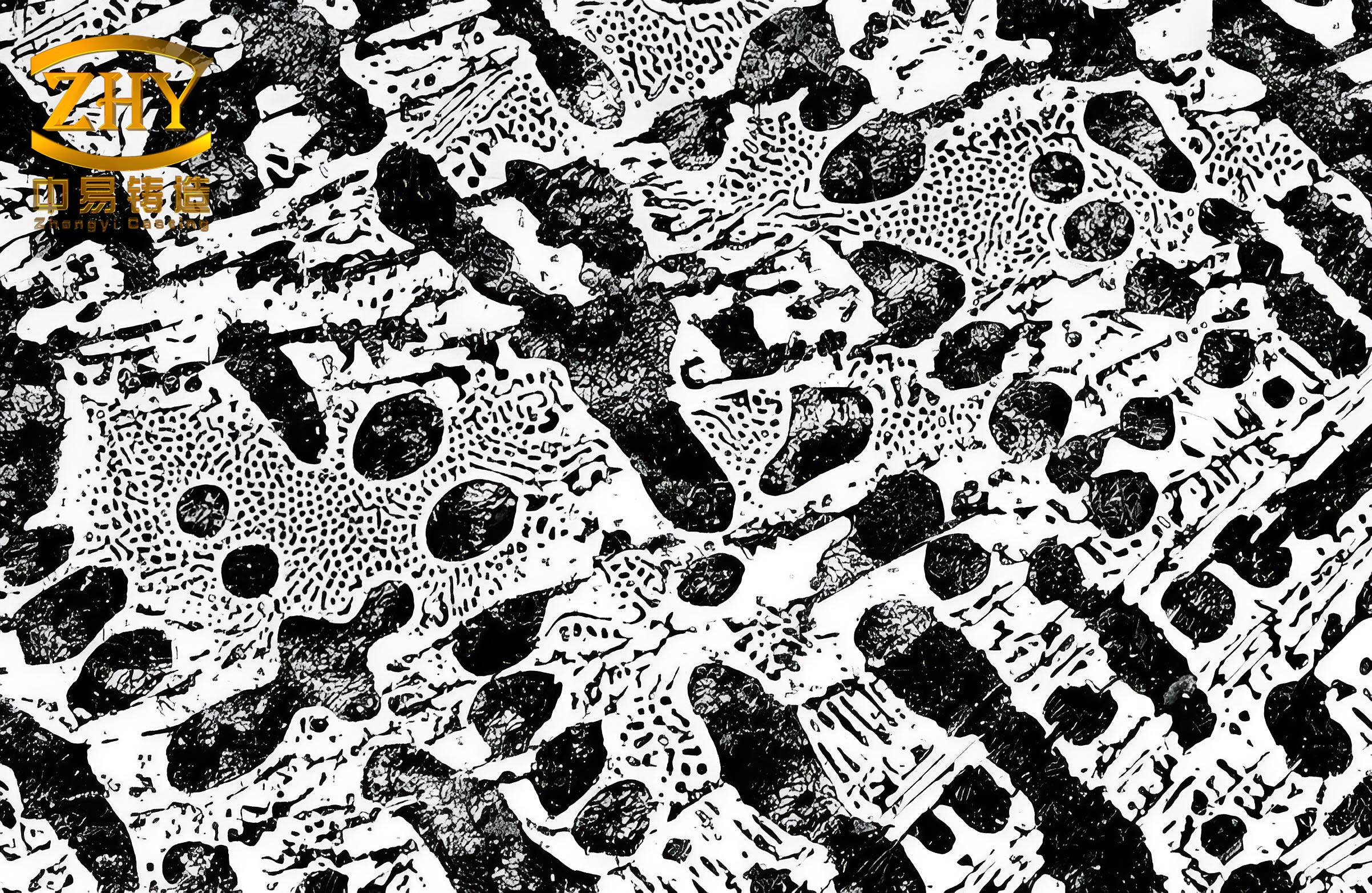
The microstructural evolution of the tungsten alloy white cast iron upon RE modification was profound and directly influenced its mechanical behavior. In the unmodified state (sample W0), the white cast iron exhibited a coarse microstructure with eutectic carbides forming a continuous network throughout the matrix. This network, typical of hypoeutectic white cast irons, acts as stress concentrators and crack propagation paths, leading to brittleness. However, with RE addition, I observed a gradual refinement and morphological shift. At 0.6% RE (W1), the carbide network began to fragment into a discontinuous or broken-net configuration. At higher levels like 1.2% RE (W2), the carbides further isolated into blocky or granular forms, and at 1.8% RE (W3), they approached an isolated distribution. To quantify these changes, I used image analysis to measure the shape factor of eutectic carbides, defined as the ratio of total perimeter (P) to total area (A) in a given cross-section. This shape factor, P/A, increases as carbides become more isolated, indicating a transition from continuous to discrete phases. The data, presented in Table 2, clearly show that RE treatment elevated the P/A ratio, confirming the microstructural refinement in the white cast iron. For instance, the shape factor rose from 0.26 μm⁻¹ in W0 to 0.36 μm⁻¹ in W3, underscoring the role of RE in promoting carbide spheroidization and dispersion. This alteration is attributed to the nucleation and growth inhibition effects of RE elements, which segregate at carbide interfaces and modify solidification kinetics. The refined microstructure not only enhances toughness by impeding crack propagation but also improves wear resistance by providing a more uniform distribution of hard phases.
| Sample ID | Total Perimeter P (μm) | Total Area A (μm²) | Shape Factor P/A (μm⁻¹) |
|---|---|---|---|
| W0 | 566841.40 | 2214363.18 | 0.26 |
| W1 | 726195.82 | 2197608.25 | 0.33 |
| W2 | 787213.06 | 2243007.69 | 0.35 |
| W3 | 798438.51 | 2220594.35 | 0.36 |
The mechanical properties of the tungsten alloy white cast iron were significantly influenced by RE modification. As shown in Figure 1 (represented descriptively here), the hardness of the white cast iron remained relatively stable across different RE levels, with values hovering around 55–58 HRC. This consistency indicates that RE treatment does not substantially alter the intrinsic hardness, which is primarily governed by the carbide volume fraction and matrix composition in white cast iron. However, the impact toughness displayed a marked improvement. The unmodified white cast iron (W0) had an impact energy of 4.74 J/cm², which increased to 6.52 J/cm² with 1.2% RE addition (W2)—a 37.6% enhancement. This boost in toughness is directly linked to the microstructural changes; the broken carbide network reduces stress concentrations and impedes crack initiation and propagation. Beyond 1.2% RE, though, I noted a slight decline in toughness, as seen in W3 (6.20 J/cm²). This downturn can be attributed to excessive RE leading to inclusions or segregation at grain boundaries, which may weaken interfacial cohesion. Thus, an optimal RE dosage exists for maximizing the toughness of this white cast iron, balancing carbide modification and impurity control. The relationship between carbide morphology and mechanical performance can be modeled using fracture mechanics principles. For instance, the critical stress intensity factor, K_IC, for a white cast iron with dispersed carbides can be approximated by:
$$ K_{IC} \propto \sqrt{\frac{E \cdot \gamma}{\lambda}} $$
where E is Young’s modulus, γ is the fracture surface energy, and λ is the mean inter-carbide spacing. With RE modification, λ decreases due to finer carbide distribution, thereby increasing K_IC and enhancing toughness. This theoretical framework supports my empirical observations, reinforcing the value of microstructural engineering in white cast iron development.
Wear resistance is a paramount property for ball mill liner materials, and my tests revealed substantial gains from RE modification. The relative wear resistance β, as defined earlier, increased from 1.58 for unmodified white cast iron (W0) to 2.14 for the optimally modified sample (W2), a 35.4% improvement. This places the modified tungsten alloy white cast iron on par with high-chromium cast iron (β ≈ 2.20) and superior to nickel-hard cast iron (β ≈ 1.90), as illustrated in Figure 2 (described textually). The composition of these comparative materials is detailed in Table 3. The enhancement in wear resistance stems from multiple factors. Firstly, the isolated carbide morphology reduces the likelihood of carbide pull-out during abrasion, as spherical or blocky carbides have lower stress concentrations than continuous networks. Secondly, the refined carbide size and distribution minimize direct abrasive contact with the softer matrix, effectively shielding it from wear. According to abrasive wear theory, the wear rate W can be expressed as:
$$ W = k \cdot \frac{H_m^{-1} \cdot f_c}{d_c} $$
where k is a constant, H_m is the matrix hardness, f_c is the carbide volume fraction, and d_c is the carbide diameter. In my white cast iron, RE modification reduces d_c while maintaining f_c, thereby lowering W. Additionally, the presence of alloying elements like tungsten, niobium, and tantalum from the slag contributes to secondary hardening and carbide stability, further bolstering wear resistance. The synergy between RE modification and alloy design thus creates a white cast iron with exceptional durability under impact-abrasive conditions.
| Material | C | Si | Mn | Cr | W | Ni | RE | Other Elements |
|---|---|---|---|---|---|---|---|---|
| 40Cr Steel | 0.42 | 0.33 | 0.68 | 1.04 | – | – | – | – |
| High-Chromium Cast Iron | 2.88 | 0.77 | 0.85 | 17.4 | – | 0.67 | – | – |
| Nickel-Hard Cast Iron | 3.06 | 0.54 | 0.63 | 2.58 | – | 4.22 | – | – |
| W0 (Unmodified White Cast Iron) | 2.96 | 0.65 | 0.83 | 0.53 | from slag | – | trace | Nb, Ta, Ti |
| W2 (Modified White Cast Iron) | 2.98 | 0.98 | 1.57 | 0.50 | from slag | – | 0.13 | Nb, Ta, Ti |
The practical application of modified tungsten alloy white cast iron in ball mill liners has yielded promising results. Since 2001, I have conducted field trials in various gold, molybdenum, and iron ore processing plants in Henan and Shaanxi provinces, using liners installed in ball mills with diameters of 1.5 m, 1.83 m, and 2.1 m. These liners, fabricated from RE-modified white cast iron, demonstrated exceptional reliability and safety, with no instances of fracture or catastrophic failure during operation. Their service life proved equivalent to that of high-chromium cast iron and nickel-hard cast iron liners, while outperforming high-manganese steel liners by over 120%. Economically, the use of tungsten slag iron alloy as the primary alloying source drastically reduces material costs. Compared to ferrochromium (6,000–6,500 CNY/ton) and nickel metal (90,000–105,000 CNY/ton), tungsten slag iron alloy costs only 2,500–2,800 CNY/ton. Although RE ferrosilicon adds expense (8,500–9,200 CNY/ton), the overall production cost for the modified white cast iron liners is approximately 5,500 CNY/ton, which is more than 50% lower than that of high-chromium or nickel-hard variants. This cost-effectiveness, coupled with comparable performance, makes the white cast iron a compelling choice for industries seeking to minimize operational expenditures without compromising durability. Moreover, leveraging tungsten slag—a by-product abundant in China—aligns with resource efficiency and sustainability goals, mitigating dependence on scarce chromium and nickel resources.
To deepen the understanding of RE modification effects, I delved into the thermodynamic and kinetic aspects. During solidification of white cast iron, RE elements like cerium and lanthanum exhibit a strong affinity for oxygen and sulfur, forming stable compounds that act as nucleation sites for carbides. This promotes heterogeneous nucleation, leading to finer carbide grains. Additionally, RE segregates at the advancing solid-liquid interface, inhibiting carbide growth and favoring isotropic shapes. The modification process can be described by the following relationship for carbide radius r as a function of cooling rate T and RE concentration C_RE:
$$ r = \frac{A}{\sqrt{T}} \cdot \exp(-B \cdot C_{RE}) $$
where A and B are material constants. This equation highlights how RE addition reduces carbide size, contributing to the observed microstructural refinement. Furthermore, the impact of carbide morphology on wear mechanisms warrants detailed analysis. In abrasive wear, material removal occurs via microcutting, microploughing, and microfracture. For white cast iron with continuous carbides, microfracture dominates due to brittle carbide networks, leading to high wear rates. In contrast, the modified white cast iron with isolated carbides resists microfracture, and wear proceeds primarily through microcutting of the matrix, which is slower. The wear volume V can be estimated using the Archard wear model adapted for composite materials:
$$ V = \frac{K \cdot L \cdot H^{-1}}{3} \left( f_m + \frac{f_c}{H_c / H_m} \right) $$
where K is a wear coefficient, L is load, H is hardness, f_m and f_c are matrix and carbide volume fractions, and H_c and H_m are carbide and matrix hardnesses. For my white cast iron, RE modification increases effective H by optimizing carbide distribution, thereby reducing V. These theoretical insights complement the experimental data, providing a robust foundation for the material’s design.
In terms of industrial scalability, the production process for modified tungsten alloy white cast iron liners is straightforward and integrates seamlessly with existing foundry practices. The key steps include: melting base iron with tungsten slag addition, RE inoculation, casting into molds, and heat treatment. The heat treatment regimen—normalizing and tempering—is similar to that used for high-chromium cast iron, ensuring ease of adoption. Quality control measures, such as spectroscopic analysis for composition verification and ultrasonic testing for defect detection, can be implemented to maintain consistency. From an environmental perspective, utilizing tungsten slag reduces waste from tungsten processing, contributing to circular economy principles. The long service life of the liners also decreases replacement frequency, reducing downtime and material consumption in mining operations. These advantages underscore the white cast iron’s potential as a mainstream material for wear-resistant applications beyond ball mills, such as in crusher parts, pump components, and agricultural implements.
Looking ahead, further research could explore the synergistic effects of combining RE modification with other treatments, such as boron addition or thermal cycling, to enhance the white cast iron properties. Additionally, advanced characterization techniques like electron backscatter diffraction (EBSD) or in-situ wear testing could elucidate the deformation mechanisms under dynamic loads. The development of predictive models using machine learning to optimize composition and processing parameters for specific applications is another promising direction. My work establishes a baseline for these endeavors, demonstrating that cost-effective white cast iron can achieve performance metrics rivaling premium materials.
In conclusion, my investigation into the modification of tungsten alloy white cast iron with rare earth elements has yielded significant advancements in material performance and economic viability. The RE treatment effectively transforms the carbide morphology from a continuous network to a discontinuous or isolated distribution, refining the microstructure of the white cast iron. This microstructural improvement translates into a 37.6% increase in impact toughness and a 35.4% enhancement in wear resistance, making the modified white cast iron comparable to high-chromium cast iron and superior to nickel-hard cast iron. Field applications in ball mill liners confirm its reliability and extended service life, with costs reduced by over 50% through the use of tungsten slag iron alloy. The white cast iron thus represents a sustainable and efficient solution for abrasive wear challenges, leveraging abundant resources and straightforward processing. As industries continue to seek high-performance, low-cost materials, the insights from this study on white cast iron modification will undoubtedly inform future innovations in wear-resistant alloy design and application.