
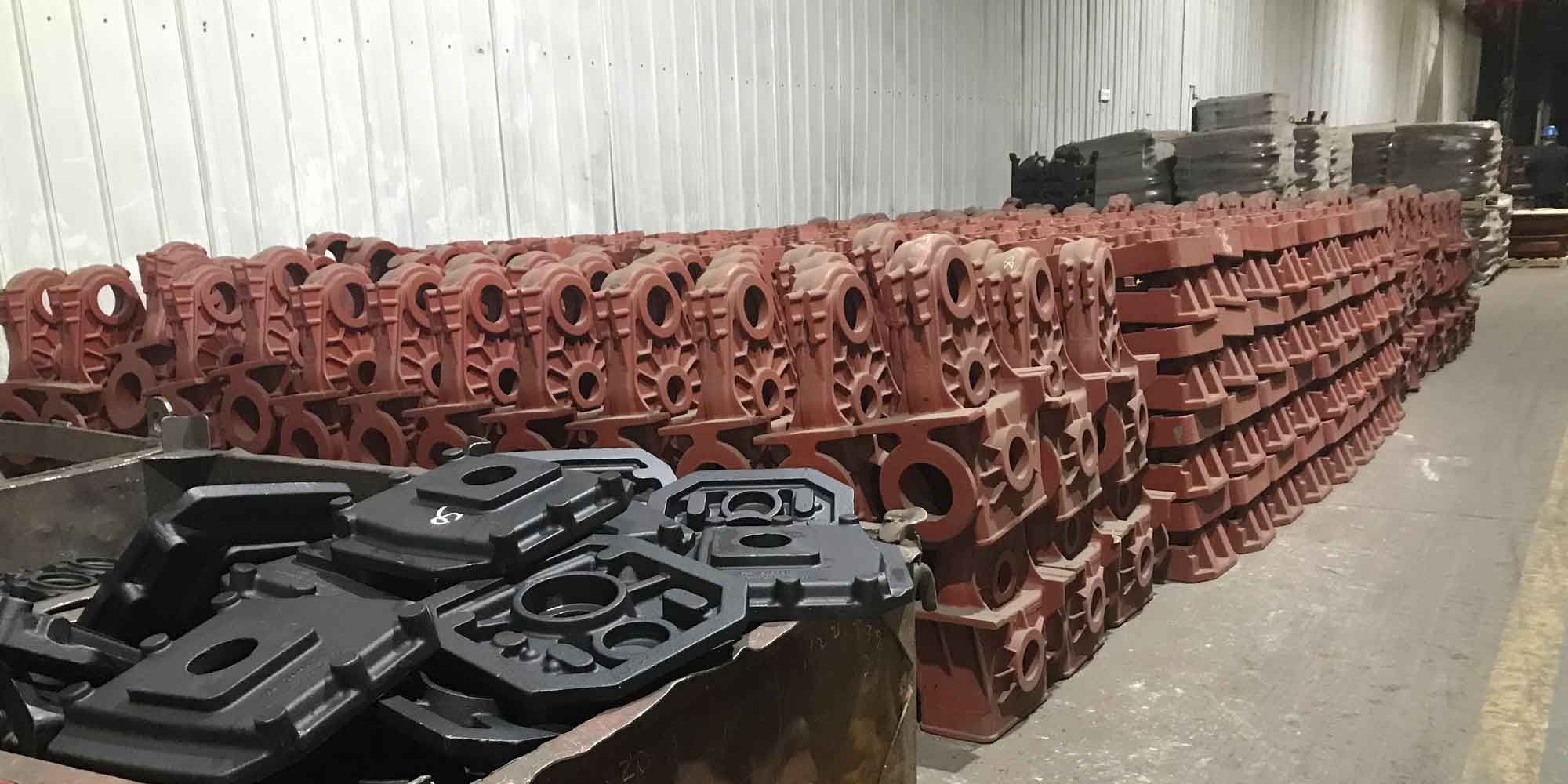
In the manufacturing of railway vehicles, steel castings play a critical role as key components, particularly in the form of bolsters for bogies. These steel castings are typically produced through sand casting processes, resulting in surfaces that require extensive cleaning and grinding to remove defects such as浇冒口余根,毛刺, and型芯披缝. Traditionally, this grinding work has been performed manually, relying on workers operating tools like cutting torches and arc air gouging machines. However, this approach poses significant safety hazards, high labor intensity, and恶劣的作业环境 due to sparks, arc lights,烟雾,粉尘, and噪音. Moreover, the consistency in product quality is often compromised, and companies face challenges in recruitment and productivity. Therefore, developing an automated robotic grinding system to replace human labor is of paramount importance. This article, from a first-person perspective as part of a research team, delves into the design, implementation, and application of a robot-based automatic grinding system specifically for steel castings like the转K6 bolster. We aim to address the core difficulties in automation, propose integrated solutions, and highlight the transformative impact on safety, efficiency, and environmental conditions in foundry operations.
Steel castings, such as the转K6 bolster, are characterized by their large尺寸, heavy weight, and complex geometries. The转K6 bolster, made of B+ grade steel (ZG25MnCrNi), has an approximate weight of 685 kg and dimensions of 2429 mm × 504.6 mm × 430 mm. After heat treatment, its hardness ranges from 137 to 228 HBW, but prior to热处理, it is typically around 150–170 HBW, making it粘性较大 and prone to tool adhesion during grinding. The primary grinding areas include nine regions: the心盘冒口,分型面披缝,拉杆孔及周围,旁承盒顶面, and八字面冒口余根, among others. These areas necessitate precise material removal to meet quality standards. However, the inherent variability in steel castings—such as deformation up to ±3 mm and uneven surface hardness—presents formidable challenges for automation. Our research focuses on overcoming these hurdles through innovative mechanical design, advanced sensing, and robust process control.
The automation of grinding for steel castings involves several technical难点 that must be addressed systematically. First, the工具寿命 and efficiency are severely impacted by the粘性 nature of steel castings before heat treatment. During grinding, the material tends to adhere to abrasive tools, reducing their lifespan and compromising grinding efficiency. Additionally, the粗糙 and non-uniform surface of steel castings, often containing hard inclusions, leads to uneven forces on the grinding tool. This results in significant冲击和振动, which can degrade磨削质量, damage tools, and even harm robotic systems. To mitigate these issues, we implemented a dual cooling approach combining风冷 and水冷. This effectively lowers tool temperature, minimizes adhesion, and extends tool life. Furthermore, we employed a high-rigidity cutting-and-grinding integrated robot with a stiffness value of approximately 6.2 N/μm, significantly higher than traditional six-axis robots. The rigidity can be expressed in terms of force per unit deformation: $$ k = \frac{F}{\delta} $$ where $k$ is the stiffness (6.2 N/μm), $F$ is the applied force, and $\delta$ is the deformation. This high stiffness helps absorb vibrations and maintain precision during grinding operations on steel castings.
Second, the外形尺寸检测 of large steel castings is complicated by substantial and irregular deformation. Unlike smaller or铸铁件, these steel castings exhibit unpredictable dimensional variations, making it difficult to achieve consistent automated grinding. To tackle this, we integrated a laser detection system into our robotic setup. This system scans the casting surface to identify deviations from the nominal geometry, enabling real-time error compensation. The correction algorithm uses point cloud data to adjust the robot’s trajectory, ensuring accurate material removal. The误差检测技术 allows for a “one-time selection, continuous utilization” effect, meaning that after initial calibration, the system can adapt to variations across multiple steel castings without manual intervention. The relationship between detected error and tool path adjustment can be modeled as: $$ \Delta P = K_e \cdot E $$ where $\Delta P$ is the path adjustment vector, $K_e$ is a gain matrix, and $E$ is the error vector from laser scanning. This ensures precise打磨效果 even for deformed steel castings.
Third, the设备精度保持 is threatened by the harsh working environment, which includes金属粉尘,钢屑,火光, and噪声. These factors can pollute the surroundings, harm operator health, and degrade equipment accuracy over time. Our solution involves a comprehensive防护 strategy. We designed a封闭式防护房 equipped with fire-resistant and noise-dampening materials to isolate sparks and reduce noise levels. A除尘器 system actively filters out粉尘 generated during grinding, while a排屑机 removes大部分钢屑 automatically. Regular manual cleaning is scheduled for residual debris. Additionally, the打磨机器人 is protected with钣金 enclosures, and the物流滑台 uses风琴式钣金机构 to shield moving parts. This multi-layered approach preserves设备精度 and ensures a safer, cleaner workspace for handling steel castings.
Building on these solutions, we devised a detailed robotic automation grinding scheme. The system is centered around a工件固定 approach, where the steel casting remains stationary while the robot manipulates the grinding tool. This is essential given the large size and weight of steel castings like the转K6 bolster. The overall layout comprises several key components: a打磨机器人,打磨主轴,刀具,激光检测系统,零件工装夹具系统,物料输送系统,外围安全防护房,悬臂吊, and电控系统. The process flow begins with manual浇冒口切割 of the steel casting, followed by transport via a物料转运台车 to an上料工位. An operator uses a悬臂吊 to place the casting onto the物流滑台系统, which then conveys it into the防护房. Upon启动, the安全卷帘门 closes, and the robot proceeds with automated grinding, utilizing刀头切换功能 to change tools as needed. The物流滑台系统 facilitates rotation and movement of the casting for complete coverage. After grinding, the casting is returned to the unloading area for removal by the悬臂吊, and the cycle repeats. This integrated system streamlines the entire打磨工序 for steel castings.
The核心 of our system is the打磨机器人, designed for high rigidity and versatility. It features a板焊结构 for lightweight yet robust construction, consisting of a床身,立柱,滑鞍,从动臂与主动臂, and主轴. Motion is controlled by a数控伺服系统, ensuring high precision in positioning and加工. The主轴 employs an交流伺服控制直联旋转运动 for excellent dynamic response. The robot’s kinematics can be described using Denavit-Hartenberg parameters, but for simplicity, the overall stiffness matrix $K_{robot}$ relates joint torques $\tau$ to end-effector displacements $x$: $$ \tau = K_{robot} \cdot x $$ where $K_{robot}$ is derived from the structural properties, contributing to the 6.2 N/μm rigidity. This design is crucial for handling the demanding grinding tasks on steel castings.
Selecting the appropriate打磨工具 is vital for effective material removal on steel castings. Given the high hardness of B+ grade steel, we conducted extensive tests with various砂轮片:金刚石砂轮片,树脂片, and合金片. The results are summarized in Table 1, which compares key performance metrics. For instance, the金刚石砂轮片 showed superior durability and minimal cracking, making it ideal for打磨高硬度材质的 steel castings. The grinding efficiency can be analyzed using specific energy $E_s$, defined as the energy per unit volume of material removed: $$ E_s = \frac{P}{Q} $$ where $P$ is the power consumed and $Q$ is the material removal rate. For steel castings, lower $E_s$ indicates better tool performance. Our tests confirmed that金刚石砂轮片 achieves lower $E_s$ due to its wear resistance, aligning with the data in Table 1.
| Tool Type | Spindle Load Rate (at Specific Feed) | Cracking Occurrence | Overall Effectiveness | Relative Specific Energy $E_s$ |
|---|---|---|---|---|
| Diamond Grinding Wheel | 80%-120% | No | Excellent | Low |
| Resin Bonded Wheel | 150% | Yes (traces) | Poor | High |
| Alloy Blade | 170% | No | Moderate | Medium |
Furthermore, the wear rate $W$ of grinding tools on steel castings can be modeled empirically: $$ W = C \cdot v^{a} \cdot f^{b} \cdot t^{c} $$ where $v$ is the grinding speed, $f$ is the feed rate, $t$ is time, and $C$, $a$, $b$, $c$ are constants dependent on tool and material properties. For diamond wheels on steel castings, $a$, $b$, $c$ are typically lower, indicating slower wear. This aligns with our observation of extended tool life in automated grinding systems for steel castings.
The夹紧定位工装 is another critical component, designed to securely hold steel castings during grinding. It comprises a基座,定位柱,仿形辅助支撑,压板立柱,压板活动机构, and螺杆. This工装 ensures that the casting remains stable and accurately positioned, minimizing vibrations and errors. The clamping force $F_c$ must satisfy: $$ F_c \geq \mu \cdot F_g + F_d $$ where $\mu$ is the friction coefficient, $F_g$ is the gravitational force of the steel casting, and $F_d$ is the dynamic force from grinding. Our design uses multiple压板 to distribute forces evenly, accommodating the irregular shapes of steel castings. Table 2 outlines the key parameters of the工装 for the转K6 bolster.
| Component | Function | Design Feature | Force Capacity |
|---|---|---|---|
| Base | Foundation support | Rigid welded structure | Withstands >5000 N |
| Positioning Pins | Precise location | Hardened steel, conical tips | Accuracy ±0.1 mm |
| Contoured Supports | Adapt to casting shape | Adjustable pads | Distributes load evenly |
| Clamping Plates | Secure casting | Lever-actuated, quick release | Clamping force 2000-3000 N |
In terms of control and programming, the电控系统 integrates all components. We developed custom software for path planning and optimization, considering the geometry of steel castings. The robot’s trajectory is generated using CAD models of the bolster, with offsets for grinding passes. The material removal rate $Q$ for each pass can be calculated as: $$ Q = w \cdot d \cdot v_f $$ where $w$ is the width of cut, $d$ is the depth of cut, and $v_f$ is the feed velocity. For steel castings, we optimized these parameters to balance efficiency and tool life, often setting $d$ to 0.5–2 mm and $v_f$ to 100–500 mm/min based on tool type. The激光检测系统 feeds correction data into this loop, ensuring adaptability to variations in steel castings.
The environmental benefits of our automated system are substantial. By enclosing the process in a防护房 and using除尘器, we significantly reduce粉尘 emissions. The noise level inside the房 is dampened by over 20 dB compared to open grinding. Moreover, the排屑机 automates waste removal, cutting manual cleanup time by 70%. These improvements create a healthier workplace, which is especially important when dealing with steel castings that generate hazardous by-products. The economic impact is also notable: the system reduces labor costs by approximately 60% per casting and increases throughput by 30% due to continuous operation. Consistency in grinding quality for steel castings is enhanced, with surface roughness $R_a$ maintained within 6.3–12.5 μm across all batches, as per ISO standards.
To further illustrate the technical details, we can analyze the vibration dynamics during grinding of steel castings. The system can be modeled as a mass-spring-damper system, where the robot arm and tool interact with the casting. The equation of motion is: $$ m \ddot{x} + c \dot{x} + k x = F(t) $$ where $m$ is the effective mass, $c$ is damping coefficient, $k$ is stiffness (6.2 N/μm), and $F(t)$ is the grinding force varying with time. By solving this differential equation, we can predict resonant frequencies and avoid them in operation. For our system, the natural frequency $f_n$ is: $$ f_n = \frac{1}{2\pi} \sqrt{\frac{k}{m}} $$ which typically falls above 100 Hz, well beyond common grinding disturbances, ensuring stability when processing steel castings.
In conclusion, the development and application of this robot automatic grinding system represent a significant advancement in the manufacturing of steel castings. By addressing key challenges such as tool adhesion, dimensional variability, and environmental hazards, we have successfully implemented a solution that replaces manual labor with automated precision. The system incorporates high-rigidity robots, advanced laser sensing, and comprehensive防护 measures, all tailored to the unique properties of steel castings. The result is a safer, more efficient, and environmentally friendly grinding process that enhances product consistency and operational scalability. Future work may focus on integrating artificial intelligence for adaptive tool wear prediction and expanding the system to other types of steel castings in heavy industry. Ultimately, this research underscores the transformative potential of robotics in modern foundries, paving the way for wider adoption of automation in the production of critical components like steel castings.
Throughout this article, we have emphasized the importance of steel castings in various applications and how robotic automation can revolutionize their post-processing. The tables and formulas provided summarize key technical aspects, from tool performance to system dynamics. By repeatedly highlighting steel castings, we aim to reinforce their central role in this technological evolution. As industries continue to seek efficiency and safety improvements, automated grinding systems for steel castings will undoubtedly become a standard, driving innovation and sustainability in manufacturing worldwide.