
In my extensive study of wear-resistant materials, I have focused on chromium-containing white cast iron, a class of alloys that has garnered significant attention due to its exceptional hardness and abrasion resistance. White cast iron, characterized by its cementite-dominated microstructure, forms the backbone of many industrial applications where durability against abrasive wear is paramount. The incorporation of chromium into white cast iron fundamentally alters its properties, leading to the classification into high-chromium, medium-chromium, and low-chromium white cast iron based on chromium content. This article delves into the research status, microstructural evolution, mechanical performance, and practical applications of these alloys, emphasizing the economic and technical rationale behind advancing medium-chromium white cast iron in resource-constrained contexts.
The evolution of chromium white cast iron began in earnest following the development of nickel-hard white cast iron in 1928. However, it was the successful introduction of Cr15-Mo3 white cast iron by the International Molybdenum Company in the 1950s that truly catalyzed widespread adoption. The key parameter governing the microstructure and properties of these alloys is the chromium-to-carbon ratio (Cr/C). This ratio dictates the type, morphology, and distribution of carbides, which in turn critically influence toughness and wear resistance. In general, higher Cr/C ratios promote the formation of isolated, rod-like M7C3 carbides, which are harder and less detrimental to toughness than the networked M3C carbides prevalent in unalloyed or low-alloy white cast iron. The continuous pursuit of optimizing this balance between cost and performance drives ongoing research in this field.
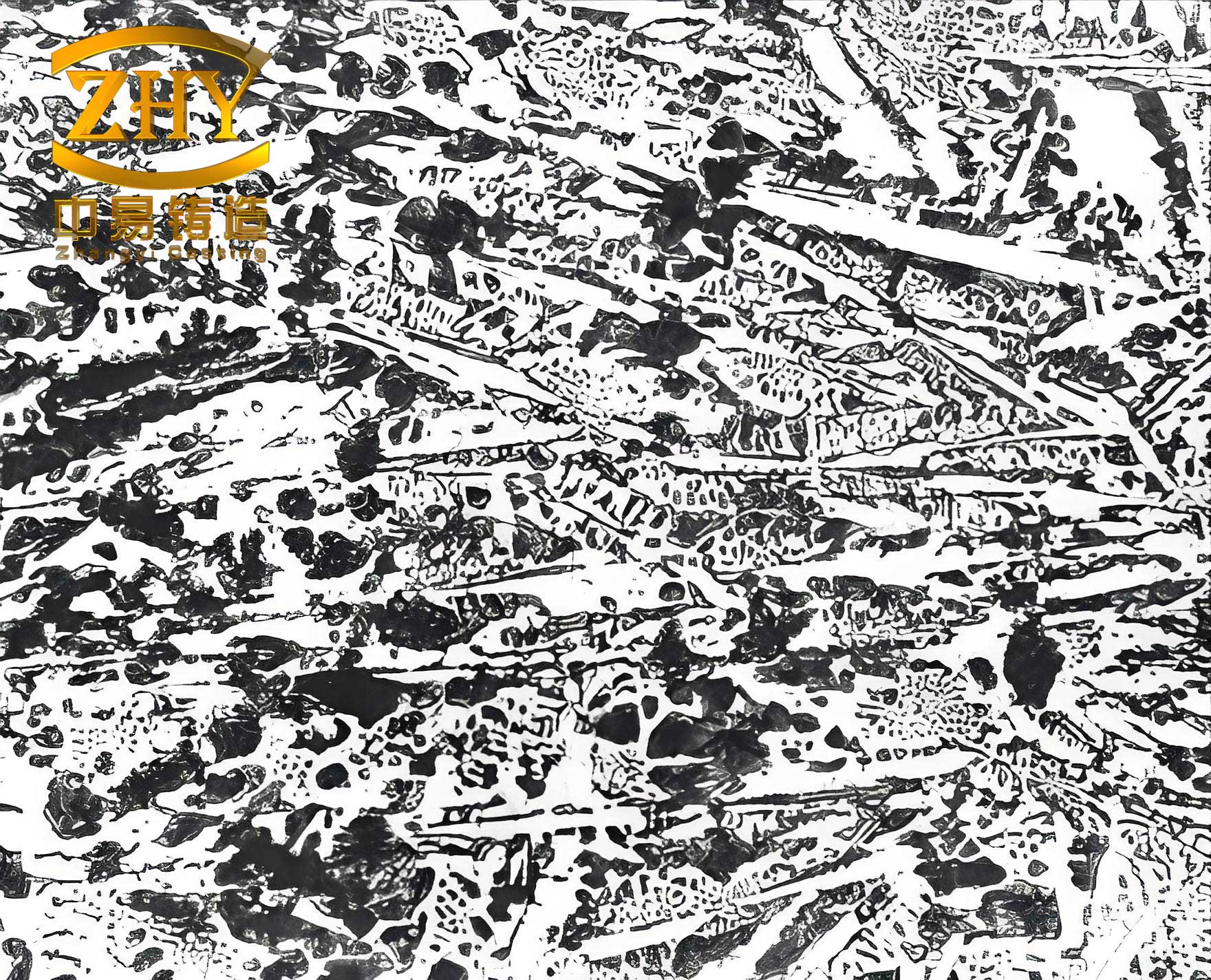
High-chromium white cast iron, typically defined as containing more than 12% Cr, emerged in the 1930s and is widely regarded as a superior anti-wear material. The high Cr/C ratio ensures that the primary carbides are of the M7C3 type. Their hexagonal crystal structure confers high hardness (approximately HV 1300-1800), and their isolated, eutectic morphology significantly improves the toughness of the white cast iron matrix compared to materials with continuous carbide networks. The mechanical properties and wear resistance are further tailored through heat treatment, which controls the matrix structure—be it austenite, martensite, or various tempered states.
The wear resistance of high-chromium white cast iron can be modeled considering the carbide volume fraction and matrix hardness. A simplified relationship for relative wear resistance (WR) under abrasive conditions is often expressed as:
$$ WR \propto f_c \cdot H_c + (1 – f_c) \cdot H_m $$
where \( f_c \) is the volume fraction of carbides, \( H_c \) is the hardness of the carbides, and \( H_m \) is the hardness of the matrix. For high-chromium white cast iron, \( f_c \) is a function of the total carbon content, and \( H_c \) is supremely high due to the M7C3 composition. Applications are vast, spanning mining (crusher liners, slurry pump parts), cement production (grinding balls, mill liners), power generation (pulverizer rolls), and construction machinery. However, the widespread use of this high-performance white cast iron is hampered by two major factors: high cost and limited impact toughness. The cost stems from the significant chromium content, the necessity for electric furnace melting, and mandatory high-temperature heat treatments (e.g., destabilization at 950-1050°C followed by air quenching and tempering). The impact toughness, typically in the range of 5-9 J/cm², restricts its use in high-impact environments, prompting the search for more balanced alternatives.
On the opposite end of the spectrum lies low-chromium white cast iron, with chromium content usually ≤ 5%. This variant was developed primarily to suit production conditions in regions where cupola melting is prevalent, offering a more economical route to manufacturing wear-resistant white cast iron. The microstructure, however, is dominated by the less desirable M3C-type carbides, which tend to form a continuous or semi-continuous network. This morphology severely embrittles the material. Consequently, while its abrasion resistance is respectable and cost is low, its application is limited to low-stress, purely abrasive wear conditions. Research efforts to improve low-chromium white cast iron have focused on several strategies to refine its carbide network and enhance matrix strength:
- Micro-alloying: Adding small amounts of elements like titanium, vanadium, or boron to refine the as-cast structure.
- Modification/Inoculation: Using rare earth elements or other inoculants to change carbide morphology.
- Thermomechanical Processing: Applying hot deformation to break up the carbide network.
- Advanced Heat Treatment: Utilizing sub-critical heat treatments or austempering to produce tougher matrix structures like bainite.
The effectiveness of micro-alloying in refining primary carbides can be estimated using a potency factor related to the formation enthalpy of carbides or nitrides. For instance, the grain refinement effect ΔGS from a carbide-forming element X can be related to its concentration [X] by an equation of the form:
$$ \Delta GS = k \cdot \sqrt{[X]} $$
where \( k \) is a material constant. Despite these advances, the fundamental limitations of the M3C carbide in low-chromium white cast iron keep it from matching the performance of its higher-chromium counterparts in demanding applications.
The most compelling area of current research, in my view, is medium-chromium white cast iron, with chromium content ranging from approximately 7% to 10%. This class represents a strategic compromise, aiming to capture much of the performance of high-chromium white cast iron while significantly reducing cost, especially by minimizing or eliminating the use of expensive nickel. The seminal Ni-hard 4 alloy (containing 7-11% Cr and 4-6% Ni) demonstrated excellent wear resistance, but its high nickel content is prohibitive. Therefore, a central research thrust has been to substitute nickel with more economical elements like manganese, copper, and molybdenum, coupled with optimized heat treatment.
The microstructure of medium-chromium white cast iron is complex and highly sensitive to composition and processing. At these intermediate chromium levels, the carbide type can be a mixture of M7C3 and M3C, depending on the exact Cr/C ratio and cooling conditions. A critical parameter identified in studies is the silicon-to-carbon ratio (Si/C). Research indicates that controlling the Si/C ratio between 0.65 and 0.75 leads to an optimal combination of hardness and toughness. This can be explained through its influence on the activity of carbon and the stability of various phases. From a thermodynamic perspective, silicon is a graphitizer but in white cast iron, it primarily remains in solid solution, strengthening the matrix and influencing the eutectic reaction. The “Empirical Electron Theory of Solids and Molecules” provides a qualitative framework: a specific Si/C ratio optimizes the electron concentration in the solid solution, promoting the formation of a multiphase matrix (like martensite-bainite-austenite or austenite-bainite) that offers a good balance. The hardness (HRC) and impact toughness (\(a_k\)) follow an approximate trade-off relation:
$$ a_k \approx \alpha – \beta \cdot (HRC)^2 $$
where \( \alpha \) and \( \beta \) are constants dependent on the specific microstructure.
Heat treatment is paramount for medium-chromium white cast iron. A typical process involves austenitizing at 880-920°C, air cooling to form martensite (with significant retained austenite), followed by tempering at 280-350°C to transform some retained austenite and relieve stresses. This yields a final microstructure of tempered martensite, secondary carbides, and stable, isolated primary carbides. The effect of tempering temperature (T, in Kelvin) on final hardness can be described by a tempering parameter such as the Hollomon-Jaffe parameter:
$$ P = T \cdot (C + \log t) $$
where \( t \) is time in hours, and \( C \) is a constant. Optimizing this parameter is key to achieving the desired matrix hardness without excessive softening.
The mechanical and wear properties of developed medium-chromium white cast iron alloys compare favorably with the benchmark Ni-hard 4, as summarized in the table below. This data consolidates findings from various studies, including those presented at major materials conferences.
| Property | Material: Ni-hard 4 | Material: Medium-Chromium White Cast Iron |
|---|---|---|
| Mechanical Properties | ||
| Hardness (HRC) | 55 – 65 | 55 – 65 |
| Bending Strength, σwb (MPa) | 716 – 784 | 784 – 931 |
| Deflection, f (mm) | 2.20 – 2.60 | 2.20 – 2.80 |
| Impact Toughness, ak (J/cm²) | 7.64 – 8.62 | 6.86 – 9.31 |
| Abrasive Wear Resistance (Relative Index)* | ||
| Against SiO2 abrasion | 1.28 | 1.30 – 1.47 |
| Against Garnet abrasion | 1.74 | 1.83 – 1.96 |
| Against SiC abrasion | 1.51 | 1.42 – 1.55 |
| Typical Heat Treatment | Austenitize: 780-820°C, Air Cool Temper: 400-450°C |
Austenitize: 880-920°C, Air Cool Temper: 280-350°C |
*Wear resistance index normalized to a reference material (e.g., standard low-chromium white cast iron).
The synergy between composition and heat treatment in medium-chromium white cast iron is critical. For a nominal composition of C 2.8% and Cr 8.8%, varying silicon content significantly affects hot workability and forged properties. Research shows that with silicon in the range of 1.1% to 1.6%, forged medium-chromium white cast iron with a tempered martensite base achieves an excellent property combination: HRC 58, impact toughness of 37 J/cm², and a specific wear rate (U) as low as 4.5755 (in appropriate units). The improvement in toughness from forging is dramatic, following a relationship where forged toughness \(a_{k(forged)}\) relates to as-cast toughness \(a_{k(cast)}\) by a factor dependent on the reduction ratio R:
$$ a_{k(forged)} \approx a_{k(cast)} \cdot (1 + \gamma \cdot \ln R) $$
where \( \gamma \) is a material constant. This opens avenues for producing near-net-shape components with superior properties.
Beyond traditional wear parts, I believe medium-chromium white cast iron holds untapped potential in tooling applications. Currently, premium cold-work tool steels like Cr12MoV, Cr12, and CrWMn, and hot-work steels like 5CrMnMo, offer outstanding combinations of strength, hardness, and wear resistance. However, their high cost increases overall模具 manufacturing expenses. Given that properly processed medium-chromium white cast iron can achieve high surface hardness (HRC 58-65) and considerable wear resistance, it presents a cost-effective alternative for certain模具 applications, particularly those involving abrasive forming processes or where very high wear resistance is needed but extreme impact loading is absent. The economic driving force is powerful: substituting even a fraction of tool steel applications with this advanced white cast iron could yield substantial savings while maintaining performance in selected cases. This crossover application necessitates further research into the fatigue behavior, fracture toughness, and thermal fatigue resistance of these white cast iron grades under cyclic模具 loading conditions.
To systematically design new grades of chromium white cast iron, computational thermodynamics plays an increasing role. Using CALPHAD-based software, one can predict phase fractions as a function of composition and temperature. For instance, the volume fraction of M7C3 carbides, \(V_{M7C3}\), in a Fe-Cr-C system can be estimated from an isothermal section of the phase diagram at the eutectic temperature. A simplified linear rule for the carbide fraction in hypoeutectic alloys might be:
$$ V_{M7C3} \approx \frac{C – C_{\alpha}}{C_{carb} – C_{\alpha}} $$
where \( C \) is the total carbon content, \( C_{\alpha} \) is the carbon solubility in ferrite/austenite at the temperature, and \( C_{carb} \) is the carbon content in the carbide phase. More accurate calculations require full thermodynamic databases.
The future of chromium-containing white cast iron research is multifaceted. Key directions include:
- Ultra-Low-Cost Alloy Design: Further reduction or replacement of chromium with other carbide formers (e.g., vanadium, titanium) combined with boron micro-additions, while maintaining a white cast iron structure.
- Hybrid Processing Routes: Combining casting with additive manufacturing (e.g., laser cladding) to deposit wear-resistant white cast iron surfaces on cheaper substrates.
- Nanostructuring: Using rapid solidification or severe plastic deformation to achieve nanocrystalline carbides within the white cast iron matrix for potentially unprecedented property combinations.
- Sustainability: Investigating the use of recycled alloy scrap streams to produce high-performance white cast iron, reducing the environmental footprint.
In all these endeavors, the fundamental understanding of the solidification kinetics, phase transformations, and wear mechanisms in these complex ferrous alloys remains crucial. The wear mechanism itself often transitions from micro-cutting to fatigue spalling as carbide size and spacing change, a phenomenon that can be modeled using contact mechanics theories applied to a two-phase white cast iron composite.
In conclusion, the research landscape for chromium-containing white cast iron is dynamic and driven by the perpetual need for materials that offer superior wear resistance at manageable cost. High-chromium white cast iron sets a performance benchmark but faces economic and toughness barriers. Low-chromium white cast iron offers an economical solution for less demanding tasks. The most promising and actively researched domain is medium-chromium white cast iron, which strikes a compelling balance. Through careful compositional design, particularly control of Cr/C and Si/C ratios, and optimized heat treatment or thermomechanical processing, it is possible to achieve a combination of high hardness, improved toughness, and excellent abrasion resistance that rivals established but costly nickel-chromium alloys. Given global resource constraints on elements like nickel and chromium, the development and commercialization of these advanced medium-chromium white cast iron grades are not just academically interesting but hold substantial practical and economic significance. Their potential expansion into new application fields like tooling could further amplify their impact. As research continues to refine our predictive capabilities and processing techniques, the future for this versatile family of white cast iron materials appears exceedingly bright.