
In recent years, the domestic manufacturing of machine tools has been transitioning from rapid development to high-quality development. As the industry shifts from relatively mature three-axis machines to five-axis machining centers and gantry machining centers, issues such as poor machining accuracy and inadequate precision retention have emerged. Simultaneously, the reliance on imported high-end machine tool castings remains significant, posing a bottleneck for the transformation and advancement of the manufacturing sector. As critical foundational components, machine tool castings produced via traditional methods have long suffered from high residual stress, low elastic modulus, susceptibility to deformation, and poor stability, which are persistent pain points for downstream clients and challenges for the foundry industry. Therefore, this study focuses on addressing these issues through systematic research and production practices.
The traditional approach to producing machine tool castings often involved low carbon equivalent (CE) and high-strength formulations. Due to the low CE, these castings exhibited high shrinkage and a tendency toward chill formation, leading to problems such as high residual stress, low elastic modulus, deformation, and poor machinability. Additionally, defects like shrinkage porosity, cavities, and uneven hardness were common, with severe cases resulting in cracking and scrap. Key issues included: (1) High residual stress, with significant tensile stress concentrations in specific areas; (2) Poor hardness uniformity, with large variations and high hardness in thin sections causing machining difficulties; and (3) Casting defects such as cracks, shrinkage, and porosity. To overcome these limitations, this research explores advanced material design and process optimization.
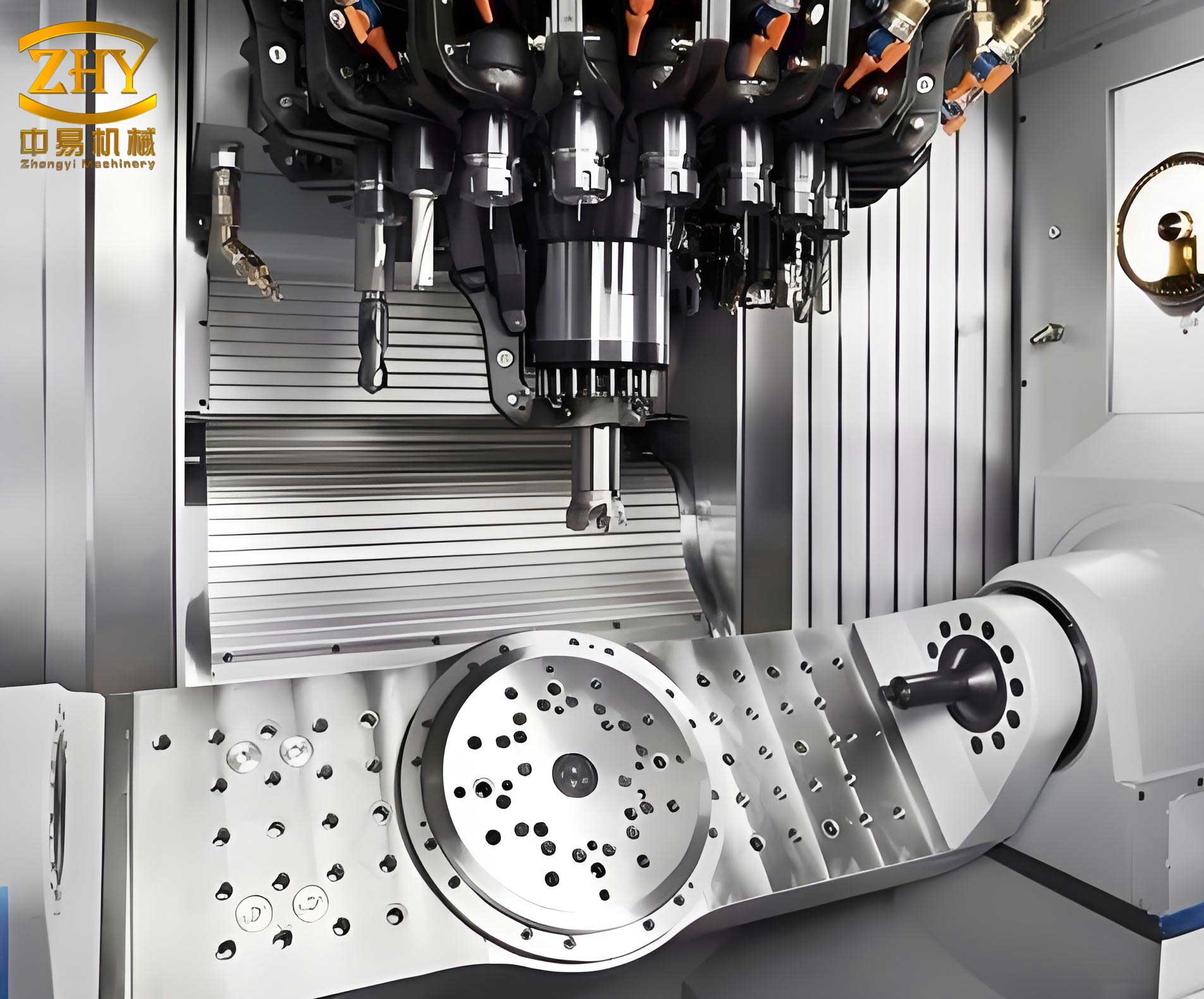
The production of high-performance machine tool castings requires precise control over chemical composition, melting practices, and inoculation. In this study, the chemical composition is tailored to achieve high carbon equivalent and high silicon-to-carbon ratio, coupled with micro-alloying and enhanced inoculation. The carbon equivalent (CE) is elevated above 3.8%, and the silicon-to-carbon ratio (Si/C) is maintained between 0.69 and 0.74. Micro-alloying elements such as tin (Sn), chromium (Cr), and nitrogen (N) are added in controlled amounts. The melting process employs synthetic cast iron production, using steel scrap as the primary charge material, with high-quality carburizers and silicon carbide for carbon and silicon adjustment. The melting temperature is set at 1500–1530°C, followed by high-temperature holding before pouring. Multiple inoculation steps are implemented to refine graphite morphology and improve matrix structure.
The chemical composition is critical for achieving the desired properties in machine tool castings. The carbon equivalent is defined as:
$$ CE = C + \frac{Si + P}{3} $$
where C, Si, and P are the mass percentages of carbon, silicon, and phosphorus, respectively. For high stiffness and low stress, the target CE is set above 3.8%. The silicon-to-carbon ratio is expressed as:
$$ R = \frac{Si}{C} $$
with a target range of 0.69–0.74. This ratio influences graphite formation and matrix strength. Additionally, alloying elements are added to enhance hardness and strength without compromising machinability. The typical composition ranges for HT300 grade machine tool castings are summarized in Table 1.
| Element | Target Range | Control Limits |
|---|---|---|
| Carbon (C) | 3.0–3.25 | 3.10–3.15 |
| Silicon (Si) | 1.8–2.0 | 2.0–2.2 |
| Manganese (Mn) | 0.8–1.2 | 0.7–1.0 |
| Phosphorus (P) | < 0.12 | < 0.1 |
| Sulfur (S) | < 0.12 | < 0.1 |
| Chromium (Cr) | 0.2–0.4 | 0.1–0.3 |
| Tin (Sn) | – | 0.04–0.06 (for HT350) |
| Nitrogen (N) | – | 0.0075–0.0095 |
| Carbon Equivalent (CE) | ≥ 3.8 | 3.8–3.85 |
| Silicon-to-Carbon Ratio (Si/C) | – | 0.69–0.74 |
The melting and inoculation practices are optimized to ensure homogeneity and low stress. The high-temperature holding of molten iron at 1500–1530°C promotes degassing and inclusion removal. Inoculation is performed using ferrosilicon-based inoculants, with multiple additions during tapping and pouring to enhance graphite nucleation. The pouring temperature is strictly controlled between 1380°C and 1420°C to minimize thermal gradients and residual stress. The metallurgical quality is assessed using parameters such as eutectic saturation (Sc), relative maturity (RG), hardening degree (HG), and quality index (Qi), which are derived from chemical composition and mechanical properties. These parameters are defined as follows:
Eutectic saturation (Sc) is calculated as:
$$ Sc = \frac{C}{4.26 – 0.31 \times Si – 0.33 \times P} $$
Relative maturity (RG) represents the ratio of actual tensile strength to the expected strength based on Sc:
$$ RG = \frac{\sigma}{100 \times Sc} $$
where σ is the tensile strength in MPa. Hardening degree (HG) relates the hardness to a reference value:
$$ HG = \frac{HB}{250} $$
with HB being the Brinell hardness. The quality index (Qi) combines RG and HG to evaluate overall performance:
$$ Qi = RG \times HG $$
Extensive trials involving over 400 heats were conducted to validate the approach. The results demonstrate that high carbon equivalent and high silicon-to-carbon ratio gray iron can reliably achieve HT300 and higher grades for machine tool castings. The chemical composition, mechanical properties, and metallurgical quality data from selected heats are presented in Table 2 and Table 3. These tables summarize the average values and variations, highlighting the consistency of the process.
| Heat No. | CE (%) | Si/C | C (%) | Si (%) | Mn (%) | Sn (%) | Cr (%) | N (%) | Tensile Strength (MPa) | Hardness (HBW) | Elastic Modulus (GPa) |
|---|---|---|---|---|---|---|---|---|---|---|---|
| 1 | 3.81 | 0.68 | 3.10 | 2.12 | 0.894 | 0.017 | 0.072 | 0.0092 | 330 | 232 | – |
| 2 | 3.82 | 0.67 | 3.12 | 2.10 | 0.923 | 0.016 | 0.222 | 0.0090 | 340 | 237 | 132 |
| 3 | 3.84 | 0.67 | 3.14 | 2.09 | 0.970 | 0.015 | 0.221 | 0.0096 | 334 | 241 | 120 |
| 4 | 3.82 | 0.71 | 3.09 | 2.19 | 0.723 | 0.074 | 0.221 | 0.0094 | 345 | 239 | 129 |
| 5 | 3.82 | 0.71 | 3.09 | 2.20 | 0.606 | 0.050 | 0.217 | 0.0091 | 340 | 235 | – |
| 6 | 3.83 | 0.72 | 3.09 | 2.21 | 0.693 | 0.079 | 0.215 | 0.0092 | 330 | 239 | – |
| 7 | 3.81 | 0.70 | 3.09 | 2.17 | 0.614 | 0.073 | 0.198 | 0.0089 | 346 | 235 | – |
| 8 | 3.84 | 0.68 | 3.13 | 2.12 | 1.022 | 0.017 | 0.216 | 0.0091 | 352 | 241 | – |
| 9 | 3.79 | 0.68 | 3.09 | 2.10 | 0.622 | 0.064 | 0.200 | 0.0082 | 313 | 229 | – |
| 10 | 3.78 | 0.69 | 3.07 | 2.12 | 0.945 | 0.074 | 0.191 | 0.0085 | 340 | 239 | – |
| Average | 3.82 | 0.69 | 3.10 | 2.15 | 0.811 | 0.040 | 0.168 | 0.0084 | 334 | 235 | 130 |
| Heat No. | Sc | RG | HG | Qi | Machinability Index (m) |
|---|---|---|---|---|---|
| 1 | 0.87 | 1.10 | 0.83 | 1.32 | 1.42 |
| 2 | 0.88 | 1.15 | 0.86 | 1.33 | 1.43 |
| 3 | 0.88 | 1.14 | 0.89 | 1.29 | 1.39 |
| 4 | 0.88 | 1.16 | 0.86 | 1.34 | 1.44 |
| 5 | 0.88 | 1.14 | 0.85 | 1.35 | 1.45 |
| 6 | 0.88 | 1.11 | 0.87 | 1.28 | 1.38 |
| 7 | 0.88 | 1.15 | 0.84 | 1.37 | 1.47 |
| 8 | 0.88 | 1.20 | 0.88 | 1.36 | 1.46 |
| 9 | 0.87 | 1.03 | 0.81 | 1.27 | 1.37 |
| 10 | 0.87 | 1.11 | 0.84 | 1.32 | 1.42 |
| Average | 0.88 | 1.12 | 0.85 | 1.32 | 1.42 |
The machinability of machine tool castings is a critical factor, as it affects the final precision and surface finish. The machinability index (m) is defined as the ratio of tensile strength to hardness:
$$ m = \frac{\sigma}{HB} $$
where σ is in MPa and HB is the Brinell hardness. A higher m value indicates better machinability, as it reflects a favorable balance between strength and hardness. From the data, the average m value is 1.42, demonstrating excellent machinability for these high-performance machine tool castings. The relationship between carbon equivalent, silicon-to-carbon ratio, and machinability is further analyzed using regression models. For instance, a linear relationship can be expressed as:
$$ m = \alpha \times CE + \beta \times R + \gamma $$
where α, β, and γ are coefficients derived from experimental data. This model helps optimize composition for specific machining requirements.
The microstructural analysis reveals that the optimized machine tool castings exhibit over 95% Type A graphite, with a size rating of 4–5 according to standard classifications. The matrix consists of more than 98% pearlite, ensuring high strength and wear resistance. The graphite morphology and matrix uniformity contribute to the low residual stress and high stiffness. The residual stress in the as-cast condition is measured using the blind-hole drilling method, with values consistently below 50 MPa. The hardness uniformity across castings, especially in sections with varying thickness, is significantly improved, with hardness variations within 20 HBW. This uniformity is crucial for the stability and precision of machine tool castings during service.
The production of these high-quality machine tool castings has been successfully implemented, with over 2000 tons delivered to domestic and international customers. The castings range in weight from 2.2 to 20 tons and include various structural components such as beds, columns, and slides. The hardness uniformity and residual stress measurements from production batches confirm the reliability of the process. For example, hardness tests on guideways show consistent values between 200 and 240 HBW, and residual stress measurements indicate compressive or low tensile stresses distributed evenly. These results validate the effectiveness of the high carbon equivalent, high silicon-to-carbon ratio approach for producing machine tool castings with enhanced performance.
The advantages of this methodology for machine tool castings are multifaceted. First, the improved fluidity due to higher carbon equivalent allows for lower pouring temperatures, reducing energy consumption and minimizing thermal stress. Second, the as-cast residual stress is significantly lower and more uniform, decreasing the risk of distortion and cracking during machining and service. Third, the hardness uniformity across different section thicknesses enhances the machinability and final accuracy of the castings. Fourth, the consistent formation of Type A graphite and high pearlite content ensures stable mechanical properties and high stiffness. Fifth, the reduced chilling tendency improves the surface finish and tool life during machining. These benefits collectively address the longstanding issues in traditional machine tool castings production.
In conclusion, the research and production of high stiffness and low stress machine tool castings through high carbon equivalent, high silicon-to-carbon ratio, and micro-alloying techniques have proven successful. The process achieves HT300 grade castings with tensile strength exceeding 300 MPa, hardness of 200–240 HBW, elastic modulus of 120–135 GPa, and as-cast residual stress below 50 MPa. The extensive trials and production data demonstrate the feasibility and consistency of this approach. Future work may focus on further optimizing alloy additions for specific applications and exploring digital simulation tools to refine casting designs. This advancement contributes to the development of high-performance machine tool castings, supporting the growth of precision manufacturing industries worldwide.