
This study focuses on developing a bimetal composite casting process that integrates the wear resistance of white cast iron with the toughness of cast steel, aiming to produce integral composite wear-resistant parts. These parts are designed to have white cast iron in areas subject to abrasive wear and cast steel in regions requiring strength and toughness, thereby achieving enhanced safety, reliability, and durability in service. The research demonstrates that the bimetal composite casting process is stable, with excellent bonding between the two metals. The strength at the bonding interface exceeds that of white cast iron alone, while both materials retain their original properties. Field trials across multiple factories show that composite parts, such as hammer heads, plate hammers, jaw plates, and large ball mill liners, exhibit wear resistance and service life improvements of over three times compared to traditional single-material high-manganese steel components. This presents a technologically advanced and economically viable new route for producing wear-resistant parts in harsh abrasive environments.
The base material selected for this process is 45# cast steel, subjected to modification treatments, while the wear-resistant material is high-chromium white cast iron, treated with modifiers like rare earth or titanium to enhance toughness. The chemical compositions of these materials are summarized in Table 1 below. White cast iron, particularly high-chromium variants, is crucial for its superior abrasion resistance, making it ideal for composite applications.
| Material | Process Type | C | Si | Mn | P | S | Cr | Mo | Ni | Others |
|---|---|---|---|---|---|---|---|---|---|---|
| 45# Cast Steel | Insert Casting | 0.42–0.50 | 0.17–0.37 | 0.50–0.80 | ≤0.04 | ≤0.04 | – | – | – | – |
| High-Cr White Cast Iron | Insert Casting | 2.4–3.0 | 0.3–1.0 | 0.5–1.5 | ≤0.10 | ≤0.06 | 14–18 | 0.5–3.0 | 0–1.5 | RE, Ti |
| High-Cr White Cast Iron | Double-Pour Casting | 2.8–3.2 | 0.5–1.2 | 0.8–1.5 | ≤0.10 | ≤0.06 | 18–22 | 1.5–2.5 | 0–2.0 | RE, Ti |
Bimetal Casting Processes and Parameters
The study explores two primary techniques: insert casting and double-pour casting. In insert casting, preformed blocks of high-chromium white cast iron are placed in the mold cavity, followed by pouring of 45# cast steel. Alternatively, steel preforms can be inserted before pouring white cast iron. The white cast iron blocks are produced via sand or metal molds, with their shape, size, and distribution optimized for the process. Surface treatment of these blocks is essential to ensure cleanliness. During pouring, the blocks must remain stationary, and the bonding interface should stay液态 for a period after casting to achieve defect-free bonding. Gating system design is critical, as illustrated in the schematic diagram. For double-pour casting, two liquid metals are poured sequentially into the same mold through separate gating systems. The key is controlling the time interval between pours. If too short, mixing occurs; if too long, poor bonding results. The optimal time for pouring the second layer (white cast iron) is when the first layer (steel) has nearly solidified, but its surface can be partially remelted by the iron stream to form a thin layer. We define minimum and maximum pouring intervals, \( t_{min} \) and \( t_{max} \), related to the solidification time of the steel layer, \( \tau_s \). The relationships are derived as follows:
$$ t_{min} = \frac{\tau_s}{4} $$
where \( \tau_s \) is the solidification time of the steel layer, calculated using the equivalent thickness rule:
$$ R = \frac{V}{S} $$
$$ \tau_s = \frac{R^2}{K^2} $$
Here, \( V \) is the volume of the steel layer, \( S \) is its surface area, and \( K \) is the solidification coefficient for steel in sand molds, typically taken as \( K = 0.8 \, \text{cm/min}^{1/2} \). Thus:
$$ t_{min} = \frac{R^2}{4K^2} $$
$$ t_{max} \approx 2t_{min} $$
Table 2 lists measured \( t_{min} \) and \( t_{max} \) values for various composite castings, showing close agreement with theoretical calculations. This confirms that controlling the pouring interval within these bounds ensures optimal bonding. Additionally, preventing oxidation at the bonding interface is vital. A protective agent with good fluidity, anti-oxidation, and de-rusting properties—characterized by low density, surface tension, melting point, and high vaporization temperature—is poured into the steel cavity concurrently with the steel. This agent forms a protective layer, shielding the surface from oxidation. When white cast iron is poured, it displaces the agent into overflow channels, maintaining a clean interface.
| Component Name | \( t_{min} \) (s) | \( t_{max} \) (min) |
|---|---|---|
| Jaw Plate | 20–30 | 1.5–2.0 |
| Plate Hammer | 25–35 | 2.0–2.5 |
| Ball Mill Liner Strip | 30–40 | 2.5–3.0 |
| Fan Mill Strike Plate | 15–25 | 1.0–1.5 |
Composition and Microstructure of the Bimetal Bonding Zone
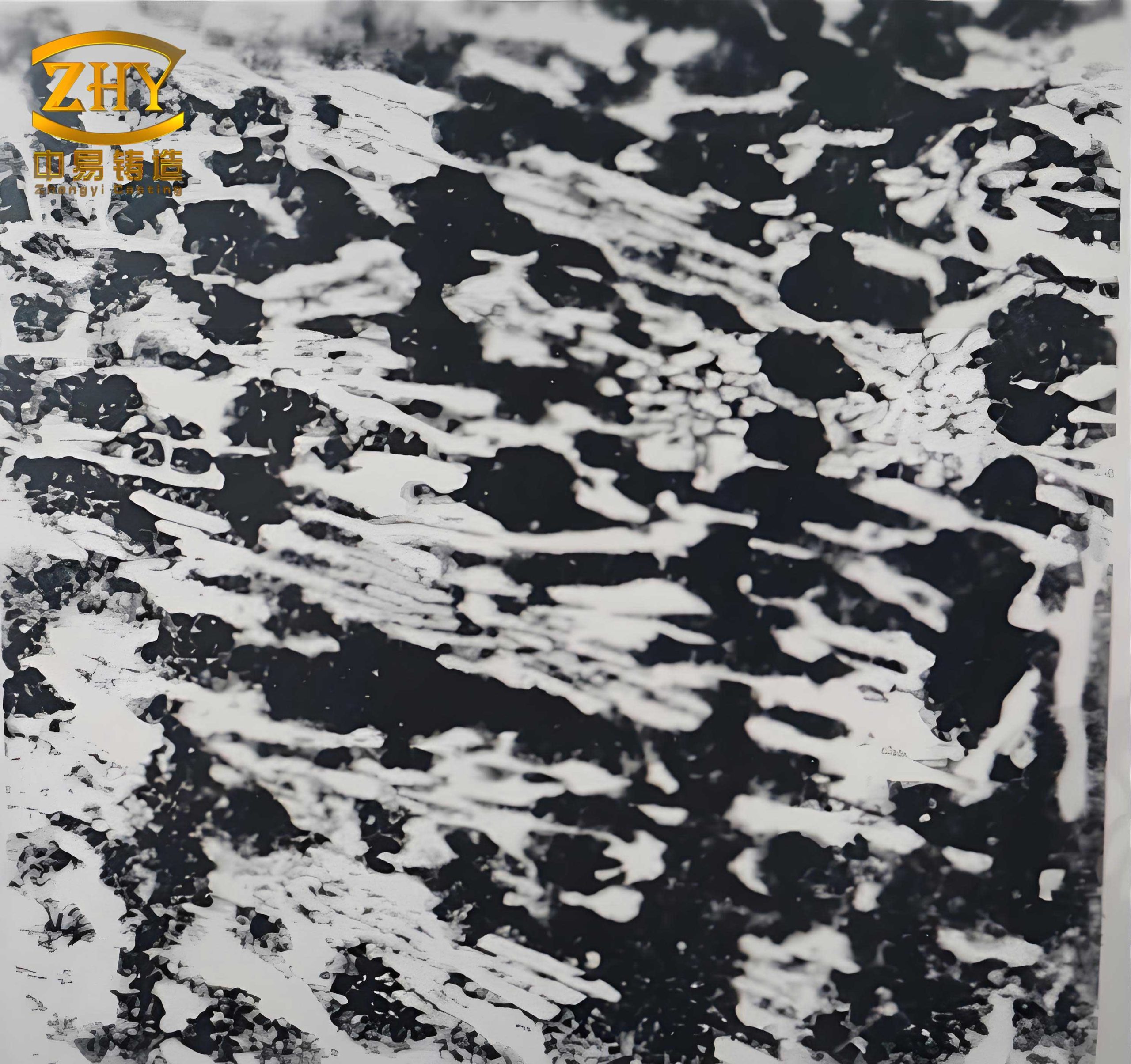
To understand the transition region formed during composite casting, electron probe microanalysis was conducted. The results, summarized in Table 3, indicate mutual diffusion and melting of alloy elements, creating a transition zone with composition intermediate between white cast iron and steel. This zone, approximately 10–50 μm wide, provides essential thermodynamic conditions for bonding. The microstructure of the bonding area in double-pour castings shows a gradual transition from steel to white cast iron, with no abrupt changes. Crystal structure analysis reveals that the transition zone contains phases present in both materials—such as ferrite and carbides—without new phases. For instance, ferrite with orientations like [110] and [111] coexists with carbides from the white cast iron layer, confirming that bonding occurs via epitaxial growth on existing crystal fronts.
| Distance from White Iron Layer (μm) | C (%) | Si (%) | Mn (%) | Cr (%) | Fe (%) | Remarks |
|---|---|---|---|---|---|---|
| 0 (Transition Zone) | 1.2–1.8 | 0.4–0.8 | 0.6–1.0 | 5–10 | Balance | As-cast |
| 10–20 (Steel Side) | 0.5–0.7 | 0.2–0.4 | 0.5–0.8 | 0–2 | Balance | As-cast |
| 20–30 (White Iron Side) | 2.5–3.0 | 0.6–1.0 | 0.8–1.2 | 15–20 | Balance | As-cast |
The crystallization of the transition metal initiates when the mold temperature drops sufficiently. Primary dendrites form and grow, with their morphology dependent on composition, solidification temperature, and cooling conditions. For double-pour casting, the transition metal has a carbon content higher than steel but lower than white cast iron, resulting in a melting point between them. Due to thermal dynamics and the chilling effect of the steel layer, crystallization in the transition zone precedes that of the white cast iron. Nucleation occurs at the existing crystal interface or impurities, followed by dendritic growth. As dendrites advance, concentration undercooling promotes branching, forming a network that tightly connects to the steel matrix. Subsequently, white cast iron solidifies, using the transition zone as a substrate, completing its crystallization process. Thus, the transition zone acts as a bridge, organically linking the two materials.
Bonding Strength and Mechanical Properties
Systematic testing was performed to evaluate the mechanical properties of bimetal composites. Tensile strength, shear strength, torsional strength, microhardness, and impact toughness were measured, with selected results in Tables 4 and 5. The bonding strength falls between that of the two parent materials, exceeding white cast iron alone. Notably, impact toughness improves by 2–3 times compared to single white cast iron, highlighting the composite’s balance of wear resistance and toughness. Fracture analysis indicates failures often occur in the white cast iron layer or steel, confirming strong interfacial bonding. Heat treatment is essential for these composites: insert-cast parts typically undergo quenching, while double-pour parts are normalized to optimize their properties.
| Sample ID | Tensile Strength (MPa) | Torsional Strength (MPa) | Shear Strength (MPa) | Remarks |
|---|---|---|---|---|
| Bimetal-1 | 450–500 | 380–420 | 280–320 | Fracture in white cast iron |
| Bimetal-2 | 480–520 | 400–440 | 300–340 | Fracture in white cast iron |
| Bimetal-3 | 500–550 | 420–460 | 320–360 | Fracture in steel layer |
| Material Type | Impact Toughness \( a_k \) (J/cm²) | Remarks |
|---|---|---|
| Single High-Cr White Cast Iron | 8–12 | Standard test |
| Bimetal Composite (White Iron Side) | 15–25 | Steel layer thickness 20–30 mm |
| Bimetal Composite (Steel Side) | 40–60 | Steel layer thickness 20–30 mm |
Field Trials and Comparative Validation
Composite castings were tested in multiple industrial settings to verify reliability and lifespan. Results for hammer heads, plate hammers, and ball mill liners are summarized in Tables 6, 7, and 8. In all cases, bimetal parts showed no fracture, breakage, or delamination, meeting safety and durability requirements. Service life increased significantly—often threefold or more—compared to high-manganese steel counterparts. For example, composite hammer heads in cement plants lasted over 2000 hours, crushing more material with lower cost per ton. These trials demonstrate that white cast iron-based composites perform reliably under high-impact, severe abrasive conditions.
| Material | Site | Component Type | Initial Weight (kg) | Final Weight (kg) | Service Life (h) | Improvement Factor | Crushing Rate (t/h) | Cost per Ton (USD) | Performance |
|---|---|---|---|---|---|---|---|---|---|
| Bimetal Composite | Cement Plant A | Hammer Head | 50–60 | 30–40 | 2000–2500 | 3.0–3.5 | 80–100 | 5–8 | No fracture |
| High-Mn Steel | Cement Plant A | Hammer Head | 50–60 | 20–30 | 600–800 | 1.0 | 70–90 | 10–15 | Occasional breakage |
| Material | Site | Component Type | Initial Weight (kg) | Final Weight (kg) | Service Life (days) | Improvement Factor | Crushing Rate (t/day) | Cost per Ton (USD) | Performance |
|---|---|---|---|---|---|---|---|---|---|
| Bimetal Composite | Cement Plant B | Plate Hammer | 100–120 | 60–80 | 90–120 | 2.5–3.0 | 500–600 | 6–9 | Stable |
| High-Mn Steel | Cement Plant B | Plate Hammer | 100–120 | 40–60 | 30–40 | 1.0 | 400–500 | 12–18 | Wear-prone |
| Material | Site | Component Type | Operation Time (h) | Cement Output (t) | Improvement Factor | Performance |
|---|---|---|---|---|---|---|
| Bimetal Composite | Cement Plant C | Ball Mill Liner | 8000–10000 | 50000–60000 | 3.0–4.0 | Minimal wear, in use |
| High-Mn Steel | Cement Plant C | Ball Mill Liner | 2000–3000 | 15000–20000 | 1.0 | Worn out, replaced |
Conclusions
The bimetal composite casting of high-chromium white cast iron and 45# cast steel yields components with a distinct transition zone of 10–50 μm width, where composition and microstructure are intermediate between the two materials. Crystal structure analysis confirms no new phases; instead, existing phases like ferrite and carbides interconnect via epitaxial growth. This transition zone serves as a bridge, enabling tight bonding. The composites retain the inherent properties of both white cast iron and steel, offering a synergistic combination of wear resistance and toughness. Mechanical tests show bonding strength and impact toughness are intermediate between the parent materials, with toughness notably higher than white cast iron alone. Key process parameters vary by component, but essential conditions include a clean interface and maintained液态 state after pouring. The protective agent effectively prevents oxidation, ensuring process success. Heat treatment is mandatory: quenching for insert-cast parts and normalizing for double-pour parts to maximize performance. Field trials prove that white cast iron-based composites are safe, reliable, and durable in demanding abrasive environments, with service life increases exceeding threefold over high-manganese steel. The process is simple, economically beneficial, and socially valuable, saving steel and boosting equipment efficiency. Future work could explore other white cast iron grades or steel combinations to broaden applications.
The success of this research underscores the potential of bimetal composites in wear-resistant industries. By leveraging white cast iron’s hardness and steel’s韧性, we can design parts that outperform traditional materials. Further optimization of parameters like pouring temperature and cooling rates could enhance bonding. Mathematical modeling of solidification, using equations like the Fourier heat transfer law, might refine process control. For instance, the temperature gradient \( G \) and growth rate \( R \) influence microstructure, as described by:
$$ \lambda = k \cdot G^{-1/2} \cdot R^{-1/4} $$
where \( \lambda \) is dendrite arm spacing and \( k \) is a constant. Such insights can help tailor the transition zone properties. In summary, white cast iron remains a cornerstone material for abrasion resistance, and its integration with steel via composite casting opens new avenues for durable component manufacturing.