
In my extensive work with ductile iron casting, I have come to understand that the selection of raw materials and precise control of chemical composition are paramount. The journey towards producing high-integrity ductile iron casting involves navigating the complex interplay of major elements, nodulizing agents, alloying elements, and, most critically, trace elements. Over the decades, the permissible limits for harmful trace elements have consistently decreased, reflecting an industry-wide push for higher purity and performance. This article, drawn from my observations and analysis, delves into the intricate world of trace element control, the indispensable role of rare earths, and the transformative impact of high-purity base irons. My goal is to provide a comprehensive guide that underscores why meticulous raw material selection is the bedrock of superior ductile iron casting.
The foundation of any ductile iron casting process lies in its melt chemistry. Elements are typically categorized into four groups: major elements (Fe, C, Si, Mn, P, S), nodulizing elements (Mg and rare earths like Ce), alloying elements (Cu, Mo, Ni), and trace elements. It is this last group—those inadvertently introduced through charge materials—that often poses the greatest challenge to consistent quality in ductile iron casting. Even in minute quantities, these traces can profoundly destabilize graphite morphology and degrade the matrix structure.
Historical research established that elements like Ti, Pb, Sb, Bi, As, and Sn are potent interferents. They can inhibit the formation of spheroidal graphite, promoting deleterious forms like flake, vermicular, or other degenerate structures. Furthermore, some act as strong pearlite or carbide stabilizers, segregating to eutectic cell boundaries and forming intercellular carbides and inclusions. These imperfections severely compromise mechanical properties, especially impact toughness and fatigue strength—a critical concern for safety-critical ductile iron casting components in applications such as high-speed trains, wind turbines, and nuclear transport containers.
To quantify the aggregate detrimental effect of these elements, the anti-nodulizing factor, K1, was developed. This formula remains a vital tool for assessing the propensity of a base iron melt to form well-shaped nodules in ductile iron casting.
$$K1 = 4.4(\%Ti) + 2.0(\%As) + 2.3(\%Sn) + 5.0(\%Sb) + 290(\%Pb) + 370(\%Bi) + 1.6(\%Al)$$
As the coefficients indicate, lead and bismuth exert the most potent anti-nodulizing effects. A K1 value below 1.0 is generally considered safe for producing ductile iron casting with a high nodule count and spherical shape. Conversely, a value exceeding 1.0 signals a high risk of degenerate graphite, necessitating corrective measures.
Parallel to graphite control, the matrix structure must be managed. The pearlite influence factor, Px, helps predict the tendency towards pearlite and carbide formation in ductile iron casting.
$$Px = 3.0(\%Mn) – 2.65(\%Si-2.0) + 7.75(\%Cu) + 90(\%Sn) + 357(\%Pb) + 333(\%Bi) + 20.1(\%As) + 9.60(\%Cr) + 71.7(\%Sb)$$
A lower Px value signifies a cleaner, more ferritic-prone iron. For ductile iron casting requiring high elongation and low-temperature impact resistance, maintaining a low Px is essential. I have often observed that controlling these factors—K1 and Px—is the first step towards engineering a predictable and high-performance ductile iron casting.
The historical trend is clear: tolerance limits for trace elements have tightened dramatically. The following table synthesizes recommended maximum limits from various industrial and research sources over the years, highlighting this progression for ductile iron casting production.
| Element | Typical Maximum Limit (wt.%) circa 1970s | Typical Maximum Limit (wt.%) circa 2000s | Critical Function in Ductile Iron Casting |
|---|---|---|---|
| Lead (Pb) | 0.0050 | 0.001 – 0.002 | Powerful anti-nodulizer, pearlite promoter |
| Bismuth (Bi) | 0.002 | 0.0005 – 0.002 | Powerful anti-nodulizer, pearlite promoter |
| Antimony (Sb) | 0.02 – 0.03 | 0.002 – 0.004 | Anti-nodulizer, strong pearlite promoter |
| Titanium (Ti) | 0.05 – 0.10 | 0.02 – 0.04 | Anti-nodulizer, carbide promoter |
| Tin (Sn) | 0.05 | 0.01 – 0.02 | Pearlite promoter, minor anti-nodulizer |
| Arsenic (As) | 0.05 | 0.005 – 0.01 | Anti-nodulizer, pearlite promoter |
| Aluminum (Al) | 0.05 | 0.01 – 0.03 | Can be anti-nodulizing at higher levels |
| Chromium (Cr) | 0.10 | 0.05 – 0.10 | Carbide stabilizer |
| Boron (B) | 0.005 | 0.001 – 0.002 | Potent carbide former |
For most foundries, achieving a K1 value consistently below 1.0 using conventional charge materials (scrap steel, returns, standard pig iron) is challenging. This is where rare earth elements (REE), primarily cerium and lanthanum, become indispensable in ductile iron casting production. Their primary function is to neutralize the harmful effects of trace interferents. Rare earths react with elements like Pb, Bi, Sb, and As to form stable, high-melting-point intermetallic compounds. This sequesters the interferents, preventing their segregation to the solidification front and their subsequent disruption of graphite growth.
The required amount of rare earth is not fixed; it depends on the total load of interferents, often approximated by the K1 factor. From practice, I’ve noted that a cerium addition of approximately 0.005% to 0.02% is often sufficient to neutralize moderate levels of tramp elements in standard ductile iron casting. The ratio of rare earth to interferents is crucial. An excess of rare earth, while sometimes beneficial for nodule count and roundness, carries significant risks. Rare earths themselves are strong carbide promoters. Over-addition can lead to the formation of rare-earth-containing inclusions and carbides, increasing shrinkage propensity and potentially fostering another defect—chunky graphite—in heavy-section ductile iron casting.
Therefore, a delicate balance must be struck. The modern trend in ductile iron casting is towards leaner rare earth additions in nodulizing alloys, driven by both cost and the desire to avoid these side effects. This makes the initial purity of the base iron even more critical.
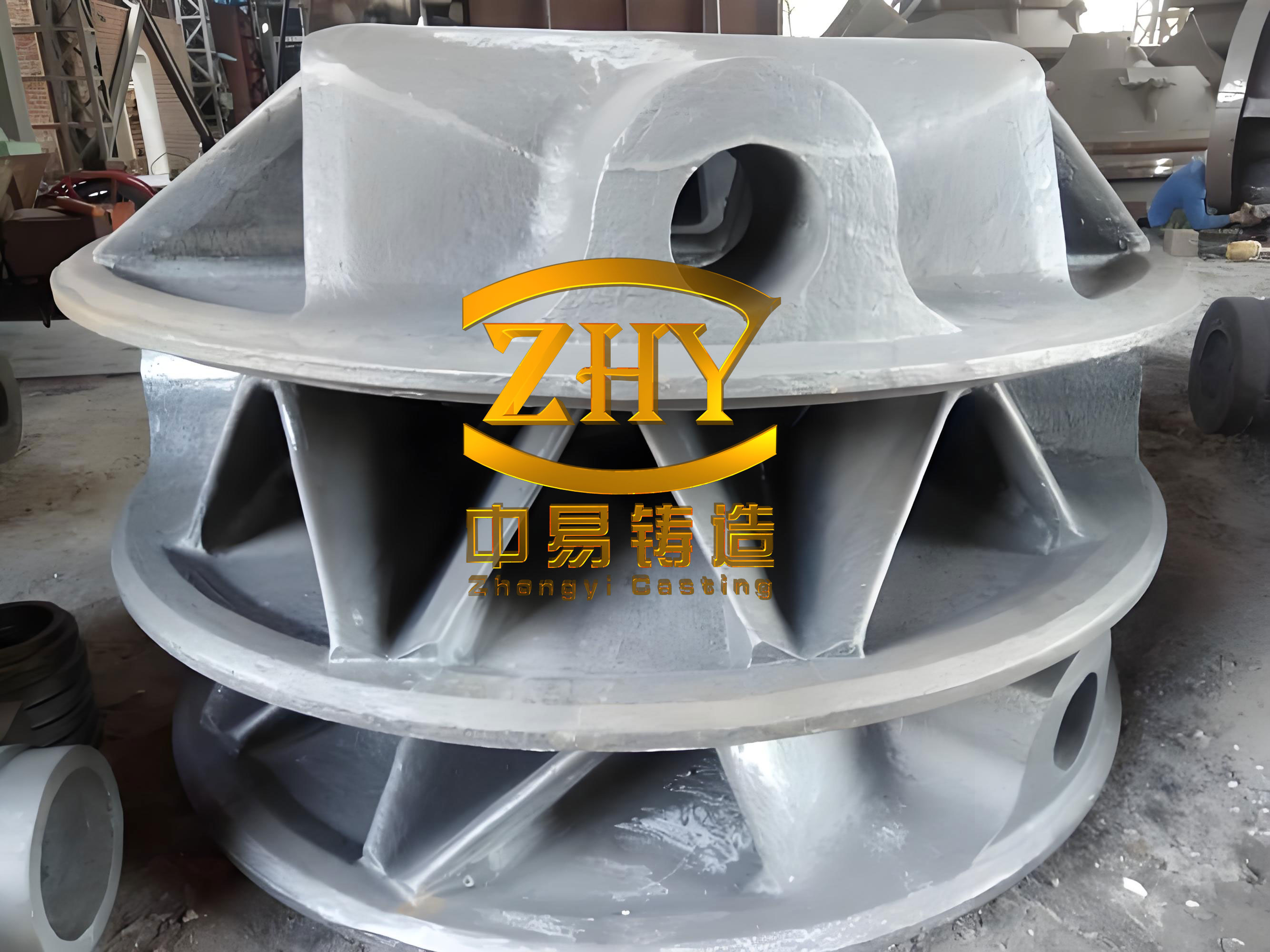
The most significant advancement in my work has been the adoption of high-purity and ultra-high-purity pig irons. These materials are specifically processed to have extremely low levels of the harmful trace elements discussed. Their use directly and dramatically lowers the K1 and Px factors of the base melt, creating a fundamentally cleaner starting point for ductile iron casting.
Let’s define these grades quantitatively. A high-purity pig iron for premium ductile iron casting typically guarantees a sum of 12 critical trace elements (Cr, V, Mo, Sn, Sb, Pb, Bi, Te, As, B, Al, Ti) to be less than 0.05%. An ultra-high-purity grade pushes this sum to below 0.025%. The benefits are profound and multi-faceted.
Firstly, with a naturally low K1 (often below 0.5), the dependency on rare earths for neutralization is reduced or eliminated. This allows for the use of low-rare-earth or even rare-earth-free nodulizing alloys, simplifying process control and reducing the risk of carbide-related defects. Secondly, the low Px factor inherently promotes a ferritic matrix, making it far easier to achieve high-ductility grades like QT400-18 or QT450-10 in the as-cast condition, even in moderately thick sections. This is vital for energy-efficient production of ductile iron casting.
Thirdly, and perhaps most importantly for demanding applications, the superior cleanliness translates directly to enhanced dynamic properties. I have conducted and reviewed studies where ductile iron casting produced from high-purity base iron exhibited remarkably consistent and high low-temperature impact values. The relationship between impact toughness and composition can be expressed through a quality index (QI) or the sum of pearlite-stabilizing elements:
$$\text{Sum of Pearlite Elements} = \%Cu + \%Mn + \%P + \%Mo + \%Cr + \%Sn + \%Sb + \%Ti$$
Empirical data consistently shows a strong inverse linear correlation between this sum (or the Px factor) and the Charpy impact energy at temperatures like -40°C or -60°C. For a ductile iron casting to reliably exceed 12 J at -40°C, the sum of pearlite elements should ideally be below 0.25, and the Px factor below 1.0. High-purity base irons make these targets achievable in industrial production.
A particularly persistent problem in heavy-section ductile iron casting (sections > 50 mm) is the formation of chunky graphite. This degenerate form appears as isolated, ragged chunks under a light microscope but is revealed as a interconnected, coral-like network upon deep etching. Chunky graphite can reduce tensile strength by 25% and elongation by over 80%, rendering a casting unfit for service.
Its formation is associated with slow cooling, certain levels of carbon and silicon, and often, an imbalance in rare earth content. While small additions of elements like bismuth or antimony, balanced with rare earths, are sometimes used to increase nucleation and suppress chunky graphite, this approach risks promoting pearlite and introduces more trace elements into the melt.
Here, ultra-high-purity base iron offers a more fundamental solution. By providing a melt with an exceptionally low initial content of all interfering elements (K1 << 1), it removes one of the key destabilizing factors for graphite growth during the prolonged solidification of a heavy-section ductile iron casting. In trials I have overseen, heavy blocks (up to 1000 mm in diameter) poured from 100% ultra-high-purity base iron and treated with minimal rare earths consistently showed well-formed spheroidal graphite at the center, with no chunky graphite, even with solidification times exceeding 10 hours. This is a breakthrough for producing sound, heavy-section ductile iron casting for applications like mill rolls, press frames, or large wind turbine hubs.
The advantages of using high-purity raw materials extend across the entire spectrum of ductile iron casting production. Consider the production of safety-critical components for transportation. One manufacturer, by switching to a charge based on high-purity pig iron, successfully produces axle boxes for high-speed trains. The resulting ductile iron casting exhibits a remarkably clean microstructure: nodule counts above 90%, fully ferritic matrix free from intercellular carbides and inclusions, and consistent mechanical properties surpassing QT400-18AL specifications, with impact values at -40°C routinely between 14-16 J. The low and stable K1 and Px factors achieved through raw material purity are directly responsible for this performance and reliability.
Similarly, for complex, thin-and-thick walled castings like pump bodies or valve housings, the use of high-purity iron ensures uniform microstructure and properties throughout, minimizing the risk of isolated spots of degenerate graphite or carbides in the heavier sections. This uniformity is critical for the pressure integrity and fatigue life of such ductile iron casting.
The economic argument is also compelling. While high-purity pig irons may have a higher upfront cost per ton, the overall cost of production for a high-quality ductile iron casting can be lower. This stems from several factors: reduced nodulizer and inoculant consumption, higher yield due to lower shrinkage porosity, fewer defective castings, reduced need for annealing heat treatments (for ferritic grades), and eliminated costs associated with salvage welding or scrap. The consistency brought by pure charge materials streamlines the entire foundry process, making the production of ductile iron casting more predictable and efficient.
Looking forward, the trajectory for ductile iron casting is towards even higher performance and more demanding applications. This will necessitate even tighter control over metallurgical quality. The role of trace elements, particularly their synergistic effects, requires deeper study. Furthermore, the interaction between ultra-high-purity melts, next-generation inoculants, and novel processing techniques (like controlled pouring or cooling) presents a rich field for research. The goal is to push the boundaries of what is possible with ductile iron casting, perhaps developing grades with tensile strengths exceeding 1000 MPa while maintaining high toughness, or grades capable of operating reliably in extreme cryogenic or high-temperature environments.
In conclusion, the journey to producing superior ductile iron casting is fundamentally a journey towards greater melt purity. The control of trace elements through rigorous raw material selection, embodied in the management of factors like K1 and Px, is non-negotiable. While rare earth elements remain a valuable tool for mitigating impurities, their role is optimized when the starting point is already clean. The advent of high-purity and ultra-high-purity base irons represents a paradigm shift, enabling foundries to produce ductile iron casting with microstructural perfection and mechanical properties that far exceed conventional standards. From thin-walled, high-integrity components to massive, heavy-section castings free from chunky graphite, the strategic use of pure raw materials is the key to unlocking the full potential of ductile iron casting. As we continue to innovate, this focus on purity will undoubtedly remain the cornerstone of quality and reliability in the ductile iron casting industry.