
In the field of metal casting, the production of thick and large gray iron castings presents significant challenges due to inherent material properties and complex geometries. Gray iron casting, characterized by its graphite flake structure, offers excellent machinability and damping capacity but is prone to defects such as shrinkage porosity and slag inclusions, especially in heavy sections. This article details a comprehensive study on optimizing the casting process for a spiral series of gray iron castings, focusing on mitigating these defects through innovative gating system design, chill and riser optimization, and stringent process controls. The insights gained are applicable to a wide range of gray iron casting applications, emphasizing the importance of tailored solutions for high-integrity components.
The spiral series components under investigation are representative of small-batch, multi-variant production typical in industrial machinery. These gray iron castings vary in weight from 500 kg to 2000 kg, with wall thicknesses ranging from 20 mm to 100 mm, exhibiting non-uniform distribution and complex thermal hotspots. The structural configuration, akin to a helical form, necessitates precise control over solidification and feeding to ensure defect-free outcomes after machining. Key requirements include adherence to non-destructive testing standards like UT (Ultrasonic Testing) and MT (Magnetic Particle Testing), with zero visible defects post-processing. The inherent challenges in gray iron casting, such as pronounced shrinkage tendency due to the graphitization expansion and susceptibility to slag formation from oxide inclusions, underscore the need for a robust工艺 framework.
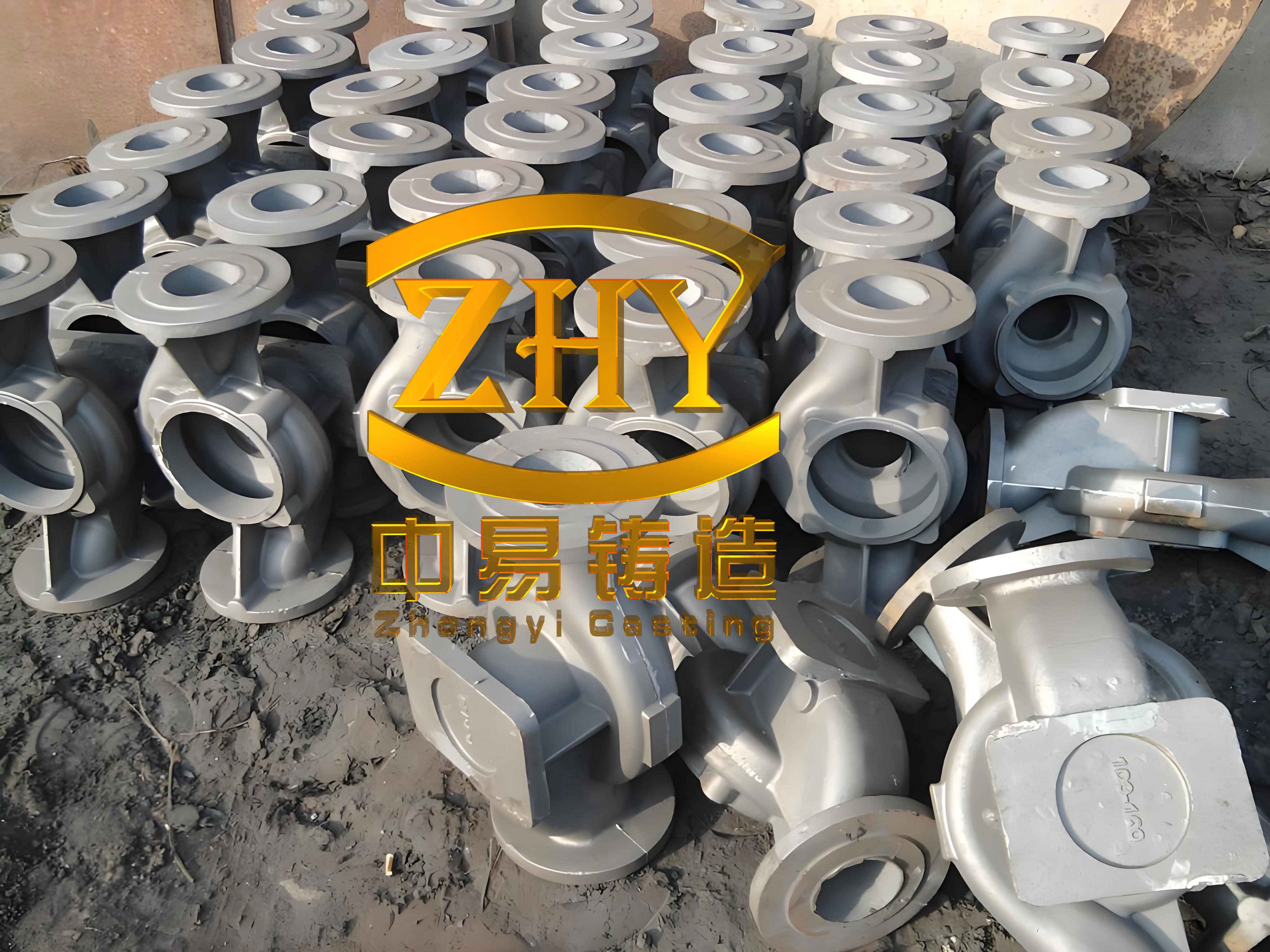
To address these issues, an experimental方案 was devised, centered on a bottom-gating system complemented by strategic placement of chills and risers. This approach aims to promote directional solidification, enhance feeding efficiency, and minimize turbulence-induced defects in gray iron casting. The trials involved multiple batches of castings, with process parameters meticulously recorded and analyzed. The following sections elaborate on the methodology, results, and analytical insights, incorporating tables and formulas to summarize key aspects of gray iron casting technology.
The initial phase involved a detailed analysis of the casting geometry to identify critical regions prone to shrinkage and slag entrapment. For gray iron casting, the solidification behavior is governed by the cooling rate and graphite precipitation, which can be modeled using thermal dynamics principles. The solidification time \( t_s \) for a gray iron casting can be approximated by Chvorinov’s rule:
$$ t_s = k \left( \frac{V}{A} \right)^2 $$
where \( t_s \) is the solidification time, \( V \) is the volume of the casting, \( A \) is the surface area, and \( k \) is a mold constant specific to gray iron casting conditions. In thick sections, this time increases, elevating the risk of shrinkage porosity. To counteract this, chills were employed to accelerate cooling in hotspots, while risers provided supplemental feed metal. The effectiveness of such measures depends on precise calculation of chill dimensions and riser sizes, often derived from empirical data for gray iron casting.
A summary of the defect types and corresponding countermeasures in gray iron casting is presented in Table 1. This table highlights the interconnected nature of process variables and defect manifestation, underscoring the holistic approach required for quality assurance in gray iron casting.
| Defect Type | Primary Causes | Mitigation Strategies | Relevance to Gray Iron Casting |
|---|---|---|---|
| Shrinkage Porosity | Inadequate feeding, high thermal gradients | Use of chills, optimized riser design, controlled pouring temperature | High due to graphitization expansion and slow solidification in thick sections |
| Slag Inclusions | Oxide formation, turbulence during pouring, mold sand erosion | Bottom-gating systems, filters, ladle slag control, mold cleanliness | Significant as gray iron is prone to oxidation; inclusions impair mechanical properties |
| Cold Shuts | Low fluidity, improper gating | Increased pouring temperature, improved gating design | Moderate; gray iron has good fluidity but requires careful design |
| Graphite Flotation | Slow cooling in heavy sections | Enhanced cooling via chills, alloy modification | Unique to gray iron casting due to graphite precipitation behavior |
The experimental setup utilized a consistent gating system across all casting variants to streamline operations and reduce costs. For gray iron casting, the gating ratio was designed as 1:2:4 (sprue:runner:ingate) to ensure laminar flow and minimize air entrainment. The pouring temperature was maintained at \( 1320 \pm 10^\circ \text{C} \), a relatively low range to reduce shrinkage and gas dissolution in gray iron casting. The mathematical modeling of fluid flow in the gating system can be expressed using Bernoulli’s equation, adapted for molten gray iron:
$$ \frac{P_1}{\rho g} + \frac{v_1^2}{2g} + z_1 = \frac{P_2}{\rho g} + \frac{v_2^2}{2g} + z_2 + h_f $$
where \( P \) is pressure, \( \rho \) is density of gray iron, \( v \) is velocity, \( z \) is elevation, \( g \) is gravitational acceleration, and \( h_f \) represents head losses. This principle guided the design of the bottom-gating system to maintain steady filling and reduce slag formation in gray iron casting.
Optimization of mold design was another critical aspect. Given the small-batch nature, wooden patterns were employed to lower模具 costs, with modular components allowing flexibility across different spiral sizes. The mold assembly process emphasized cleanliness to prevent sand inclusions, a common issue in gray iron casting. Additionally, ceramic filters and sprues were integrated into the gating system to trap impurities, enhancing the purity of the gray iron melt entering the cavity.
The placement of chills and risers was systematically analyzed using solidification simulation software. For gray iron casting, the shrinkage compensation volume \( V_{sh} \) can be estimated as a percentage of the thermal contraction during solidification, typically ranging from 2% to 4% for gray iron. The required riser volume \( V_r \) is thus:
$$ V_r = V_{sh} \times \frac{1}{\eta} $$
where \( \eta \) is the feeding efficiency, often around 0.15 for gray iron casting with insulating risers. Chills, made of iron or copper, were positioned at thermal junctions to modify the cooling rate, effectively reducing the local solidification time. The chill effectiveness factor \( C_{eff} \) can be derived from:
$$ C_{eff} = \frac{k_{chill} \cdot A_{chill}}{k_{mold} \cdot A_{mold}} $$
where \( k_{chill} \) and \( k_{mold} \) are thermal conductivities, and \( A \) denotes contact areas. This factor influences the extent of shrinkage reduction in gray iron casting.
Table 2 summarizes the key process parameters and their optimized values for the spiral gray iron castings. This data provides a reference for similar applications in gray iron casting, highlighting the interplay between design and process variables.
| Parameter | Value/Range | Impact on Gray Iron Casting Quality |
|---|---|---|
| Pouring Temperature | 1320 ± 10°C | Reduces shrinkage and gas defects; balances fluidity for gray iron |
| Gating System Ratio | Sprue:Runner:Ingate = 1:2:4 | Ensures calm filling, minimizes turbulence and slag in gray iron casting |
| Riser Size (Diameter × Height) | ø200 mm × 200 mm (main), ø100 mm × 100 mm (auxiliary) | Provides adequate feed metal for shrinkage compensation in gray iron |
| Chill Material and Thickness | Iron, 20-40 mm thick | Accelerates cooling in hotspots, refines microstructure in gray iron casting |
| Mold Material | Furan sand with appropriate additives | Ensures good collapsibility and surface finish for gray iron castings |
| Pouring Time | 30-60 seconds depending on weight | Prevents premature solidification and cold shuts in gray iron casting |
The experimental results from multiple production batches demonstrated significant improvements. Non-destructive testing revealed that over 95% of the gray iron castings met the stringent UT and MT criteria, with shrinkage porosity levels below 1% as predicted by simulation. The slag inclusion rate was reduced by more than 80% compared to initial trials, attributing to the combined effect of bottom-gating, filtration, and rigorous mold cleaning. Microstructural analysis of the gray iron casting samples showed uniform graphite flake distribution and pearlitic matrix, indicating effective cooling control.
Further analysis involved statistical evaluation of defect occurrence relative to process variables. For gray iron casting, the relationship between pouring temperature and shrinkage can be modeled using a regression equation. Based on collected data, the shrinkage volume \( S_v \) (in cm³) for a given gray iron casting section can be expressed as:
$$ S_v = \alpha \cdot T_p^2 + \beta \cdot T_p + \gamma $$
where \( T_p \) is the pouring temperature in °C, and \( \alpha, \beta, \gamma \) are coefficients derived from experimental data specific to gray iron casting conditions. This quadratic relationship underscores the non-linear impact of temperature on shrinkage in gray iron casting, with optimal ranges minimizing defects.
The economic aspects were also considered. By standardizing the gating system and employing modular patterns,模具 costs were reduced by approximately 50%, and造型 time per gray iron casting decreased by 30%. This efficiency gain is crucial for small-batch production of gray iron castings, making the process viable for diverse industrial applications. The use of代用砂箱 and adjustable pattern components further enhanced flexibility, allowing the same setup to accommodate varying sizes of gray iron castings with minimal adjustments.
In terms of metallurgical control, maintaining melt quality was paramount. For gray iron casting, the carbon equivalent (CE) plays a vital role in defining fluidity and shrinkage behavior. The CE is calculated as:
$$ \text{CE} = \%C + 0.33(\%Si) + 0.33(\%P) – 0.027(\%Mn) $$
where the percentages represent the composition of the gray iron. In this study, the CE was kept between 4.0 and 4.3 to ensure good castability while minimizing shrinkage. Additionally, inoculants were used to promote fine graphite formation, enhancing the mechanical properties of the gray iron casting.
The solidification simulation results, as illustrated in the porosity distribution plots, confirmed the efficacy of the optimized design. The simulated shrinkage percentage averaged 1.2% for the worst-case sections, aligning with practical observations. This validation through software tools is instrumental in refining gray iron casting processes without costly physical trials.
To encapsulate the findings, a comprehensive framework for gray iron casting optimization is proposed, integrating design, process, and quality control elements. The success of this approach hinges on understanding the unique behavior of gray iron during solidification, particularly its response to chills and risers. Future work could explore advanced alloys or real-time monitoring systems to further enhance the reliability of gray iron casting for critical components.
In conclusion, the study substantiates that a well-orchestrated combination of bottom-gating, strategic chilling, and riser placement can effectively address shrinkage and slag defects in thick and large gray iron castings. The methodologies outlined here not only improve product quality but also offer cost-effective solutions for small-batch production. As industries continue to demand high-performance gray iron casting, such工艺 innovations will be pivotal in meeting technical and economic challenges. The repeated emphasis on gray iron casting throughout this article underscores its significance in modern manufacturing, where material properties and process precision converge to produce durable, defect-free components.