
In the realm of precision machine tool manufacturing, cast iron parts serve as the backbone for structural components and key assemblies. These cast iron parts, such as bed frames, worktables, crossbeams, columns, and slides, are primarily fabricated from gray cast iron grades like HT250 and HT300, or ductile cast iron grades like QT450, QT500, and QT600. The performance of these cast iron parts directly influences the machining accuracy, stability, and longevity of high-end machine tools. My research and production applications have centered on addressing deformation and cracking issues in cast iron parts by optimizing casting processes, melting techniques, and aging treatments. The goal is to achieve cast iron parts with high strength, high stiffness, and low residual stress, thereby enhancing the reliability and precision retention of machine tools. This article summarizes key findings from studies on structural design, material composition, and heat treatment, emphasizing the importance of high carbon equivalent and composite alloying in producing superior cast iron parts.
The failure of cast iron parts in machine tools often stems from excessive residual stress, poor structural design, or inadequate material properties. Through case studies, I have identified common issues: cracking due to non-uniform wall thickness and lack of fillet transitions in large HT300 columns; stress-induced cracks in HT300 crossbeams from inappropriate composition choices; thermal stress cracks in large HT300 ring castings from insufficient cooling control; and multiple cracks in HT250 worktables from rapid cooling during aging. These examples highlight the need for comprehensive process control in producing robust cast iron parts. To mitigate such failures, I have focused on two critical aspects: structural stiffness and material stiffness. Structural stiffness involves optimizing design elements like uniform wall transitions, rounded corners, and reinforcement ribs, while material stiffness relies on achieving high tensile strength, hardness, and elastic modulus through tailored metallurgical approaches.
Structural rationality is paramount for ensuring the stability of cast iron parts. In one instance, a large HT300 base casting measuring 16 m × 1.9 m with a mass of 68 tons was analyzed using casting simulation software. The initial design showed high residual tensile stress at junction points, with a Mises coefficient exceeding 0.8, indicating a high risk of cracking. By optimizing the rib structure—adding transverse reinforcements without increasing weight—the Mises coefficient was reduced to below 0.5, significantly lowering crack probability. This demonstrates how simulation-driven design refinements can enhance the integrity of cast iron parts. The relationship between stress and geometry can be expressed using formulas like the Mises yield criterion, which for cast iron parts under multiaxial stress is given by: $$\sigma_{v} = \sqrt{\frac{1}{2}[(\sigma_1 – \sigma_2)^2 + (\sigma_2 – \sigma_3)^2 + (\sigma_3 – \sigma_1)^2]}$$ where $\sigma_v$ is the equivalent stress, and $\sigma_1, \sigma_2, \sigma_3$ are principal stresses. Optimizing cast iron parts to keep $\sigma_v$ below the material’s yield strength is crucial for preventing failure.
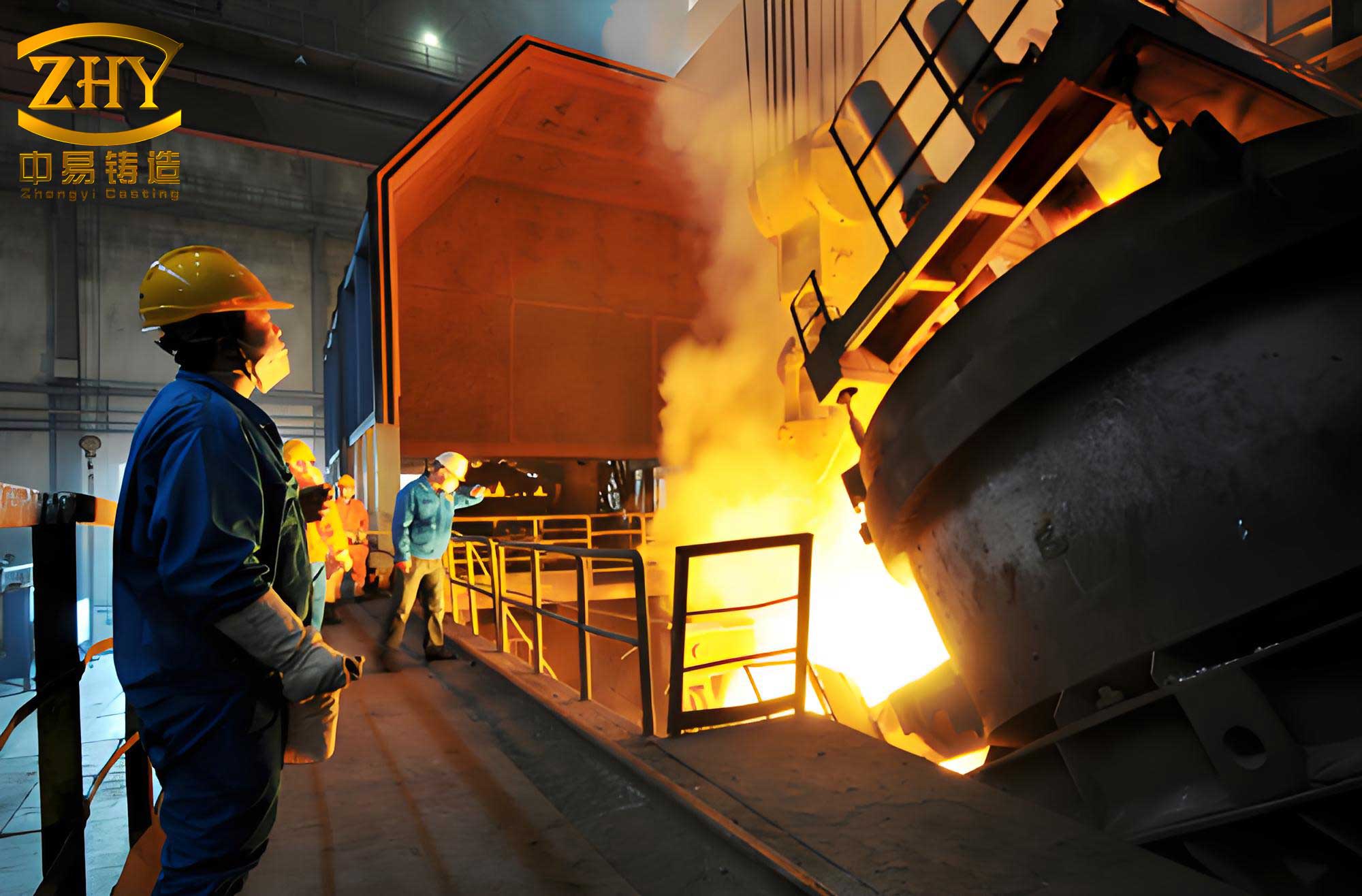
The production of high-strength low-stress cast iron parts hinges on advanced melting practices. My investigations into gray and ductile cast iron compositions reveal that a high carbon equivalent (CE) is foundational for low stress. For gray cast iron, CE is calculated as: $$CE = C + \frac{Si}{3} + \frac{P}{3}$$ where C, Si, and P are weight percentages. By adopting a synthetic cast iron process with 50–60% scrap steel and high-temperature graphitizing carburizers, I achieved more consistent microstructures. Overheating the iron melt to 1500–1550°C for 5–10 minutes enhances purity, while multi-stage inoculation (ladle, stream, and pouring) improves nucleation. The table below summarizes the effect of composition on gray cast iron properties for cast iron parts, based on production data from 2018–2020.
| Year | Tensile Strength (MPa) | Hardness (HBW) | C (%) | Si (%) | CE (%) | Si/C Ratio |
|---|---|---|---|---|---|---|
| 2018 | 383 (avg) | 234 (avg) | 3.04 (avg) | 1.56 (avg) | 3.55 (avg) | 0.49 (avg) |
| 2019 | 376 (avg) | 235 (avg) | 3.01 (avg) | 1.58 (avg) | 3.57 (avg) | 0.50 (avg) |
| 2020 | 354 (avg) | 232 (avg) | 3.05 (avg) | 1.55 (avg) | 3.58 (avg) | 0.52 (avg) |
To further enhance material stiffness, I explored high-carbon-equivalent approaches with composite alloying. For gray cast iron parts, increasing CE to 3.60–3.80% and adding elements like Cu, Cr, and Sn promotes pearlitic structures while maintaining low stress. The Si/C ratio also plays a role; in trials with HT300 guide rails, a higher Si/C ratio (e.g., 0.72) improved tensile strength without significantly affecting hardness. The relationship can be modeled as: $$\sigma_t = k_1 \cdot (Si/C) + k_2$$ where $\sigma_t$ is tensile strength and $k_1, k_2$ are material constants. For ductile cast iron parts, pre-treatment of the melt with inoculated additives increased graphite nodule counts from 75–107 nodules/mm² to 75–135 nodules/mm², refining microstructure and boosting elastic modulus. The elastic modulus $E$ for cast iron parts is critical for stiffness and can be expressed in terms of stress and strain: $$E = \frac{\sigma}{\epsilon}$$ where $\sigma$ is stress and $\epsilon$ is strain. The table below compares elastic modulus values for different cast iron parts under various alloying conditions.
| Material Type | Alloy Additions | Average Elastic Modulus (GPa) | Range (GPa) |
|---|---|---|---|
| Gray Cast Iron (HT300) | None | 124.9 | 93–164 |
| Gray Cast Iron (HT300) | Cu, Cr, Sn | 124.1 | 117–142 |
| Ductile Cast Iron (QT600-3) | None | 158.2 | 139–182 |
| Ductile Cast Iron (QT600-3) | Cu, Sb | 164.5 | 144–178 |
| Ductile Cast Iron (QT600-3) | Cu, Sn | 170.0 | 160–190 |
The impact of alloying on the elastic modulus of ductile cast iron parts is significant. As shown in the table above, adding Cu and Sn to QT600-3 consistently yields elastic moduli above 160 GPa, meeting international standards. The strengthening mechanism can be described by solid solution and precipitation hardening models, such as: $$\Delta \sigma = k \cdot \sqrt{c}$$ where $\Delta \sigma$ is the increase in yield strength due to alloying, $k$ is a constant, and $c$ is the concentration of alloying elements. For cast iron parts, this translates to improved load-bearing capacity and reduced deformation under stress.
Aging treatments are essential for reducing residual stress in cast iron parts. I evaluated natural aging, thermal aging, and vibration aging methods. Thermal aging, which involves heating cast iron parts to 500–600°C, holding, and slow cooling, reduces stress by 50–70% but requires careful control to avoid distortion. Vibration aging, applying cyclic stress to induce microplasticity, offers 30–50% stress relief with minimal energy use. Natural aging, though simple, only achieves 20% reduction over months or years. For optimal results, I recommend combining thermal and vibration aging for cast iron parts, which can achieve up to 78% stress reduction. The kinetics of stress relief during thermal aging can be modeled using an Arrhenius-type equation: $$\frac{d\sigma}{dt} = -A \cdot \exp\left(-\frac{Q}{RT}\right) \cdot \sigma^n$$ where $\sigma$ is residual stress, $t$ is time, $A$ is a pre-exponential factor, $Q$ is activation energy, $R$ is the gas constant, $T$ is temperature, and $n$ is a constant. This highlights the importance of temperature and time management for cast iron parts.
Residual stress measurements on cast iron parts before and after process optimizations reveal significant improvements. Initially, HT300 bed frames in as-cast state showed maximum residual stresses of 175 MPa, which dropped to 79.7 MPa after thermal aging but remained uneven. By adopting high-carbon-equivalent compositions and composite alloying, I produced cast iron parts with predominantly compressive residual stresses and low tensile values. The table below presents residual stress data from five different cast iron parts (worktables and bed frames) after optimized processing, demonstrating the effectiveness of the approach.
| Cast Iron Part | Measurement Point | Principal Stress σ1 (MPa) | Principal Stress σ2 (MPa) | Von Mises Stress (MPa) |
|---|---|---|---|---|
| Worktable 01 | 1 | -26.0 | -74.1 | 37.9 |
| Worktable 01 | 2 | -23.7 | -50.8 | 45.5 |
| Worktable 02 | 1 | -33.3 | -51.1 | 46.9 |
| Bed Frame 01 | 1 | -152.7 | -234.4 | 214.1 |
| Bed Frame 02 | 1 | 112.5 | 19.0 | 95.3 |
| Bed Frame 03 | 1 | 25.7 | -82.8 | 64.0 |
The data indicate that most residual stresses are compressive, which is beneficial for cast iron parts as it counteracts tensile loads in service. The elastic modulus of these optimized cast iron parts was also assessed, with HT300 parts showing values above 110 GPa and QT600-3 parts exceeding 160 GPa. This aligns with international benchmarks for high-performance cast iron parts. The relationship between elastic modulus and residual stress can be complex, but generally, a higher elastic modulus correlates with better dimensional stability in cast iron parts.
In summary, producing high-strength low-stress cast iron parts requires an integrated approach. Simulation-based design optimization minimizes stress concentrations in cast iron parts. Melting processes that emphasize high carbon equivalent and composite alloying, such as adding Cu, Cr, Sn, or Sb, enhance both strength and elastic modulus. For gray cast iron parts, a CE of 3.60–3.80% with a Si/C ratio around 0.6–0.7 yields optimal properties. For ductile cast iron parts, pre-treatment and alloying ensure fine graphite nodules and high stiffness. Aging treatments, particularly combined thermal and vibration methods, effectively reduce residual stress in cast iron parts. Future work could explore advanced alloys or real-time monitoring during casting to further refine the performance of cast iron parts. The continuous improvement of these processes will enable the manufacturing of cast iron parts that meet the escalating demands of precision machinery, ensuring longevity and accuracy in challenging applications.
To further illustrate the material behavior, consider the general constitutive equation for cast iron parts under stress: $$\epsilon = \frac{\sigma}{E} + \alpha \Delta T + \epsilon_p$$ where $\epsilon$ is total strain, $\sigma$ is stress, $E$ is elastic modulus, $\alpha$ is thermal expansion coefficient, $\Delta T$ is temperature change, and $\epsilon_p$ is plastic strain. This equation underscores the multifactorial nature of deformation in cast iron parts, highlighting why low residual stress and high stiffness are critical. By mastering these parameters, I have successfully produced cast iron parts that resist deformation and cracking, contributing to the advancement of machine tool technology. The journey toward perfecting cast iron parts is ongoing, but with the strategies outlined here, significant strides have been made in achieving reliable, high-performance components for industrial applications.