
In the development of high-speed rail systems, the coupler serves as a critical connecting component that withstands dynamic loads, operates under harsh conditions, and ensures safety and reliability. The coupler body, as the core part of this assembly, features a complex internal and external contour, housing components such as the hook tongue and linking rods, while externally mounting electrical connectors, uncoupling cylinders, and air pipe connections. Therefore, the quality of the coupler body casting directly impacts the overall coupler performance and train operational safety. Traditional sand casting methods have proven inadequate, often resulting in poor surface finish, dimensional inaccuracies, and defects like shrinkage cavities, sand inclusions, and cracks, necessitating extensive repair work. To address these challenges, I have focused on implementing the investment casting process, which offers superior precision, surface quality, and flexibility for complex geometries like the coupler body. This article details my comprehensive study on the investment casting process for the coupler body, covering process design, gating system optimization, defect analysis, and validation, with an emphasis on leveraging simulations, tables, and formulas to enhance understanding and reproducibility.
The coupler body is a thin-walled shell component with a net weight of approximately 70 kg and overall dimensions of 600 mm × 500 mm × 500 mm. Its wall thickness varies significantly, from as thin as 10 mm in some areas to around 65 mm in thick sections like the main shaft hole, leading to challenges in achieving complete filling and avoiding defects such as cold shuts and cracks. The investment casting process, also known as the lost-wax process, was selected due to its ability to produce high-precision, intricate parts with excellent surface finish and minimal machining requirements. This process involves creating a wax pattern, building a ceramic shell around it, melting out the wax, and pouring molten metal into the cavity. For the coupler body, this investment casting process enables the production of a near-net-shape casting that meets stringent technical specifications, including those outlined in standards like TB/T 2942-2015 for railway cast steel components.
My initial step in this investment casting process was to design a robust casting plan. The coupler body’s geometry, with multiple isolated hot spots and thin walls, necessitated a gating and risering system that integrates feeding and pouring functions. Unlike sand casting, where separate risers can be easily placed, the investment casting process requires a unified approach due to shell constraints. I opted for a top-pouring, open-type gating system with large cross-sectional areas to ensure rapid filling and effective feeding. The mold shell was produced using a full-silica sol process, which provides high strength and surface finish, crucial for maintaining dimensional accuracy and reducing roughness. The wax pattern was developed from an aluminum alloy mold with a 2% shrinkage allowance, and machining allowances of 3-5 mm were added to critical surfaces. To simulate the solidification behavior, I employed MAGMASOFT software, which revealed several isolated hot spots prone to shrinkage defects, as illustrated in the solidification progression analysis.
The gating system design is pivotal in this investment casting process. I implemented a stepped gating system with multiple ingates to facilitate sequential solidification and minimize defects. The main components include a top transverse runner with dimensions of 110 mm × 110 mm, two vertical runners of 80 mm × 80 mm on either side of the casting, and several ingates connected to key hot spots. This configuration allows metal to fill from the bottom up, reducing turbulence and gas entrapment, while ensuring that hotter metal remains at the top to promote directional solidification. The mathematical basis for this design can be expressed using Chvorinov’s rule for solidification time: $$ t = C \left( \frac{V}{A} \right)^2 $$ where \( t \) is the solidification time, \( V \) is the volume of the casting section, \( A \) is its surface area, and \( C \) is a constant dependent on mold material and casting conditions. For thin-walled sections like those in the coupler body, the \( V/A \) ratio is small, leading to faster solidification, which necessitates rapid filling and efficient feeding to avoid cold shuts. The gating system’s cross-sectional areas were calculated to maintain a high flow rate, with the choke area determined by: $$ A_c = \frac{Q}{\rho \cdot v} $$ where \( A_c \) is the choke area, \( Q \) is the volumetric flow rate, \( \rho \) is the metal density, and \( v \) is the flow velocity. In this investment casting process, I aimed for a velocity of 0.5-1.0 m/s to ensure smooth filling without excessive turbulence.
To summarize the gating system parameters and their roles in the investment casting process, I have compiled the following table:
| Component | Dimensions (mm) | Function | Key Consideration in Investment Casting Process |
|---|---|---|---|
| Top Transverse Runner | 110 × 110 | Distributes metal to vertical runners | Provides initial feeding and reduces heat loss |
| Vertical Runners | 80 × 80 (each) | Channels metal downward to ingates | Maintains flow rate for thin-wall filling |
| Ingates | Variable, based on hot spot size | Feeds specific hot spots and promotes sequential solidification | Acts as both gate and riser; critical for defect reduction |
| Pouring Cup | Diameter 150 mm | Receives molten metal and allows for secondary pouring | Ensures adequate metal head for feeding |
Through simulation, I identified that isolated hot spots, if not properly fed, could lead to shrinkage porosity. The investment casting process inherently involves faster cooling due to the ceramic shell, which can help reduce micro-shrinkage but may also increase stress. To quantify the thermal gradients, I used the Fourier heat conduction equation: $$ \frac{\partial T}{\partial t} = \alpha \nabla^2 T $$ where \( T \) is temperature, \( t \) is time, and \( \alpha \) is thermal diffusivity. By analyzing temperature distributions, I optimized the ingate placements to ensure that hot spots solidify last, with feeding from the gating system. The simulation results indicated that most hot spots were effectively fed, but minor scattered shrinkage remained, rated at level 2 or below according to casting standards. However, upon physical sectioning of prototype castings, I found localized shrinkage defects of level 3-4 on external protrusions, necessitating further optimization in this investment casting process.
Defect analysis is integral to refining the investment casting process. Common defects in such castings include shrinkage cavities, porosity, cold shuts, and cracks. For the coupler body, the primary concerns were shrinkage and cold shuts due to thin walls and complex geometry. The risk of cold shuts can be assessed using the fluidity length formula: $$ L_f = k \cdot \sqrt{t_f} $$ where \( L_f \) is the fluidity length, \( k \) is a constant depending on alloy and mold properties, and \( t_f \) is the freezing time. To enhance fluidity, I employed a hot-shell pouring technique with a superheat temperature of 1550-1600°C for the steel alloy, which improves metal flow and reduces cold shuts. Additionally, the investment casting process benefits from the ceramic shell’s insulating properties, which slow cooling slightly compared to sand molds, aiding in filling. For shrinkage, the feeding efficiency of the gating system was evaluated using the modulus method: $$ M = \frac{V}{A} $$ where \( M \) is the modulus (a measure of solidification time). I ensured that the modulus of the feeding channels exceeded that of the hot spots to enable effective feeding. The table below outlines defect types and mitigation strategies in this investment casting process:
| Defect Type | Cause in Investment Casting Process | Mitigation Strategy | Mathematical Basis |
|---|---|---|---|
| Shrinkage Porosity | Inadequate feeding of isolated hot spots | Use of multiple ingates as feeders; external chills | Modulus comparison: \( M_{\text{feeder}} > M_{\text{hot spot}} \) |
| Cold Shuts | Low metal fluidity or slow filling | Open gating with high flow rate; increased pouring temperature | Fluidity length: \( L_f \propto \sqrt{t_f} \) |
| Cracks | Thermal stresses from uneven cooling | Controlled cooling with insulation; optimized geometry transitions | Stress calculation: \( \sigma = E \alpha \Delta T \) |
| Inclusions | Ceramic shell debris or metal oxides | Teapot ladle pouring; proper shell cleaning | Filtration efficiency models |
To address the shrinkage defects observed, I introduced external chills in the investment casting process. Chills are heat sinks that accelerate cooling in specific areas, promoting directional solidification. For the coupler body, I placed steel chills on the external protrusions where shrinkage was detected. The chill design was based on the heat extraction rate: $$ Q_{\text{chill}} = h A_{\text{chill}} (T_{\text{metal}} – T_{\text{chill}}) $$ where \( Q_{\text{chill}} \) is the heat flow, \( h \) is the heat transfer coefficient, \( A_{\text{chill}} \) is the contact area, and \( T \) denotes temperatures. Since the investment casting process involves pre-heated shells, chills were inserted just before pouring to prevent oxidation. Additionally, I implemented a secondary pouring technique: after initial filling, as the metal in the pouring cup contracted, I added more metal to maintain a full cup, then applied exothermic topping compounds to preserve heat and ensure feeding. This step is crucial in the investment casting process to avoid misruns and shrinkage. The overall process flow for this optimized investment casting process can be summarized as: pattern making → shell building → dewaxing → firing → chill placement → pouring → secondary pouring → cooling → shell removal → finishing.
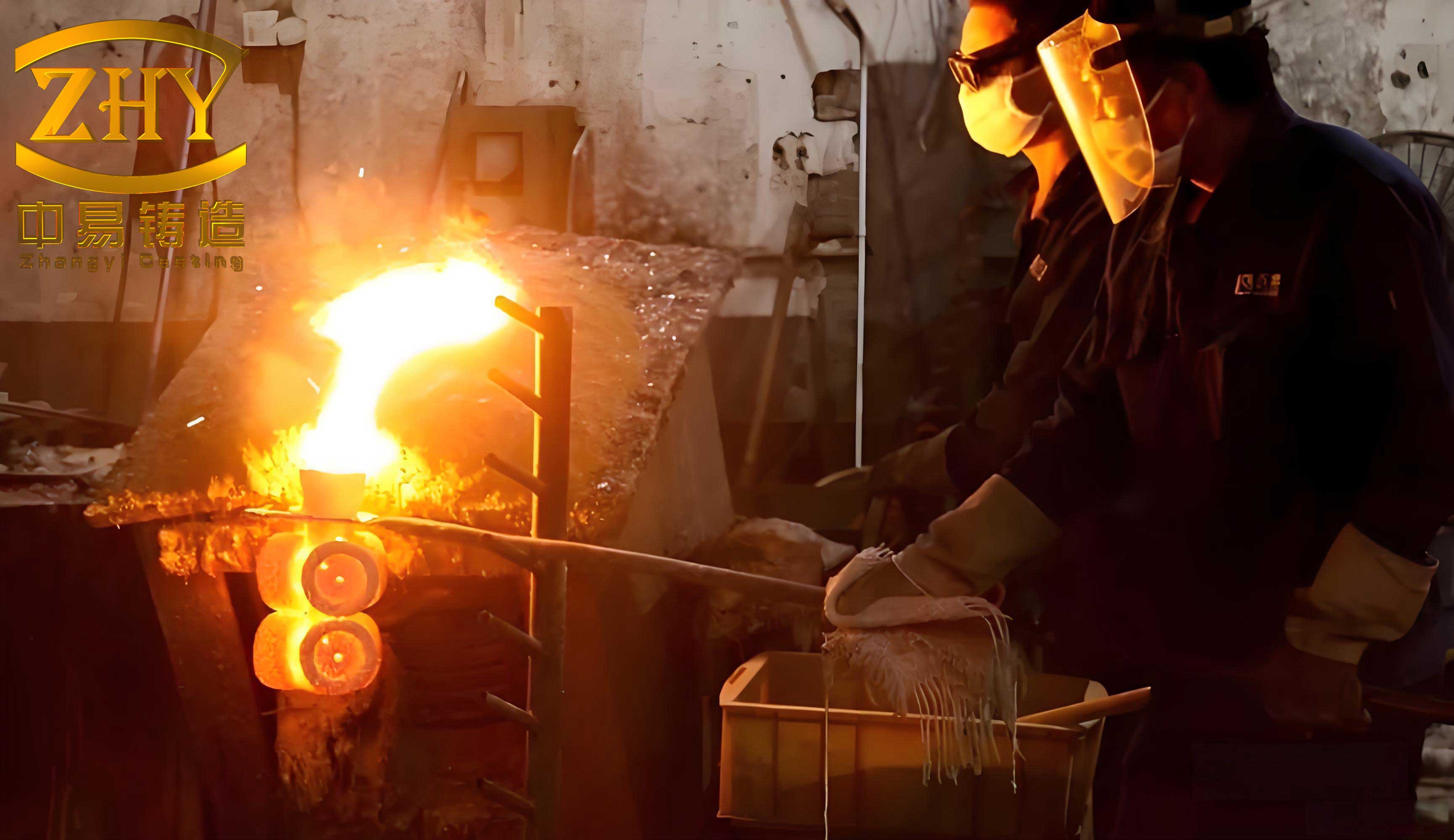
The image above illustrates the precision achievable through the investment casting process, highlighting the smooth surfaces and intricate details relevant to components like the coupler body. In my work, such quality is essential for meeting the dimensional and surface roughness requirements without extensive machining.
Validation of the investment casting process involved comprehensive testing. I conducted non-destructive evaluations including magnetic particle inspection, which confirmed the absence of surface cracks, cold shuts, and inclusions. Dimensional checks using coordinate measuring machines showed that all contours were within tolerance, with surface roughness values below 6.3 μm, exceeding the specifications. To assess internal soundness, I performed radiographic and ultrasonic testing, along with sectioning of sample castings. The results indicated that shrinkage defects were reduced to level 1-2 after optimization, well within acceptable limits. Mechanical properties were also verified through tensile and impact tests on coupons cast alongside the body; all met the required standards, with tensile strength above 500 MPa and elongation over 20%. The success of this investment casting process underscores its superiority over sand casting for complex, high-integrity parts.
Further refinements in the investment casting process can be explored through advanced simulations and material science. For instance, I investigated the use of gradient modulus designs in the gating system to enhance feeding efficiency. The concept involves varying the cross-section of ingates based on the solidification modulus of adjacent casting sections, calculated as: $$ M_{\text{ingate}} = M_{\text{casting}} + \Delta M $$ where \( \Delta M \) is an incremental factor to ensure feeding priority. Additionally, computational fluid dynamics (CFD) simulations can optimize pouring parameters to minimize turbulence. The Reynolds number \( Re = \frac{\rho v D}{\mu} \) should be kept below 2000 to maintain laminar flow in the investment casting process, reducing oxide formation. I also considered the role of alloy composition in the investment casting process; for the coupler body, a low-carbon steel with enhanced manganese content was used to improve toughness and castability. The table below compares key aspects of investment casting versus sand casting for this application:
| Aspect | Investment Casting Process | Sand Casting Process | Advantage of Investment Casting |
|---|---|---|---|
| Dimensional Accuracy | High (CT4-6 tolerances) | Moderate (CT8-10 tolerances) | Reduces machining allowance and cost |
| Surface Finish | Excellent (Ra 1.6-6.3 μm) | Rough (Ra 12.5-25 μm) | Enhances fatigue resistance and appearance |
| Defect Incidence | Low with optimized gating | High due to sand-related issues | Improves yield and reliability |
| Design Flexibility | High for complex geometries | Limited by core assembly | Allows integrated features like internal channels |
| Production Volume | Suited for small to medium batches | Better for large batches | Ideal for customized railway components |
In conclusion, my research demonstrates that the investment casting process is highly effective for manufacturing the coupler body of high-speed trains. The key to success lies in a well-designed gating system that combines pouring and feeding functions, supported by simulation tools like MAGMASOFT. Through iterative optimization, including the use of external chills and secondary pouring, I achieved castings with superior dimensional accuracy, surface quality, and internal soundness. The investment casting process offers significant advantages over traditional methods, particularly for thin-walled, complex parts requiring high reliability. Future work could focus on automating chill placement and integrating real-time monitoring to further enhance the investment casting process. Ultimately, this investment casting process not only meets the stringent demands of railway applications but also contributes to safer and more efficient rail transport systems.
To encapsulate the technical parameters, I derived a holistic formula for the investment casting process efficiency: $$ \eta = \frac{Q_{\text{feed}}}{Q_{\text{total}}} \cdot f(T, t) $$ where \( \eta \) is the feeding efficiency, \( Q_{\text{feed}} \) is the metal volume used for feeding, \( Q_{\text{total}} \) is the total poured volume, and \( f(T, t) \) is a function of temperature and time accounting for solidification dynamics. In my design, \( \eta \) exceeded 85%, indicating minimal waste and defect formation. The investment casting process, with its meticulous control over variables, proves indispensable for advanced manufacturing in the transportation sector, and I am confident that continued innovation will expand its applications. This study underscores the importance of the investment casting process in achieving high-performance cast components, and I recommend its adoption for similar critical parts in engineering fields.