
In the production of medium-horsepower tractor gray iron castings using the lost foam casting process, our team encountered a persistent quality issue with a specific component: the gearbox housing, designated MF704.37101. This part is a high-volume production item, making consistent quality and yield paramount. The initial process design for this lost foam casting resulted in an unacceptably high scrap rate due to the frequent occurrence of cold lap defects on a prominent, large-diameter boss feature of the casting. This article details the first-person investigation, analysis, and resolution of this problem through systematic process engineering, leveraging both theoretical understanding of the lost foam casting process and modern simulation tools.
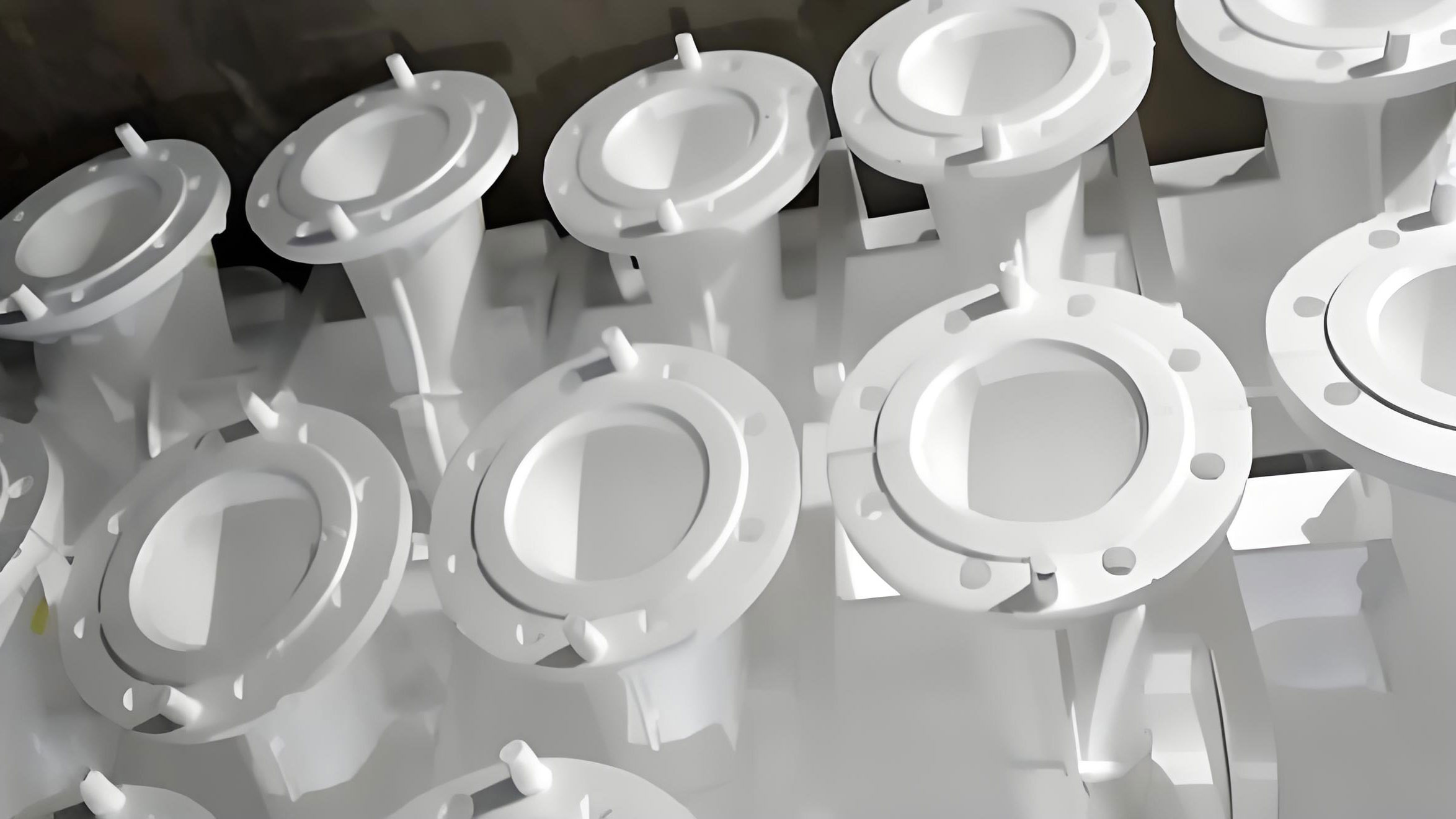
The core principle of lost foam casting involves creating a foam pattern, clustering it with its gating system, coating it with a refractory slurry, and embedding it in unbonded sand under vibration. Molten metal is then poured, displacing and decomposing the foam to form the casting. The success of this process hinges on controlling the thermal dynamics of metal filling and solidification. For the gearbox housing in question, the initial gating strategy proved inadequate. The part, with a weight of 87 kg, was cast in HT250 gray iron, requiring a hardness between 180-230 HBW. Its wall thickness was a uniform 8 mm, with maximum overall dimensions of 615 mm (L) x 500 mm (W) x 480 mm (H). The standard production setup involved placing two foam pattern clusters in a flask measuring 1200 mm x 1000 mm x 1300 mm.
The original lost foam casting process for the MF704.37101 housing is summarized in the table below:
| Parameter | Original Design Specification |
|---|---|
| Casting Material | HT250 Gray Iron |
| Cluster Configuration per Flask | 2 patterns |
| Total Pour Weight (per flask) | 205 kg (including gating) |
| Pouring Temperature | 1490 – 1510 °C |
| Gating Design | Top-gated, sprue at 35° angle |
| Ingate Location | Upper-middle section of the casting |
| Ingate Dimensions & Quantity | 3 ingates, 50 mm x 8 mm each |
| Vacuum Pressure | -0.06 to -0.04 MPa |
In this configuration, the sprue was angled at 35°, causing the entire pattern cluster to tilt within the flask. This meant the large-diameter boss feature was oriented upwards. During pouring, metal would enter from the ingates located on the upper-middle body, flow downward to fill the lower sections of the mold cavity, and then rise upward to fill the topmost regions, culminating at the elevated boss. The inherent heat loss in the lost foam casting process, exacerbated by the thin 8 mm sections, was the root cause of the defect. The early-arriving metal at the mold front suffered significant temperature drop as it traveled the long path to the boss. By the time this cooler metal met the last metal to fill the area, it lacked sufficient superheat and fluidity to fuse properly, resulting in a cold lap or misrun. This can be conceptualized by considering the heat loss of the metal front. The temperature drop $\Delta T$ of the flowing metal can be approximated by considering convection and heat transfer into the sand and decomposing foam:
$$ \frac{dT}{dt} = -\frac{h A_s (T – T_m)}{\rho V c_p} $$
where $h$ is the effective heat transfer coefficient (high in lost foam casting due to foam decomposition), $A_s$ is the surface area of the metal front, $T$ is the metal temperature, $T_m$ is a characteristic mold/foam interface temperature, $\rho$ is metal density, $V$ is volume, and $c_p$ is specific heat. In the original design, the metal front reaching the boss had a long residence time ($t$), leading to a large cumulative $\Delta T$ and a high risk of cold shut formation. The critical condition for avoiding a cold lap can be expressed as the need for the metal temperature at the meeting point $T_{meet}$ to remain above a critical coalescence temperature $T_{crit}$:
$$ T_{meet} = T_{pour} – \Delta T_{travel} > T_{crit} $$
In our initial process, $T_{meet}$ at the boss fell below $T_{crit}$.
To confirm this theoretical analysis, we employed MAGMA softare to simulate the filling sequence. The simulation visually confirmed the problematic flow path: the last area to fill was indeed the elevated boss, with the metal arriving there being the coolest. The simulation solidified (pun intended) our hypothesis that the ingate location was the primary controllable factor leading to the defect in this lost foam casting.
The logical solution was to redesign the gating system to ensure that hotter metal was delivered to, or was present during the filling of, the problematic boss area. The goal was to alter the thermal gradient during filling. The improved lost foam casting process design made a critical change: it repositioned the ingates to directly feed the large boss feature. The new design, as simulated and later implemented, is detailed below:
| Parameter | Improved Design Specification | Rationale for Change |
|---|---|---|
| Ingate Location | Two lower ingates moved to the planar face of the boss ring; one upper ingate moved to the top of the boss ring. | To introduce hot metal directly into the defect-prone zone throughout the fill cycle. |
| Gating Function | Direct feeding & thermal compensation. | The boss becomes a primary filling zone rather than a last-fill dead-end. |
| Expected Metal Flow | Concurrent filling from the boss area and the main body. | Prevents the formation of a distinct, cool metal front at the boss. |
The MAGMA simulation for the revised lost foam casting process told a completely different story. The filling animation showed metal entering the boss cavity from the new ingates early in the pour. This continuous influx of fresh, hot metal provided a constant “thermal recharge” to that region. The temperature gradient was fundamentally altered, ensuring that any metal meeting within the boss cavity had adequate superheat to fuse seamlessly. The governing thermal equation was now favorable:
$$ T_{meet,new} = T_{pour} – \Delta T_{short} \approx T_{pour} > T_{crit} $$
Here, $\Delta T_{short}$ represents the minimal cooling from the ingate to the meeting point within the now actively fed boss, resulting in $T_{meet,new}$ being sufficiently high.
With strong simulation backing, we proceeded to production trials. The new foam pattern clusters were assembled, coated, dried, and molded according to standard lost foam casting procedures. The pouring parameters were maintained identically to the previous runs (1490-1510°C, controlled vacuum) to isolate the variable of gating design. The results were immediately apparent upon shakeout. The previously defective boss area on the MF704.37101 casting was now completely sound, free from any trace of cold lap. The visual inspection confirmed the success of the modified lost foam casting process.
To ensure overall quality was maintained, we conducted hardness tests on the production castings. The results fell perfectly within the specified range, as shown below:
| Sample | Indentation Diameter (mm) | Brinell Hardness (HBW) | Specification (HBW) | Result |
|---|---|---|---|---|
| MF704.37101-1 | 4.18 | 209 | 180 – 230 | PASS |
| MF704.37101-2 | 4.22 | 205 | ||
| MF704.37101-3 | 4.15 | 212 |
Subsequent batch production and machining by the customer validated the fix entirely. The machined surfaces of the gearbox housing were clean and defect-free, with all bore locations accurate. The component fully met all drawing specifications, and the high scrap rate associated with the cold lap defect was eliminated.
This case study underscores several critical best practices in lost foam casting engineering:
- Thermal Management is Paramount: In lost foam casting, the decomposition of foam consumes energy, accelerating metal cooling. Gating design must account for this by ensuring short, efficient flow paths to critical sections or by providing direct thermal replenishment.
- Simulation is a Powerful Diagnostic and Predictive Tool: Software like MAGMA allows for rapid visualization and analysis of filling patterns and thermal histories, reducing the time and cost associated with physical trial-and-error. It was instrumental in confirming the failure mode and validating the corrective action for this lost foam casting.
- Gating Design Dictates Thermal Gradients: The location of ingates is not merely about getting metal into the cavity; it’s about controlling the sequence and temperature of filling. A “last-to-fill” area is inherently at risk of being a “coldest-to-fill” area.
The successful resolution for the MF704.37101 gearbox housing can be generalized into a procedural formula for addressing similar cold lap issues in thin-wall lost foam castings:
1. Identify the Defect Zone (D): Map the location of cold laps.
2. Analyze Original Filling Path (Fo): Determine if D is the terminal point of a long flow path.
3. Calculate/Simulate Thermal Loss ($\Delta T_{path}$): Estimate the temperature drop to D.
4. Redesign Gating to Shorten Path or Provide Direct Feed: Modify gating geometry G to create a new flow path Fn where hot metal is introduced at or near D.
5. Verify with Simulation: Confirm that the new thermal profile ensures $T_{meet} > T_{crit}$.
6. Implement and Validate: Conduct production trials and quality checks.
In conclusion, the challenge posed by the cold lap defect on the tractor gearbox housing was a classic example of a thermally-driven failure mode in lost foam casting. Through a systematic approach combining fundamental analysis of metal flow and heat transfer with advanced solidification simulation, we identified the root cause as an unfavorable thermal gradient created by the original top-gating design. The solution—strategically relocating the ingates to directly feed the problem area—was simple in concept but profoundly effective. It transformed the boss from a thermally-starved last-fill zone into an actively-fed region, ensuring complete fusion. This optimization not only solved an immediate production bottleneck but also reinforced the critical importance of designing the lost foam casting process with a primary focus on thermal control throughout the filling stage.