
The manufacturing level of engine blocks serves as a critical indicator of a nation’s automotive industry development. Lost foam casting (LFC), recognized as a “green foundry technology,” enables near-net-shape casting with minimal post-processing while reducing environmental pollution through dry sand reuse and elimination of binders. This study explores optimized LFC processes for producing HT250 low-alloy diesel engine blocks, achieving a first-pass qualification rate exceeding 95% and a yield of 91%.
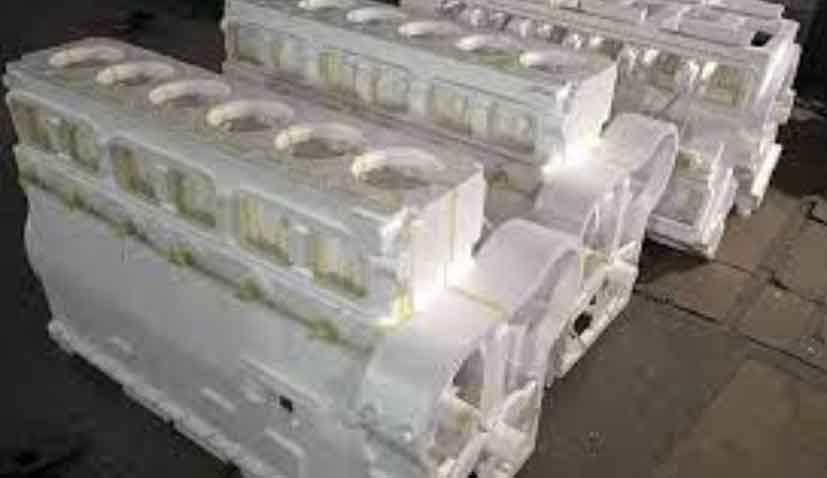
The LFC process flow follows:
$$ \text{EPS Preparation} \rightarrow \text{Pattern Assembly} \rightarrow \text{Coating} \rightarrow \text{Sand Molding} \rightarrow \text{Pouring} \rightarrow \text{Cooling} $$
1. Key Process Parameters
| Parameter | Value | Control Method |
|---|---|---|
| EPS Density | 23-24 g/L | Pre-expansion density: 20-21 g/L |
| Coating Thickness | 1.0-1.5 mm | Two-layer dipping |
| Pouring Temperature | >1480°C | Infrared pyrometer |
| Vacuum Pressure | -0.035 to -0.040 MPa | Digital pressure control |
| Cooling Time | 90 min | Thermocouple monitoring |
2. Material Composition
The HT250 alloy composition follows:
$$ \text{C: 3.1-3.3\%}, \ \text{Si: 1.6-1.8\%}, \ \text{Mn: 0.6-0.75\%} $$
$$ \text{Cu: 0.6-1.0\%}, \ \text{Cr: 0.3-0.5\%}, \ \text{P/S: <0.06\%} $$
| Element | Target (%) | Tolerance |
|---|---|---|
| C | 3.2 | ±0.1 |
| Si | 1.7 | ±0.1 |
| Mn | 0.68 | ±0.07 |
| Cu | 0.8 | ±0.2 |
| Cr | 0.4 | ±0.1 |
3. Gating System Design
The closed gating system ratio follows:
$$ F_{\text{横}}:F_{\text{内}}:F_{\text{直}} = (1.3-2):(1-1.5):1 $$
Multi-gate design ensures uniform filling:
$$ Q = \frac{\pi d^2}{4} \sqrt{2gh} \cdot n $$
Where:
\( Q \) = Total flow rate (cm³/s)
\( d \) = Gate diameter (cm)
\( h \) = Metallostatic head (cm)
\( n \) = Number of gates
4. Process Optimization
Critical improvements in lost foam casting include:
- Pattern segmentation optimization reducing glue usage by 40%
- Vacuum control algorithm minimizing gas defects
- Sand compaction formula:
$$ C = \frac{V_{\text{compact}}}{V_{\text{loose}}} = 1.25-1.35 $$
5. Quality Validation
| Parameter | Result | Standard |
|---|---|---|
| Tensile Strength | 255-265 MPa | >250 MPa |
| Hardness | 195-240 HB | 187-255 HB |
| Dimensional Accuracy | CT8-9 | CT10-11 (Sand Casting) |
| Surface Roughness | Ra 12.5-25 μm | Ra 50 μm (Conventional) |
The lost foam casting technology demonstrates superior performance in engine block production through:
- 25-30% reduction in machining allowance
- 95% sand reclamation rate
- 40% energy saving compared to traditional methods
This research confirms lost foam casting as a viable solution for high-complexity castings, particularly for diesel engine components requiring precise dimensional control and superior surface quality.