
In the field of aerospace engineering, the production of critical components such as engine shells demands the highest levels of accuracy and reliability. These parts often feature complex geometries, significant wall thickness variations, and stringent requirements for dimensional precision and metallurgical quality. My research focuses on addressing the challenges associated with manufacturing a specific shell casting using K403 high-temperature alloy through precision lost wax casting, a method renowned for its ability to produce intricate, near-net-shape components. The term precision lost wax casting encapsulates the meticulous control needed to avoid defects like cracks, porosity, and incomplete filling, which are common in alloys like K403 due to their solidification characteristics. This article delves into the comprehensive optimization of the entire process chain, from pattern making to shell building and melting-pouring, aiming to provide a robust framework for high-quality production. Throughout this discussion, I will emphasize the principles of precision lost wax casting, as it is the cornerstone of achieving defect-free castings in demanding applications.
The shell casting in question is a vital part of an aero-engine, serving as a配套 component that must withstand extreme operational conditions. Its 3D model reveals a complex structure with pillars reaching 129 mm in height, a length of 111 mm, and diameters ranging from 14 mm to 32 mm, with a wall thickness of 6.5 mm. This geometry leads to multiple hot spots and uneven cooling, making it a high-difficulty, no-allowance precision casting. The primary technical hurdles include: difficulty in pattern removal and dimensional distortion due to the intricate shape; susceptibility to shell cracking, run-out, and burrs during pouring due to structural constraints; and the propensity for defects like porosity, cracks, and cold shuts because of thermal concentration and poor filling. To tackle these, I embarked on a systematic study to refine each step of the precision lost wax casting process, leveraging both empirical data and theoretical insights.
First, let’s consider the alloy composition. K403 is a nickel-based superalloy with specific chemical ranges that influence its castability. The table below summarizes its main elements, which contribute to its high-temperature strength but also to challenges like hot tearing and microporosity during solidification. Understanding these properties is essential for optimizing the precision lost wax casting parameters.
| Element | Content |
|---|---|
| C | 0.11–0.18 |
| Cr | 10.00–12.00 |
| Co | 4.50–6.00 |
| W | 4.80–5.50 |
| Mo | 3.80–4.50 |
| Ti | 2.30–2.90 |
| Al | 5.30–5.90 |
| Ce | ≤ 0.01 |
| Fe | ≤ 2.00 |
| Si | ≤ 0.50 |
| Mn | ≤ 0.50 |
| S | ≤ 0.01 |
| P | ≤ 0.02 |
| Ni | Balance |
The solidification behavior of K403 can be modeled using thermal analysis. For instance, the rate of heat extraction from the casting affects defect formation. I employ the Fourier heat conduction equation to approximate temperature gradients:
$$ \frac{\partial T}{\partial t} = \alpha \nabla^2 T $$
where \( T \) is temperature, \( t \) is time, and \( \alpha \) is thermal diffusivity. In precision lost wax casting, controlling this gradient through shell design and pouring parameters is critical to minimize shrinkage porosity. The challenge lies in balancing rapid cooling at hot spots with sufficient fluidity for complete filling.
Moving to pattern making, this stage is foundational in precision lost wax casting. Wax patterns must replicate the final part with high fidelity, as any imperfections translate directly to the casting. Initially, we faced issues with dimensional deviations exceeding 2 mm in features like cylindrical centers, stemming from a multi-part pattern assembly method. This approach relied on manual alignment in a splicing fixture, introducing human error. To eliminate this, I redesigned the process using a monolithic pattern mold, ensuring integral wax patterns that bypass assembly-related distortions. The optimization of injection parameters is equally vital. Based on systematic trials, I established that wax temperature between 55–63°C, mold temperature of 25–35°C, injection pressure of 15–25 bar, and hold time of 15–20 s yield optimal results. These settings balance flowability and contraction, reducing defects like cold folds or sinks. The relationship between injection pressure \( P \) and wax shrinkage \( S \) can be expressed empirically:
$$ S = k_1 – k_2 \cdot P $$
where \( k_1 \) and \( k_2 \) are material constants. Higher pressure reduces shrinkage but must be capped to avoid gas entrapment or mold sticking. This refinement is a key aspect of precision lost wax casting, as it ensures dimensional accuracy from the outset.
Next, shell building plays a pivotal role in precision lost wax casting, providing the mold cavity that dictates metal solidification. The shell must possess adequate green and fired strength to withstand handling and thermal shocks. For this shell casting, I adopted a multi-layer system using silica sol and ethyl silicate binders with various refractories. A critical innovation involved local shell thinning at thick sections to enhance cooling. After applying the fourth coating, I returned the pattern to the wax room to apply soft wax pads on the upper and lower holes and soft strips around the eight ingate openings. This created thinner shell regions at hot spots, promoting faster heat dissipation. The table below details the shell-making parameters, which were fine-tuned through iterative testing.
| Layer | Slurry | Viscosity (s) | Stucco | Drying/Curing | Ammonia Dry | Ventilation |
|---|---|---|---|---|---|---|
| 1 | Silica sol-Zircon flour | 40–50 | White alumina WAF70 | ≥ 12 h air dry | – | – |
| 2 | Ethyl silicate hydrolyzate-Shangdian flour | 37–42 | Shangdian sand 36 mesh | ≥ 20 min | 10 min | ≥ 10 min |
| 3–8 | Ethyl silicate hydrolyzate-Shangdian flour | 13–15 | Shangdian sand 24 mesh | ≥ 20 min | 10 min | ≥ 10 min |
| Seal | Ethyl silicate hydrolyzate-Shangdian flour | 13–15 | – | ≥ 12 h | – | – |
The shell is subsequently preheated to 950–1000°C before pouring. This temperature selection is crucial in precision lost wax casting: too low, and metal fluidity drops, risking cold shuts; too high, and grain coarseness or porosity may increase. The preheat temperature \( T_p \) influences the initial temperature gradient \( G \) at the metal-shell interface, approximated by:
$$ G \propto \frac{T_m – T_p}{d} $$
where \( T_m \) is the metal pouring temperature and \( d \) is the shell thickness. By optimizing \( T_p \), we enhance fillability while maintaining a favorable gradient for directional solidification.
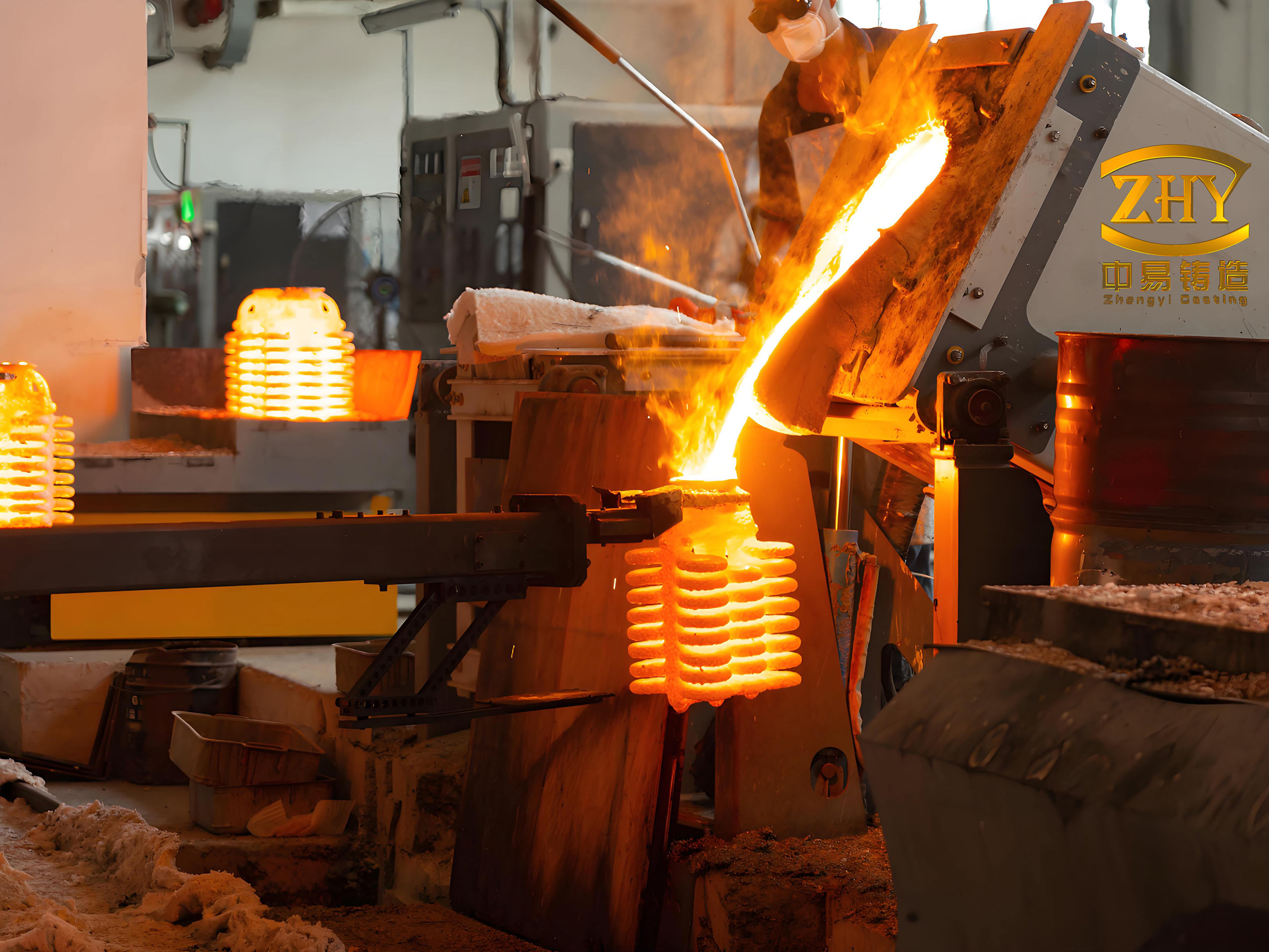
Melting and pouring constitute the final act in precision lost wax casting, where alloy transformation occurs under vacuum to prevent oxidation. The gating system must support the cluster and act as a feeder to compensate for shrinkage. I designed a system with multiple ingates to ensure uniform filling and adequate feeding pressure. Pouring parameters were rigorously tested. The table below presents the finalized settings, which balance fluidity and solidification control.
| Shell Preheat Temperature (°C) | Pouring Temperature (°C) | Pouring Speed (s/mold) |
|---|---|---|
| 950–1000 | 1430 ± 10 | 2–3 |
The pouring temperature is set approximately 50–100°C above the liquidus of K403, which is around 1380°C, to ensure sufficient superheat. The pouring speed is maximized within practical limits to boost dynamic pressure and reduce temperature stratification. The fluidity length \( L_f \) can be estimated using a simplified model:
$$ L_f = v \cdot t_f + \frac{1}{2} a \cdot t_f^2 $$
where \( v \) is initial velocity, \( a \) is deceleration due to viscosity and cooling, and \( t_f \) is filling time. Faster pouring increases \( v \), extending \( L_f \) and improving completeness. However, turbulence must be avoided to prevent slag entrainment. This delicate balance is at the heart of precision lost wax casting success.
To validate the optimized precision lost wax casting process, I conducted a production trial with 40 castings. After implementing the monolithic pattern mold, local shell thinning, and refined pouring parameters, the results were striking. A total of 35 castings met all quality standards, yielding a qualification rate of 87.5%. Dimensional inspections showed deviations within tolerance, and metallurgical examinations revealed significant reductions in porosity and cold shuts. This demonstrates that the holistic approach to precision lost wax casting can overcome the inherent challenges of complex shell components. The improvement is not merely incremental; it represents a paradigm shift in how we address thermal management and dimensional stability in investment casting.
Furthermore, I explored additional mathematical formulations to deepen the understanding. For instance, the Niyama criterion, often used to predict shrinkage porosity, can be adapted for precision lost wax casting. It relates the temperature gradient \( G \), cooling rate \( R \), and a critical value \( C \):
$$ \frac{G}{\sqrt{R}} \geq C $$
By ensuring that local conditions satisfy this inequality through shell thinning and controlled pouring, we can mitigate porosity. Similarly, stress analysis during solidification helps prevent cracks. The thermal stress \( \sigma \) can be expressed as:
$$ \sigma = E \cdot \alpha_T \cdot \Delta T $$
where \( E \) is Young’s modulus, \( \alpha_T \) is the coefficient of thermal expansion, and \( \Delta T \) is the temperature difference. Optimizing cooling uniformity reduces \( \Delta T \), lowering stress concentrations. These theoretical underpinnings reinforce the empirical adjustments made in the precision lost wax casting process.
In conclusion, my research underscores the effectiveness of a systematic methodology in precision lost wax casting for challenging alloys like K403. Key takeaways include: the adoption of monolithic pattern molds to eradicate assembly-induced dimensional errors; the strategic use of local shell thinning to accelerate cooling at hot spots; and the careful calibration of pouring temperatures and speeds to enhance fillability while controlling solidification. Each of these elements contributes to what we term precision lost wax casting—a process that marries empirical refinement with scientific principle. The success rate of 87.5% in trial production validates this approach, paving the way for scalable manufacturing of similar components. Future work could integrate computational simulation to predict defect formation more accurately, but the current findings already offer a robust blueprint for engineers seeking to master precision lost wax casting in high-stakes applications. As the aerospace industry continues to demand lighter, stronger, and more complex parts, the role of precision lost wax casting will only grow, and this study provides a tangible pathway to excellence.