
In the context of rapid global economic development, the depletion of traditional energy reserves has accelerated, necessitating an urgent search for alternative energy sources. Wind power has emerged as a prominent clean and renewable energy solution, widely adopted due to its potential to mitigate energy crises and generate economic benefits. Within wind turbine systems, the hub is a critical component, constituting part of the rotor alongside blades. It endures complex forces and moments during operation, making its structural integrity paramount. The hub’s intricate geometry, with substantial wall thicknesses, demands high-quality manufacturing free from defects such as shrinkage porosity, cracks, gas holes, and slag inclusions. Conventional casting often employs risers to compensate for shrinkage, but riserless sand casting presents a promising alternative by leveraging the graphite expansion characteristics of ductile iron. This study focuses on the design and implementation of a riserless sand casting process for a large 3.5 MW wind power hub using QT500-14 ductile iron, employing numerical simulation to optimize the process and ensure quality.
The hub, modeled as a spherical shell with complex features at blade and main shaft mounting points, has overall dimensions approximately 3500 mm × 3000 mm × 3200 mm and a net weight of around 18,000 kg. Wall thicknesses vary significantly, from 60–80 mm in primary sections to a maximum of 350 mm in heavier zones. Material specifications require a minimum tensile strength of 500 MPa and elongation of 14% for QT500-14, which offers more uniform tensile strength, hardness, and better machinability compared to grades like QT400-18. Achieving this grade typically involves stringent spheroidization and inoculation practices, often with alloy additions that increase cost. This research explores compositional adjustments, specifically comparing high-carbon low-silicon and low-carbon high-silicon melts, to establish a viable production route via silicon solid-solution strengthening.
| Parameter | Value |
|---|---|
| Approximate Dimensions | 3500 mm × 3000 mm × 3200 mm |
| Net Weight | 18,000 kg |
| Primary Wall Thickness | 60–80 mm |
| Maximum Wall Thickness | 350 mm |
| Material Grade | QT500-14 (Ductile Iron) |
| Required Tensile Strength | ≥500 MPa |
| Required Elongation | ≥14% |
Casting process design for sand castings must balance technical feasibility with production practicality, ensuring defect-free solidification. The fundamental principle involves controlling the thermal gradient during solidification to promote simultaneous freezing across sections. For ductile iron, the mushy solidification mode, characterized by a broad liquid-solid coexistence zone, narrows feeding channels. However, graphite precipitation during solidification induces volumetric expansion, which can counteract liquid shrinkage if harnessed effectively. This forms the basis for riserless sand casting, where proper control of carbon equivalent, mold rigidity, and sand strength is crucial. The design encompasses gating and risering, molding method, chilling, and padding.
In riserless sand castings, the absence of traditional risers necessitates reliance on graphitization expansion for self-feeding. To minimize liquid shrinkage, low-temperature rapid pouring is adopted. Additionally, external chills are strategically placed at thermal junctions to accelerate cooling and achieve uniform solidification. For this hub, thermal analysis identified hot spots at blade mounting hole peripheries and adjacent bosses, where shrinkage defects and coarse grains are likely. Consequently, conformal chills were designed for the blade hole contours, and rectangular chills for the bosses. To mitigate slag inclusion defects—common in sand castings due to incomplete slag flotation or sand erosion—the height of three upper bosses was increased to provide a reservoir for slag accumulation during pouring.
The gating system and parting plane design are pivotal. The hub was oriented with the thick face connecting to the main shaft positioned at the bottom. A bottom-gating system was chosen to ensure smooth, high-flow-rate filling, reducing turbulence and minimizing defect formation in critical areas like shaft and blade holes. The parting plane, perpendicular to the main shaft axis and passing through the common center of inner and outer spherical surfaces, facilitated pattern and core box preparation. An open gating system with area ratios $$F_{\text{inner}} : F_{\text{横}} : F_{\text{直}} = 3 : 1.2 : 1$$ was used, where $$F_{\text{inner}}$$, $$F_{\text{横}}$$, and $$F_{\text{直}}$$ represent the cross-sectional areas of ingates, runners, and sprue, respectively. This ratio ensures controlled filling with minimal冲蚀. Molding employed manual sand box methods with two flasks, using furan resin self-setting sand for mold and cores. The mold coat consisted of alcohol-based lead powder paint applied 3–4 times. Pouring temperature was maintained at 1280–1300°C, with a total metal weight of 23,000 kg.
Numerical simulation using MAGMASOFT software was integral to validating the casting process for these large sand castings. The process model was converted to STL format and meshed with approximately 15 million cells. Finite difference method simulations analyzed temperature fields and defect formation during solidification. Key parameters for boundary and initial conditions are summarized in Table 2.
| Boundary Condition | Interface | Value |
|---|---|---|
| Temperature | Mold-Sand | 20°C |
| Heat Transfer Coefficient | Casting-Chill | 1500 W/m²K |
| Heat Transfer Coefficient | Casting-Sand | 700 W/m²K |
| Initial Temperature | Casting | 1300°C |
| Material | Casting | GJS400 (Ductile Iron) |
| Material | Mold | Furan Sand |
| Material | Chill | Steel |
The temperature field evolution during solidification revealed the effectiveness of chills. At the start of solidification, regions in contact with chills exhibited rapid temperature drop, indicating active chilling. As solidification progressed, heat conduction led to overall cooling, with chills consistently acting as end-cooling zones. The final temperature field demonstrated near-simultaneous solidification across the hub, validating the chill placement and thickness design. This uniformity is critical in sand castings to prevent defects arising from disparate cooling rates in varying wall thicknesses. The thermal behavior can be described by the heat conduction equation:
$$ \frac{\partial T}{\partial t} = \alpha \nabla^2 T $$
where $$T$$ is temperature, $$t$$ is time, and $$\alpha$$ is thermal diffusivity. For sand castings, the boundary conditions incorporate interfacial heat transfer coefficients, as listed in Table 2.
Defect prediction focused on shrinkage cavity and porosity. The simulation indicated no macroscopic shrinkage cavities within the hub body; only minor cavities appeared in the heightened boss regions intended for slag collection. These cavities exhibited a “high-center, low-periphery” morphology, attributable to volume expansion from graphitization constrained by mold rigidity. Porosity was evaluated using the Niyama criterion, which accounts for thermal gradients and pressure drop during solidification. The Niyama value $$N_y$$ is given by:
$$ N_y = \frac{G}{\sqrt{\dot{T}}} $$
where $$G$$ is the temperature gradient and $$\dot{T}$$ is the cooling rate. Regions with $$N_y$$ below a critical threshold indicate susceptibility to microporosity. As shown in Figure 5 (simulated output), porosity was confined to the sacrificial boss extensions, not the functional hub body, confirming process adequacy for sand castings.
| Defect Type | Location | Severity | Implication |
|---|---|---|---|
| Shrinkage Cavity | Heightened Boss Regions | Low (Sacrificial) | Acceptable, does not affect hub integrity |
| Microporosity | Heightened Boss Regions | Low (Sacrificial) | Acceptable, eliminated after machining |
| Shrinkage in Body | None Detected | None | Process successful |
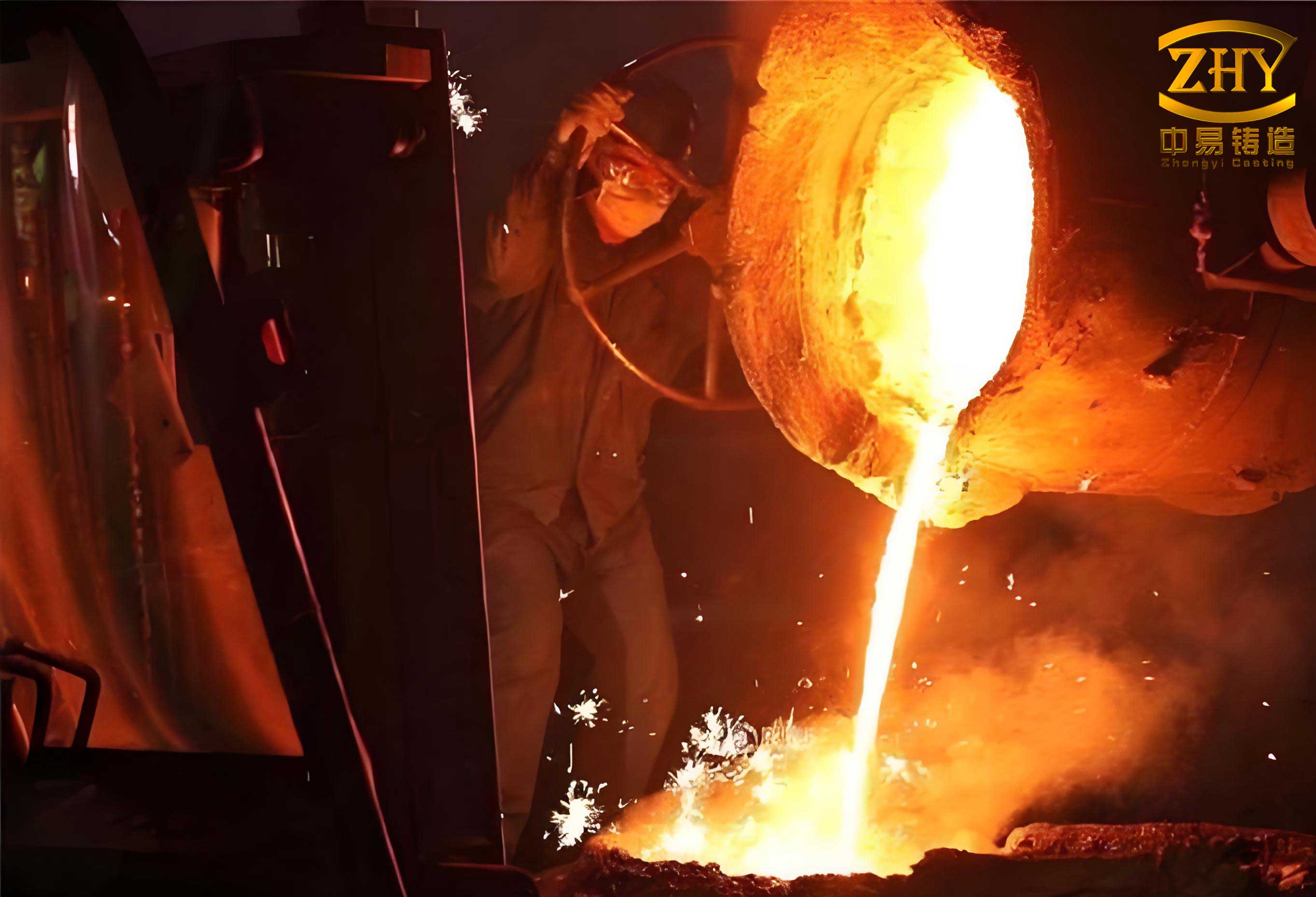
Practical production followed the optimized design. Pouring was conducted using two ladles to achieve low-temperature rapid filling, further reducing liquid shrinkage and enhancing self-feeding in these riserless sand castings. After pouring, the casting was insulated to slow cooling, then subjected to heat treatment, cleaning, grinding, and shot blasting. Non-destructive testing via 100% ultrasonic inspection was performed per standard GB/T25390-2010 (equivalent to wind turbine casting standards), revealing sound internal quality. Attached test blocks were evaluated for material properties: nodularity achieved 90%, graphite size grade 6, tensile strength 520 MPa, yield strength 403 MPa, elongation 18%, and hardness 193 HB. These meet and exceed QT500-14 specifications, validating the compositional and process approach.
The success of this project underscores the value of numerical simulation in advancing sand castings technology. MAGMASOFT provided insights into thermal management and defect formation, enabling efficient process optimization without costly physical trials. For large, complex sand castings like wind power hubs, simulation reduces development time and cost while improving reliability. The riserless approach, leveraging graphitization expansion, proves viable for heavy-section ductile iron castings when combined with controlled gating, chilling, and mold rigidity.
In conclusion, this study demonstrates a comprehensive methodology for producing large wind power hubs via riserless sand casting. Key elements include material optimization for QT500-14, strategic use of chills to uniformize cooling, bottom-gating for smooth filling, and simulation-driven validation. The final sand castings exhibited excellent mechanical properties and defect-free bodies, confirming the process robustness. Future work could explore scaling to larger hubs or adapting the principles to other complex sand castings. The integration of simulation and practical foundry techniques paves the way for sustainable, cost-effective manufacturing in the renewable energy sector, highlighting the enduring relevance of sand castings in modern industry.
From a broader perspective, the principles applied here—such as thermal gradient control and exploitation of material properties—can be generalized to other sand castings applications. The heat transfer dynamics in sand castings involve complex interactions between metal, mold, and chills. A simplified model for solidification time in sand castings can be derived from Chvorinov’s rule:
$$ t_s = B \left( \frac{V}{A} \right)^n $$
where $$t_s$$ is solidification time, $$V$$ is volume, $$A$$ is surface area, $$B$$ is a mold constant, and $$n$$ is an exponent typically near 2. For riserless sand castings, ensuring that $$t_s$$ is consistent across sections minimizes shrinkage risks. Additionally, the pressure drop in the mushy zone, relevant for porosity formation, can be approximated using Darcy’s law for flow through porous media:
$$ \vec{v} = -\frac{K}{\mu} \nabla P $$
where $$\vec{v}$$ is velocity, $$K$$ is permeability, $$\mu$$ is viscosity, and $$\nabla P$$ is pressure gradient. In sand castings, maintaining adequate pressure via graphitization expansion counteracts this drop.
The economic and environmental implications of riserless sand castings are significant. By eliminating risers, yield improves—reducing metal consumption and energy use in melting. For large-scale production of wind components, this translates to lower costs and smaller carbon footprint. Moreover, the durability of sand castings hubs contributes to wind turbine longevity, supporting sustainable energy infrastructure. As the demand for renewable energy grows, advancements in sand castings technology will remain crucial for manufacturing reliable, high-performance components.
In summary, this research provides a replicable framework for riserless sand casting of large ductile iron parts, with emphasis on simulation, process design, and material science. The successful production of a 3.5 MW hub validates the approach, offering a reference for similar sand castings in heavy industry. Continued innovation in sand castings will undoubtedly play a pivotal role in the transition to clean energy and efficient manufacturing worldwide.